
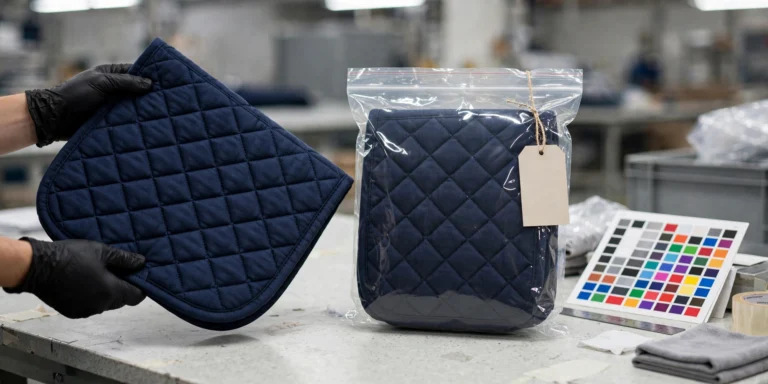
Saddle Pad Reorder Consistency: How Brands Keep Color, Specs, and Quality Stable Across Runs
Published · Cornovo Saddlery
Consider a common scenario: a distributor’s navy dressage pad sells through its first run. The reorder arrives on schedule — and visibly wrong: a lighter navy, binding a touch narrower, the embroidered logo sitting off its original spot. Customers who owned the first run spot it instantly. The distributor discounts the whole run to move it, absorbs the margin hit, and spends weeks arguing with the factory about what counts as acceptable variation. Nothing in the specification changed on paper. Everything drifted in practice.
The short answer: treat every reorder as a new production run, not a repeat of an old email. Keep one master spec record per SKU, one sealed gold seal sample as the physical standard, approve a lab dip per run, and judge every pre-production sample side-by-side against the gold seal under consistent lighting.
This guide covers reorder consistency: keeping second and later production runs identical to the first in color, dimensions, materials, and branding. It companions the planning posts — our inventory planning guide, SKU architecture for private-label brands, and tech sheet guide — plus our typical MOQs and lead times and our pre-shipment QC checklist. Those posts cover the first run; this one covers every run after it: the master spec record, dye-lot discipline, gold seal samples, reorder approval, and what to do when a run arrives off-spec.
Key takeaways
- Second runs drift because mills, trim suppliers, artwork files, and factory staff change between orders — drift is normal; unmanaged drift is the expensive problem.
- Maintain one master spec record per SKU — Pantone references, measurements, stitch counts, material and trim sources, label artwork versions — plus one sealed gold seal sample as the physical standard.
- Manage color with dye-lot discipline: keep each order on as few dye lots as practical, approve a physical lab dip per run, and judge trims as a set against the face fabric under consistent lighting.
- Approve every reorder against the gold seal sample, never against phone photos of the last shipment — photos lie about color.
- Reorders skip the full first-order sampling: a pre-production sample checked side-by-side with the gold seal is usually enough, and our reorder programs run at the same 50 pieces per color MOQ.
What is reorder consistency, and why do second runs drift?
Direct answer: Reorder consistency means production runs two, three, and ten match run one on color, dimensions, materials, and branding — and runs drift because nearly every input can change between orders: the fabric mill tweaks its dye formula, the trim supplier substitutes an equivalent binding, or the factory works from memory instead of the specification.
None of this is sabotage. Mills discontinue shades, trim suppliers consolidate lines, and factory merchandisers turn over — the supply chain moves on while the buyer’s expectation stays frozen at the first shipment. The gap between those two realities is where drift lives, and it widens with every reorder placed as a one-line email instead of against a controlled record.
The cost of drift is asymmetric: a slightly-off binding shade costs the factory nothing to substitute and costs the brand everything in customer trust — especially for colorways bought to match, like the second navy pad that clashes with the first navy bonnet. Consistency is a product feature for repeat buyers, which makes it a margin protector.
What goes into a master spec record?
Direct answer: One controlled document per SKU recording everything needed to remake the pad identically: fabric construction and supplier reference, Pantone numbers for face, binding, piping, and thread, finished measurements with tolerances, the embroidery stitch-file version and stitch count, label and hang-tag artwork versions, the packing specification, and the gold seal sample ID it pairs with.
The master spec record is the document our tech sheet guide teaches you to write — this post is about keeping it alive. Version it and date every change: when the factory proposes a substitute binding, the change enters the record as a new version with an approval date, not as a verbal okay in a chat thread. Verbal approvals evaporate; versioned records settle disputes.
Keep one copy with the buyer and one with the factory, and let the record — not any one person’s memory — be the standard that survives staff turnover on both sides. The gold seal sample is the physical half of the system: one approved piece from the reference run, sealed, labeled with the spec version, stored away from daylight — the standard every future run is judged against.
How do you keep color consistent across dye lots and runs?
Direct answer: You cannot eliminate dye-lot variation, so you manage it — consolidate each order onto as few dye lots as practical, approve a physical lab dip (a dyed fabric swatch) for each run, and approve trims as a set against the face fabric under consistent, daylight-balanced lighting.
The lab dip is the unit of color control. Before bulk cutting, the mill dyes a small swatch of the actual fabric to the specified Pantone reference; the buyer approves or rejects it against the gold seal sample. Record the approved dip reference with the run — it is the traceability link if color is disputed later. Industry guidance treats lab-dip approval as the point where the color standard is formally set for the whole production run (see Sources).
Judge trims as a set, not in isolation: binding, piping, and thread each carry their own dye lots, and a binding that matches the Pantone chip under office lighting can clash with the face fabric under daylight. Approve the trim card against the approved face fabric under the same lighting every time, and use photos only to document the decision — the gold seal remains the standard. When quantities force multiple dye lots in one order, segregate them by carton and never mix lots within a single retail set.
Where does drift hide?
Direct answer: Drift hides in the inputs buyers stop checking after the first successful run. The table below maps the usual symptoms to their causes and the prevention that belongs in your reorder process — run it as a checklist against every reorder, not just the troubled ones.
| Drift symptom | Usual cause | Prevention |
|---|---|---|
| Color shift between runs | New dye lot or mill formula change | Lab-dip approval per run; as few dye lots per order as practical |
| Binding width or shade change | Trim supplier substitution | Trim card with supplier reference in the master spec; approve trims as a set |
| Logo position or size shift | Artwork re-digitized by a new operator | Placement measurements from a fixed reference; locked stitch-file version |
| Fabric hand-feel change | Mill or construction change | Fabric and supplier reference recorded; hand-feel check at the pre-production sample |
| Care label or hang-tag errors | Artwork version mix-up | Version-controlled label artwork; text check on the pre-production sample |
| Packing or carton change | Packing specification never recorded | Packing method written into the master spec |
Drift caught at the pre-production sample costs a swatch and a week; drift caught at the container costs the run.
What does reorder sample approval look like?
Direct answer: Shorter than first-order sampling — a pre-production sample checked side-by-side against the gold seal sample, with a wash test when print or trim colors are involved, and a written sign-off that becomes the new run’s auditable reference.
When the master spec is unchanged, skip the proto rounds: the pre-production (PP) sample is the whole approval. Lay it beside the gold seal under consistent lighting and compare color, check measurements against the recorded tolerances, branding placement against the recorded measurements, and labels against the versioned artwork. If the run involves printed fabrics or new trim dye lots, wash-test the PP sample under the care-label instructions.
Seal one approved piece as the run’s reference and sign off in writing with the date, approver, and spec version. That sign-off is what our pre-shipment QC checklist’s inspector works from — the chain from master spec to gold seal to PP sample to bulk inspection makes consistency auditable instead of hopeful.
What do you do when a run arrives off-spec?
Direct answer: Document the deviation against the gold seal sample and the master spec, quantify how many pieces are affected and which spec lines failed, then take that evidence to the factory — remedies range from rework to credit to remake, depending on severity.
Evidence discipline decides these disputes. Photograph defective pieces beside the gold seal sample under consistent lighting, note the measurements that miss tolerance, and count the affected cartons — the navy is off loses to an evidence-style count, e.g., 42 pieces in cartons 7–9 miss the binding-width tolerance against spec version 3 (an illustrative example of the documentation format, not a real claim). Our returns and warranty claims guide covers the dealer-side claim mechanics; this factory-side documentation is what funds those remedies.
The deeper fix is deciding tolerance thresholds before the dispute, not during it. Acceptable variation argued after delivery is a negotiation; the same variation judged against a signed spec version is a finding. Every off-spec run should end with the master spec record updated — a tightened tolerance, a new trim source, a new version — so the same drift cannot recur quietly.
What should you confirm when requesting a quote?
A reorder quote is not a price on pads — it is a price on repeating an exact specification. Before the factory prices the reorder, confirm these in writing:
- Master spec version — the purchase order references the current spec record version and the gold seal sample ID it pairs with.
- Lab-dip approval per run — a physical lab dip approved against the gold seal under lighting conditions agreed in advance.
- Dye-lot discipline — as few dye lots per order as practical; when multiple lots are unavoidable, segregate by carton and never mix lots within a single retail set.
- Trim card as a set — binding, piping, and thread approved together against the approved face fabric, with supplier references on record.
- Pre-production sample — checked side-by-side with the gold seal for color, measurements, branding placement, and label artwork; wash-test when prints or new trim dye lots are involved.
- Tolerance thresholds — acceptable variation agreed and signed before production, not argued after delivery.
- Packing specification — the recorded packing method confirmed for the run, with reorder MOQ at 50 pieces per color.
Frequently asked questions
How many pieces must I reorder to stay on one dye lot?
It depends on the fabric and the mill’s dyeing batch size — confirm with the factory when placing the reorder. The program MOQ is 50 pieces per color, but single-lot continuity may favor consolidating colorways; ask about lot sizing before finalizing the color breakdown.
Should the gold seal sample stay with me or with the factory?
Both. Keep one sealed sample yourself and leave one with the factory. If the factory’s reference goes missing — or looks different when a dispute arises — yours settles the argument. Label each with the spec version and store them away from daylight.
What if the factory says the original fabric is discontinued?
Treat it as a new spec version, never as a quiet substitution. Approve the closest-match fabric as a new lab dip, record it as a new master spec version with its own gold seal piece, and tell customers who reorder by color name — a new navy, spring run note beats a surprise.
Do reorders need the full sampling process again?
Usually not. If the master spec is unchanged, a pre-production sample checked against the gold seal covers the approval. Restart fuller sampling only when materials, trims, or artwork change — which is exactly what the versioned spec record tells you.
How often should the master spec record be reviewed?
At least annually, and immediately after any drift incident, material change, or staff handover on either side. A spec record nobody re-reads is decoration; the review is what keeps it the working standard.
Planning a reorder and want run two to match run one? Send us the SKU and quantities — we keep master spec records and gold seal references on file for every program, approve each reorder against them, and produce at 50 pieces per color MOQ.
Sources & Further Reading
- Boonchuay Industry: What is a Lab Dip? Fabric Colour Control — industry walkthrough of the lab-dip process: the approved dip as the binding color standard for the run, standard lighting (D65/TL84) for assessment, and Delta E acceptance thresholds — the basis for this post’s dye-lot discipline section. Verified accessible 2026-10-04.
- AATCC TM61 — Test Method for Colorfastness to Laundering: Accelerated — the test method to name when requiring a documented wash-fastness check on the pre-production sample. Verified accessible 2026-10-04.
- Packaging for Equestrian Wholesale — the packing specification that belongs in the master spec record.
- Returns and Warranty Claims Guide — dealer-side claim mechanics to pair with this post’s factory-side evidence discipline.
