
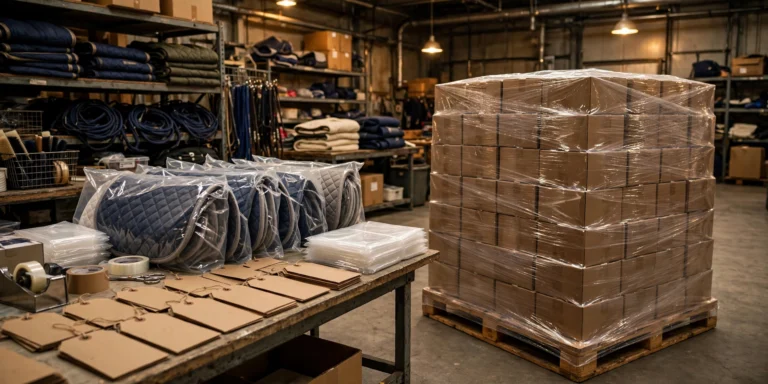
Packaging for Equestrian Wholesale: Protecting Pads in Transit
Published · Cornovo Saddlery
Consider a common scenario: a distributor opens a container of dressage pads and finds the top layer of every carton crushed flat, the quilted tops compressed into ridges that don’t fully recover. The pads themselves were fine — the cartons were single-wall boxes rated for half the stacking weight. One packaging mistake, and the margin goes to chargebacks and markdowns.
Saddle pads are bulky, compressible, and surprisingly easy to damage. They don’t break like glass, so factories treat them as low-risk cargo — but crushed quilting, moisture staining, and mixed colorways in unlabeled cartons all turn into real money lost at the receiving dock. Packaging is part of the product, and it should be specified in the purchase order, not left to habit.
How should saddle pads be packed for equestrian wholesale export? Specify three layers in your purchase order: an individual polybag per pad, a double-wall export carton sized to the folded pad, and shrink-wrapped pallets — plus moisture control and printed labels. Vague terms like ‘standard export packing’ leave the outcome to the factory’s cost pressure.
Key takeaways
- Equestrian wholesale packaging has three layers: individual polybag, export carton, and pallet — specify each in the PO with measurable standards.
- Carton dimensions and compression discipline decide your freight cost per unit more than weight does.
- Set stacking height from the carton’s tested burst strength, not from the factory’s optimism — confirm before the container is loaded.
- Specify desiccant and moisture-barrier polybags for ocean shipments; condensation damage is a recurring container claim on textile cargo.
- Standardize printed carton labels with SKU, color, size, and piece count — mislabeled cartons slow receiving and cause wrong shipments to dealers.
What is equestrian wholesale packaging?
Equestrian wholesale packaging is the export-grade packing system that protects riding textiles — saddle pads, half pads, cinches — through ocean freight, warehousing, and last-mile delivery to dealers: an individual polybag per pad, an export carton sized to the compressed product, and palletization for container loading. It is specified by the buyer in the purchase order, not improvised by the factory.
Why does packaging matter more for pads than for other tack?
Bits and stirrups are dense and nearly indestructible; saddle pads are the opposite. A pad springs back to full volume the moment compression stops, which means it fights its carton the whole way. Over-compress it and the quilting takes a permanent set; under-pack it and you ship air at container rates.
Pads also show damage that other products hide. A crushed quilt line is visible the second the customer opens the bag, and horse owners read it as a quality defect — even when the pad’s function is unaffected. For a distributor, that means returns on products that are technically fine. Proper equestrian wholesale packaging is really damage-prevention marketing: the pad must look as good arriving as it did leaving the factory.
How should individual pads be packed?
Each pad goes into its own polybag — the default expectation in wholesale, and usually included in the factory’s unit price. Specify the details rather than assuming them: bag thickness, whether the bag is printed with your brand or plain, and whether each bag carries a barcode or SKU sticker.
A common export bag range is 0.03–0.05 mm — confirm what your factory stocks and whether it suits your route before you write the spec. For premium lines, a custom-printed polybag with your logo and care instructions is a small add at volume and makes the product feel branded before the pad is even unwrapped. Attach hangtags with UPC or EAN codes before bagging so retail-ready units flow straight to your dealers’ shelves.
One detail buyers forget: the pad should be folded, not rolled, unless you have tested that rolling doesn’t distort the shape. Folded pads stack cleanly in cartons and recover their shape faster at the retail end.
What makes a good export carton for saddle pads?
The export carton is where most packaging failures happen, so specify it like an engineer: corrugated wall grade, dimensions matched to your folded pad, fixed piece count per SKU, a stated compression limit, and taping standard. Every spare inch of dead space is freight you pay for twice — on the way in and in warehouse storage.
- Carton type: double-wall corrugated is the standard for export; single-wall is acceptable only for short domestic shipments.
- Dimensions: matched to your folded pad with minimal dead space.
- Piece count: a typical range is 10–20 pads per carton depending on pad thickness — fix the count per SKU in the PO so receiving can spot-check by carton weight, and confirm it with your factory.
- Compression limit: state a maximum — for example, no more than 10% of the pad’s loft — so packers can’t stuff extra units into a carton to save boxes.
- Tape and strapping: H-taped seams are the export minimum; add strapping for heavy cartons or mixed shipments.
Ask the factory to confirm the loaded carton weight and dimensions in the pre-shipment photos. If the cartons in the photos don’t match the spec sheet, the shipment is already off-spec before it leaves the dock.
How should pallets and containers be handled?
For full-container loads, pallets keep cartons stable and let forklifts move product without crushing edges. Specify standard pallet dimensions for your market — the common export size is 120 × 100 cm — and set the maximum stack height from the carton’s tested burst strength, not from the factory’s optimism.
Require shrink-wrap on every pallet, and for ocean shipments specify container loading with cartons stacked, not thrown. It sounds obvious, but hand-loaded containers packed by piece rate are where the crushed-top-layer problem comes from — make a photo of the loaded container, floor to ceiling, part of your pre-shipment documentation. For LCL (less-than-container) shipments your cartons will be handled more times by more people: upgrade to stronger cartons and add corner protectors for LCL. The marginal cost is far below one damage claim.
What about moisture and humidity in transit?
Condensation — container rain — is one of the most common and costly container claims on textile cargo. As the container moves between climates on a multi-week voyage, moisture condenses on the cold steel walls and ceiling and drips onto the top cartons. Saddle pads, especially wool-blend shells, absorb it fast. The fixes are cheap and should be non-negotiable.
The mechanism — temperature swings across the dew point condensing water on the coldest steel surfaces, with each cycle depositing more moisture — is the standard container-rain explanation across freight guidance (see DunLash’s container-rain page for the dew-point cycle and damage categories, including textiles). Plan your spec around it:
- Desiccant packs in every carton — specify the quantity per carton, not some desiccant; add container desiccant poles or bags for high-humidity routes or monsoon-season sailings.
- Moisture-barrier polybags for each pad on ocean shipments, especially for wool-blend shells that absorb water.
- No floor contact: cartons sit on pallets or dunnage, never directly on the container floor where condensation pools.
Write these into the PO as line items. Standard export packing means whatever the factory feels like that day; a short moisture spec costs nothing to write and prevents the most common claim you’ll ever file.
How should cartons be labeled?
A carton label is a receiving tool. Every carton should carry your SKU, product name, color, size, piece count, carton number (e.g., 7 of 42), gross weight, and country of origin. Add a simple color dot or stripe per colorway so warehouse staff can sort by sight.
Insist on printed labels, not handwriting. Handwritten cartons are how a distributor receives 200 navy pads marked as black and ships the wrong color to three dealers. Barcode the carton labels if your warehouse system scans — the factory can print them from your data file at negligible cost.
| Packaging layer | What to specify | Common failure if skipped |
|---|---|---|
| Polybag | Thickness, print, SKU sticker, moisture barrier | Humidity staining, unbranded presentation |
| Export carton | Double-wall, dimensions, piece count, compression limit | Crushed quilting, wasted freight on air |
| Pallet | Size, max stack height, shrink-wrap | Top-layer crushing, forklift damage |
| Container | Desiccant, no floor contact, loading photos | Moisture claims, load-shift damage |
| Labeling | Printed labels, SKU/color/size/count, barcodes | Receiving errors, wrong shipments to dealers |
Requesting a quote: specs to confirm
Before requesting a wholesale quotation, confirm these packing specs so they land as line items in the quote:
- Polybag: thickness, printed vs plain, moisture-barrier requirement for ocean routes, SKU/barcode sticker per unit
- Carton: wall grade, dimensions, piece count per SKU, compression limit, taping and strapping standard
- Pallet: dimensions, maximum stack height from tested burst strength, shrink-wrap requirement
- Container: desiccant type and quantity per carton and container, no floor contact, loaded-container photos in pre-shipment docs
- Labeling: printed labels with SKU, product name, color, size, piece count, carton number; barcodes if your warehouse scans
- Packing confirmed as a priced line item in the quotation — packing by inquiry, not standard export packing; MOQ 50 pieces per color
Frequently asked questions
Who pays for export packaging — the factory or the buyer?
Basic export packaging (polybag, standard carton, pallet) is normally included in the factory’s FOB price, but upgraded specs — printed polybags, stronger cartons, container desiccant — may carry a small surcharge. Get the packing spec itemized in the quotation so you can compare suppliers on equal terms rather than discovering the difference at the dock.
How many saddle pads fit in a standard export carton?
It depends on pad thickness and fold size — a typical range is 10–20 western or dressage pads per carton, confirmed with your factory. Thinner half pads pack denser; thick contoured western pads pack fewer. Always fix the exact piece count per carton in the PO and verify it against the pre-shipment photos and packing list.
Should pads be vacuum-packed for shipping?
Generally no. Vacuum packing saves freight volume but risks permanent compression set in the quilting and foam, especially on long ocean voyages. Light compression in a properly sized carton is the safer middle ground. If a factory proposes vacuum packing, request a test shipment first and check loft recovery on arrival.
What is the biggest packaging mistake importers make?
Leaving the packing spec out of the purchase order. Standard export packing is undefined, so the factory optimizes for its own cost — thinner cartons, fewer desiccants, handwritten labels. A one-page packing specification attached to the PO, with measurable standards, prevents nearly all of the common failures.
How do I verify packaging before the container ships?
Require pre-shipment photos showing loaded cartons, pallet stacks, carton labels, and the loaded container interior. Better still, include packaging in your third-party inspection checklist — the inspector checks carton specs, piece counts, and labeling against your PO before the container is sealed. See the pre-shipment QC checklist for how to fold packaging into inspection. Packing by inquiry is standard — confirm yours in writing.
Send us your target SKUs and annual volume for a wholesale quotation. We manufacture western saddle pads, dressage pads, half pads, and cinches with OEM and private-label options, a standard MOQ of 50 pieces per color, and export packing by inquiry.
Sources & Further Reading
- DunLash — Container Rain Prevention — the dew-point cycle behind container condensation, damage categories including textiles, and desiccant dosage guidance
- Pre-Shipment Saddle Pad QC Checklist — folding packaging checks into your inspection routine
- Saddle Pad Landed Cost Guide — how carton volume and freight shape landed cost
- Saddle Pad Returns & Warranty Claims — documenting damage claims against your packing spec
- Hang Tags & Care Labels — what US and EU retailers require on tags and labels
