Pricing Private-Label Saddle Pads for Tack Shops
Published · Cornovo Saddlery
Consider a common scenario: a tack shop carries a well-known western pad at the brand’s MSRP and earns a thin per-sale margin, while a competitor across town sells a comparable house-brand pad at a lower shelf price and keeps more per sale. Same customer, same horse, very different profit — which is why the house line is often the highest-margin wall in a tack shop.
Private label means a factory’s proven pattern with your logo, colors, and woven labels. You skip the R&D risk of designing from scratch, but you still have to price the line deliberately: too high and it sits next to discounted big brands, too low and you train customers to expect bargains.
How should a tack shop price private-label saddle pads? Work from landed cost — factory price plus freight, duty, labeling — choose a target margin that covers markdowns and slow SKUs, then sanity-check the shelf price against the branded pads beside it. Follow that order and the house line stays profitable; skip a step and the margin is usually an illusion.
Key takeaways
- Price from landed cost — factory price plus freight, duty, labeling, and inbound handling — not from the factory quote alone.
- Ask for itemized quotes: shell fabric, fill spec, quilting density, and binding grade are the cost drivers that move the factory price.
- Use a target-margin formula to set MSRP, with the target chosen from your own cost structure — markdown cadence, slow-SKU exposure, warranty reserve.
- A two-tier line (everyday value plus premium) covers more price points and gives staff an upsell story.
- Standard MOQ is 50 pieces per color — plan colorways, sizes, and reorder depth around that floor.
What are private label saddle pads?
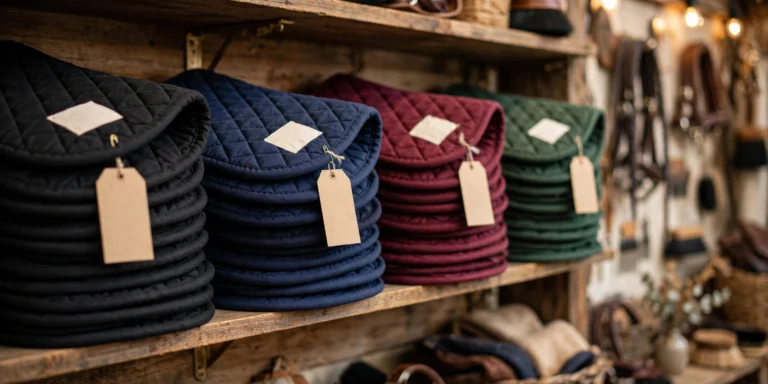
Private label saddle pads are manufactured by a wholesale supplier and sold under a retailer’s own brand — the shop’s woven labels, hangtags, and often exclusive colorways on a factory-proven pattern. They sit between reselling an established brand and developing a fully custom product: faster to launch than original designs, with the margin and exclusivity benefits of a house brand.
What should a tack shop’s landed cost include?
Landed cost is everything you spend before the pad hits your shelf — factory unit price, freight, duty, labeling, inbound handling, and a damage reserve. Build it line by line, because the factory quote is only the first line. Shops that price from the quote instead of the landed cost usually discover the real margin only after the container clears.
- Factory unit price — the EXW or FOB quote, including your private labeling (woven labels, hangtags, embroidery) so it isn’t a surprise later.
- Freight — quoted per shipment mode; ocean and air price the same pad very differently.
- Duty and customs — confirm the HS code and rate with your broker before you quote retail; duty is a line item, not a rounding error.
- Inbound handling — warehouse receiving, QC checks, and any re-bagging to your presentation standard.
- Shrinkage reserve — a small reserve for freight damage, factory defects that slip through, and in-store damage, sized to your own experience.
In our experience, landed cost often lands meaningfully above the quoted unit price — the gap widens with air freight, high-duty classifications, and re-bagging, and shrinks on efficient ocean shipments with simple labeling. Because the gap moves with every order, rebuild it per order rather than carrying a fixed adder forward. A quote that looks unbeatable on unit price can lose once freight and duty are added. For the full method, see the saddle pad landed-cost guide.
What drives the factory price of private label saddle pads?
Four cost drivers decide most of the factory price: shell fabric, fill type and density, quilting density, and binding quality. Ask for an itemized quote so you can see where the money goes — and change one variable at a time when you need to hit a target landed cost.
Shell fabric is usually the biggest variable: a wool-blend top costs noticeably more than a basic polyester twill, and prints or embroidery add per-piece labor. Fill is next — denser or specialty fills price above standard polyurethane, and most factories offer two or three fill grades. Tighter quilting uses more thread and machine time, which shows up in the price. Binding is the quiet driver buyers underestimate: premium grosgrain or woven binding costs more than basic polyester, but binding is also where cheap pads fail first — and returns cost far more than the upgrade. Private labeling itself (woven labels, printed hangtags, custom polybags) is typically a small line item at volume; confirm the exact add in your quote rather than assuming it.
How should tack shops set the MSRP?
Work backward from a target margin: MSRP equals landed cost divided by one minus your target margin. Choose the target from your own cost structure — markdown cadence, staff discounts, slow-SKU exposure, warranty reserve — not from a chart. Then sanity-check the result against the branded pads it will sit beside on the wall.
For illustration only: a pad landed at $24 with a 60% target margin prices at $60 (24 ÷ 0.40). The numbers are arbitrary — the point is the method: pick your own margin from your own numbers, then run the formula. There is no industry-standard target that works for every shop; a store that rarely marks down can run a lower target than one that clears slow colors at 30% off twice a year.
Then test the price against anchors. A common starting position is 10–20% below the comparable branded MSRP — for example, a house western pad at $119–$129 beside a branded $149 equivalent. Treat that as a starting hypothesis, not a rule: if your build story (fill density, binding quality, wither relief) justifies more, price up; if your market is discount-heavy, leave room for the markdown you know is coming. Price the house line far below the brands and customers wonder why they shouldn’t buy the brand they trust; price it at the branded level and the house brand has no reason to exist. Resist becoming the cheapest wall in the store — a house line priced at bargain level reads as suspect to horse owners who worry about quality, and leaves no money for your next color launch.
Should you tier the line or sell one price point?
Most shops do better with two tiers than one: an everyday value line that drives foot traffic and volume, and a premium line that protects margin and gives staff an upsell story. Tiering also solves the colorway problem — safe colors on the value line, seasonal prints on the premium line, ordered in different depths.
| Line | Typical build | Margin role (illustrative) |
|---|---|---|
| Everyday value | Polyester twill, standard fill, your branding | Volume driver; moderate margin per pad, fast turns |
| Premium | Wool-blend or denser fill, upgraded binding | Margin builder; slower turn, higher contribution per pad |
| Seasonal/limited | Printed shell on the proven pattern | Excitement and urgency; trim the margin target to keep it moving |
The margin roles above are illustrative starting positions — set your own targets from your cost structure. Order the safe colors deeper and the seasonal ones tighter, and let reorder data — not launch-day intuition — decide the second buy. For colorway planning, see saddle pad inventory planning for tack shops.
How do reorder economics change the real price?
A factory’s per-unit price is only half the deal — the reorder terms decide whether the line is profitable in practice. First, confirm whether the MOQ applies per color or per order: 50 pieces per color is manageable for a single shop, but if the factory counts it per size too, small shops can end up overstocked.
Second, ask about reorder timelines separately from first-order timelines. Reorders on an approved pattern should be faster than the original run — samples and strike-offs are already done — so confirm the reorder timeline in writing. If a factory quotes the same timeline for reorders as for first runs, your bestsellers will stock out between runs. For how MOQs and timelines work across the line, see custom saddle pad MOQ and lead times.
Third, price the fill-in reality: a bestseller out of stock for a month costs not just lost sales but customers who buy the competitor’s pad instead and never return to your house line.
What mistakes sink a private-label pricing plan?
The classic failure is pricing from the factory quote instead of landed cost, then discovering the margin was an illusion. The second is chasing the lowest unit price and accepting thin binding or low-density fill — the returns eat the savings and damage the house brand. The third is over-ordering slow colors to hit a volume discount.
A better unit price on a color that takes two seasons to sell is not a discount, it’s a storage bill. And don’t launch with too many SKUs: ten colors in three sizes is thirty inventory positions for a brand customers haven’t heard of yet. Start with three to four colors in the core sizes, prove the pattern, then expand with the winners.
Requesting a quote: specs to confirm
Before requesting a private-label quote, confirm these so the first sample matches the line you plan to price:
- Itemized factory quote showing shell fabric, fill spec, quilting density, and binding grade per line
- Landed-cost inputs: freight quote per shipping mode, HS code and duty rate confirmed with your broker, private-label inclusions
- Target-margin inputs: your markdown cadence, staff-discount policy, slow-SKU exposure, and warranty reserve
- Two or three branded anchor pads your line will sit beside, for the MSRP sanity check
- MOQ: 50 pieces per color — confirm whether it applies per color, per size, and on reorders
- Reorder timeline confirmed in writing, separately from the first-order timeline; packing and labeling spec per line
Frequently asked questions
How do tack shops set a target margin for private label?
From their own cost structure, not from a chart. Start with the margin you need to cover your markdown cadence, staff discounts, slow-SKU exposure, and warranty reserve — then back into the MSRP with the landed-cost formula. House-brand margins typically run higher than third-party-brand margins because you remove the brand’s own margin layer, but the exact target is yours to set from your numbers.
How many colors should a new private-label line launch with?
Most shops launch with three to four colors in core sizes — enough to look like a real line without stranding cash in slow colors. Black, navy, and brown cover the everyday buyers; add one seasonal print for visibility. Expand only after the reorder data shows which colors actually turn.
Does private labeling add much to the unit cost?
Usually not. Woven labels, printed hangtags, and custom polybags typically add only a small per-piece cost at standard MOQs. The bigger cost is design time: digitizing embroidery files and approving strike-offs. One-time setup fees for embroidery or label plates should be amortized across your expected first-year volume.
How do I price against big brands without racing to the bottom?
Anchor below the comparable branded MSRP — a common starting position is 10–20% below — and compete on construction, not just price. Train staff on your pad’s fill density, binding quality, and wither relief — the specifics big brands don’t always explain. A house pad positioned as the same build, our name, less outsells one positioned as cheap.
Can a single store hit the MOQs for private label?
Often yes. A standard MOQ of 50 pieces per color is built for single-store testing — roughly a season of sales for a strong colorway in one busy shop. Consolidate sizes within the MOQ if the factory allows, and negotiate the first order down if you can commit to a documented reorder schedule.
Send us your target colors, sizes, and annual volume for a private-label quotation. We supply western saddle pads, dressage pads, half pads, and cinches with OEM and private-label production, a standard MOQ of 50 pieces per color, and packing by inquiry.
Sources & Further Reading
- Saddle Pad Landed Cost Guide — the full landed-cost method with a worked example
- How Distributors Price Saddle Pads — how distributor margin tiers differ from retail pricing
- Launching a Private-Label Saddle Pad Line — the timeline from brief to first reorder
- Saddle Pad Custom Branding — embroidery, piping, and logo options with strike-off approval
