Hang Tags and Care Labels for Saddle Pads: What US and EU Retailers Require
Published · Cornovo Saddlery
Consider a common scenario: a distributor’s first private-label container clears customs, then stalls at the retailer’s distribution center. The care labels read premium fabric instead of fiber content, and country of origin sits on the removable hang tag rather than the permanent label. The retailer refuses the shipment until every pad is relabeled — destination-country relabeling costs weeks and real money, in the middle of the selling season.
Labeling is the least glamorous part of a private-label program and one of the most expensive to get wrong. US and EU retailers audit labels against real requirements: fiber content in standardized names, correct care instructions, permanent country-of-origin marking, and accurate brand identity. Miss any of them and the goods do not sell — they sit.
Short answer: the sewn-in care label carries the legally relevant information — fiber content in generic names, care instructions, and country of origin — while the hang tag is marketing and does not substitute for it. US rules center on the FTC’s textile labeling guidance; EU rules center on Regulation 1007/2011. Build one label set that satisfies the strictest market you serve, then adapt.
Key takeaways
- Hang tags are removable marketing pieces; care labels are permanent, sewn-in, and carry the legally relevant information — retailers audit the care label, not the hang tag.
- US requirements follow the FTC’s textile labeling guidance: fiber content in generic fiber names, care instructions, country of origin, and the identity of the manufacturer or importer (company name or RN). Confirm the exact wording with a compliance specialist.
- EU requirements follow Regulation 1007/2011: standardized fibre names with percentages in descending order, durable legible marking, per-component composition, and the official language(s) of each destination market.
- The most common rejection causes are vague fiber descriptions (premium fabric), missing country of origin on the permanent label, and confusing designed in with made in.
- Specify every label — content, size, placement, attachment method — in the tech pack, and approve physical label samples before bulk production.
What’s the difference between a hang tag and a care label?
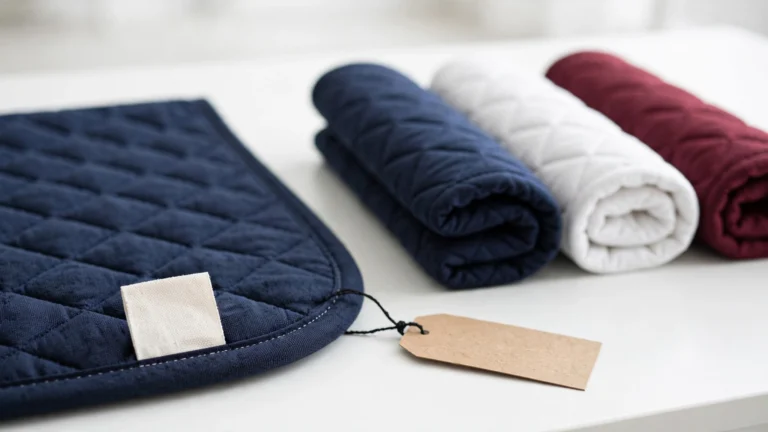
A hang tag is the removable card attached with a string or plastic fastener — it carries branding, product features, size, color, and the barcode. A care label is the small fabric label sewn permanently into the product — it carries fiber content, care instructions, and country of origin. Retailers and customs check the care label for compliance; the hang tag is marketing, and reprinting a hang tag is cheap while a wrong sewn-in label is a relabeling job.
What is a care label? A care label is a permanent label sewn into a textile product stating its fiber content and care instructions. For saddle pads it typically lists fiber content (cotton, polyester, wool), washing instructions as text or symbols, and the country of manufacture. It must stay attached and legible through the product’s life.
Do not pour energy into the hang tag and treat the care label as an afterthought. Approve the care label content first, then design the hang tag around it. If you are building a full private-label program rather than labels alone, our OEM saddle pad program guide covers where labels fit in the overall timeline.
What do US retailers typically require on labels?
US textile labeling follows the FTC’s guidance under the Textile and Wool Acts: most textile products must carry the fiber content, the country of origin, and the identity of the manufacturer or another business responsible for the item, and the FTC’s Care Labeling Rule separately requires care instructions for clothing. The FTC’s plain-language business guide spells out the mechanics — generic fiber names in descending order of predominance, country of origin on the front of the label, and either the company name or a registered identification number for identity (FTC: Threading Your Way Through the Labeling Requirements Under the Textile and Wool Acts).
Fiber names matter more than buyers expect. Premium microfiber is a marketing phrase, not a fiber name — the label should state the actual fiber, e.g., the polyester percentage, with each fiber listed in descending order of predominance. If your pad has a cotton face, polyester fill, and mesh underside, each layer’s content may need stating — check with a compliance specialist how multi-layer constructions should be declared.
Country of origin means where the product was processed or manufactured — the permanent label should state it plainly. Designed in the USA on the hang tag does not substitute for origin marking on the care label, and printing the two side by side in a confusing way is one of the fastest routes to a retailer rejection.
What do EU retailers typically require?
EU textile labeling follows Regulation (EU) No 1007/2011 on textile fibre names and fibre composition labelling: the fibre composition must use the regulation’s standardized fibre names (Annex I), products of several fibres list every fibre’s name and percentage by weight in descending order, multi-component products show each component’s composition, and the marking must be durable, legible, visible, and accessible (EUR-Lex summary: Textile products — fibre names and labelling).
Language is the detail that catches US-focused brands expanding into Europe. Care symbols cross borders, but label text — fiber names, made in statements, importer details — must be offered in the official language(s) of the country where the product is sold. Plan for multilingual labels in the tech pack, and confirm each market’s language requirements with a compliance specialist.
Care instructions commonly use the internationally recognized five-symbol system (wash, bleach, dry, iron, professional care, per ISO 3758), and EU retailers expect the correct symbols for the actual construction. A machine washable symbol on a pad whose fill felts in the machine is not just a compliance problem — it is a returns problem. Make sure the symbols match what your factory’s own wash testing supports, and record what your brand claims about materials in one place — our sustainable materials guide covers claim-verification discipline for eco-positioned ranges.
| Label element | US — typically expected | EU — typically expected |
|---|---|---|
| Fiber content | Generic fiber names with percentages, in order of predominance (FTC guidance) | Standardized fibre names (Reg. 1007/2011 Annex I) with percentages in descending order |
| Care instructions | Text or standard symbols the consumer can follow (FTC Care Labeling Rule) | Five-symbol system (ISO 3758) for the actual construction |
| Country of origin | On the front of the permanent label (FTC guidance) | Origin marking expected; confirm per market |
| Company identity | Manufacturer/importer name or RN | Importer or brand identity details |
| Language | English generally sufficient | Official language(s) of each destination market — confirm per market |
| Hang tag | Marketing + barcode/SKU; not a substitute for label content | Marketing + barcode/SKU; not a substitute for label content |
This table is a planning overview, not legal advice. Labeling rules have exceptions and product-specific quirks — especially for products with leather, wool, or down components. Before you lock label content for a production run, have a compliance specialist review the exact construction and destination markets.
What should a private-label brand put on the hang tag?
The hang tag is where the brand earns its keep. Beyond the required identifiers (brand, product, size, color, barcode/SKU), strong hang tags answer the shopper’s two questions: what makes this pad different, and why trust this brand? A short feature list — contoured spine, moisture-wicking lining, reinforced girth area — beats a paragraph of adjectives.
Retailers consistently ask for: a scannable barcode tied to your SKU system, size and color stated in text (not just a sticker that falls off), and a QR code linking to size or care guides. If distributors re-ticket your products, leave clear space on the back for their sticker. For coordinating hang tags with your broader branding — embroidery, piping, logo placement — see our custom branding guide.
Keep hang tag claims defensible. Waterproof on a merely water-resistant pad, or genuine sheepskin on synthetic fleece, creates liability and retailer chargebacks. If the factory cannot substantiate a claim in writing, do not print it — check wording with a compliance specialist when unsure.
What are the most common labeling mistakes?
The same handful of errors causes most rejections. Vague fiber content tops the list: premium fabric, high-quality materials, or a proprietary fiber name with no generic equivalent. Second is country of origin on the hang tag only — once the hang tag is removed at point of sale, the origin marking disappears with it.
Third is the designed in trap: Designed in California in large type with Made in China in tiny type reads as evasive to auditors even when technically complete. State origin plainly; do not let marketing copy crowd it.
Fourth is label durability. Cheap printed satin fades or frays after a few washes — exactly when the consumer needs it. Specify woven or high-quality printed labels and confirm wash-fastness with the factory. Fifth is placement: a label sewn where it rubs the horse or sits under the saddle gets cut out by the rider. Standard placements are the spine seam or a pad corner, away from pressure areas. Catch these at inspection, not at the retailer’s dock — our pre-shipment QC checklist includes label checks.
How do you specify hang tags and care labels in a tech pack?
Give the factory a complete label package, not a verbal description. For each label, specify: the exact content (approved text and symbols), dimensions, material (card weight for hang tags; woven vs. printed for care labels), artwork files, placement, and the attachment method (which seam, or string/fastener type). Our tech pack guide walks through the full briefing format these specifications slot into.
Ask the factory for physical label samples — actual printed hang tags and woven care labels — for approval before bulk production, not just PDF proofs. Colors shift between screen and print, and tiny text turns unreadable at small sizes. Approving the physical sample is the labeling equivalent of approving a lab dip: cheap insurance against an expensive bulk mistake.
Finally, decide who supplies what. Many factories produce tags and labels in-house or through local printers, keeping timing under one roof. If you print labels yourself, confirm the delivery schedule early — labels arriving after production starts means pads waiting, or shipping without them.
What should you confirm when requesting a quote for tags and labels?
Confirm in writing with the factory: the label content locked per destination market (US wording and any EU languages); the care symbol set against the actual construction and wash testing; fiber content wording by layer; country-of-origin wording; label quantities tied to your pad order (our saddle pad program runs on a 50 pieces per color MOQ); whether the factory supplies woven labels, printed labels, and hang tags in-house or through a local printer, and at what lead time; the physical sample approval step before bulk; and the label placement and attachment method per pad shape. If labels cross borders with the goods, coordinate with your import paperwork so descriptions stay consistent file to file.
Frequently asked questions
Can the factory supply our hang tags and care labels?
Usually yes — most equestrian textile factories work with local tag and label printers and can produce both to your artwork: one supplier, one timeline, labels matched to the production schedule. For special finishes (foil, embossing, woven damask), confirm the factory’s printer can handle them before you finalize the design.
Can our RN or company name go on the hang tag instead of the care label?
The FTC guidance allows the required disclosures to appear on one label or on separate labels, and company identity may appear on the back of a label — but the required information must be clearly legible, conspicuous, and readily accessible. In practice, private-label brands put fiber content, care, and origin on the sewn-in care label and repeat identity on both. Check your retailer’s vendor guide, because many require identity on the permanent label regardless.
What if we sell the same pad in both the US and the EU?
Design one care label for both: fiber content in standardized generic names, the international five-symbol care system, country of origin, and your company identity. In practice this means a slightly larger label with multilingual text lines — cheaper than managing two label versions and risking a mix-up in production.
Can we put care instructions on the hang tag instead of a sewn-in label?
No — care and fiber information must live on the permanent label, precisely because hang tags are removed before use. You can repeat care highlights on the hang tag for marketing, but the sewn-in label must stand alone. A pad with care details only on the hang tag will fail most retailer compliance checks.
Who is responsible if the label content is wrong — us or the factory?
Commercially, it is your brand on the product, so the liability sits with you — which is why the content approval must be yours, in writing. Errors usually trace back to an unclear tech pack or a skipped sample approval. Keep the signed approval on file, and check labels again at pre-shipment inspection.
Setting up hang tags and care labels for a private-label program? Send your target markets, label artwork or brand guidelines, and quantities — we will quote the full package including label production and sample approvals.
Sources & further reading
- Threading Your Way Through the Labeling Requirements Under the Textile and Wool Acts — US Federal Trade Commission: fiber content, country of origin, manufacturer identity, hang-tag disclosures.
- Textile products: textile fibre names and labelling — EUR-Lex summary of Regulation (EU) No 1007/2011: standardized fibre names, composition rules, language requirements.
- Saddle Pad Custom Branding: Embroidery, Piping and Logo Options — internal.
- How to Brief a Factory on Custom Saddle Pads — internal.
- Pre-Shipment Saddle Pad Quality Control Checklist — internal.
- Saddle Pad Import Paperwork and HS Codes Guide — internal.
