Saddle Pad Custom Branding: Embroidery, Piping and Logo Options for Private Label Buyers
Published · Cornovo Saddlery
Consider a common scenario: a buyer approves a private-label saddle pad run from a screen mockup, and the corner logo arrives half the expected size, the lettering unreadable from a few feet away. The factory digitized the artwork to fit its standard hoop without asking. The pads are fine. The branding — the entire reason for the order — did not do its job.
Custom branded saddle pads carry a private label’s identity through embroidery, woven labels, heat-transfer print, or custom piping and trim. Each method suits different price tiers, wash demands, and artwork styles — and each is priced differently. Buyers who specify artwork files, placement measurements, and a physical strike-off approval get bulk branding that matches the approved sample.
Key takeaways
- Match the branding method to the program: embroidery for durable raised logos, woven labels for low-cost minimal marks, heat-transfer print for multi-color fashion graphics, custom piping for colorway branding without artwork.
- Embroidery pricing follows stitch count — simplify artwork to two or three colors and keep lettering above minimum legible heights to control cost.
- The two standard logo placements are the front corner (retail visibility) and the spine or drop area (under-saddle visibility); specify placement with measurements, not words.
- Always approve a physical strike-off on the actual pad fabric before bulk — screens do not show thread sheen, puckering, or true scale.
- Supply vector artwork (AI, EPS, or vector PDF) with Pantone references; raster logos and match the website logo are the top causes of branding rework.
What branding options are available on custom branded saddle pads?
A saddle pad can carry a brand mark in four main ways, and the right choice depends on the program’s price tier, the logo’s complexity, and how the pad will be washed. There is no universally best method — each trades durability, look, and cost differently.
| Method | Where it typically fits | Watch out for |
|---|---|---|
| Embroidery | Programs where a raised, textured mark signals quality — tack shop private labels, team and stable programs, mid-to-high lines | Cost rises with stitch count; small lettering loses legibility; dense designs can pucker thin quilted faces |
| Woven damask label | Clean minimal branding at low cost; works on every pad style including those too thin for embroidery | Label production carries its own minimum order; check placement consistency across bulk |
| Heat-transfer / screen print | Fashion prints, sponsor-style graphics, bold multi-color designs where photographic detail matters | Cracking and peeling over repeated washes — wash-test the strike-off to the care-label instructions before approving |
| Custom piping and trim | Colorway branding without any logo artwork — brand colors carried in the binding, cord, or girth-strap trim | Dye-lot matching across bulk; trim consistency between suppliers if trims are sourced separately |
Many private-label programs combine two methods: an embroidered logo on the corner plus custom-color piping. The combination reads as a designed product rather than a stock pad with a logo added — and the piping colorway stays recognizable even where the logo is hidden under the saddle. When you structure the full custom program, follow the same briefing discipline as how OEM saddle pad programs work: every branding choice named, measured, and approved on a sample.
How is embroidery pricing actually calculated?
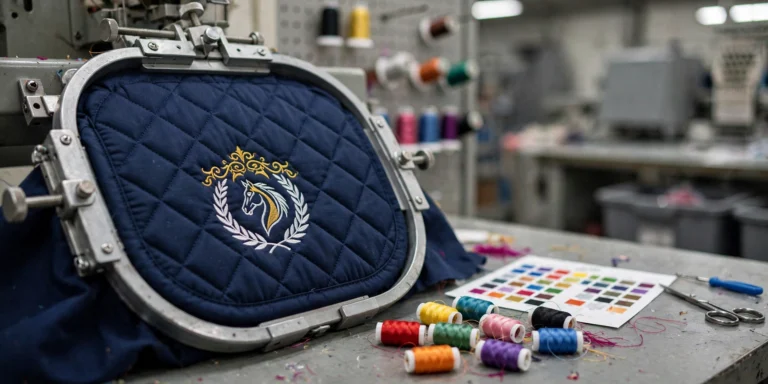
Embroidery is priced by stitch count — the number of individual stitches the machine sews. A simple text logo runs a few thousand stitches; a detailed crest with shading runs tens of thousands. More stitches mean more thread, more machine time, and a higher unit price, which is why artwork simplification is the buyer’s strongest cost lever. The exact per-thousand-stitch rate is factory-specific — confirm it per quote rather than assuming a market rate.
Practical rules that keep embroidery costs under control:
- Simplify the artwork. Every color change and fine detail adds stitches. A two- or three-color version of the logo usually reads as well on a pad corner as the full-color version — and costs noticeably less at volume.
- Respect minimum lettering sizes. In our supplier experience, embroidered lettering below roughly 5 to 6 mm cap height loses legibility on most quilted pad fabrics — but the exact minimum depends on the fabric, thread, and digitizing. Design the lockup at real finished size and confirm the minimum with the factory’s digitizer before approving.
- Choose the backing. Thin quilted pad faces can pucker under dense embroidery. Factories stabilize the area with cut-away or tear-away backing — confirm which is used, because it affects the feel of the pad’s underside.
- Confirm thread type. Standard rayon or polyester embroidery thread suits most pads; metallic threads look premium but break more often in production and fade faster in sun. Specify the thread type on the purchase order instead of assuming.
Ask the factory for the stitch count on the approved design and keep it on file. If a reorder is quoted higher with no design change, the stitch count is the first thing to compare — it is the objective measure of what changed. For print methods rather than embroidery, the wash-durability trade-offs are different — see saddle pad print methods compared for a method-by-artwork decision guide.
Where should the logo go on a saddle pad?
Placement determines who sees the branding and when. The two standard positions:
- Front corner (near the wither). Visible in product photos, at the tack shop rail, and in the stable yard. This is the default for retail private label — it photographs well and reads at a distance.
- Spine or drop area (rear/side). Visible when the horse is ridden and in competition photos. Preferred for team, sponsor, and performance-brand programs where the logo needs to read under saddle.
Less common but worth knowing: girth-strap branding (visible only up close), binding-tape printed logos (repeating pattern along the edge), and inside-label branding for buyers who want a clean exterior with the brand story on the inner tag. Whatever the placement, specify it with a measurement from a fixed reference point — for example, centered 10 cm from the front edge along the spine. Put it on the corner is not a specification, and vague placement instructions are a common source of bulk-to-sample mismatch.
What artwork files does the factory need?
Artwork problems cause more branding delays than any production issue. Supply:
- Vector files — AI, EPS, or vector PDF. The digitizer converts these to stitch files; raster images (JPG, PNG) require redrawing, which introduces interpretation errors.
- Pantone (PMS) references for every thread and trim color. Navy blue is not a color specification; a Pantone number is.
- The design at real finished size — or at least with the intended dimensions noted. A logo designed for a website header will not survive shrinking to a 7 cm pad corner without redesign.
- Placement instructions with measurements, as described above.
If the buyer only has a raster logo, say so upfront and budget for digitizing and redraw time. The expensive version of this problem is discovering it after bulk production started, when the close enough redraw is already sewn into hundreds of pads. Build the artwork block into the tech pack — see how to brief a factory on custom saddle pads — so the artwork, placement, and color references travel with the order.
How do buyers approve branding before bulk production?
The approval sequence that prevents branding failures:
- Digital proof. The factory returns a mockup showing artwork, size, placement, and thread colors. Check scale against a ruler, not against the screen — screens mislead on size.
- Physical strike-off. The factory embroiders or prints the actual design on the actual pad fabric. This is non-negotiable for embroidery: only the physical sample shows thread sheen, puckering, true color against the fabric, and legibility at real size.
- Wash-test the strike-off. Wash it the way the care label instructs, through a couple of cycles. Embroidery that puckers, print that cracks, or trim that bleeds shows up here — when it is still cheap to fix.
- Written sign-off. Approve the strike-off in writing with the stitch count, thread colors (Pantone), placement measurements, and the wash-test result recorded. This document is the defect-claim evidence if bulk branding drifts.
Keep one approved strike-off sealed as the bulk reference. When the pre-shipment inspector compares bulk pads against the approved sample, this is the sample they should hold — and reorders should be matched against it so the branding stays consistent run to run. For reorder discipline across the whole product, see reorder consistency for brands.
Which branding methods suit different customer types?
These are starting hypotheses from our supplier experience — adjust them to your customers’ reorder behavior, not industry rules:
- Tack shop retail private label: embroidered corner logo plus custom-color piping is the typical starting point — it photographs well for the shop’s social media and reads on the rail.
- Distributor house brands: woven damask labels with standard piping keep the branding cost low across a wide color range; add embroidery on the top tier only.
- Stable, school, and team programs: embroidery on the spine or drop area with a team colorway in the trim — the mark needs to read under saddle, not just on the shelf.
- Fashion and sponsor lines: heat-transfer or screen print where the graphic is the product — but only after wash-testing the strike-off to the care-label instructions.
One method across all programs is rarely the right answer. The method mix should follow where each program’s pads are seen and how they are washed.
What specs should I confirm when requesting a quote?
When requesting a quote on custom branded saddle pads, confirm: the branding method per program, the stitch count for the approved embroidery design, thread type and Pantone color references, placement measurements from a fixed reference point, backing type under the embroidery, piping or trim Pantone references and dye-lot controls, artwork file requirements (vector plus color references), the strike-off and wash-test approval sequence, setup fees and how they scale with quantity, and the MOQ per branded colorway — our standard is 50 pieces per color. Pricing and delivery terms are confirmed per quote.
Frequently asked questions
How much does custom embroidery add to a saddle pad’s cost?
It depends on stitch count, which follows artwork complexity and finished size. Simple text logos add a modest per-unit cost; large detailed crests cost several times more. Simplify artwork to two or three colors and get the stitch count confirmed in writing — it is the objective basis for comparing quotes between factories. For pricing the full private-label program around the branding, see pricing private-label saddle pads for tack shops.
What is the minimum order for custom-branded saddle pads?
Branding setup — digitizing, screens, label dies — is typically amortized across the order, so very small runs carry high per-unit branding costs. Our standard program runs at 50 pieces per color; confirm the branding setup fee and how it scales with quantity when requesting a quote.
Will embroidery survive regular washing?
Properly digitized embroidery with stabilized backing survives normal washing well in our experience. Problems come from overly dense designs on thin fabric (puckering) and metallic threads (breakage and fading). Wash-test the strike-off through a couple of care-label cycles before approving bulk.
Can I get my logo in custom piping colors instead of embroidery?
Yes — custom-dyed binding and piping in brand colors is a common alternative or complement to logo embroidery. It requires dye-lot control across the bulk order, so specify Pantone references and approve a trim swatch before production.
What file format should my logo be in?
Vector formats: AI, EPS, or vector PDF, with Pantone color references. Raster images (JPG, PNG) need redrawing into stitch files, which adds time and interpretation risk. Supply the design at its intended finished size wherever possible — and plan the full product timeline in launching a private-label saddle pad line.
Sources & Further Reading
- How OEM saddle pad programs work (internal): the full custom-program structure — embroidery, colors, and private label under one roof.
- Saddle pad print methods compared (internal): sublimation vs screen print vs embroidery — which method suits which artwork and wash demands.
- How to brief a factory on custom saddle pads (internal): tech packs, artwork blocks, and sample rounds for custom programs.
- Saddle pad reorder consistency for brands (internal): keeping branding and construction identical across repeat runs.
- Pricing private-label saddle pads for tack shops (internal): building the branded pad’s price from landed cost to shelf margin.
Developing a private-label line? We produce custom branded saddle pads at 50 pieces per color — embroidery, woven labels, heat-transfer print, custom piping, and full colorway programs with strike-off approval before bulk. Send your logo files and target quantities for a quotation.
