Saddle Pad Print Methods Compared: Sublimation vs Screen Print vs Embroidery for Brands
Published · Cornovo Saddlery
Consider a common scenario: a private-label brand launches all-over printed dressage pads with a photographic desert-sunset design that looks spectacular in the product photos. To save on setup, the buyer chooses screen printing over the factory’s sublimation recommendation. By mid-season the returns start: the sunset has cracked along the quilt lines, the oranges have washed to mud, and customers post new vs three washes photos. The brand pays for the order twice — once for the pads, again in replacements and discounts. The design was fine. The print method was wrong for it.
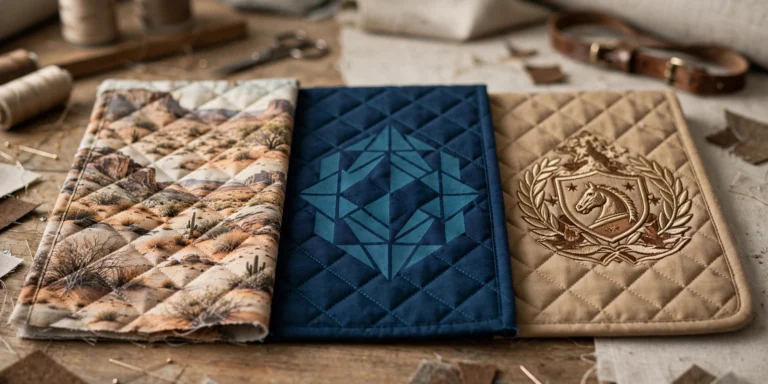
The short answer: match the print method to the artwork and the face fabric. All-over or photographic designs belong on polyester via sublimation; bold flat graphics on cotton belong in screen print; logos and crests belong in embroidery. No method wins on every factor — confirm wash durability with a strike-off wash test, not a rule of thumb.
This guide compares the three decoration processes used on saddle pads — sublimation, screen printing, and embroidery — on design capability, wash durability, hand feel, setup and MOQ impact, and cost behavior at volume. It companions our custom branding guide — that post answers how to put your mark on a pad; this post answers which print process your line should be built on. It also differs from our western saddle pad design guide, which covers the design process for patterned western pads; this post covers the production methods those designs are printed with. For print specs in a tech pack, see our tech sheet guide; for inspecting printed bulk, see our pre-shipment QC checklist — both linked in the approval section below.
Key takeaways
- Sublimation dyes the polyester fibers themselves — the choice for all-over, edge-to-edge photographic patterns with unlimited colors in a single setup, with no hand-feel change.
- Screen printing lays ink on the fabric surface — the choice for bold spot graphics, text, and sponsor-style prints; each color needs its own screen, so multi-color designs raise setup cost and effective minimums.
- Embroidery is stitched thread, not print — the premium standard for logos and crests, priced by stitch count; it cannot reproduce photographic detail or gradients and can pucker thin face fabrics.
- Wash durability is conditional, not a ranking — a fully penetrated sublimation usually holds longest on polyester, but a poorly cured one can lose to a well-cured screen print; judge every strike-off by a wash test, not by the method name.
- Choose the method before pricing the order: a design drawn for sublimation will disappoint in screen print, and re-sampling wastes the setup investment.
What is sublimation printing on saddle pads?
Direct answer: Sublimation printing transfers the design into the fabric with heat — solid dye turns to gas, bonds with polyester fibers, and becomes part of the cloth rather than a layer on top. On saddle pads it produces all-over, edge-to-edge patterns: photographic prints, gradients, and complex multi-color designs that would be impractical in any other method.
One heat-press setup handles unlimited colors at no per-color penalty — a ten-color sunset costs the same as a two-color stripe. Nothing sits on the surface, so there is no hand-feel change and nothing to crack or peel — which is why sublimation dominates fashion colorway programs and all-over western blanket-top patterns.
The constraint is material: the face must be polyester or a high-polyester blend — sublimation will not work on cotton — and colors render truest on white or light bases. On wash durability: sublimation is usually strong on polyester because the dye sits inside the fiber, but a poorly penetrated sublimation can lose to a well-cured screen print — so judge the strike-off by a wash test under the care-label instructions, not by the method name.
How does screen printing work, and when is it the right choice?
Direct answer: Screen printing pushes ink through a mesh screen onto the fabric surface — one screen per color — which makes it the right choice for bold, flat spot graphics, text, and sponsor-style prints, especially on cotton and cotton-blend pad faces where sublimation cannot work.
Its strengths are vivid, opaque inks and low per-unit ink cost at volume, on cotton, poly-cotton, and polyester alike — plus effects such as metallic or puff inks the other methods cannot touch. For a two-color team logo on a cotton schooling pad, it is usually the most economical decoration available.
Its limits are structural: each color needs its own screen, so setup cost and registration complexity climb with every color added, while fine detail and gradients lose fidelity — and surface ink can crack, peel, or fade with repeated washing. Keep graphics to a few flat colors; the approval section below covers how to wash-test the strike-off before bulk.
Where does embroidery fit against the two print methods?
Direct answer: Embroidery is not a print method at all — it is stitched thread, and it remains the premium standard for logos, crests, and monograms on mid-to-high saddle pad lines, priced by stitch count rather than by color alone.
Embroidery brings raised texture and perceived value neither print method can match, and properly digitized embroidery with stabilized backing survives washing well — which is why it anchors most premium private-label programs. Thread colors carry no per-color setup penalty; the cost driver is stitch count, which follows artwork size and density.
What embroidery cannot do matters just as much: no gradients, no photographic detail, no all-over coverage at sane cost — and dense designs can pucker thin quilted faces without proper backing. The common premium combination is sublimated all-over pattern plus an embroidered logo: the print carries the fashion, the embroidery carries the brand. For placement, artwork files, stitch-count pricing, and strike-off approval, see the custom branding guide linked above.
How do the three methods compare side by side?
Direct answer: No single method wins on every factor. Durability depends on the process–substrate pairing, not on a fixed ranking — so judge each option against your artwork, face fabric, and care regime, and confirm the choice with a wash-tested strike-off before committing.
| Factor | Sublimation | Screen print | Embroidery |
|---|---|---|---|
| What it is | Dye bonded inside polyester fibers | Ink layered on the fabric surface | Thread stitched into the fabric |
| Design strengths | All-over photographic prints, gradients, unlimited colors | Bold flat graphics, text, opaque spot colors | Logos, crests, monograms; premium texture |
| Design limits | Polyester face required; muted on dark bases | One screen per color; weak on fine detail | No gradients or photo detail; minimum lettering sizes |
| Best face fabrics | Polyester, high-polyester blends | Cotton, poly-cotton, polyester | Most quilted faces; thin fabrics need backing |
| Wash durability (conditional) | Usually strong on polyester — poor penetration reverses this | Fully cured ink holds well — under-cured ink cracks and fades | Usually strong with proper digitizing and backing |
| Hand feel | Unchanged — no surface layer | Slight ink film; heavy prints feel stiffer | Raised texture at the design area |
| Setup and MOQ impact | One setup covers all colors | Per-color screens raise setup and effective minimums | Digitizing per design; cost follows stitch count |
| Cost at volume | Flat across colors; economical for complex art | Cheapest for one-to-two-color graphics | Premium; large coverage scales poorly |
| Best use case | Fashion all-over pads, western blanket tops | Team graphics, cotton schooling pads | Brand logos, premium private label |
Wash-cycle research on printed branded textiles supports this conditional framing: in a Clemson University study, sublimation held color on polyester while screen printing held on cotton — but sublimation on the wrong substrate shifted badly (see Sources). The pairing matters more than the process name.
Which method should your product line use?
Direct answer: Match the method to the artwork first and the price tier second — all-over or photographic art goes to sublimation, bold flat graphics go to screen print, and logos and crests go to embroidery; combining methods on one pad is normal for premium lines.
Fashion colorway programs — seasonal all-over patterns, photographic collections, western blanket-top show pads — belong in sublimation. The unlimited-color setup means the artwork is never negotiated down to fit the process, and the wash durability protects the brand through the season. See the western design guide linked above for the design framework.
Team, stable, and sponsor programs with bold logos and text on cotton schooling pads belong in screen print, provided the artwork stays within a few flat colors. This is the value tier: vivid graphics at the lowest per-unit decoration cost.
Premium private label belongs in embroidery for the brand mark, with sublimation or screen print added only if the design needs more than a logo. The embroidered crest is what customers feel at the rail — that tactile signal is why it remains the equestrian standard despite the stitch-count cost.
One warning for all three: a design drawn for one method rarely ports cleanly to another. Approve the method with the artwork, not after it — re-sampling wastes the setup investment and weeks of calendar.
What should the purchase order and sample approval lock in for printed pads?
Direct answer: The purchase order should name the print method, the exact artwork version, color references, placement measurements, and the wash test the strike-off must pass — because print the design is not a specification, and each method fails in its own way.
Start with artwork discipline from the custom branding guide linked above: vector files with Pantone references for every color, supplied at the intended finished size. Then require the strike-off on the actual face fabric — a paper proof shows layout, but only fabric shows true color, scale against the quilt pattern, and how the method behaves on the real substrate.
Wash-test every strike-off under the care-label instructions, more than once: screen prints reveal cracking, sublimation reveals color weakness, embroidery reveals puckering. The test is cheap; bulk is where the same failure becomes expensive. If hang tags or listings will carry colorfastness claims, ask the factory what wash-fastness testing it offers and confirm the method in writing — do not invent claims. Record the approved method, artwork version, and stitch count in the master specification so reorders repeat the decision — see our tech sheet guide and our pre-shipment QC checklist.
What should you confirm when requesting a quote?
Lock the decoration decisions before the factory prices the run — quoting a design without a named print method produces numbers that cannot be compared. Confirm these in writing:
- Print method per design — sublimation, screen print, or embroidery, locked with the artwork before pricing.
- Face fabric compatibility — polyester or high-polyester blend confirmed for sublimation; cotton or blends confirmed for screen print.
- Artwork files — vector format with Pantone references for every color, supplied at the intended finished size.
- Strike-off approval — produced on the actual face fabric and wash-tested under the care-label instructions before bulk; paper proofs alone are not approval.
- Placement and version control — placement measurements from fixed reference points; embroidery stitch-file version and stitch count recorded.
- Setup fees quoted separately — screens per color, digitizing per design, sublimation setup, so small runs can be judged honestly.
- MOQ and amortization — program MOQ confirmed at 50 pieces per color, with setup costs amortized across the full order quantity.
- Wash-fastness testing named in writing — e.g., AATCC TM61 — if colorfastness claims will appear on hang tags or listings.
Frequently asked questions
Can sublimation print on cotton saddle pads?
No — sublimation dye bonds with polyester fibers, so cotton faces cannot take the print. Switch the face to polyester or a high-polyester blend, or choose screen print or embroidery for cotton pads. Confirm face fabric content with the factory before approving artwork drawn for sublimation.
How many colors can screen printing handle on a saddle pad?
Technically many, but each color needs its own screen — setup cost, registration risk, and cure time climb with every color added. Keep graphics to a few flat colors; anything photographic or gradient-heavy belongs in sublimation.
Will screen print survive regular washing?
It depends on the ink, the cure, and the fabric — a fully cured print on a compatible fabric can survive many washes, while an under-cured one cracks and fades early. Wash-test the strike-off under the care-label instructions before bulk: if it cracks in the test, it will crack in customers’ barns.
Can I combine sublimation and embroidery on the same pad?
Yes — a sublimated all-over pattern with an embroidered logo is a common premium combination. Sequence matters: print first, embroider second. Confirm the combination on the strike-off, since embroidery over a printed area behaves differently than on plain fabric.
Does the print method change my MOQ?
The program MOQ stays 50 pieces per color, but setup economics differ: multi-color screen printing and embroidery digitizing carry per-design setup investments that weigh heaviest on small runs. Confirm setup fees per method in the quote, and amortize them across the full order quantity.
Choosing between sublimation, screen print, and embroidery for your next pad line? Send us the artwork and target quantities — we will recommend the method that fits the design, quote the options side by side, and run strike-off plus wash-test approval before bulk at 50 pieces per color MOQ.
Sources & Further Reading
- AATCC TM61 — Test Method for Colorfastness to Laundering: Accelerated — the industry test method to name in a quote when asking what wash-fastness testing a factory can run; one 45-minute accelerated test approximates five typical home launderings. Verified accessible 2026-10-04.
- Walker & Bridges, Clemson University (2024): Color Accuracy and Durability for Printed, Branded Textiles — peer-reviewed wash-cycle data showing durability depends on the process–substrate pairing: sublimation held color on polyester, screen printing held on cotton, sublimation on the wrong substrate shifted badly — the basis for this post’s conditional durability framing. Verified accessible 2026-10-04.
- SKU Architecture for Private-Label Brands — how print method and colorway choices multiply SKU count, and how to keep the matrix manageable.
- Typical MOQs and Lead Times for Custom Saddle Pads — where setup economics and the 50-pieces-per-color MOQ fit the ordering calendar.
