
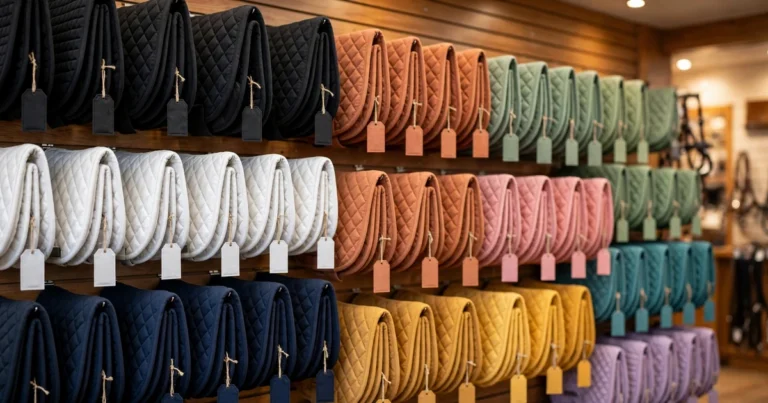
Saddle Pad SKU Architecture: How Private-Label Brands Structure Their Collections
Published · Cornovo Saddlery
Saddle pad SKU architecture is the planned structure behind a private-label line: how many collections the brand runs, what job each collection does, how many SKUs each holds, and the rules for naming them, retiring them, and keeping reorder colors consistent. It is not the catalog itself — it is the plan the catalog follows, the one that stops the assortment from growing one approved sample at a time.
Consider a common scenario: a young private-label brand enters its second year with a SKU list nobody can explain. A core schooling line in more colors than anyone can justify, a premium line that overlaps the core by discipline, a clearance corner of one-off seasonal colors, and several naming conventions inherited from different factories. When reorder season arrives, no one can say which SKUs earned their place and which exist by accident — the spreadsheet treats every row as equal. That drift is exactly what architecture prevents.
This guide covers the three-layer split between core lines and collections, the color-by-discipline-by-price matrix that decides SKU count, a readable SKU naming scheme, colorway retirement rules, and the continuity infrastructure that keeps core colors consistent year after year. This is operator guidance, not a catalog — quantities below are illustrative starting assumptions; confirm your actual numbers with your factory and your sales data.
Key takeaways
- Three layers with three jobs: the evergreen core line carries revenue, seasonal collections drive traffic and margin, limited capsules test ideas and create buying events.
- Plan the assortment on a three-dimensional matrix — colorway, discipline, price tier — and let the matrix decide the SKU count instead of sample approvals.
- A readable SKU naming scheme (line + discipline + shape + color + size) cuts order errors and powers reorder and sell-through analysis.
- Retire colorways on rules — agreed sell-through thresholds and a calendar — announced before stock runs dry, not on feelings.
- Continuity is manufactured: sealed master swatches, a Pantone reference plus the factory’s dye formula, fabric reservation for hero core colors.
How should a brand split core lines and collections?
Three layers, three jobs. The evergreen core carries the revenue and the reorder business. The seasonal collection drives traffic, margin, and social content. The limited capsule tests concepts cheaply and gives retailers a reason to buy at shows and buying events. Every SKU lives in exactly one layer, and the layer decides how long the SKU lives.
| Layer | Job | Typical content | Lifespan |
|---|---|---|---|
| Core line | Reliable revenue, reorderable stock, entry point for new customers | Schooling and all-purpose pads in black, white, navy; basic dressage and jump shapes | Permanent — reviewed yearly, rarely retired |
| Seasonal collection | Margin, traffic, social content, retailer re-engagement | Fashion colorways, coordinated binding and trim, seasonal quilting | One season — retirement date set at launch |
| Limited capsule | Test concepts cheaply, reward loyal accounts, brand storytelling | Experimental colors, collaboration pads, event editions | Sold once — no reorder promised |
The core line does the heavy lifting, and its defining trait is reorderability: a documented dye formula, fabric and trim with a known supply state, so a year-two reorder matches year one and a rider can replace a worn pad without a shade mismatch. That quiet continuity is a big part of why riders stay loyal to a pad brand — see our guide to reorder consistency for the buyer’s side of the same problem.
The classic mistake is letting seasonal colors bleed into the core. A fashion color sells well, gets reordered just once more without continuity infrastructure — no reserved fabric, no documented dye formula — and the second run drifts from the first. If a seasonal color proves itself, promote it to the core properly: document the spec, confirm fabric continuity with the factory, then promise it again. A planned seasonal color drop should be designed with that promotion path in mind from day one.
What does the color-by-discipline-by-price matrix look like?
The matrix is a grid on three axes — colorway, discipline, price tier — where each cell holds a SKU or deliberately does not. It turns vague requests like we should do more colors into a decision with a number attached, and it is where the SKU count for each collection gets decided before a single sample is approved.
An illustrative example, not a prescription: the core line covers four neutral colorways × three disciplines × one price tier, which plans out to 12 SKUs. A seasonal collection adds three fashion colorways × three disciplines — 9 more. A dressage-only premium tier adds 2. Total: 23 planned SKUs, each with a reason for existing — and the matrix forces the hard questions early, like whether the jumping customer ever buys fashion colors at all. Treat any such matrix as a starting assumption and resize it against your actual sell-through data, not against the wish for a fuller line.
The MOQ is the matrix’s reality check: every planned colorway means a production commitment at the standard 50 pieces per color, so a sprawling color plan multiplies the inventory investment fast. Count the colorways, weigh the total investment against the budget — most we want more variety plans should die at this step, before fabric is cut, which is exactly what the step is for.
How should brands name their saddle pad SKUs?
Name SKUs so that anyone — factory, warehouse, retailer, new hire — can read the structure from the code: line, discipline, shape, color, size, in a fixed order, with no private abbreviations. Example: CORE-DR-SQ-BLK-DL (core, dressage, square, black, dressage/large); SS26-AP-SQ-ROSE-AP (spring/summer 2026 fashion, all-purpose, square, rose). Self-teaching after two examples, and the scheme should match what appears on hang tags and care labels so the warehouse, the retail floor, and the factory all speak the same code.
- One scheme for everything. New lines, collaborations, and capsules all use the same format. The moment the capsule gets its own logic, the system dies.
- Season codes on seasonal SKUs only. Core SKUs stay season-free — a core pad stamped FW24 in 2027 looks like old stock.
- Colors by name, not by code. BLK and NVY beat C-011 and C-014 — a retailer reordering the navy one should find it without the catalog. Keep a Pantone reference behind the name for factory accuracy.
- Version suffixes for spec changes. When binding or quilting changes mid-life, add V2 rather than reusing the SKU — otherwise a reorder of the same pad delivers a different one.
- Retired SKUs never get reused. A retired code stays dead forever, or the year-two reorder collides with old records.
Clean codes power the data: fastest colorway per discipline, decaying margins, which seasonal collection drove reorders. Inconsistent naming leaves the brand blind on the exact decisions the matrix exists to support.
When and how should a colorway retire?
A colorway retires when the rules say so — a sell-through threshold crossed, a planned season ended — and the retirement is announced before stock runs out, so loyal buyers can place a final order. Numbers and calendars retire colorways, not feelings. For a working definition of the metric, see Klipfolio’s sell-through rate explainer: there is no universal benchmark, so set your own threshold by category and season rather than borrowing one.
Seasonal colors carry their retirement from birth: announced as one-season, retired on schedule regardless of performance. Reissuing a sold-out seasonal trains customers to wait for the reissue — urgency is the whole point of the seasonal layer. If demand proves structural rather than hype-driven, promote the color to the core line with a proper continuity spec (this is the same promotion path described in the core-versus-collection section above, not a separate exception to it). For core colorways, retirement needs teeth: a color that misses the agreed sell-through rate across two consecutive reorder cycles, or cannot cover its share of warehousing and MOQ commitments, goes on the retirement list at the annual review — numbers on the table, not a debate about favorite colors.
Announce the retirement as normal rhythm, not an emergency: Sage retires at the end of March; final orders by mid-February. A final-order window announced well before stock runs dry lets shops stock up for loyal buyers and spares the brand the angry emails when a beloved color vanishes silently — while keeping the matrix honest, with the slot open for the next candidate.
How do brands keep core colorways consistent year after year?
Continuity is manufactured, not assumed: for every core colorway, keep a spec record and hold the factory to the infrastructure that lets year two match year one.
- Sealed, dated master swatch. Kept by both brand and factory, signed off together. Every reorder is judged against it — not against last year’s memory.
- Pantone reference plus the factory’s dye formula. The Pantone number is the target — a standardized, numerically coded color reference that lets designers and manufacturers speak the same color language across materials, per Design+Encyclopedia’s Pantone overview. The dye formula is how this particular factory’s fabric actually hits that target, and a new fabric lot needs its own formula.
- Trim and binding references. Navy binding drifting half a shade looks fine alone and wrong against the face fabric — continuity covers the whole construction, not just the outer material.
- Fabric reservation habit. For hero core colors, discuss reserving greige fabric or keeping small rolling stock with the factory. Brands that never run out of black and white plan that continuity rather than hoping for it.
Guard against silent substitution: require the factory to notify you of material-source changes on core SKUs, and approve a strike-off against the master swatch before the bulk run. Good factories welcome the clarity — it is a tech-pack discipline, not a trust issue, and it belongs in the factory brief and tech pack from the first order.
Requesting a quote: specs to confirm
Before asking a factory to quote a private-label line, confirm these in writing — most SKU architecture failures trace back to an item on this list being assumed rather than agreed:
- MOQ per colorway and per SKU — our standard is 50 pieces per color; confirm whether seasonal, capsule, and exclusive colorways share the same threshold.
- Whether the factory documents and supplies dye formulas per colorway for reorder matching, and keeps sealed master swatches on file.
- Greige fabric reservation terms for hero core colors: minimum quantity, storage duration, cost.
- Strike-off approval process for reorders: lead time per strike-off round, who signs, and whether formula redevelopment is needed for new fabric lots.
- Notification policy for material-source changes on core SKUs, and who absorbs the cost of a re-strike when a source changes.
- Embroidery and trim continuity: whether binding and piping suppliers are fixed per colorway or substituted by availability.
Frequently asked questions
How many SKUs should a new private-label brand start with?
Fewer than feels impressive — a reasonable starting assumption is 10 to 25 SKUs in one core line: four neutral colorways × two or three disciplines. That lets the brand learn its sell-through and reorder rhythm before adding a seasonal layer — and every SKU carries inventory cost, so expand the matrix only after the first reorder cycle shows what sells. Your launch timeline should include that review point before seasonal commitments are made.
Should the seasonal collection use the same factory as the core line?
Usually yes, at first: one quality standard, one communication rhythm, simpler continuity when a seasonal color is promoted to core. Splitting suppliers multiplies sample rounds and color-matching work. Some mature brands add a second factory for capsules — after the core relationship is solid.
How does a retailer-exclusive colorway fit the architecture?
Treat it as a capsule entry: the brand’s naming scheme, the retailer’s color, a documented retirement date. Exclusivity is the point and it expires. Write channel exclusivity into the agreement and mark the SKU code — the trap is letting the exclusive color leak into the core line or the brand’s own channels.
How do you keep colorway continuity when switching factories?
Expect a matching project, not a handoff: the new factory needs the master swatch, the Pantone reference, and its own dye-formula development against the old approved sample. Budget a strike-off round or two, and do not promise continuity until the new factory proves it on fabric. Cleanest sequence: launch the new factory on next season’s collection, migrate core colorways only after quality is proven.
Can a retired colorway ever come back?
Yes — as a planned reissue treated like a new capsule, with clear one-time framing: original dye formula (if the records survived), limited run, no ambiguity. What destroys the architecture is the quiet resurrection — restocking a retired color without the continuity spec. Retire cleanly, and a color can always come back loudly.
Send us your current product list and we will map a SKU architecture for your line: core vs seasonal layers, a naming scheme, and a colorway continuity plan built around the 50 pieces per color MOQ — so every SKU you add earns its place.
Sources & further reading
- Klipfolio, Sell-Through Rate: Definition, formula, and examples — https://www.klipfolio.com/kpis/sales/sell-through-rate (definition of sell-through rate; no universal benchmark — set your own by category and season).
- Design+Encyclopedia, Pantone — https://design-encyclopedia.com/?E=433026&I=P (Pantone as a standardized, numerically coded color communication system across materials including textiles).
