Seasonal Color Drops for Saddle Pads: How Private-Label Brands Plan Collections
Published · Cornovo Saddlery
Consider a common scenario: a private-label brand picks a trending seasonal color off a screen, approves it in a hurry to hit a launch date, and the bulk fabric arrives reading noticeably different under arena lights. The product itself is sound — the color plan was the weak link. Clearing off-shade inventory at markdown prices hurts; missing the selling window while waiting on a re-dye hurts more.
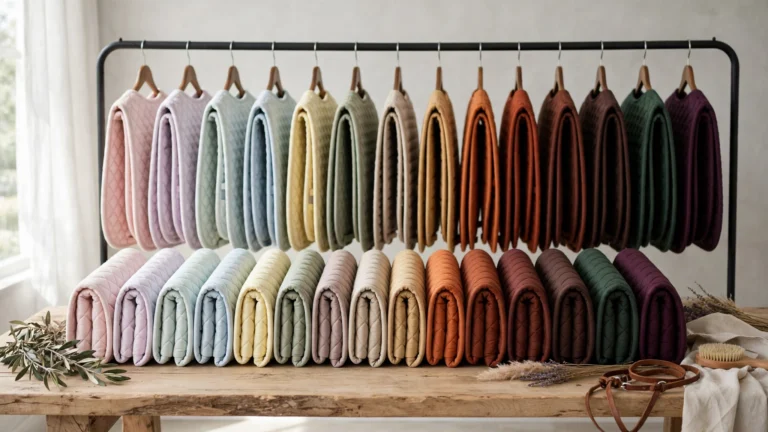
Color is the fastest way to make a private-label line feel new — and the fastest way to lose money when it is planned badly. Brands that run seasonal color drops well use a repeatable system: a written drop calendar, a disciplined lab dip process, a tight color count per drop, and inventory math that keeps small colors from becoming big write-offs.
Here is the short version: run two to three color drops a year anchored to your selling seasons, approve every color with a lab dip before bulk dyeing, keep new colors few and core carryovers steady, and plan the calendar backwards from the launch date. With a 50 pieces per color MOQ, each drop becomes testable instead of a gamble — you reorder the winners and let the rest retire quietly.
Key takeaways
- Most private-label equestrian brands run 2–3 color drops per year (spring/summer and fall/winter, sometimes plus a holiday or mid-season refresh) — each anchored to when the pads must be on the shelf, not when the idea feels fresh.
- A lab dip is a small dyed swatch the factory makes to match your target color; approve it in writing before bulk dyeing, and confirm the sampling calendar with your factory per order — rushing dip rounds is how off-shade bulk runs happen.
- New colors should stay few and core carryovers steady; treat any specific count as a starting hypothesis and adjust by your own reorder data — the examples below are labeled as such.
- Count the calendar backwards from the launch date: a full drop cycle commonly spans several months from finalized colors to landed goods. Confirm the real lead time with your factory per order.
- With a 50 pieces per color MOQ, a multi-color drop is testable: run small, track what sells, and reorder only the winning shades while the season is still live.
How many color drops do private-label brands run per year?
Two to three. Most established private-label brands run a spring/summer drop and a fall/winter drop, timed to the selling seasons of their main markets. Some add a third, smaller drop around the holidays or a mid-season refresh. More than three a year is rare in equestrian textiles — the category moves slower than fashion, and riders buy pads to match barn colors, not trends. New brands often start with just two and add a third only after they see how the first cycle lands.
Each drop needs a fixed launch date, with color selection, lab dips, sampling, production, and shipping planned backwards from it. Brands that launch whenever the factory finishes end up selling spring colors in July. The calendar below is an illustrative example for a Northern Hemisphere brand — confirm timing with your factory and adjust to your own markets.
| Milestone | Spring/Summer drop (launch March) | Fall/Winter drop (launch September) |
|---|---|---|
| Color selection finalized | October–November | April–May |
| Lab dips approved | November–December | May–June |
| Pre-production sample signed off | December–January | June–July |
| Bulk production | January–February | July–August |
| Goods arrive in warehouse | Late February | Late August |
Note the overlap: while the spring drop is in production, fall colors are already being selected. The system works only if both drops sit on a written calendar with a named owner for each milestone. For more on building the first collection calendar, see our private-label launch timeline, and for the SKU logic behind each drop, SKU architecture for private-label brands.
What is a lab dip, and how does the approval process work?
What is a lab dip? A lab dip is a small dyed fabric swatch the mill or factory produces to match a target color, usually given as a Pantone reference. Buyers review each dip and approve one in writing before bulk dyeing begins. Rejecting a swatch costs almost nothing; disputing an off-shade bulk run can cost the entire order. The process is standard across textile manufacturing: the colorist mixes dye formulations, applies them to the actual production fabric, and adjusts the formula across rounds until the match is approved (GMT: What Is a Lab Dip).
The process runs in rounds: you send the color target, the factory returns dips, and you approve or request another round. Most colors clear in one or two rounds, but confirm the sampling calendar with your factory per order — rush rounds late in the season and you end up approving a shade you have not really evaluated. Always judge dips on the actual production fabric, since different fabrics absorb dye differently, and agree the lighting standard with the factory so both sides judge the same way.
Get the approval in writing, with the approved dip kept as the physical reference for bulk-production QC. When shade disputes arise later, the signed-off dip is what both sides measure against — not a phone photo from three months earlier. Keeping repeat runs identical is a discipline of its own; see our guide to reorder consistency for the full method.
How many colors should each drop include?
Enough novelty to give retailers a reason to reorder, few enough that each color gets meaningful volume and no single shade can sink the order. The carryovers matter more than the new colors: black, navy, white, and brown sell every season in English pads; black, chocolate, and tan anchor Western lines. These are the volume drivers that pay for the drop, while the new seasonal colors give retailers a reason to place another order.
Specific counts vary by brand type, so treat the examples below as starting hypotheses — adjust by your own sell-through and reorder data, not by anyone else’s rule of thumb:
| Brand type | Starting color count (hypothesis) | Why |
|---|---|---|
| New private-label brand, no reorder history | Mostly core carryovers plus one or two seasonal tests | You have no data yet on which shades your accounts reorder; the carryovers carry the order while the tests teach you. |
| Established brand with sell-through data | A wider new-color mix alongside the proven cores | Reorder history tells you which shades are safe bets and which accounts buy new colors — widen the mix where the data supports it. |
| Distributor house brand serving multiple accounts | A coordinated color story across products in fewer shades | Fewer shades per product, spread across dressage, all-purpose, and half pads, give every account something to buy without fragmenting volume. |
Weight the order toward the proven core colors rather than the new shades — set your own split from your margins and reorder history rather than a fixed industry ratio. The costly mistake is the opposite: launching a drop with ten or twelve new colors and no carryovers. Each new color splits the order thinner and raises the odds that one or two shades flop. Start tight — you can always add a mid-season refresh of proven winners, but you cannot un-produce a flop.
How far ahead should the calendar start?
Work backwards from the launch date and confirm every stage with your factory per order. A full drop cycle commonly spans several months from finalized colors to goods in your warehouse: color selection on your side, lab dip rounds, the pre-production sample, bulk production for custom-dyed runs, and ocean freight plus customs. Any stage slipping pushes the whole drop — and the stage that most often blows up the calendar is sampling, not production. Brands finalize colors late, then compress the lab dip rounds to catch up — and end up approving a shade they have not really evaluated.
Build the buffer into the front of the timeline, not the back: a week saved on shipping cannot fix a color approved in a rush. If you are working against a hard launch date — a trade show, a catalog deadline — tell the factory the real date and why. Factories plan capacity around firm dates; as soon as possible gets scheduled after someone else’s firm date. For the broader buying calendar this sits inside, see the tack shop buying calendar.
What happens when bulk colors arrive off-shade?
Shade variation between lab dip and bulk production is one of the most common disputes in textile importing, and it is almost always a process failure. Prevention is straightforward: factory QC should check production fabric against the approved lab dip under the agreed lighting, and shade should be confirmed again at pre-shipment inspection against the same reference. Some variation is normal — dye lots shift slightly, and most buyers accept a small commercial tolerance around the approved standard. What is not acceptable is a bulk run that visibly does not match the signed-off dip.
That is why the written approval matters: without a dated, approved reference, off-shade becomes an argument about memory. With one, it is a measurement. This is also where colorfastness testing earns its keep — dark pads that bleed in the wash are a different failure from off-shade, but the same discipline of specifying and verifying applies; see our color fastness guide for the test standards buyers use.
How does a 50 pieces per color MOQ change color-drop planning?
It makes small, multi-color drops practical. At 50 pieces per color, a five-color drop is a 250-pad order — testable, not a gamble. That changes the planning math three ways.
First, you can afford experimental colors. A brand at 50 pieces per color can run one adventurous shade per drop alongside safe sellers — if it flops, the exposure is 50 pads, not 500.
Second, you can split the drop across products without overcommitting. Fifty pieces of a seasonal color in dressage pads, fifty in all-purpose pads, fifty in half pads — three SKUs, one color story, 150 pads of exposure per shade. Retailers like coordinated color stories, and the low per-color MOQ lets you build them without overloading any single SKU.
Third, reordering gets surgical. When the drop lands and two colors clearly outperform, you reorder just those two at 50 pieces each while the season is still live. The brands that grow fastest on private label are usually the ones that test small and reorder fast, not the ones that place the biggest first order.
One caution: per-color MOQ is not the same as per-order or per-style minimums. Confirm with your factory how the 50 pieces per color applies across styles and sizes before you build the drop around it — a color split across two pad shapes may count as two colorways. For the general MOQ picture across custom programs, see typical MOQs and lead times.
What should you confirm when requesting a quote for a color drop?
Send the factory a complete drop brief rather than a color list. Confirm, in writing: the target color references (Pantone numbers or physical swatches); the production fabric each color will be dyed on; the agreed lighting standard for judging dips; the sampling calendar — how many dip rounds, and the turnaround per round; the bulk production window for custom-dyed runs; how cross-product color matching is handled where the same shade runs across pad shapes; the per-color and per-style minimums and how they interact; and the freight lane duration to your market. If you are still assembling the brief, our tech pack guide walks through the full factory briefing process.
Frequently asked questions
Can we carry over last season’s colors without new lab dips?
Often yes, if the factory kept the dye formula and the fabric is the same — ask them to confirm the formula is on file and request a fresh dip against the old approved standard before bulk. If the fabric base changed, treat it as a new color and run the full dip process. Carryover colors are usually the fastest part of a drop to approve.
Should we follow fashion color forecasts for saddle pad colors?
Forecasts are useful input, not instructions. Equestrian buyers follow barn and discipline conventions more than runway trends — a forecasted neon may sell in athleisure and sit dead in dressage pads. Use forecasts to nudge your seasonal shades (warmer, cooler, dustier), then validate against what your retailers actually reordered last season.
What if we miss the drop deadline?
Do not compress lab dip approvals to catch up — that is how off-shade bulk runs happen. Better options: launch with the carryover core colors on time and add the new seasonal colors as a mid-season refresh, or shift the whole drop. A late color launch still sells; a wrong-color launch costs the goods and the retailer’s trust.
How do we keep colors consistent between our saddle pads and matching products?
Specify cross-product color matching in the tech pack and send one physical reference — the approved lab dip — for all products in the colorway. Ask the factory to dye or source the fabrics for the whole color story together where possible, and check the match at the pre-production sample stage across every product, not just the main pad. Confirm how the factory handles matching across different fabrics before the drop, not after the goods arrive — different fabric bases dye differently, so cross-product matching needs to be a stated requirement.
How far ahead should a new private-label brand plan its first color drop?
Give yourself one extra drop cycle of runway. Your first drop will surface questions — artwork formats, trim sourcing, packaging — that experienced brands have already answered. Starting color selection well ahead of your target launch leaves room to learn the process without rushing the lab dips, where first-timers most often get burned.
Planning a seasonal color drop for your private-label saddle pad line? Send your target colors, pad styles, and quantities — a 50 pieces per color MOQ keeps each drop testable, and we will quote the full run including lab dips, sampling, and delivery timing.
Sources & further reading
- What Is a Lab Dip? A Guide to Fabric Color Approval in Textile Production — GMT: lab dip rounds, Pantone standards, controlled lighting, approval before bulk dyeing.
- Saddle Pad SKU Architecture for Private-Label Brands — internal.
- Saddle Pad Reorder Consistency for Brands — internal.
- Saddle Pad Color Fastness Buyer’s Guide — internal.
- The Tack Shop Buying Calendar — internal.
- Launch a Private-Label Saddle Pad Line: Timeline — internal.
