Saddle Pad Color Fastness Explained: Wash, Rub, and Light-Fade Ratings Wholesale Buyers Should Specify
Published · Cornovo Saddlery
Consider a common scenario: a distributor’s bestselling black dressage pad starts earning dye-transfer complaints — streaked white breeches after wet rides, a faint tint across a gray horse’s coat under the saddle, a tack shop boxing up cartons for return. The bulk lot’s wet-rub fastness had never been specified or tested. One unmeasured property turned a bestseller into a recall, a refund, and a lost account.
The short answer: color fastness is three separate ratings — wash, rub (dry and wet), and light — each graded 1 to 5, higher is better. Deep shades on cotton are the riskiest. Put minimums tied to named ISO/AATCC standards on the tech sheet, verify them with a lab report on the dye lot, and back the PO with a retest clause plus a care label.
This guide covers the three fastness ratings (wash, rub, light), what the 1-to-5 grades mean, the riskiest colorways, how to write fastness lines into the tech sheet without inventing figures, how to verify test reports, and the purchase-order language that protects you. It companions our print methods comparison, reorder consistency guide, and tech sheet guide.
Key takeaways
- Color fastness is three separate ratings — wash, rub (dry and wet), and light — each graded 1 to 5 on a gray scale; higher is better.
- Deep cotton shades — black, navy, burgundy, dark green — carry the most dye-transfer risk, especially against white breeches, gray horses, and light contrast binding.
- Write fastness minimums on the tech sheet as spec lines tied to a named ISO/AATCC standard, and treat them as targets confirmed by a lab report — not guesses.
- Fastness belongs to the dye lot, not the color name: a new lot means a new check, even when the color name hasn’t changed.
- A fastness test costs a small fraction of a container’s value; one dye-transfer recall costs the container, the freight, and the customer.
What is color fastness, and which three ratings matter for saddle pads?
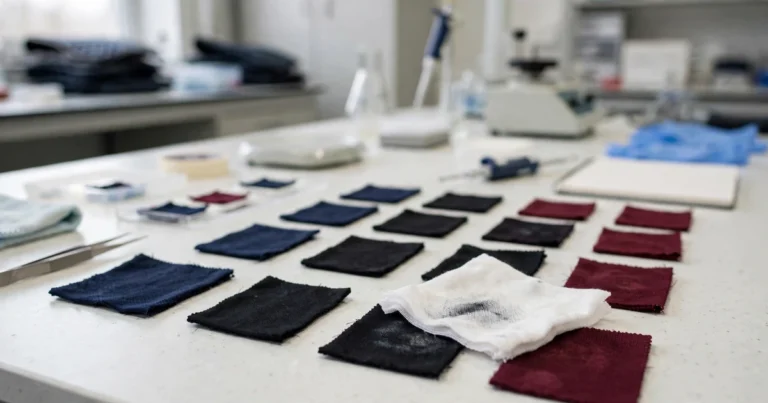
Direct answer: Color fastness measures how well dye stays put under washing, friction, and sun. Three ratings matter: wash fastness (color change and staining after laundering), rub fastness or crocking (dye transfer under dry and wet friction), and light fastness (fading under light exposure). Each is graded 1 to 5 on a gray scale — 5 means no perceptible change, 1 means severe failure.
The grading uses a gray scale — a set of gray chips the lab compares the sample against. Grade 4 means slight change, visible mainly to a trained eye; grade 3 is noticeable to an ordinary customer. Specifications write grades as minimums tied to a named standard — a grade 4 claim without a standard number is a claim, not evidence.
The standards behind the grades are international: the ISO 105 series (C06 for wash, X12 for rub, B02 for light) and the AATCC equivalents (61, 8, 16). As a reference point rather than a spec, one published textile mill guide describes good-quality materials as scoring around grade 4 for dry rub and around grade 3 for wet rub — your own minimums should be set on the tech sheet and confirmed against the lab report for your program.
| Fastness test | Standard (ISO / AATCC) | What it simulates | Spec target |
|---|---|---|---|
| Wash fastness | ISO 105-C06 / AATCC TM61 | Repeated laundering per the care label | High — upper end of the 1–5 scale |
| Rub fastness, dry | ISO 105-X12 / AATCC TM8 | Saddle and rider friction on a dry pad | High — upper end of the 1–5 scale |
| Rub fastness, wet | ISO 105-X12 / AATCC TM8 | Sweat, rain, or a wet horse under the pad | A realistic floor on deep shades, confirmed per lab report |
| Light fastness | ISO 105-B02 / AATCC TM16 | Sun exposure in use and on the shop wall | High — upper end of the 1–5 scale |
Wet rub is graded lower almost by definition — moisture mobilizes surface dye, so labs and buyers treat it as the hardest property to maximize on deep shades. Set each target on the tech sheet, name the standard with it, and let the lab report confirm what the dye lot actually achieved.
Why do dark saddle pads bleed dye — and which colorways carry the most risk?
Direct answer: Dark pads bleed because deep shades on cotton carry far more surface dye than light shades, and sweat, friction, and body heat under a saddle mobilize it. Polyester-rich fabrics generally hold dye better. The risk cases are predictable: dark pads on gray horses, dark pads against white breeches, and dark contrast binding on light grounds.
The chemistry is straightforward. Cotton takes reactive and direct dyes well but leaves unfixed dye on the surface when the mill skimps on wash-off — the rinsing step that removes loose dye after dyeing. Deep shades need the heaviest dye loads, so they leave the most surface dye when wash-off is incomplete. Sweat, saddle friction, and body heat mobilize that dye — onto the horse’s coat, the rider’s breeches, and light binding in the same pad. Independent textile-lab write-ups on crocking note that surface dye residues on dark products transfer more easily during wear, which is why black, navy, and burgundy are the usual suspects.
Two details raise the stakes: quilted pads pair dark face fabric with light undersides or binding, so migration stains the pad itself; and pads sit in the sweat zone for hours — far longer and wetter than most apparel.
| Risk case | Why it fails | Severity |
|---|---|---|
| Black or navy pad on a gray horse | Sweat and friction move surface dye onto a light coat where every mark shows | High |
| Dark pad + white show breeches | Rain or sweat wets the pad edge; dye transfers to light breeches | High |
| Dark binding on a light pad ground | Dark trim on a light ground; wet rub moves dye across the boundary | High |
| Pad displayed in a shop window | Weeks of daylight fade one side before the pad ever sells | Medium |
| White show pads | Light fastness and yellowing; the pad must stay white through washes | Medium |
| Light pastels (pink, sky, mint) | Low dye loads; fading is the main concern | Low |
When reviewing a colorway plan, give every dark colorway and dark-on-light combination a fastness line on the tech sheet and a test on the bulk lot. Light colorways can ride on the mill’s standard grades unless the brand claims fade resistance.
How should you write fastness into the tech sheet?
Direct answer: Write fastness as spec lines on the tech sheet — qualitative minimums tied to named standards, e.g. wash fastness: high minimum per ISO 105-C06 — with tighter wet-rub language for black, navy, or dark-on-light combinations. Confirm with the factory and lab before locking the sheet, since higher grades can mean better dyes, longer wash-off, and different cost.
Add the fastness lines to the fabric entries from our tech sheet guide: construction, GSM, supplier reference, then the fastness line. Naming the standard with the grade — wash fastness: high minimum per ISO 105-C06 — stops anyone arguing later about which test was meant. For contrast binding, write separate lines for face and binding; different dye lots fail independently.
One common mistake: specifying fastness on the sample swatch and assuming the bulk lot matches. Swatches often come from an earlier lot or a lab dip — which is why our reorder consistency guide insists on dye-lot discipline. The specification applies to the bulk lot, and the report must reference that lot.
If a line’s positioning needs the strongest wet-rub performance on deep shades, spec it — but confirm the dye and wash-off cost impact with the factory rather than assuming it is small. For white show pads, add a non-yellowing note alongside the light-fastness line.
How do you verify fastness before committing to a bulk order?
Direct answer: Ask for a test report on the bulk dye lot — not the salesman sample, not last season’s lot — showing the standard number, grade per test, test date, and lot reference. The factory’s own lab is fine for routine runs; use an independent lab for high-risk colorways, large orders, or after a previous failure.
Time verification with the pre-production sample: the bulk-lot fastness report should arrive with the PP sample, and both are approved together. Check four things: the fabric matches your bulk fabric, the lot reference matches the lot being cut, every property meets the tech-sheet minimum, and the standard number is recognizable. A report missing any of these is incomplete — ask for the missing piece before approving, and use our pre-shipment QC checklist to fold the check into the broader inspection.
Retest when the inputs change: a new mill, a new dye supplier, a reformulated shade, or a reorder months later all reset the assumption. Fastness is a property of the dye lot, not the color name.
If the factory cannot produce test reports at all, commission the test yourself on a bulk-lot swatch before cutting is approved — or decline dark colorways from that supplier. A supplier you cannot verify is a supplier whose dye you cannot trust.
What purchase-order and care-label language protects you when dye transfers anyway?
Direct answer: Put the minimums and a retest in the purchase order — e.g. color fastness per the tech-sheet minimums (ISO 105 / AATCC equivalents); buyer may retest independently at supplier’s cost if a lot fails — and put wash separately before first use; dark colors may transfer when wet on the care label. The PO gives the remedy; the label warns the customer.
The PO clause does three jobs: it makes fastness contractual rather than hopeful — our returns and warranty claims guide works far better when the failed property was written down; the retest right keeps the factory honest on lots you cannot watch being dyed; and a factory that balks at the clause is telling you something about its dyeing.
The care label is the cheaper second line of defense. Wash separately before first use costs nothing to print; dark colors may transfer when wet sets the rider’s expectation for the residue even good dyeing leaves on a first ride. Neither line replaces testing; both shrink the damage when a marginal lot slips through.
What specs should you confirm when requesting a quote?
Direct answer: Send the colorway list with target fastness language per colorway, name the ISO/AATCC standard each grade refers to, state whether you accept the factory’s lab or require an independent one, and ask what bulk-lot testing is already included in the sampling price. Fastness questions asked at RFQ stage get answered; asked after the deposit, they get delayed.
- Colorway list with deep-shade and dark-on-light combinations flagged for wet-rub attention
- Target fastness language per test (wash, dry rub, wet rub, light), each tied to a named ISO/AATCC standard
- Whether fastness reports reference the bulk dye lot, and how lot changes are communicated
- Factory lab vs independent lab: which tests run in-house, which go out, and typical turnaround
- Care-label wording the factory can print, including first-wash separation warnings for darks
- Binding and embroidery thread treated as separate dye lots with their own rub lines where relevant
Frequently asked questions
Does heavier fabric (higher GSM) bleed less?
Not directly. Bleed is a dye-chemistry and wash-off question — a heavy twill with poor wash-off bleeds worse than a lighter fabric with complete wash-off. Judge dye risk by the test grades, not the GSM.
Can a bleeding production run be fixed after it arrives?
Rarely at reasonable cost. Caught at the pre-production sample, the factory can sometimes re-run wash-off on the bulk fabric before cutting. After the pads ship, your options are pre-washing the stock yourself or discounting with a warning. Prevention at the dye lot is cheaper than every cure.
Do white pads need fastness testing too?
Yes: light fastness against yellowing, and rub fastness where white pads carry colored binding or embroidery. A yellowed white pad, or one stained by its own binding, fails just as visibly as a bleeding black one.
How often should fastness be retested on reorders?
Every time the dye lot changes — in practice, every reorder unless the factory confirms the same lot. Pair the retest with the reorder discipline in our reorder consistency guide: new lot, new lab dip, new fastness check.
What if the factory has no testing capability at all?
Test it yourself through an independent lab on a bulk-lot swatch before approving cutting. If the margins cannot carry independent testing, restrict that supplier to light colorways.
Specifying fastness on your next pad program? Send us the colorways and target grades — we test bulk dye lots against ISO and AATCC standards, write the minimums into the tech sheet, and produce at 50 pieces per color MOQ.
Sources & Further Reading
- AATCC TM61 — Test Method for Colorfastness to Laundering: Accelerated (the standard behind wash-fastness grades cited in this guide)
- EYSAN Fabrics: Ultimate Guide to Color Fastness of Fabrics (maps each fastness property to its ISO/AATCC method — 105-C06/61 wash, 105-X12/8 crocking, 105-B02/16 light — and describes reference grade levels)
- Testex: Comprehensive Evaluation of Color Fastness Testing (crockmeter procedure per ISO 105-X12 and why dark products carry the highest surface-dye transfer risk)
- Saddle Pad Print Methods Compared
- Saddle Pad Reorder Consistency for Brands
- Saddle Pad Tech Sheet: Stitch Density & Foam Density
- Pre-Shipment QC Checklist for Saddle Pads
- Saddle Pad Returns & Warranty Claims Guide
