
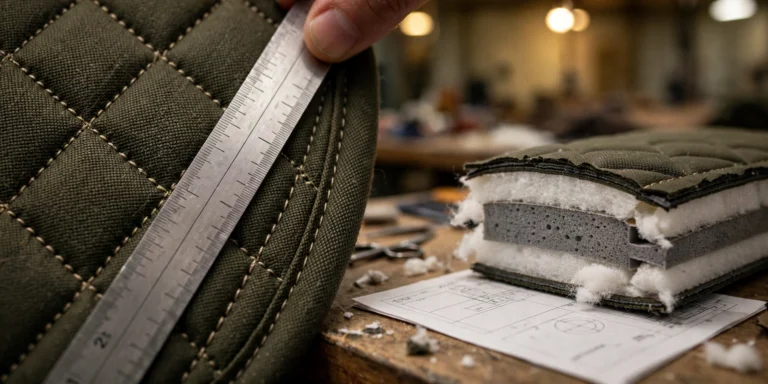
Saddle Pad Stitch Density and Foam Density Specs: How Buyers Read a Tech Sheet
Published · Cornovo Saddlery
Consider a common scenario: a distributor approves a quilted pad off a photo and a one-line spec reading high-density foam. By mid-season the complaints arrive — quilting flattened after repeated washing, skipped stitches along the binding, foam that bottomed out under a typical saddle. The factory’s reply is short and, technically, fair: nobody specified the stitch count, and nobody specified the foam density. High density meant nothing on the production floor.
Here is the short version for busy buyers. SPI (stitches per inch) is the core workmanship number — quilting commonly runs 6–8 SPI. Foam density in kg/m³ predicts shape-holding, not firmness — specify firmness alongside it. Polyfill needs both GSM and thickness on the sheet. Break the pad into face, fill, and lining with per-layer numbers, then add ± tolerances and an agreed inspection standard so correct means the same thing to both sides.
Reading and writing a saddle pad tech sheet is the skill that prevents the opening scenario. This guide covers stitch density (SPI), foam density, polyfill GSM versus thickness, a three-layer spec breakdown buyers can hand to a factory, and how to write tolerances so both sides agree what correct means. For fill choice by discipline, see our thickness and fill guide; for pattern aesthetics, see our quilting patterns guide; for inspection, see our pre-shipment QC checklist.
Key takeaways
- SPI is the core quilting metric — quilting lines commonly run 6–8 SPI, binding stitches longer at about 5–6 SPI; too low puckers, too high perforates lighter face fabric.
- Foam density in kg/m³ predicts shape-holding, not firmness — comfort layers commonly sit in the 25–35 range, core support layers higher; always quote firmness alongside density.
- Polyfill needs both GSM and thickness — two fills with the same GSM can loft differently depending on fiber quality and processing, so record the batt type too.
- Split the spec into face fabric, fill, and lining, each with its own material, weight, and stitching parameters; do not forget binding and straps, which fail most often.
- Tolerances (±) and an agreed AQL sampling plan turn a spec sheet from a wish list into an inspection standard.
What is stitch density, and what does SPI mean on a tech sheet?
SPI — stitches per inch — is the number of stitches in one inch of a sewn line, and it is the single most useful number for reading a quilted saddle pad’s workmanship. Quilting lines on saddle pads commonly run 6–8 SPI; edge and binding stitches commonly run longer at 5–6 SPI; strap bartacks are counted in total stitches rather than SPI.
The number matters in both directions, and always in context. Below about 5 SPI, rows go wavy and can gap under load on quilted pads where the fill shifts. Above about 9 SPI, the needle perforates lighter face fabrics — the seam behaves like a torn postage stamp — which is why the 6–8 band suits typical poly-cotton quilting where the fill needs to stay flat without chewing through the fabric.
On a tech sheet, stitch density appears per line type: quilting SPI, binding SPI, piping SPI, strap bartack count. A buyer reading a sample checks it with a ruler across one inch of seam — three seconds, no instrument — and compares against the sheet. Consistency across panels matters as much as the number: a line drifting from 7 SPI to 5 SPI across one pad signals tension problems, which is exactly what our QC checklist flags under stitching.
What foam density should buyers specify, and how does it relate to rebound?
Comfort layers in saddle pads commonly sit in the 25–35 kg/m³ range; core support layers roughly 35–55 kg/m³. Typical bands — confirm the exact grade with your factory, since the right grade depends on the pad’s construction and target price.
Density and firmness are separate properties, and confusing them causes most bad foam orders. Density is a measurement of mass per unit volume; firmness — how hard the foam feels — is measured independently, usually as ILD (indentation force/load deflection). As foam supplier eFoam explains, density and firmness aren’t directly related: a higher-density foam isn’t automatically firmer, and a low-density foam isn’t automatically soft. A light-but-firm foam can feel supportive on day one and lose its loft quickly, which is why both numbers must be specified together. (eFoam: Foam Density vs Foam Weight vs Foam Firmness)
What buyers actually want from the density number is a shape-holding promise. Higher-density foams generally resist compression set — the permanent flattening that kills a pad’s pressure distribution over a season. So the spec sheet reads: foam type, density in kg/m³, firmness in the factory’s quoted unit, and layer thickness. If a factory answers a density question with high density, that is not an answer — ask for the number, or the supplier’s grade code, before the order is confirmed.
Should you specify polyfill by GSM or by thickness?
Specify both. GSM — grams per square meter — is the fill’s weight and therefore its insulation and cost driver; thickness — in millimeters — is its loft and therefore its pressure-distribution behavior. One without the other leaves the factory guessing, because two fills with identical GSM can hold different loft, and two fills of identical thickness can carry different weight.
Polyfill for quilted saddle pads commonly runs in the 150–400 g/m² band, with finished quilted thickness commonly 10–30 mm depending on discipline. A dressage pad in the lower-middle of that band drapes and quilts crisply; a jumping or all-purpose pad runs thicker for shock absorption. Typical ranges — confirm with the factory against your target price.
Why do two pads with the same GSM fill feel different? Fiber quality and processing. Siliconized hollow fibers rebound better than solid round ones; well-needled batts survive washing better than loose batts; resin-bonded fills feel board-like where thermally bonded ones stay soft. Record the batt type on the tech sheet alongside the number.
Our thickness guide covers fill choice by discipline; here the point is that the spec sheet records both the as-made thickness and how it is measured — on a flat surface, no compression, at the pad’s center panel. A pad that measures 25 mm out of the bag and 12 mm after repeated washing has a fill problem, and the sheet is where that check gets defined.
What does a three-layer spec breakdown look like?
A saddle pad is three functional layers — face fabric, fill, lining — and the tech sheet specs each one separately. Splitting the spec this way settles arguments about which layer a defect belongs to: a torn seam is a face-layer issue, a flattened pad is a fill issue, pilling underneath is a lining issue.
| Layer | Parameters to specify | Typical entries |
|---|---|---|
| Face fabric | Material, weave, GSM, colorfastness standard, thread type | Poly-cotton twill, 200–260 g/m², bonded polyester thread, quilting 6–8 SPI |
| Fill | Fill type, polyfill GSM, foam grade + density (kg/m³) + firmness, layer thickness ±, loft method | Siliconized hollow-fiber batt 250 g/m² + PU foam 40 kg/m³, 20 mm ± 2 mm |
| Lining | Material, GSM, moisture behavior, stitching | Brushed tricot or cotton flannel, 120–180 g/m², quilting 6–8 SPI matched to face |
| Trims (binding, straps) | Binding material + width, bartack count, strap webbing spec | Polyester twill binding 25 mm, double-needle 5–6 SPI, bartacks 28+ stitches |
Notice the trims row. Binding and straps fail more often than any of the three main layers — binding that ripples, straps that tear at the bartack — yet many tech sheets leave them off. Our binding and edge-finishing guide covers material choice; the spec sheet records the numbers: binding width, stitch length, and a bartack stitch count the inspector can verify at final QC. Reference color to an approved Pantone number or swatch — never a word like navy.
How do you write tolerances a factory can actually build from?
A factory-ready spec sheet has four parts: the construction breakdown above, tolerances on every dimension, a defined reference sample, and an inspection standard both sides agree to. Tolerances are the difference between a professional document and a wish list — write them with ±, and keep them realistic for commercial production.
- Dimensions: length and width ± 1 cm on a finished pad is a realistic commercial tolerance; much tighter than that can raise the reject rate without any benefit the rider feels.
- Thickness: ± 2 mm on the quilted center panel, measured uncompressed on a flat surface.
- Stitch density: ± 1 SPI against the nominal value, checked with a ruler at three points per panel.
- Foam density: quoted by the foam supplier’s grade with their tolerance — commonly ± 5–10% — rather than a buyer-invented number.
The reference sample matters as much as the numbers. Seal one approved pre-production sample — signed, dated, with its swatch card attached — so the bulk run has a physical target for the borderline calls numbers cannot resolve.
Finally, name the inspection standard. Our pre-shipment QC checklist covers AQL sampling — how many pads get checked and how many defects fail the lot. Writing AQL inspection per agreed plan on the sheet, with defect classes agreed in advance, turns it from a design document into a contract.
What specs should I confirm when requesting a quote?
When you send a target pad — shape, discipline, and any sample you like — these are the numbers a factory needs back from you before quoting accurately:
- Face fabric: material, weave, GSM, colorfastness requirement, thread type
- Fill: batt type, polyfill GSM, finished thickness in mm, foam grade + density + firmness per layer
- Quilting: pattern, cell size, quilting SPI; binding: material, width, SPI; straps: webbing spec, bartack count
- Tolerances: dimensions ±, thickness ±, SPI ±; the inspection standard and defect classes
- Color reference: approved Pantone number or physical swatch, plus the sealed reference sample
Frequently asked questions
Does a higher stitch density always mean a better pad?
No. Above roughly 9 SPI, the needle perforates lighter face fabrics — the classic postage-stamp tear. Quality stitching means consistent SPI in the typical 6–8 band with balanced tension, not the highest count the machine can reach.
Can I specify foam density without specifying firmness?
You can, but you should not. Density predicts how long the foam keeps its shape; firmness predicts how it feels under the saddle. A dense, soft foam and a light, firm foam are both real products with opposite behavior. Ask the factory for the foam supplier’s grade code, which pins down both, or quote density and firmness together.
What thickness tolerance is reasonable at bulk production?
± 2 mm on the finished quilted panel, measured uncompressed on a flat surface, is a realistic commercial tolerance. Much tighter than ± 1 mm can push the reject rate up without any benefit the rider can feel. Measure at the pad’s center panel — edges and bound areas read thinner by construction.
How does this guide relate to your thickness guide and quilting patterns guide?
Clean division of labor. The thickness and fill guide helps you choose which fill suits which discipline; the quilting patterns guide covers pattern aesthetics and cell sizing. This article is the numbers layer beneath both: SPI, foam density, GSM, loft, and how to write those numbers so a factory can build to them and an inspector can check them. For lab-level verification, see our lab testing guide.
Sources & Further Reading
- eFoam — Foam Density vs Foam Weight vs Foam Firmness: the independent reference behind the density-vs-firmness distinction in this guide — density and firmness are not directly related, and both must be specified.
- Saddle pad thickness and fill guide — choosing fill by discipline.
- Saddle pad quilting patterns guide — pattern aesthetics and cell sizing.
- Pre-shipment QC checklist for saddle pads — AQL sampling and stitching checks.
- Saddle pad binding and edge-finishing guide — binding material choice and spec numbers.
Send us your target pad — shape, discipline, and any sample you like — and we will return a full three-layer tech sheet with stitch densities, foam grades, tolerances, and AQL terms for your approval, then produce to it at our standard 50 pieces per color MOQ.
