
Western Show Pads and Overlays: Show Standards and Buying Guide for Tack Shops
Published · Cornovo Saddlery
Consider a common scenario: a tack shop buys show pads for how they photograph — bold patterns, heavy rhinestone work — and finds that local show customers return them as too much for the ring on trainer advice. The stock clears slowly, at cost, well after season. The shop bought for the camera, not the rail.
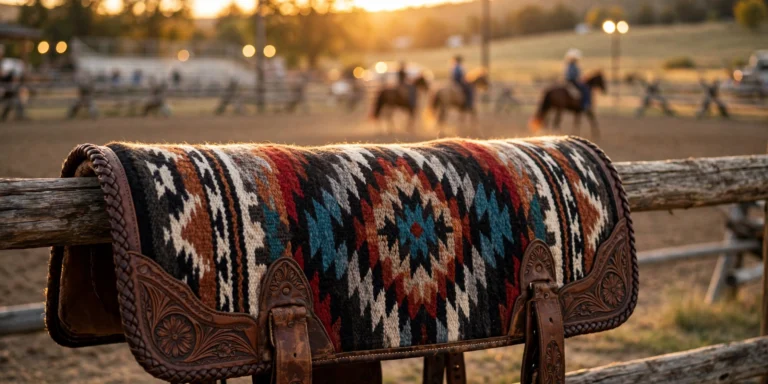
The short version for tack-shop buyers: a show pad is a display piece — patterned wool or wool-blend top, wear leathers, bound edges — built around the widely used 34 x 42 inch footprint. No rulebook dictates pad design; the standard is ring culture, meaning clean, coordinated, and restrained. Stock neutral core colors with depth and seasonal accents with breadth, and order private-label show pads as planned colorway families at our standard 50 pieces per color MOQ.
Western show pads follow an unwritten standard, and it is the ring — not the trend cycle — that sets it. This guide covers how show pads differ from work pads, standard sizing and overlay construction, what show-ring culture actually expects, which colors a tack shop should carry, and how private-label show pads are ordered. For the design process behind custom western pads — patterns, tooling, beadwork, colorways — see our western design guide; this article is about show standards and retail buying.
Key takeaways
- Show pads are display pieces: patterned wool tops, wear leathers, and bound edges over a fitted base; work pads are wash-and-go tools built for daily training.
- The widely used show pad size is 34 x 42 inches — the common stock size across the trade — with size tolerance ± 1 cm written into your factory spec.
- No rulebook dictates pad design; the standard is ring culture — coordinated, restrained, and matched to the horse — and overdressing is the classic expensive mistake.
- Anchor stock on neutral core colors with depth, add seasonal accents with breadth, and treat the lineup as a starting hypothesis to adjust by your own sell-through.
- Private-label show pads follow the standard custom order path at 50 pieces per color MOQ, with extra attention to wear-leather tooling and binding color.
What is the difference between a show pad and a work pad?
A show pad is a display piece built for the rail — a patterned wool top with wear leathers and bound edges, meant to be seen. A work pad is a tool built for daily training — simpler, tougher, and priced to be replaced. They share a job (protecting the horse’s back) but differ in almost everything else.
| Feature | Show pad | Work pad |
|---|---|---|
| Top | Patterned wool or wool-blend top, often with an overlay panel | Plain canvas, felt, or quilted cotton |
| Wear leathers | Tooled or plain leather wear guards at the corners and front | Usually none, or minimal synthetic guards |
| Fill | Thinner profile for a crisp look; often layered felt | Thicker cushioning for daily shock absorption |
| Binding | Contrasting bound edges, a visible design element | Functional binding, matched or neutral |
| Care | Kept clean and rested between shows; spot-cleaned | Washed often, ridden daily |
| Price position | Premium — it is part of the show outfit | Value — it is barn equipment |
The buying point: customers need both, but for different reasons and at different price tolerances. A rider will spend far more on the pad the judge sees than on the one the barn washes. Stock them as separate categories.
Construction-wise, show pads are usually thinner and more tailored than work pads — a crisp 34 x 42 inch rectangle with a contoured spine that lies flat under the saddle. Thickness is for the work pad; the show pad’s job is a clean line. But the fill still matters: a show pad that wrinkles under the saddle looks worse than a plain one that lies flat.
What size and construction should a proper show pad have?
The widely used show pad size is 34 x 42 inches — along the spine by across. Most show-pad makers quote this as their standard stock size, so it is the safest default to buy and stock to: it is what customers expect and what keeps your inventory comparable with the rest of the market.
Overlay construction is the show pad’s signature build: a decorative wool or wool-blend top panel — the overlay — over a fitted base, with leather wear guards at the corners and front edge and a bound edge all around. The guards take the abrasion that would shred a wool top; tooled or plain, they frame the pad. A single-layer printed pad is not the same product — price accordingly.
A few construction details buyers should check on samples:
- Spine contour. A shaped or cutback spine so the pad sits into the back without bridging — a flat rectangle that tents over the withers is a fit problem in show clothes.
- Wear-leather attachment. Corners and front guards should be riveted or bartacked through the base, not glued — glue is the attachment most likely to fail in heat and at the first wash.
- Binding. The bound edge is a visible design line — check batch-to-batch color consistency, since customers match it to their outfits, and put the reference on the tech sheet. Our tech sheet guide covers binding stitch density and tolerances alongside the color reference.
- Size tolerance. ± 1 cm on finished dimensions is a realistic commercial tolerance for a cut-and-bound pad — write it into the factory spec so 34 x 42 means the same thing to both sides.
Sizes outside 34 x 42 exist — slightly smaller for youth classes, longer drops for riders who like more coverage — but they are variations on the common size. Stock the common size first; add variations only when customers ask by name.
What do show rings actually expect from a pad?
No association rulebook publishes pad design rules — there is no written standard to quote. The standard is ring culture: judges and trainers expect a pad that is clean, coordinated, and restrained, matched to the horse and the rider’s outfit. It is unwritten, but it is enforced — by placings, by trainer advice, and by the quiet consensus of what looks right on the rail. Association equipment rules do exist — for permitted and prohibited tack, with penalties for violations — but they govern tack safety, not pad aesthetics, so always check the current rulebook for the association your customers show under. (Cowgirl Magazine: Equipment Rules for AQHA Showing)
The coordination principle is simple: the pad should complement the horse’s color and the rider’s outfit, not compete with them. Dark horses carry bold patterns; light horses suit softer tones. The pad, shirt, and hat band form one visual unit — a clashing pad reads as carelessness from the judge’s stand.
Restraint is the expensive lesson. The classic mistake — our opening scenario — is over-decoration: rhinestones, metallic threads, and neon colors that photograph well and show badly. Small, deliberate amounts of bling have their place in some classes, but a pad that outshines the horse’s performance is a liability.
Condition matters as much as design. A mid-range pad that is clean, brushed, and rested between shows out-presents a premium pad that is sweat-stained and matted. Sell the care routine with the pad — brush the wool top, air it, rest it flat — and stock the brushes and spot-cleaners alongside.
Which colors should a tack shop stock for show customers?
Anchor show-pad stock on neutral core colors that coordinate with common saddle leather and outfit palettes, then add one or two seasonal accents. The core colors sell year-round; the accents create the reason to visit this season. Treat the lineup below as a starting hypothesis — adjust depth and breadth by your own sell-through, because what moves in a pleasure-horse shop can stall in a ranch-shop’s rack.
A practical starting core lineup, by customer type:
- General mixed tack shop: black-based patterns (the workhorse — coordinates with black and dark-oil tack), chocolate/dark brown-based (the classic western look), and one conservative neutral such as navy or hunter. Keep depth in these three.
- Show-focused shop (pleasure/horsemanship clientele): the same core plus tan/beige-based patterns that brighten light horses — pleasure classes reward the brighter coordination.
- Seasonal accents, all shop types: one or two rotating colorways (burgundy, teal, dusty rose) bought with breadth, not depth — they sell for a season, then rotate. Our seasonal color drops guide covers planning the rotation.
Two stocking rules keep this from becoming dead inventory. Buy depth in the core colors and breadth in the accents — the black-based pad sells every month, the seasonal accent sells for a season. Keep wear-leather and binding colors predictable in the core line, and let the accents experiment with contrast.
Note the sizing-color interaction: because 34 x 42 is the common size, color is the main variable customers choose between. That makes colorway planning — not size planning — the inventory skill for show pads. Our inventory planning guide covers reorder math; apply it here per colorway, with the core colors carrying the highest reorder points.
How does private-label ordering work for show pads?
Private-label show pads follow the standard custom order path — tech pack, strike-off, bulk production — at our standard 50 pieces per color MOQ, with three show-pad-specific details that need extra attention in the brief.
Wear-leather tooling is the cost driver. Plain leather guards are standard; tooled guards add a tooling step with its own cost and approval. Lock the tooling pattern at the strike-off — changes after bulk starts are effectively a new order. Our western design guide covers the tooling tiers in detail.
Binding color needs a physical reference. Binding is a visible design line, and dye-lot variation across the run is the most common cosmetic complaint. Approve a physical swatch — not a screen image — and write it into the tech sheet. See our color fastness guide for what to test before approving that swatch.
Order the full colorway family together. Customers buy show pads as outfit coordination, so a private-label line lands better as a planned family — core neutrals plus the season’s accent — than as single colors trickled out over months. At 50 pieces per color, a four-colorway launch is 200 pads: a sensible first collection. Plan all strike-offs in one sampling round so binding and leather dye lots match across the family.
What specs should I confirm when requesting a quote?
When you send a show-pad line plan — colorway family, wear-leather tooling choice, and binding references — these are the specs to pin down before quoting:
- Size: finished dimensions (commonly 34 x 42 in) with ± 1 cm tolerance; spine contour or cutback shape
- Top: wool or wool-blend, pattern/weave, overlay panel construction; bottom layer material
- Wear leathers: plain vs tooled, tooling pattern reference, rivet/bartack attachment method
- Binding: material, width, color — approved as a physical swatch, dye-lot consistency terms
- Fill: layered felt or thin foam spec, thickness in mm; quilting SPI and bartack counts per the tech sheet
- Packing and labeling: polybag or carry bag, hang-tag/branding spec
Frequently asked questions
Can a work pad be used at a show?
Physically yes, but it reads as unprepared in judged classes. A clean work pad is fine for schooling shows; rated shows expect the overlay show pad. Stock both and let the customer’s calendar decide.
Do different western events want different pads?
Broadly, the 34 x 42 overlay pad serves pleasure, horsemanship, and trail; reining and cutting riders often prefer simpler, darker pads, and ropers prioritize function over display. One well-chosen core line covers most disciplines — do not over-assort by event until customers ask.
How thick should a show pad be?
Thinner than a work pad — the show pad’s job is a crisp line, not maximum cushioning. Most run a layered felt or thin foam base under the wool top: enough to protect the back without bulk. Confirm the target thickness in mm with the factory at the strike-off stage.
How long does a show pad keep its crisp show-ring look?
That depends on care, not a fixed lifespan — this is a qualitative judgment confirmed against your own samples, not a number to quote to customers. With proper rotation — rested flat between shows, brushed after use, spot-cleaned rather than machine-washed — a quality wool-top show pad holds its presentation for several seasons. Daily use, machine washing, and sun-fading shorten that drastically. Sell the care routine with the pad.
Sources & Further Reading
- Cowgirl Magazine — Equipment Rules for AQHA Showing: association equipment rules govern permitted vs prohibited tack (with penalties) — the reference for why buyers should check the current rulebook, even though pad design itself is unwritten ring culture.
- Western saddle pad design guide (private label) — patterns, tooling tiers, beadwork, colorways.
- Saddle pad tech sheet guide — SPI, foam density, tolerances for the spec sheet.
- Saddle pad inventory planning for tack shops — reorder math per colorway.
- Saddle pad color fastness guide — testing binding and top colors before approval.
- Seasonal color drops guide — planning accent rotations.
Send us your show-pad line plan — colorway family, wear-leather tooling choice, and binding references — and we will quote private-label western show pads at our standard 50 pieces per color MOQ, with strike-offs timed to your pre-season buying calendar.
