
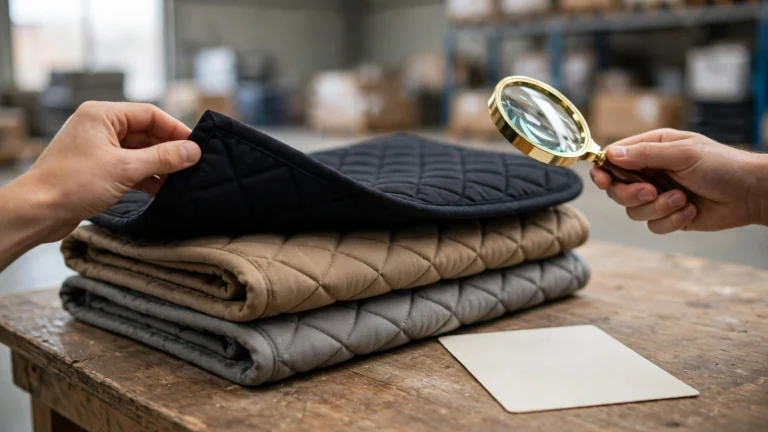
How Tack Shops Handle Saddle Pad Returns and Warranty Claims: A Dealer Process Guide
Published · Cornovo Saddlery
Tack shops handle saddle pad returns and warranty claims by sorting each return into one of three paths at the counter: a supplier warranty claim for manufacturing defects, a store-policy return for fit and preference issues, or a transit claim for shipping damage. Only documented defect claims with photos and batch codes go upstream to the distributor; everything else is resolved on the spot with an exchange, credit, or replacement sale.
Consider a common scenario: a shop sells through a spring run of quilted dressage pads and starts getting returns. Some have burst stitching along the binding, some bled dye in the first wash, and several are fit returns — riders who guessed the wrong shape and blamed the pad. The pads aren’t always the whole problem; often the saddle pad warranty claims process is. Defects and wear, warranty cases and fit complaints, factory issues and counter mistakes all go into one bucket, and the bucket leaks margin.
This guide separates those buckets: what counts as a claim, how to document one so the distributor can act on it, when the supplier should pay, and when a defect pattern means the real problem is upstream at the factory.
Key takeaways
- A saddle pad warranty claim covers manufacturing defects — burst seams, binding failure, color bleeding, premature fill collapse — not wrong sizes, rider misuse, or normal wear.
- Document every claim the same way: purchase date, failure photos, the batch code from the inner tag, and the customer’s use and wash history.
- Fit complaints and buyer’s remorse are store-policy returns, not supplier claims — settling them at the counter protects both your margin and your supplier relationship.
- Ask your distributor for a simple RMA routine: one intake form, one photo set, clear credit-versus-replacement rules, and a committed response time.
- Track claims by batch code: one failure is customer service, a repeated failure across a batch is factory QC data.
- Build the returns SOP before the season starts, so staff resolve claims by a written rule instead of negotiating case by case.
What is a saddle pad warranty claim?
A saddle pad warranty claim is a request to the supplier for credit, replacement, or repair of a pad that failed because of how it was made — not how it was used. Typical coverage runs one riding season, roughly 6 to 12 months from purchase, with the exact window and exclusions written into the dealer agreement rather than printed on the hang tag.
A warranty is the supplier standing behind their manufacturing; your store policy is you standing behind the sale. Mixing the two is how shops end up absorbing factory defects — or, in the opposite direction, billing the factory for a rider’s sizing mistake. Keeping them separate from day one is the foundation of every saddle pad warranty claims process that works.
How do you tell a manufacturing defect from normal wear?
The direct answer: a defect shows up early and looks like the factory’s fault, while normal wear shows up late and looks like the barn’s fault. Burst stitching, delaminating binding, dye that bleeds in the first washes, fill that clumps or foam that collapses within weeks of normal use — those are defects. Faded color after a season of sun and washing, fill that compresses after months of daily use, stirrup-leather scuffs, the general grime of barn life — that is wear.
The gray zone is fit-related stress: a pad yanked tight under an ill-fitting saddle can tear at the stress points faster, but the root cause is the fit, not the stitching. That’s why intake asks about use, washing, and storage. A pad ridden daily for a full season with collapsed foam is not a claim; the same pad collapsing within weeks of purchase deserves investigation. (For the defect side of this judgment, the checks in our pre-shipment QC checklist describe what factory-side defects look like before goods ever reach your floor.)
Train counter staff on one rule of thumb: if the rider is genuinely surprised it failed this soon, investigate it as a possible defect. If the rider admits it had a hard life, it’s a replacement sale, not a claim. Most saddle pad warranty claims live or die on that thirty-second judgment.
Why do saddle pads get returned — and which path does each reason take?
Most pad returns fall into eight buckets across three paths — supplier warranty claim, store-policy return, or transit claim. Sorting them correctly at the counter is where the money is saved; only a few of the rows below generate genuine saddle pad warranty claims.
| Return reason | Defect? | Typical resolution path |
|---|---|---|
| Burst or broken stitching, binding separating | Yes — warranty | Photograph the failure, tag with the batch code, submit an RMA to the distributor; credit or replacement |
| Color bleeding or crocking in the first washes | Yes — warranty | Document the wash conditions; claim against the batch, since dye lots tend to fail together |
| Fill clumping or foam collapsing within weeks | Yes — warranty | Claim; check whether other colors from the same batch behave the same way |
| Wrong size or shape chosen by the rider | No | Store-policy exchange; turn it into a fitting consultation, not a supplier claim |
| Doesn’t fit my saddle with no defect present | No | Fit guidance at the counter; suggest a corrective half pad or a different shape — an upsell, not a claim |
| Changed mind, color didn’t match the set | No | Store credit per your posted policy; keep the pad resalable |
| Faded, compressed, or worn after heavy use | No | Care advice and a replacement sale at full margin |
| Arrived damaged in shipping | Transit damage | Photo of carton plus product; reship or replace, then file with the carrier or shipper |
Notice how few rows touch the supplier. In most shops, the majority of returns are fit, sizing, or wear issues that the counter can resolve in a few minutes — no RMA, no waiting, no margin lost to a process that was never needed. The table above describes typical paths from dealer experience, not a warranty promise: your dealer agreement sets the actual terms.
How should a tack shop run saddle pad warranty claims?
Run every saddle pad warranty claim the same way: one intake form, one photo set, one decision rule. Consistency is what makes claims fast, and speed is what keeps the rider.
- Take the claim at the counter, not over the phone. Ask for the purchase date, use frequency, wash routine, and what the rider noticed first. Log the answers — use history separates defect from wear.
- Photograph the evidence before anything is cleaned or repaired. Four photos in two minutes: full pad, failure close-up, care label, batch code. A claim without a batch code is nearly impossible for a distributor to act on.
- Tag and quarantine the pad. A simple claim-number tag keeps returned pads from being resold, thrown away, or mixed back into stock — any of which kills the claim and the evidence with it.
- Check coverage before you promise anything. Is it inside the warranty window? Is there proof of purchase? Is the failure actually a defect? If any answer is no, it’s a store-policy decision, not a supplier claim — say so kindly and move on.
- Submit the RMA in one thread. Send the intake form, photos, batch code, and your ask — credit, replacement, or repair — in one message to your distributor. Scattered emails across three weeks are how claims die.
- Apply a credit-versus-replacement rule you set in advance. Replacement keeps the rider on your brand and works when the SKU is in stock; credit works when the colorway is discontinued or the season has moved on. Decide the rule before the season, not in the argument.
- Log every claim by SKU, batch, and month. The log turns isolated complaints into the pattern data your supplier can act on — the subject of the next section.
Set a written service standard — for example, acknowledge every claim within 48 hours and resolve it within two weeks, telling the rider both timeframes up front. These numbers are starting assumptions to calibrate against your own sales and service data, not industry rules; most anger about returns comes from silence, not from the outcome.
When should defect patterns go back to the factory?
When the same failure repeats across a batch — not when one rider is unhappy. A single claim is a customer-service event. A handful of the same failure from the same batch code within a short window is a QC signal, and it’s the most valuable thing a dealer can send a factory.
This is why the batch code on the intake form matters so much. Without it, you have anecdotes. With it, you have a report: SKU, batch code, units sold from that batch, number of failures, failure mode, and photos. Well-documented saddle pad warranty claims are what make a distributor take a pattern report seriously — and they give the factory the batch data it needs to act. Ask your supplier up front whether their packing keeps batch codes traceable; the packing guidance in our wholesale packaging guide covers what batch-level traceability looks like in practice.
Send pattern reports inside the season, while the factory can still adjust — and say what you want: replacement units, a spec change, or a discount covering your handling costs. Factories respond better to a concrete ask than to a complaint.
One practical note on corrective runs: if a defect means re-producing a colorway, the factory’s standard minimums still apply — 50 pieces per color on standard private-label programs. Smaller shops usually consolidate a fix through their distributor rather than placing a corrective run alone, which is another reason the distributor relationship matters more than the unit price.
Requesting a quote: specs to confirm
Before you place a pad program order, confirm the warranty and claims machinery in writing — it is as much a part of the product spec as the quilting pattern. Use this checklist with any supplier, and don’t treat verbal assurances as terms:
- Warranty term length and start point (purchase date vs ship date)
- Which failure modes are covered (seam failure, binding separation, color bleeding, fill collapse) and which exclusions apply (misuse, alterations, commercial rental use)
- Claim response time commitment from the distributor
- Credit-versus-replacement policy for claimed units
- Batch-code traceability: how batch codes are assigned, where they appear on product and carton, and how long records are kept
- Photo documentation standard required before a claim is accepted
- Minimum order for a corrective re-run of a failed colorway (50 pieces per color is standard on private-label programs)
- Whether care and washing guidance is supplied for resale — mis-washing is a common cause of disputed claims (see our wash-care handout)
Frequently asked questions
How long should a saddle pad warranty last?
Typically 6 to 12 months from purchase against manufacturing defects — roughly one riding season — written into the dealer agreement. Wear, fading, and misuse damage sit outside it. A supplier who won’t put a warranty term in writing is telling you something.
Should we replace a claimed pad or issue a credit?
Replace when the SKU is in stock and the colorway is current — it keeps the rider on your brand. Issue credit when the color is discontinued, the season has moved on, or the rider has lost confidence in that model. Set the rule before the season so staff don’t negotiate it case by case.
What documentation does a distributor need for an RMA?
Four things: proof of purchase, photos of the full pad and the failure, the batch code from the inner tag, and a note on use and wash history. The batch code is the piece most shops forget — and the one distributors need most.
Do fit complaints count as warranty claims?
No — unless a manufacturing defect caused the fit problem, such as a pad cut asymmetrically. Doesn’t suit my saddle is a fitting issue for the counter, not the factory. Handle it with fit guidance and, where appropriate, an upsell to a corrective half pad or a different shape. Sending fit complaints upstream burns credibility you’ll need when a real defect pattern appears.
How many returns make a pattern worth reporting to the factory?
As a starting assumption: two or three claims with the same failure mode from one batch code — or a failure rate clearly above your normal pad return rate — is worth an early report. Report it inside the season with consolidated data (SKU, batch, units sold, failures, photos) and a concrete ask. Early reports can still change the next production run; calibrate the threshold against your own sales data.
Sources & Further Reading
These saddle pad warranty claims practices come from dealer-side experience rather than a published standard — warranty terms live in dealer agreements, which is why the article keeps pointing you back to getting terms in writing. For the operational details referenced above:
- Pre-Shipment Saddle Pad Quality Control Checklist — the factory-side defect checks that feed into claim intake
- Saddle Pad Binding and Edge Finishing: What Wholesale Buyers Should Check — binding failure modes to photograph at claim intake
- How to Wash Saddle Pads: A Care Handout Retailers Can Give Customers — care guidance that reduces disputed claims
A clean returns process protects margin twice: it stops the shop absorbing factory defects, and it turns real defect data into leverage for better product. If you’re evaluating pad suppliers on more than unit price — how they handle saddle pad warranty claims, RMA responsiveness, batch traceability, and how fast defect feedback reaches the factory floor — send your target specs and quantities for a quotation.
