
How to Wash Saddle Pads: A Care Handout Retailers Can Give Customers
Published · Cornovo Saddlery
Consider a common scenario: a tack shop replaces several faulty dressage pads in a single month. They all come back with the same complaint: the fill has bunched into lumps and the pads no longer sit flat. None of the pads is defective. All of them were machine-washed hot and tumble-dried on high — a combination that destroys fiberfill in one cycle.
Those returns cost the shop the wholesale price several times over, plus the staff time. And they were preventable with a care card that costs a few cents to print.
Knowing how to wash saddle pads properly is one of the cheapest returns-prevention tools a retailer has — and most customers were never taught it. This guide gives you the full routine — written so you can hand it straight to customers, print it as a shelf card, or pack it with every pad you sell.
Key takeaways
- Most quilted saddle pads wash safely in cold water (30°C / 86°F) on a gentle cycle — always check the care label first.
- Never tumble-dry a saddle pad; hang it to dry away from direct heat and strong sun.
- Brush or shake off dried sweat and horse hair before washing, and fasten all Velcro straps closed.
- Wool-felt pads need gentler handling than synthetic pads: cold water, minimal agitation, no dryer, no wringing.
- A printed care card in the package prevents most defective pad returns — which are usually wash-damage returns.
What does machine washable mean on a saddle pad care label?
Machine washable on a saddle pad care label means the pad can go through a domestic washing machine without damage — but only under the conditions printed next to it, typically cold water, gentle cycle, and mild detergent. It does not mean any temperature, any cycle, or the dryer. When the label and the customer’s habit disagree, the label wins and the warranty usually says so.
How to wash saddle pads: what is the safest routine?
This routine for how to wash saddle pads covers the large majority of quilted cotton and polyester pads. Wool-felt pads need the gentler variant noted below.
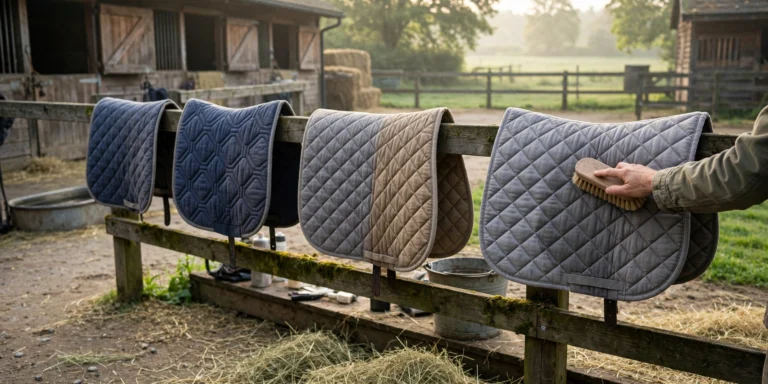
- Remove hair and dried sweat first. Brush the pad with a stiff body brush or rubber curry comb, underside especially. Hair left on the pad felts into the quilting in the wash.
- Close all Velcro and fasten straps. Open hook-and-loop strips grab the pad’s own fabric and pill it; loose straps tangle and stress their anchor stitching.
- Load the machine loosely. Wash the pad alone or with one other pad at most. An overstuffed drum can’t rinse properly and creases the quilting.
- Use cold water, gentle cycle, mild detergent. Cold means 30°C (86°F) or below. Use a mild liquid detergent — no bleach, no fabric softener.
- Skip the high spin. A moderate spin is fine for synthetics; for wool, choose the lowest spin or none and press water out by hand.
- Reshape while damp. Lay the pad flat, smooth the quilting with your hands, and straighten the binding before hanging.
- Hang dry in shade with airflow. Drape over a rail or fence — never on a direct heat source, never in the tumble dryer.
What ruins a saddle pad in the wash?
Almost every wash-damaged pad failed on one of these points:
| Mistake | What happens |
|---|---|
| Hot water (40°C+) | Shrinks cotton shells, felts wool tighter, can set stains permanently |
| Tumble dryer | Clumps fiberfill into lumps, melts or deforms foam inserts, shrinks binding |
| Bleach | Weakens cotton fibers, yellows white pads over time, damages colored binding |
| Fabric softener | Coats fibers and kills moisture-wicking performance; buildup attracts dirt |
| Washing with Velcro open | Hook side chews the pad’s own fabric and any other laundry in the drum |
| Wringing a wool pad | Stretches and distorts felt that will never fully recover its shape |
How should saddle pads be dried?
Hang the pad over a clean rail, fence, or purpose-made pad rack so air reaches both sides. Drying flat on a rack works too and is kindest to heavy wool pads, which can stretch under their own wet weight on a narrow line. Keep pads out of direct midday sun — UV fades colors and degrades elastic and Velcro over time — and away from radiators, heaters, and heated tack-room dryers.
A pad is dry when the quilting feels uniformly light and the binding is no longer cool to the touch. In humid weather that can take a full day; plan the wash so the pad isn’t needed the next morning. Riders who learn how to wash saddle pads the right way — and dry them the right way — get noticeably more seasons out of each pad, which is exactly the story that brings them back to your store for the next one.
Does care differ for wool vs synthetic pads?
Yes — this is the distinction worth printing in bold on any handout:
| Care step | Wool / wool felt pads | Synthetic pads |
|---|---|---|
| Water temperature | Cold only (30°C max) | Cold to warm (30–40°C) |
| Cycle | Gentle / wool cycle, minimal agitation | Gentle or normal |
| Detergent | Wool-safe or mild detergent, no enzymes | Mild detergent |
| Spin | Low or none; press water out by hand | Normal spin is fine |
| Drying | Flat or hung in shade, reshape carefully | Hung in shade; still no tumble dryer |
| Frequency | Wash less often; air and brush between rides | Tolerates frequent washing |
The rule of thumb for customers: wool pads get brushed and aired after most rides and washed only when truly dirty; synthetic schooling pads can go through the machine weekly without complaint. Our western vs English guide notes which disciplines tend to buy which fill — match the care advice to the pad you sold.
How can retailers turn this into fewer returns?
Make the care routine impossible to miss. Tuck a printed care card into every pad’s packaging — one side with the 7-step wash routine, the other with the never do this list. Put the same steps on a small shelf talker next to your pad display. Customers researching how to wash saddle pads online will find your store’s advice useful long before they buy, which is free marketing. And train staff to mention washing at the register: Cold wash, hang dry, and it’ll last you years takes ten seconds and heads off the most common misuse.
When a customer does bring back a defective pad, check the care history before reaching for a replacement. Clumped fill with a scorched-dryer smell, or a wool pad washed hot, is wash damage — and explaining that kindly, with the care card in hand, protects your margin without losing the customer.
Requesting a quote: specs to confirm
If you private-label pads, the care story is part of the product spec. Confirm with your factory:
- Care label wording matched to the actual fill and shell — and translated correctly
- Whether custom care cards or hang tags are included in the packaging
- Wash-testing behind any machine washable claim on the label
- Binding and Velcro specifications that survive the recommended wash routine
Frequently asked questions
How often should a saddle pad be washed?
It depends on use. A daily schooling pad in regular work does well with a wash every one to two weeks; brush off hair and sweat after each ride in between. Show pads may only need washing a few times a season. Wool pads last longest when washed least — airing and brushing between rides keeps them fresh without the wear of the machine.
Can you pressure-wash a saddle pad?
It gets the mud off, but it also drives water deep into the fill, can tear quilting stitches at close range, and leaves the pad soaked to the core — which then takes days to dry and can mildew. A stiff brush and a normal wash do the job with far less risk. Save the pressure washer for the horse trailer.
Why does the fill bunch up after washing?
Usually heat: hot water or the tumble dryer breaks down the binders in polyester fiberfill and lets the batting migrate and clump inside the quilting. Poorly quilted pads — wide-spaced stitch lines with nothing anchoring the fill — bunch faster. Cold wash, gentle cycle, and no dryer keep the fill where the factory put it. See how saddle pads are made for what proper quilting looks like.
Can white show pads be bleached?
No — chlorine bleach weakens cotton fibers and can yellow whites over time. For dingy white pads, soak in cold water with an oxygen-based stain remover before a normal cold wash, and dry in indirect daylight, which naturally brightens whites. Prevention beats cure: a white pad used only for shows stays white far longer.
Sources & Further Reading
- How Saddle Pads Are Made: Materials and Construction Guide — quilting, binding, and fill construction behind the care rules
- Saddle Pad Thickness and Fill Guide: Wool Felt vs Foam vs Gel — which fills tolerate which wash routines
- How OEM Saddle Pad Programs Work — adding custom care cards and hang tags to your order
Want this routine as a printed care card with your own branding? We pack custom care cards, hang tags, and private-label packaging with every wholesale saddle pad order — western, dressage, half pads, and cinches at a standard MOQ of 50 pieces per color. Send your specs and quantity for a quotation.
