
Western vs English Saddle Pads: What's the Difference?
Published · Cornovo Saddlery
Consider a common scenario: a distributor orders a full container of saddle pads from a new factory — one shape, one size, one thickness. Half the cartons turn out to be western pads, and his customers are English tack shops. The pads are fine quality. They are simply the wrong product for his buyers, and moving them takes two seasons of discounting.
The western vs English saddle pads question looks basic, but it decides your whole assortment: which shapes to stock, which thicknesses your customers expect, and which factories can actually make both well. Get it right and each discipline’s riders find what they need; get it wrong and you’re sitting on stock that fits nobody’s saddle.
Key takeaways
- Western pads are large, thick (commonly 3/4 to 1 inch), and often wool felt; English pads are smaller, thinner quilted pads shaped to the saddle’s panels.
- Shape is the hard constraint: a western pad won’t fit under an English saddle, and an English pad won’t cover a western saddle’s bars.
- Western pads attach with the saddle’s own weight and cinch; English pads use billet straps, girth straps, and keepers.
- Dressage, jumping, and all-purpose pads are all English-family shapes with different flap coverage — stock them as separate SKUs.
- For wholesale, confirm the factory makes your discipline’s shape on proper dies; a one-shape-fits-all supplier is a red flag.
What is the difference between western and English saddle pads?
Western and English saddle pads differ in shape, size, thickness, and material because the saddles they sit under are fundamentally different. Western pads are large rectangles or contoured blankets of thick felt that spread the weight of a heavy stock saddle; English pads are smaller, thinner quilted pads cut to follow the close-contact shape of an English saddle.
Western vs English saddle pads: how do shape and size differ?
Western pads are large rectangles — typically 30 by 30 inches or bigger — cushioning a heavy western saddle’s wide bars. English pads are smaller and shaped to the saddle: square or contoured, with flap profiles mirroring the saddle type. Size follows the saddle, not the horse — stock pads by the saddles your customers ride.
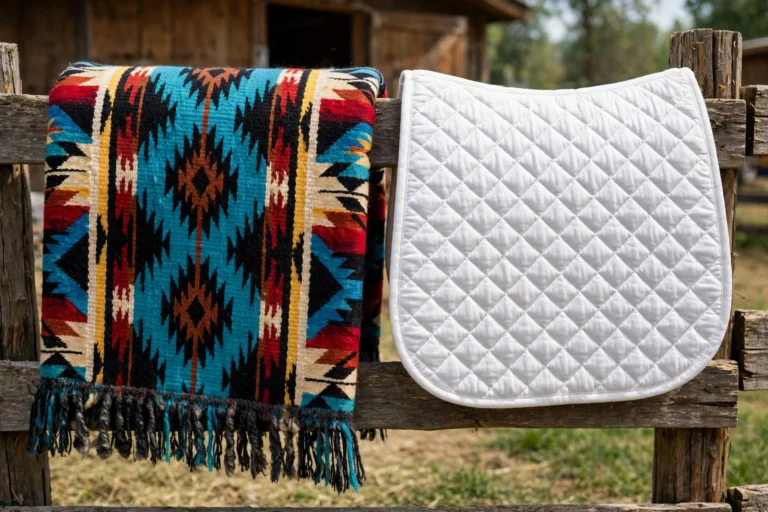
Western pads are big. A standard western pad measures roughly 32 x 32 inches to 34 x 38 inches, built to extend past the saddle’s skirts on all sides. The classic shape is a rectangle with a contoured top line that follows the horse’s back, sometimes with a wither cut-out. Thickness is the point: these pads carry real weight.
English pads are cut to the saddle. Dressage pads are long and straight to match long, straight dressage flaps; jumping and all-purpose pads are shorter with a forward-cut shape for the rider’s knee. A typical dressage pad runs about 24–26 inches along the spine, far smaller than any western pad. The pad should mirror the saddle’s panels with roughly 1–2 inches showing around the edges. If you need exact numbers, our saddle pad sizing guide with measurement chart covers every discipline.
| Feature | Western saddle pads | English saddle pads |
|---|---|---|
| Typical size | 32 x 32 in to 34 x 38 in | Spine length ~22–26 in, shaped to flap |
| Typical thickness | 3/4 in to 1 in (felt) | Thin quilted, often under 1/2 in |
| Core material | Wool felt, often with foam or gel layers | Quilted cotton/poly with foam or batting fill |
| Shape family | Rectangle, contoured western cut | Dressage, all-purpose, jumping, half pad |
| Attachment | Cinch pressure and saddle weight | Billet straps, girth straps, keepers |
| Wither treatment | Contoured or cut-back top line | Raised wither profile, shaped spine |
That table is the core of the western vs English saddle pads decision: everything downstream — materials, thickness, attachment — follows from the saddle each pad is built for.
Which materials are typical for each style?
Wool felt dominates the western side because it cushions, wicks sweat, and conforms under long saddle bars, while quilted cotton, polyester, and nylon dominate the English side for their lighter weight and cleaner look. Felt vs quilted textile is the material split to remember when you brief factories — it decides which machines and skills the factory actually needs.
Western pads lean on wool felt because felt does three jobs at once: it cushions, wicks sweat, and conforms to the horse’s back under the long bars of a western saddle. Most wholesale western pads use a felt body — commonly blended wool — with wear leathers on the spine and edges, and many add a foam or gel insert in the middle for extra shock absorption. Show pads may carry decorative tops: woven blankets, tooled leather overlays, or embroidered panels. Our western saddle pad design guide covers patterns, tooling, and colorways for private-label buyers.
English pads are quilted textiles. The standard wholesale construction is a cotton or polyester top, a foam or polyester-batting fill, and a moisture-wicking bottom, stitched in a diamond or square quilting pattern. Dressage pads often get a more formal look — piped edges, subtle quilting, sometimes a discreet embroidered monogram — while jumping pads may use grippier bottom fabrics. Half pads, which sit on top of a regular pad, commonly use sheepskin, wool fleece, or memory foam; see our half pads vs full saddle pads comparison if you stock both.
Can you use a western pad under an English saddle?
No — and selling one for that job invites returns. A western pad’s size and thickness bunch under an English saddle’s narrower panels, creating pressure points instead of relieving them. The reverse is equally bad: an English pad under a western saddle leaves the bars’ edges digging into the horse’s back.
The practical rule for your staff and your product pages: match the pad family to the saddle family, then match the size to the seat. A customer with a 17.5-inch dressage saddle needs a dressage-cut pad sized for it — not a large from a different discipline.
How do western and English pads attach to the saddle?
Western pads mostly stay put by friction and the cinch — many have no straps at all, or simple wear-leather keepers. English pads attach with purpose-built straps: billet straps, girth loops, and often front Velcro or D-ring tabs. Check strap placement and stitching on samples, because a strap that tears out mid-season is the most common English pad complaint.
What about dressage vs jumping vs all-purpose pads?
Dressage, jumping, and all-purpose pads differ in flap shape and length to match their saddles. Dressage pads run long and straight for the rider’s long leg; jumping pads are forward-cut with a shorter drop for shorter stirrups; all-purpose pads split the difference. Stock all three for English riders — each discipline buys the pad cut for its saddle.
The FEI (Fédération Équestre Internationale) governs the international English disciplines — dressage, jumping, and eventing — and its rulebooks are the definitive reference for what each discipline’s equipment must do.
What should a retailer stock for each discipline?
Stock by the saddles your customers ride: western shops need thick rectangular pads in standard western sizes; English shops need dressage, jumping, and all-purpose pads in the common flap cuts, plus half pads as the add-on sale. Carry core colors first — white and black for dressage — and add fashion colors once the basics turn reliably.
One more buying tip: ask factories which discipline they specialize in. A factory set up for quilted English pads may outsource its felt western pads, and the quality gap shows. The best wholesale partners are honest about what they make in-house. For quilted pads, ask which ASTM test methods the factory uses for colorfastness and seam strength — a supplier that can name its test methods is usually one that actually runs them.
Frequently asked questions
What’s the main difference between western and English saddle pads?
Size, shape, and thickness. Western pads are large (around 32 x 32 inches and up), thick felt pads built for heavy stock saddles; English pads are smaller, thinner quilted pads cut to follow an English saddle’s panels and flaps. They are not interchangeable between saddle types.
Are western saddle pads thicker than English pads?
Yes, substantially. Western felt pads commonly run 3/4 inch to 1 inch thick to distribute the weight of a western saddle, while quilted English pads are usually well under half an inch. The thickness difference is functional, not decorative — each matches its saddle’s weight and fit.
Can I use a dressage pad for jumping?
It will fit under the saddle, but the long straight cut of a dressage pad looks wrong and can interfere with a forward jumping flap. Riders notice. If shelf space is tight, stock an all-purpose cut as the crossover SKU rather than asking a dressage pad to do double duty.
Do western saddle pads need straps?
Most don’t. The weight of the western saddle plus cinch pressure holds the pad in place, which is why many western pads ship with no attachment straps at all. English pads, being lighter and thinner, rely on billet straps, girth straps, or keepers to stay put.
Which type sells better for a new tack shop?
That depends entirely on your local riding community — a hunter/jumper barn area buys English pads, ranch country buys western. Before your first order, count the disciplines in your customer base, then build the assortment around the majority. You can add the minority discipline’s core SKUs once the main line is moving.
Sources & Further Reading
- FEI – Fédération Équestre Internationale — The international governing body for equestrian sport; definitive reference for dressage, jumping, and eventing discipline rules and equipment requirements.
- ASTM — Fashioning Standards for Textiles (Committee D13) — Standard test methods for textile properties (colorfastness, abrasion, dimensional stability) used to verify saddle pad quality claims.
- ISO 2859-1 — Sampling procedures for inspection by attributes; the standard behind AQL plans referenced in wholesale QC programs.
Getting the western vs English saddle pads choice right starts with knowing exactly where one family ends and the other begins. Tell us which disciplines your customers ride and the sizes that move fastest, and we’ll put together a wholesale assortment — standard or OEM with your own colors and embroidery — sized to your shelves, not to a generic catalog.
