How Saddle Pads Are Made: Materials and Construction Guide for Retailers
Published · Cornovo Saddlery
Consider a common scenario: a tack shop owner lays two saddle pads side by side on her counter. Both are black quilted dressage pads, both priced within a few dollars of each other at wholesale. One has lasted her customers three seasons. The other comes back with burst quilting and a lumpy fill after two months. The difference isn’t the price — it’s everything happening inside the factory that she never got to see.
If you buy saddle pads for resale, understanding how saddle pads are made is the fastest way to stop guessing between suppliers. Construction decides how long a pad lasts, how it washes, and whether your customers come back for a second one. This guide walks through the full process, the materials that matter, and the questions that separate a reliable factory from a risky one.
Key takeaways
- A saddle pad is a sandwich: top fabric, cushioning fill, moisture-handling bottom layer, and binding that holds the edges together.
- Quilted English pads are cut, layered, machine-quilted, bound, and trimmed with straps; western felt pads are pressed or needled from fiber, then cut and finished with wear leathers.
- The fill decides performance: wool felt wicks and conforms, EVA or polyurethane foam adds even cushioning, and gel inserts target pressure relief.
- Stitch density, fill weight per square meter, and wash testing are the three QC numbers worth asking any supplier about.
- A wholesale saddle pad factory should offer OEM options — custom colors, embroidery, and private labels — at workable MOQs such as 50 pieces per color.
What is a saddle pad, exactly?
A saddle pad is a shaped textile layer placed between the horse’s back and the saddle. It cushions pressure, absorbs sweat, keeps the saddle from slipping, and protects both the horse’s skin and the saddle’s underside. Pads come in discipline-specific shapes — western, dressage, all-purpose, and half pads — and each shape follows its own construction method.
What materials go into a saddle pad?
Almost every saddle pad is built from four layers: a top fabric shell, a cushioning fill, a moisture-handling bottom layer, and binding tape that seals the edges. The exact fabrics change by discipline and price point, but the sandwich stays the same — learn the four layers and you can read any factory’s spec sheet. The choices per layer are:
Top fabric. This is the visible outer shell. Common choices are cotton twill or canvas, polyester, and quilted nylons. Cotton breathes well and takes embroidery cleanly; polyester and nylon resist abrasion and hold color through repeated washing. Our saddle pad face fabrics comparison breaks down cotton twill, poly-cotton, bamboo, and mesh side by side. Many factories offer both, because tack shops in different markets ask for different looks.
Fill. The middle layer does the cushioning work. Wool felt, polyester batting, EVA foam, polyurethane foam, memory foam, and gel inserts all appear here. Fills are often combined — a foam core with a felt layer on top is a common wholesale construction — so ask suppliers to name every layer, not just the headline material. See our wool felt vs foam vs gel insert comparison for how each fill behaves under a rider’s weight.
Bottom layer. The side against the horse needs to manage moisture. Brushed cotton, bamboo-blend fabrics, and moisture-wicking mesh are typical. Some pads use a sheepskin or faux-fur panel along the spine or the whole underside for extra comfort.
Binding, trim, and hardware. Binding tape (usually polyester or cotton) seals the raw edges. Wear leathers — suede or synthetic patches — reinforce the girth area on English pads. Straps with hook-and-loop or billet keepers attach the pad to the saddle. On western pads, contoured top lines and decorative wear leathers are part of the same finishing step.
How saddle pads are made: the factory process, step by step
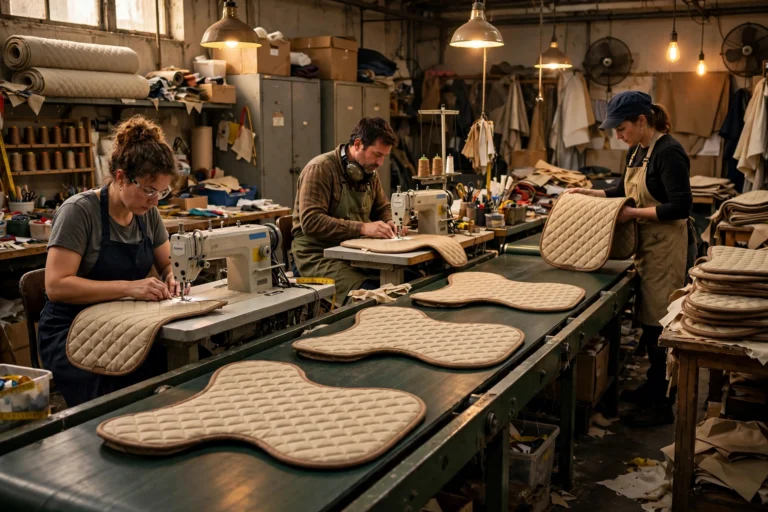
A saddle pad is built in six factory steps: cutting the face fabric and lining, quilting them together with the fill, binding the edges, adding straps and billet keepers, pressing and trimming, then final inspection and packing. Quilting matters most — stitch density and pattern decide whether the pad holds its shape or goes lumpy after a season.
- Fabric inspection and cutting. Rolls of top fabric, fill, and lining are checked for flaws, then cut in stacked layers with a die or a CNC cutter. Cutting all layers at once keeps the finished pad’s shape consistent across the production run.
- Layering. The cut pieces are stacked in order: top fabric, fill, bottom layer. Getting this stack flat and even is what prevents lumps in the finished pad.
- Quilting. An industrial quilting machine stitches the layers together in a diamond or square pattern. In our experience, decent wholesale pads commonly run 8–10 stitches per inch — fewer stitches can let the fill shift; many more add cost without much benefit. Our guide to reading stitch and foam density specs shows how to verify these numbers on a tech sheet.
- Binding. Binding tape is sewn around the full perimeter, sealing the raw edges and giving the pad its finished outline. This is a skilled step: wavy or puckered binding is one of the first quality complaints buyers raise.
- Trims and straps. Wear leathers, girth straps, billet keepers, and any decorative piping or cord go on next. Embroidery, when ordered, is usually applied before or during this stage on flat panels.
- Pressing and shaping. Pads are pressed or steamed to set the shape, especially contoured designs with a raised wither area.
- QC and packing. Each pad is checked for stitch breaks, fill lumps, binding flaws, and correct labeling, then folded and packed. Packing is by inquiry on most B2B orders — polybag, hang tag, or retail box depending on what the buyer needs.
How does western saddle pad construction differ?
Western pads are built thicker and tougher than English pads: a dense wool-felt or foam core for pressure distribution, a durable top fabric that resists ranch abrasion, and wear leathers at stress points. They use flat, even thickness instead of contoured quilting — a western saddle’s larger footprint needs uniform cushioning, not shaped lift.
Finishing is where western pads get their character: wear leathers along the spine and edges, decorative top fabrics or tooled leather overlays on show pads, and contoured wither relief cut into the felt. Because the pad is thicker and stiffer, the cutting dies and the edge finishing matter more than the stitch pattern does. When you compare suppliers, ask how the felt is made (needled vs. pressed), what the wool content is, and whether the density is consistent across the pad. Understanding how saddle pads are made across both the quilted and felt families lets you compare quotes on construction, not just on price.
What separates a good saddle pad from a cheap one?
Three things separate them: stitch density and seam strength, fill weight and consistency, and whether the factory actually wash-tests. Price tells you almost nothing until you know which of these three the factory controls well — two pads can look identical on a shelf while one uses a thin batting that flattens in a month.
Stitch density and seam strength. On quilted pads, even stitching with no skipped stitches keeps the fill locked in place through washing. Pull gently on a sample’s quilting lines — if the fill bunches or the thread gives, the pad won’t survive a season of barn laundry.
Fill weight and consistency. Reputable factories spec their fill by weight (grams per square meter) and density. Two pads can look identical while one uses a thin batting that flattens in a month. Ask for the fill spec in writing; high-density foam without a number is marketing, not a spec.
Wash and colorfastness testing. A pad that fades or shrinks after five washes becomes a return. Ask whether the factory runs wash tests and colorfastness checks, and at what standard. ASTM’s textile committee (D13) publishes the standard test methods for textile colorfastness and dimensional change that serious labs follow — a supplier that tests to a named standard is already ahead of one that doesn’t. You don’t need a lab report on every SKU, but a supplier that tests at all is already ahead of one that doesn’t.
| Check | What to ask the supplier | Typical good answer |
|---|---|---|
| Stitching | Stitches per inch on quilting lines | 8–10, even, no skipped stitches |
| Fill | Fill material and weight per square meter | Named material with a GSM or density figure |
| Binding | Binding material and how edges are finished | Flat, even binding with no puckering |
| Wash test | Do you test shrinkage and colorfastness? | Yes, tested to a stated number of wash cycles |
| Straps | Strap and keeper attachment method | Box-stitched or bar-tacked, not single-stitched |
What should retailers ask before placing a wholesale order?
Before placing a wholesale saddle pad order, get the stitch density and foam specs in writing, a sealed approval sample in your colorway, the QC standard and AQL, and confirmed lead time and MOQ per color. If a supplier hedges on any of these, keep looking — vagueness at quoting becomes defects at delivery.
Also pin down the commercial terms early: lead time for bulk production (commonly 30–45 days for OEM orders, though this varies by season and order size), sampling cost and whether it’s credited against the order, and packing options. If you’re planning custom work, our guide on how to brief a factory on custom saddle pads covers tech packs, artwork, and samples. A supplier that answers these plainly is usually a supplier that delivers plainly too.
The FEI (Fédération Équestre Internationale) is the global governing body for equestrian sport — the reference point for discipline definitions and competition rules when you brief factories on which discipline each pad shape serves.
Frequently asked questions
How long does it take to manufacture a wholesale saddle pad order?
Sampling commonly takes 7–15 days, and bulk production typically runs 30–45 days after sample approval, depending on order size and season. Custom embroidery or special fabrics can add time. Always confirm the lead time in writing before you commit to delivery dates with your own customers.
What is the typical MOQ for wholesale saddle pads?
MOQs vary by factory and customization level. A common structure is 50 pieces per color for standard or lightly customized pads, with higher minimums for fully custom designs. Stock programs with no customization sometimes allow smaller quantities — ask your supplier what tiers they offer.
Can I get my logo embroidered on wholesale saddle pads?
Yes — custom embroidery is one of the most requested OEM options, and knowing how saddle pads are made explains why it’s applied to flat panels before final assembly. You’ll need to supply your logo as a vector file (AI, EPS, or high-resolution PDF), and the factory will digitize it for their machines, usually for a one-time setup fee. Keep embroidery placement away from pressure zones so it doesn’t affect the horse’s comfort.
How do I check saddle pad quality when samples arrive?
Check stitch evenness and density, pull the binding gently for puckering, press the fill for lumps or thin spots, wash the sample twice and check for shrinkage and fading, and tug the straps to confirm they’re bar-tacked. Compare the sample against the written spec sheet — any gap between the two is a red flag.
Are wool felt pads better than foam pads?
Neither is universally better; they solve different problems. Wool felt wicks moisture, conforms to the horse’s back, and suits western riding, while foam gives even, consistent cushioning and holds its thickness well in English pads. Many pads combine both. Match the fill to the discipline and the price point your customers expect.
Sources & Further Reading
- FEI – Fédération Équestre Internationale — The international governing body for equestrian sport; reference for discipline definitions, competition rules, and horse welfare standards.
- ASTM — Fashioning Standards for Textiles (Committee D13) — Standard test methods for textile colorfastness, dimensional change, stitches and seams cited on spec sheets.
- ISO 2859-1 — Sampling procedures for inspection by attributes; the standard behind AQL plans referenced in wholesale QC programs.
Knowing how saddle pads are made turns supplier conversations from price haggling into spec discussions — and spec discussions are where good wholesale partnerships start. Send us your target materials, sizes, and quantities, and we’ll quote your saddle pad program with a full construction breakdown and pre-production samples.
