
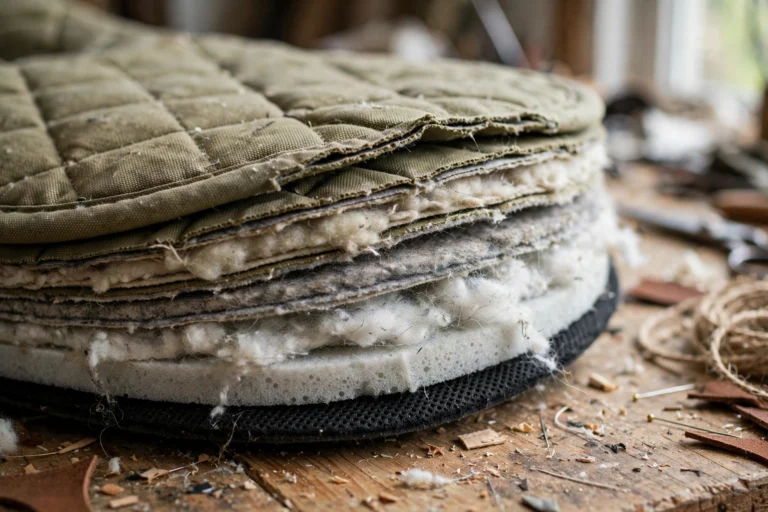
Saddle Pad Thickness and Fill Guide: Wool Felt vs Foam vs Gel
Published · Cornovo Saddlery
Consider a common scenario: a western tack-shop owner asks for the thickest felt you make — her ranch customers equate thickness with quality. A few months later, pads start coming back: sore horses, rocking saddles, over-tightened cinches. Thickness isn’t a feature to maximize. It’s a spec to match — and this guide gives you the numbers to match it.
Key takeaways
- Western felt pads commonly run 3/4 inch to 1 inch thick; quilted English pads are usually well under 1/2 inch.
- Wool felt wicks moisture and conforms to the back; foam gives even, consistent cushioning; gel targets pressure relief in specific zones.
- Thickness should match the saddle’s fit — a thicker pad cannot fix a poorly fitting saddle and often makes it worse.
- Spec fill by material and weight or density in writing; high-density without a number is not a spec.
- For wholesale orders, confirm compressed vs. uncompressed thickness with the factory, because fills measure differently under load.
What does saddle pad thickness actually measure?
Saddle pad thickness is the depth of the pad’s cushioning layers — the pressed fiber mat in a felt pad, the fill loft between the top and bottom fabrics in a quilted pad — stated in inches or millimeters. What counts in the barn is thickness under the rider’s weight, which is always lower than the number on the shelf.
The shelf number is usually uncompressed thickness. Ask your supplier whether the stated figure is measured before or after compression, and at which point of the pad — edges and centers rarely match.
How thick should a western saddle pad be?
Most western pads run 3/4 inch to 1 inch thick. The heavy western saddle spreads load over long bars, so the felt needs real body to cushion without bottoming out. Ranch and training pads usually sit at the thicker end for all-day shock absorption; 1/2-to-3/4-inch pads suit well-fitted saddles and lighter work.
The classic trap is going thicker than the saddle’s fit allows. On an already-snug saddle, an extra-thick pad lifts the saddle, narrows gullet clearance, and produces rocking. Pad thickness fills the gap the saddle leaves — no more. When customers ask for the thickest pad, the right retail answer is a fit question, not a thicker SKU. If your staff needs the vocabulary for those conversations, start with wither relief and spine clearance.
How thick should an English saddle pad be?
Standard quilted dressage or all-purpose pads carry well under half an inch of loft — the saddle’s own panels and flocking do the cushioning, while the pad handles protection, moisture management, and some comfort. Half pads add a second layer, commonly another 1/2 inch to 1 inch of lift, which is why they’re the tool for fine-tuning fit.
If your customers compete, check the rulebook before you finalize a dressage pad spec. The FEI Dressage Rules set the Tack & Equipment requirements for the arena — pads that aren’t legal in competition won’t sell to the show segment. Because English pads are thin, fill quality matters more than fill quantity. A cheap batting that compresses flat in a month gives less protection than a thinner, denser foam that holds its loft. Ask suppliers for fill weight per square meter and whether loft is measured before or after compression.
Wool felt vs foam vs gel: which fill does what?
Wool felt wicks sweat and molds to the back, making it the western workhorse; foam gives even, consistent cushioning that suits quilted English pads; gel targets shock absorption in specific zones. No fill wins on every axis — cushioning, moisture handling, weight, durability, and cost all pull in different directions, so match the fill to the discipline and price point.
Here’s the side-by-side for your spec meetings:
| Fill | How it works | Strengths | Watch-outs | Common uses |
|---|---|---|---|---|
| Wool felt | Needled or pressed fiber mat | Wicks sweat, conforms to the back, durable | Heavier; quality varies with wool content | Western pads, premium English pads |
| EVA / polyurethane foam | Closed or open-cell sheet | Even cushioning, holds thickness, light | Cheaper foams compress permanently; less breathable | Quilted English pads, half pads |
| Memory foam | Slow-rebound foam | Molds to pressure points | Can feel hot; slower to recover shape | Half pads, therapeutic pads |
| Gel | Polymer inserts, usually zoned | Targeted shock absorption | Heavy; adds cost; placement matters | Zoned inserts in western and English pads |
| Polyester batting | Lofty fiber fill | Cheap, soft hand-feel | Flattens fastest; shifts if quilting is sparse | Budget quilted pads |
Wool felt is the traditional western core, and the moisture story is real: wool fibers absorb moisture vapor and release it into the air, and — as Woolmark puts it — each Merino wool fibre is like a coiled spring that returns to its natural shape after being bent, which is the compression-recovery edge felt holds over foam and gel. One bonus for storage and shipping: the IWTO notes wool is flame retardant and will often self-extinguish… produces less smoke and toxic fumes (IWTO). Felt quality tracks wool content and needling density — get both in writing, and read our deeper breakdown of wool vs synthetic saddle pad fills.
Foam — usually EVA or polyurethane — is the workhorse of quilted English pads. Good foam keeps consistent thickness across the pad and recovers after compression; cheap foam takes a permanent set and the pad goes flat. Density is the number to ask for, not the phrase high-density — see our notes on reading foam density on a tech sheet before you accept a supplier’s wording at face value.
Gel belongs in zones, not across the whole pad: inserts under the bars or alongside the spine where shock peaks. Full-gel pads get heavy fast, and gel without breathable structure around it traps heat. When a supplier offers gel, ask where the inserts sit and how they’re anchored — a migrating gel insert is worse than none.
Many wholesale pads layer fills: a felt base with a foam middle, or a quilted pad with zoned gel inserts. Layering is fine — just name every layer on the spec sheet. For the insert-by-insert detail, see our buyer’s guide comparing wool felt, foam and gel inserts.
Does a thicker pad fix a poorly fitting saddle?
No — this is the most expensive misconception in the category. A pad can fine-tune a saddle that’s close, like a half pad shimming a slightly wide tree, but nothing compensates for a fundamentally wrong tree width or worn-out flocking. Worse, extra thickness under a bad fit creates new pressure points while hiding the original problem.
For retailers, this is a staff-training point with margin attached: customers who buy ever-thicker pads for a sore horse come back angry; customers you refer to a saddle fitter come back loyal. Stock shims and half pads for fine-tuning, keep a fitter’s card by the register, and train staff on correcting saddle-fit issues with pads so the floor gives fit answers instead of thicker SKUs.
How do you spec thickness and fill in a wholesale order?
Write the spec the way the factory builds it: name the fill material for every layer, the target thickness (stating compressed or uncompressed), the fill weight or density, and the quilting or needling pattern that locks it together. Then confirm the measuring method — a 1-inch pad measured uncompressed at the edge can be 5/8 inch where the saddle sits.
Then test it: wash samples twice, compress them under weight, and check loft recovery before approving bulk. Put the test methods on the tech sheet too — ASTM’s textile committee publishes the standard methods buyers cite: D6193 for stitches and seams, D5034 and D5035 for breaking force and elongation, D1776 for conditioning textiles before testing (ASTM Committee D13). A fill that looks generous on arrival and flat after a month of use is the classic wholesale disappointment, and sampling discipline prevents it.
Frequently asked questions
What is the standard thickness of a western saddle pad?
Most western pads run 3/4 inch to 1 inch thick, with ranch and training pads at the thicker end and lighter pads around 1/2 to 3/4 inch. The right thickness depends on the saddle’s fit — the pad should fill the gap the saddle leaves, not lift a saddle that already fits snugly.
Is wool felt or foam better for saddle pads?
Wool felt wicks moisture better and conforms to the horse’s back, making it the traditional choice for western pads. Foam gives more even, consistent cushioning and holds its thickness well, which suits quilted English pads. Many pads combine both. Neither is universally better — match the fill to the discipline and price point.
How do I know if a saddle pad fill is good quality?
Get the fill spec in numbers — material, weight per square meter, or density — and test a sample: compress it, wash it twice, and check whether it recovers its loft. Even quilting or needling that locks the fill in place matters as much as the fill itself. Vague descriptions without numbers are a warning sign.
Can gel inserts damage a horse’s back?
Gel itself isn’t harmful, but poorly placed or migrating gel inserts can create pressure points, and gel adds weight and heat. Choose pads where gel is zoned to high-impact areas and anchored in place, and prefer breathable constructions around it. As with any pad, fit matters more than the fill technology.
What thickness should I stock for a general tack shop assortment?
Cover the middle of each discipline’s range first: 3/4-inch to 1-inch contoured felt pads for western, standard quilted pads plus a sheepskin or foam half pad for English. Add thinner and thicker options only after the core sizes prove themselves. A tight, well-chosen range outsells a wall of overlapping thicknesses.
Thickness and fill are specs you can put in writing, test in samples, and build a reputation on. Send us your target disciplines and the thicknesses your customers ask for, and we’ll quote pads with a full layer-by-layer spec — felt, foam, gel, or combination — plus pre-production samples you can compress, wash, and judge for yourself.
Sources & Further Reading
- IWTO — Why Wool Matters: wool’s flame retardancy and natural performance properties.
- FEI — Dressage Rules: Tack & Equipment requirements for competition pads.
- Woolmark — The Fibre: Merino wool’s spring-like structure, moisture handling, and compression recovery.
- ASTM — Fashioning Standards for Textiles (Committee D13): standard test methods for stitches, seams, and textile strength cited on spec sheets.
