How OEM Saddle Pad Programs Work: Custom Embroidery, Colors, Private Label
Published · Cornovo Saddlery
Consider a common scenario: a first-time brand owner sends a factory a screenshot of a competitor’s dressage pad and one line — make this with our logo. Her logo is a low-resolution JPEG pulled from a website. Turning that into a real spec, a real quote, and a pad that actually sells takes weeks of back-and-forth that a proper brief would have avoided. Here’s how an OEM saddle pad program runs from brief to delivery.
Key takeaways
- An OEM saddle pad program lets you customize colors, fabrics, embroidery, binding, labels, and packaging on a factory’s proven pad patterns.
- Custom embroidery needs a vector logo file; the factory digitizes it once for a setup fee, then stitches it on every unit.
- A common wholesale MOQ is 50 pieces per color, with higher minimums for fully custom patterns or special fabrics.
- Plan on 7–15 days for sampling and typically 30–45 days for bulk production after you approve the sample.
- The fastest OEM projects start with a complete spec sheet: pattern, materials, colors, logo files, label design, and quantities.
What is an OEM saddle pad program?
An OEM saddle pad program is a manufacturing arrangement where a factory builds pads to your spec — your colors, embroidery, labels, and packaging — on proven pad patterns and construction methods. You get a line that looks and feels like your own brand without building a factory; the factory gets predictable volume.
Don’t confuse it with ODM: in OEM you define the design and spec, while in ODM you pick from the factory’s existing designs and add your branding. ODM is faster and cheaper with lower minimums. Many buyers start ODM and move to OEM once a style proves itself.
How does an OEM saddle pad program work, step by step?
Most serious factories run the same six stages: brief and spec sheet, quotation, sampling, sample approval, bulk production, and final QC with shipment. Total elapsed time is typically 3–4 months for a first order. Delays almost always come from the steps you control — an incomplete brief, a slow sample approval, or artwork that arrives in the wrong format.
- Brief and spec sheet. You send your requirements: pad style (western, dressage, all-purpose, half pad), sizes, materials, colors, embroidery placement, label design, and quantities. A complete brief moves everything after it faster — see our walkthrough on briefing a factory on custom saddle pads.
- Quotation. The factory prices materials, customization complexity, and quantity. Embroidery is often quoted by stitch count; special fabrics or trims add cost. Expect a breakdown, not a single number — our guide to pricing private-label saddle pads shows how to read one.
- Sampling. The factory makes a pre-production sample, usually in 7–15 days. Check fit, materials, colors, embroidery quality, and labeling against your spec. Most programs allow one or two revision rounds; further rounds may carry a fee.
- Sample approval. You sign off in writing — this is the reference standard for the bulk run. Photograph and keep the approved sample; it’s your QC benchmark when the shipment arrives. This is also your compliance checkpoint: the pad carries your brand, so your materials inherit chemical-compliance responsibility — check them against the AAFA Restricted Substance List before bulk.
- Bulk production. Typically 30–45 days after approval, depending on order size and season. The factory cuts, sews, embroiders, and packs your pads, running in-line QC through the run.
- Final QC and shipment. Finished goods are inspected against the approved sample, packed to your spec, and shipped. Confirm packing details (polybag, hang tag, retail box) before production starts, not after.
What can you customize on OEM saddle pads?
More than most first-time buyers expect — colors, embroidery, binding, private labels, fabrics, pattern changes, and packaging. Each option carries a cost and sometimes a higher MOQ. Factories running OEM programs at volume usually offer the full menu below; smaller shops may limit you to colors and embroidery.
| Customization | What it means | Typical MOQ impact |
|---|---|---|
| Colors | Your choice of top fabric, binding, and trim colors | Commonly 50 pieces per color |
| Embroidery | Logo, monogram, or decorative stitching | One-time digitizing/setup fee; then per-unit stitch cost |
| Binding and piping | Contrast binding, corded piping, edge treatments | Usually covered by the color MOQ |
| Private labels | Woven or printed labels with your brand | Often 500–1,000 labels per design from label makers |
| Fabrics | Specific top, fill, or bottom materials | Higher MOQ if the fabric must be custom-dyed or woven |
| Pattern changes | Altered shapes, contoured fit, added features | Highest MOQ; may need new dies or patterns |
| Packaging | Polybag, hang tag, header card, retail box | By inquiry; boxes usually need volume to be economical |
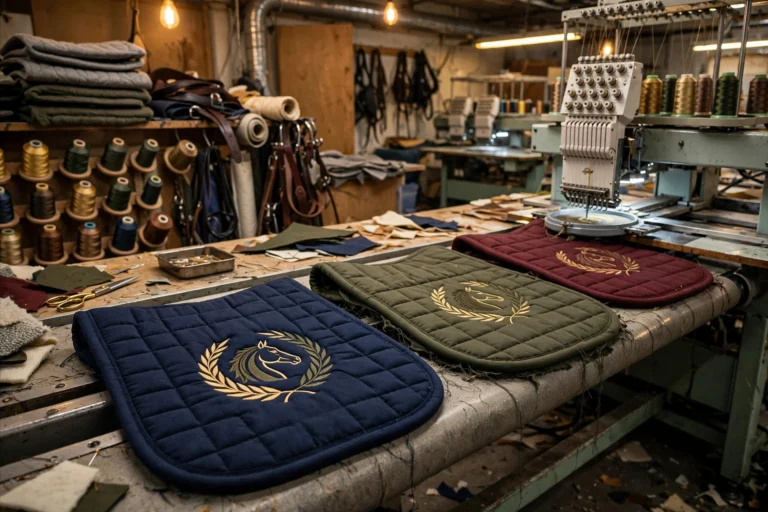
Custom embroidery is the most requested option — and the most misunderstood. The factory digitizes your logo into stitch instructions (a one-time digitizing fee), then stitches every unit in thread that outlasts any printed logo. Two rules: keep embroidery clear of pressure zones under the saddle panels, and mind the rulebook if your customers compete — USEF dressage rules limit sponsor logos to 200 cm² per side of the saddle cloth (USEF Dressage Attire & Equipment Booklet, DR121.1.b). For stitch-quality language on your tech sheet, ASTM D6193 covers standard stitches and seams (ASTM Committee D13). For the full option menu — thread types, placement, piping pairings — see embroidery, piping and logo options.
Colors are the easiest win. Most factories stock a range of top fabrics and binding tapes and can combine them to your spec at standard MOQs. Fully custom-dyed fabrics are possible but push MOQs up, since the dye lot itself has a minimum.
What is the MOQ for OEM saddle pads?
For color and embroidery changes on existing patterns, 50 pieces per color is a common wholesale MOQ — enough for the factory to run efficiently without asking a small brand to over-commit. Fully custom patterns, special fabrics, or custom-woven labels raise the minimums because the setup cost has to spread across the run.
When you’re planning, think in colorways, not just units: 50 pieces each of three colors is a very different commitment from 150 of one. And ask how the MOQ splits across sizes — some factories want the minimum per color regardless of size mix, others per color-size combination. Get the structure in writing, and compare it against our overview of typical MOQs and lead times before you plan your assortment.
What artwork files does the factory need?
For embroidery, send your logo as a vector file — AI, EPS, or SVG — or a high-resolution raster at 300 DPI at the embroidery size. A JPEG pulled from a website will not digitize cleanly; the stitch-out comes back blurry and costs you a sampling round. For woven labels, the label maker needs vector artwork plus exact dimensions, fold type, and Pantone color callouts.
For hang tags and packaging, supply print-ready PDFs with bleed. If you don’t have vector files, get your logo redrawn before you contact the factory — it’s a small one-time cost that saves weeks.
How long do OEM saddle pad orders take?
Sampling commonly takes 7–15 days including shipping the sample to you — budget one revision round. Bulk production typically runs 30–45 days after approval, longer in peak season or for complex embroidery. Add freight: sea freight from Asia commonly adds 25–40 days port to port, depending on route and season.
The realistic math for a first OEM order: brief to delivery in roughly 3–4 months. Repeat orders on an approved pattern run faster because sampling is already done. If a factory promises a fully custom embroidered program in three weeks, ask what corners that timeline cuts — it’s usually sampling or QC. For the week-by-week version, see our 90-day private label launch timeline.
What are the most common OEM mistakes?
Starting with a photo instead of a spec, approving samples too fast, changing the design mid-production, forgetting packaging until after bulk, and putting the whole first MOQ into one untested colorway. Every one of these is preventable — and every one costs real money when it slips through.
A photo can’t tell the factory the fill, the dimensions, or the stitch density. Wash the sample and check it against every line of your spec before you sign. Freeze the design at approval, decide packaging before bulk starts, and split your first order across colors to learn what sells before you double down.
Frequently asked questions
How much does custom embroidery add to the unit cost?
It varies with stitch count, thread colors, and logo size. Expect a one-time digitizing/setup fee for converting your logo to stitch files, plus a per-unit embroidery charge that scales with complexity. Simple left-chest logos are the most economical; large, dense designs cost more. Ask for the quote broken down by setup vs. per-unit so you can compare suppliers fairly.
Can I do OEM saddle pads with my own woven labels?
Yes — private labeling is standard in OEM programs. You supply the label design as vector artwork, and the factory sews it in during production. Note that woven labels themselves often carry their own MOQ (commonly 500–1,000 pieces per design from the label maker), so plan your label order alongside your pad order.
What’s the difference between OEM and ODM for saddle pads?
OEM means the factory builds to your design and spec; ODM (original design manufacturer) means you pick from the factory’s existing designs and just add your branding. ODM is faster and cheaper with lower MOQs, while OEM gives you a genuinely differentiated product. Many buyers start ODM and move to OEM once a style proves itself.
Do I need to visit the factory for an OEM program?
Not necessarily. Most programs run fine on samples, photos, video calls, and written specs — especially for standard customizations. A visit (or a third-party inspection) becomes worthwhile for large first orders or complex custom patterns. Either way, the approved pre-production sample is your real quality contract.
Can I mix colors and sizes within the MOQ?
Usually the MOQ applies per color, with size assortments allowed inside it — but confirm this explicitly. Some factories require the minimum per color-size combination, which multiplies your commitment fast. Get the MOQ structure in writing before you plan your assortment.
A good OEM program turns your brand idea into a pad your customers recognize as yours — and it starts with a complete spec, clean artwork, and realistic timelines. Send us your logo files, target styles, and quantities, and we’ll come back with a detailed quotation, sampling plan, and production schedule for your private-label saddle pad line.
Sources & Further Reading
- USEF — Dressage Attire & Equipment Booklet: DR121.1.b — saddle cloth color and sponsor logo size rules.
- AAFA — Restricted Substance List: chemical-compliance standard private-label buyers should check before bulk.
- ASTM — Fashioning Standards for Textiles (Committee D13): D6193 Practice for Stitches and Seams for embroidery and stitch-quality specs.
- U.S. CBP — Importer & Exporter Tips: basics for first-time importers on classification, valuation, and documentation.
