
Saddle Pad Sizing Guide with Measurement Chart
Published · Cornovo Saddlery
Consider a common scenario: a tack shop’s most-returned SKU isn’t a defective product — it’s a perfectly good dressage pad in the wrong size. Customers keep buying the pad that matches their jacket-size logic (I’m a medium, so medium pad) instead of their saddle’s measurements. Every return costs shipping both ways and a customer who now doubts the advice they were given.
The short answer for anyone choosing a pad today: size follows the saddle, never the rider. Measure the saddle’s seat size and flap length, then pick a pad whose spine length and drop clear the saddle’s edges by roughly 1–2 inches all around. Western pads are sold by overall dimensions (commonly 32 x 32 in for a 16-inch saddle); English pads are sold by discipline cut matched to seat size. The charts below give you the numbers.
Saddle pad sizing causes more avoidable returns than any quality issue we see in wholesale. This saddle pad size chart and measuring guide gives you — and your staff — the numbers to get it right the first time, for western, English, and half pads.
Key takeaways
- Saddle pad size follows the saddle’s seat size and shape — not the rider’s clothing size.
- Measure the pad along the spine and across the widest point, and compare against the saddle’s length and flap drop.
- A well-fitted pad shows roughly 1–2 inches of pad around the saddle’s edges, front and back.
- Western pads are sized by overall dimensions (commonly 32 x 32 in and up); English pads are sized by discipline cut matched to seat size.
- Half pads are sized to the saddle’s panel area and should never extend past the saddle’s edges.
What is saddle pad sizing based on?
Saddle pad sizing is based on the saddle it goes under — its seat size, its shape, and the discipline it’s built for. A 17.5-inch dressage saddle needs a dressage-cut pad proportioned for that seat; a 16-inch western saddle needs a western pad large enough to extend past its skirts. The rider’s size never enters the calculation.
How do you measure a saddle pad?
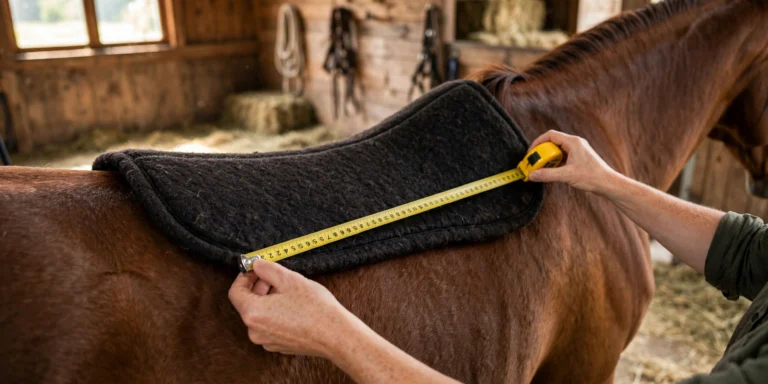
Take two measurements with a soft tape, on the pad laid flat. Spine length: from the front edge to the back edge along the top center line — this tells you whether the pad covers the saddle’s length. Width or drop: across the widest point, or from the spine down each side on English pads — this tells you whether the pad clears the flaps and shows evenly.
Then measure the saddle the same way: seat size (pommel to cantle, in inches) plus the flap length and the panel footprint. The pad’s spine should exceed the saddle’s length by a couple of inches total, and the pad’s drop should clear the bottom of the flaps. Write these numbers on your product pages — customers who can compare measurements return far less than customers guessing from S/M/L labels.
Western saddle pad size chart
This saddle pad size chart for western pads uses overall dimensions rather than seat-size codes. Match the pad to the saddle’s skirt size: the pad must extend past the skirts on every side so the saddle’s edges never press the horse directly.
| Saddle seat size | Recommended pad size | Notes |
|---|---|---|
| 14–15 in (youth / small adult) | 30 x 30 in | Check skirt length; ponies may need smaller |
| 15–16 in | 32 x 32 in | The most common western pad size |
| 16–17 in | 32 x 32 in to 34 x 34 in | Size up for long-skirted saddles |
| 17–18 in | 34 x 36 in to 34 x 38 in | Ranch and roping saddles run large |
These are typical ranges, not universal standards — manufacturers cut slightly differently, so always check the actual listed dimensions against the saddle. Contoured western pads follow the same sizing but add a shaped top line; the footprint rules don’t change.
English saddle pad size chart
English pads are sold by discipline cut, then sized within the cut. Start with the cut that matches the saddle — dressage, all-purpose (AP), or jumping — then pick the size that matches the seat.
| Saddle seat size | Dressage pad | All-purpose pad | Jumping pad |
|---|---|---|---|
| 16–16.5 in | Small / 16 in | Small | Small |
| 17–17.5 in | Medium / 17 in | Medium | Medium |
| 18 in and up | Large / 18 in | Large | Large |
A note on naming: Full, Medium, and Large mean slightly different things between brands, which is exactly why the measurement guidance above matters more than the label. When stocking, choose suppliers whose size runs are consistent — a medium that fits like a large creates the returns you’re trying to avoid. Ask for the factory’s measurement chart per size and publish it on your product pages. If you’re choosing between pad types as well as sizes, our western vs English pad guide and thickness and fill guide cover the construction side.
How much pad should show around the saddle?
As a rule of thumb, about 1–2 inches of pad visible around the saddle’s edges — front, back, and along the bottom — signals a good fit. Less than that and the saddle’s edges sit near the pad’s edge, risking pressure on unprotected areas; much more and the pad looks sloppy and can shift or bunch.
The wither area deserves its own check: the pad should clear the withers without pressing down on them, with the saddle’s gullet channel unobstructed. On English pads, pull the pad up into the gullet slightly when tacking up so it doesn’t pull tight across the withers. If a customer complains the pad slides back, the cause is usually a too-small pad or a saddle fit issue — not a pad that needs to be bigger in every direction.
How are half pads sized?
Half pads follow a simpler rule: they should sit entirely within the saddle’s footprint, never extending past its edges. Size them to the saddle’s panel area — most run in Small (16–16.5 in saddles), Medium (17–17.5 in), and Large (18 in+) — and check that the front edge doesn’t press on the withers and the back edge doesn’t extend past the cantle. A half pad that sticks out looks wrong and shifts under work; one that’s too small leaves part of the panel unprotected.
What are the most common saddle pad sizing mistakes?
Buying by rider size. The I’m a medium logic from the intro — pads follow saddles, not people. Mixing disciplines. A dressage pad under a jumping saddle (or any English pad under a western saddle) fits nowhere correctly. Ignoring flap length. Long-flapped saddles need pads with enough drop, or the flap hangs past the pad. Sizing up to fix slipping. A slipping pad usually signals a fit or balance problem; a bigger pad just slips more impressively. Forgetting the withers. Any pad that presses the withers is the wrong shape or size, whatever the chart says.
Train staff on these five and put the measurement instructions on the product page. In our experience supplying retailers, sizing guidance is among the cheapest ways to cut pad returns — cheaper than any change to the product itself.
How should retailers present sizing to reduce returns?
Publish three things on every pad product page: the pad’s actual measurements (spine length and drop), the saddle seat sizes each size fits, and a one-line measuring instruction. Add a simple fit photo showing the 1–2 inch reveal around the saddle. For wholesale buyers, request the factory’s size chart in a spreadsheet so your listings and the factory’s specs never disagree — mismatched charts between supplier and storefront are a quiet source of returns. Our guide to how saddle pads are made explains the construction behind those measurements.
Requesting a quote: specs to confirm
When you request a wholesale quotation for saddle pads, confirm these sizing-related specs in writing so your size chart and the factory’s cutting never disagree:
- Per-size measurement chart: spine length, width/drop, and thickness for every size you order — as a spreadsheet, not just S/M/L names.
- Size-run consistency: how the factory controls cut dimensions across production lots (tolerance range per size).
- Discipline cuts: which cuts are offered (dressage, AP, jumping, western square, barrel) and their shape templates.
- Custom sizing: whether OEM size runs or private size labeling are available for your program.
- Fit photography: whether the factory can supply on-horse fit photos per size for your product pages.
Frequently asked questions
What size saddle pad do I need for a 16-inch western saddle?
A 32 x 32 inch pad is the typical match for a 16-inch western saddle, giving coverage past the skirts on all sides. If the saddle has long skirts — common on ranch and roping saddles — size up to 34 x 34 inches. Always confirm against the saddle’s actual skirt measurements rather than seat size alone.
What size dressage pad fits a 17.5-inch saddle?
A medium (sometimes labeled 17-inch) dressage pad is the standard match for a 17.5-inch dressage saddle. Check that the pad’s spine length exceeds the saddle’s length by a couple of inches and that the straight cut follows the long dressage flap. When between sizes, the pad’s actual measurements decide — not the label.
Should a saddle pad be bigger than the saddle?
Yes, slightly — about 1–2 inches of pad showing around the saddle’s edges is the usual target. The pad must fully cover the saddle’s footprint so no part of the saddle presses the horse outside the pad. But bigger has limits: an oversized pad bunches, shifts, and looks unprofessional.
How do I measure my horse for a saddle pad?
You don’t measure the horse — you measure the saddle. Take the seat size (pommel to cantle), note the discipline cut and flap length, then match a pad using the charts above. The horse’s back shape matters for pad type (wither relief, shims), but size itself comes from the saddle’s dimensions.
Do saddle pad sizes vary between brands?
Yes, and this is a real source of confusion: one brand’s medium can match another’s large. A saddle pad size chart is only as good as its measurements — always confirm actual dimensions before ordering. Good suppliers publish per-size measurement charts — ask for them, and publish them on your product pages so customers compare numbers, not names.
Sources & Further Reading
- How Saddle Pads Are Made: Materials and Construction — construction behind the measurements
- Western vs English Saddle Pads: What’s the Difference? — choosing the right discipline cut first
- Saddle Pad Thickness and Fill Guide — wool felt vs foam vs gel
- How OEM Saddle Pad Programs Work — custom sizing and private size labeling
Right-size pads sell themselves: fewer returns, happier riders, and staff who answer sizing questions with numbers instead of guesses. Send us your best-selling saddle models and seat sizes, and we’ll build you a wholesale pad assortment — standard sizes or OEM with your own size labeling — matched to the saddles your customers actually ride. MOQ is 50 pieces per color.
