
Wither Relief and Spine Clearance Explained
Published · Cornovo Saddlery
Consider a common scenario: a private-label pad line launches with rich colors and clean stitching, and months later the complaints arrive — white hairs and sore spots right over the withers. The pads are well made. They simply press exactly where the horse’s skin is thinnest.
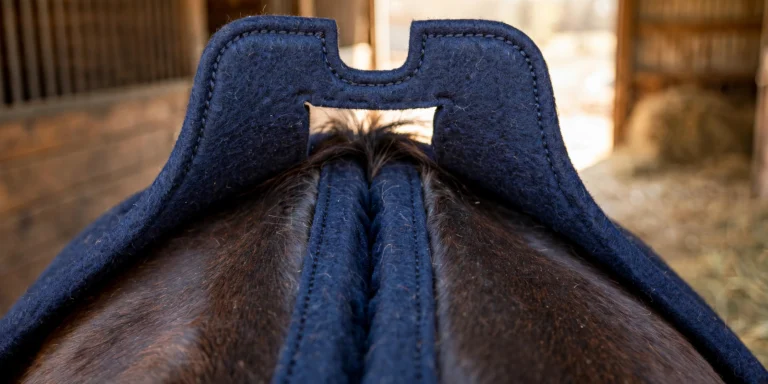
Wither relief is room built over the bony withers — a cut-out, split, or dip — so the pad doesn’t press the ridge between the shoulder blades. Spine clearance is the open channel along the backbone, keeping pressure on the muscles beside the spine. Name the construction method on your PO, and test the sample under a rider.
Key takeaways
- Wither relief is extra room built into a pad over the withers — a cut-out, split, or contoured dip — so pad and saddle don’t press the bony ridge.
- Spine clearance is the open channel along the backbone under the saddle; pressure belongs on the muscles beside the spine, never on the vertebrae.
- Wither relief on a spec sheet can mean several different constructions — name the method and dimension it, or the factory will guess.
- There is no universal clearance number: check clearance under a rider’s weight, not just with the pad laid flat.
- Standard MOQ is 50 pieces per color; each wither-treatment variant is its own run, so choose the method your customers’ horses actually need.
Why do the withers need relief at all?
The skin over the withers is thin, the bone sits close to the surface, and every stride rocks the saddle’s front edge against it. Constant pressure there restricts blood flow, and the visible result is rubbed hair, white hairs growing back, or open sores. Riders notice wither rubs fast — and in our experience as a manufacturer, they are among the most frequent fit complaints behind pad returns.
The withers are the bony ridge between the shoulder blades, and they take the brunt of the saddle’s front-end pressure. A wither relief saddle pad is built to take that pressure off — not by cushioning the ridge, but by removing the pad from it. That distinction matters when you read spec sheets: relief is absence of contact, not extra padding.
What is spine clearance, and why does it matter?
Spine clearance is the open channel along the horse’s backbone under the saddle. The top of the vertebrae carries no muscle — the big back muscles run alongside the spine — so pressure belongs on those muscles, never on the bony processes in the middle. Many western pads preserve this channel with a split or dip along the top line; many English pads rely on the saddle’s gullet plus a pad shaped to tent slightly.
A useful field check: with the pad fitted, you should be able to run two fingers down the backbone without pinching. That is a rule of thumb, not a measurement — but it captures the idea. A pad can clear the withers at the front yet press the spine in the middle, so treat the two as separate checks, not one.
How do manufacturers build wither relief into a pad?
Wither relief on a spec sheet can mean several different constructions, and they are not interchangeable. Know which one you are ordering:
| Method | How it works | Commonly suits |
|---|---|---|
| Wither cut-out | A U- or V-shaped notch removed from the pad’s top line over the withers | Horses with prominent withers, where clearance must be unambiguous |
| Split top line | The pad’s top edge is split and bound, letting the two sides flex away from the withers | General riding; adds flexibility along the whole spine |
| Contoured dip | The top line curves down and around the withers instead of cutting away | Moderate withers; riders who want full pad coverage |
| Shim pockets | Pockets that take felt or foam shims to lift the pad off the withers | Correcting fit per horse; adjustable as the back changes |
| Rolled or bound edge | A soft rolled edge along the top line instead of a hard cut | Sensitive horses; reduces edge pressure without removing material |
The cut-out removes material entirely, so the clearance is definite — but it also removes pad coverage over the withers, which is fine since no pressure should land there anyway. The contoured dip keeps full coverage for riders who want it, at the cost of less room. Shim pockets are the adjustable option: they let a rider add lift where a particular horse needs it, which suits correction pads — and backs do change shape with season, age, and condition, as saddle-fit specialists document (see Sources).
For a wholesale line, the practical question is which method your customers’ horses need — and the honest answer differs by customer type. As starting hypotheses, adjust by your own sales:
- Tack shop near sport-horse or Thoroughbred barns: lead with a real cut-out SKU. High-withered horses justify the definite clearance, and these riders check fit closely.
- Distributor serving western ranch and trail programs: a contoured dip or split top line usually covers rounder horses at a lower price point; add a cut-out SKU for barns with mixed strings.
- Riding school or lesson program: split top line or rolled edge on a budget-friendly pad — durable, forgiving across many different school horses, and cheap enough to replace.
How much clearance is enough?
There is no universal number, because clearance depends on the horse’s wither height, the saddle’s fit, and the rider’s weight. The commonly used field check — two to three fingers of space between the withers and the pommel or pad top line, with the rider mounted — is a practical rule of thumb most tack professionals recognize. Treat it as a pass/fail screen, not a specification you can print on a tech sheet.
What matters for a buyer is that clearance is checked under load. A pad that clears the withers sitting on a saddle rack can still press down once a rider’s weight compresses the felt. When you approve a sample, test it on a horse with a rider up, or at minimum on a saddle form with weight applied. A wither relief saddle pad earns its name only under real conditions.
Wither relief vs. contoured pads: are they the same thing?
Not quite. Contoured describes the pad’s overall curved shape following the spine; wither relief describes a specific feature that unloads the withers. A contoured pad usually clears the withers better than a straight one simply by following the back’s shape — but a contoured pad without a real cut-out or dip can still press on very prominent withers. Compare western vs English pad construction and you will see the same principle: profile is the shape, relief is the feature.
Think of them as two separate line items on the spec sheet: profile (contoured vs straight) and wither treatment (cut-out, split, dip, or none). Ordering contoured with wither cut-out is unambiguous. Ordering just contoured and hoping the factory adds relief is how wither complaints start.
What should buyers check before ordering bulk?
- Name the method: cut-out, split top line, contoured dip, or shim pockets — with a drawing or the approved sample as reference.
- Dimension the relief: width and depth of the cut-out or dip, so production matches the sample. A drawing beats adjectives.
- Check the binding: relief edges get flexed constantly; they should be bound or rolled, never raw-cut felt.
- Test under load: approve the sample on a horse with a rider, not just laid flat on a table.
- Confirm it survives washing: cut-outs are stress points; ask how the edge is reinforced and whether the shape holds after repeated cleaning. See how to wash and care for saddle pads for what the care label should promise.
- Match it to the saddle: relief in the pad cannot fix a saddle whose pommel already sits on the withers — train your sales staff to say so. Our pre-shipment QC checklist includes a clearance verification step for exactly this.
One honest limit to communicate to your customers: no pad fixes a badly fitting saddle. Wither relief in the pad helps a correctly fitted saddle stay comfortable; it does not rescue a saddle that bridges, rocks, or sits on the withers on its own. Retailers who say this out loud earn trust — and fewer returns blamed on the pad.
Requesting a quote: specs to confirm
Before requesting a quote, confirm these with your factory so the first sample matches the pad you plan to sell:
- Wither treatment method: cut-out, split, dip, shim pockets, or none — named explicitly
- Cut-out or dip dimensions: width and depth, drawn on the tech sheet
- Edge finish on the relief: bound, rolled, or otherwise reinforced — never raw-cut
- Pad profile (contoured vs straight) as a separate line item
- Underside material around the relief — fleece-lined edges are gentler on sensitive skin; see wool vs synthetic fills for material trade-offs
- MOQ: 50 pieces per color, per wither-treatment variant
Frequently asked questions
What’s the difference between wither relief and spine clearance?
Wither relief is clearance specifically over the bony withers at the front of the saddle area. Spine clearance is the open channel along the whole backbone under the saddle. A pad can have one without the other — for example, a cut-out that clears the withers but a flat middle that presses the spine. Good pads address both: relief at the front, a clear channel down the middle.
Can a wither relief pad fix a saddle that sits on the withers?
No. If the saddle’s pommel contacts the withers with no pad at all, adding a relief pad just moves the pressure point around. The saddle needs refitting or reflocking first; the pad then protects the area during work. Sell the pad as protection and fine-tuning, not as a cure — your returns will thank you.
Do straight saddle pads offer wither relief?
They can, if it is built in. A straight pad with a proper wither cut-out is every bit a wither relief saddle pad — the cut-out is what does the work, not the profile name. What a plain straight pad without any cut-out lacks is clearance, and that is the version that rubs on withered horses. Always check for the feature, not just the profile name.
Which materials work best around a wither cut-out?
Wool felt holds a cut edge well and breathes, which is why it is common in western pads. Fleece-lined edges are gentler on sensitive skin. Whatever the material, the relief edge should be bound or rolled — raw-cut felt at a flex point frays, and a frayed edge turns into a pressure ridge. Ask your factory how the edge is finished before you approve the sample.
Building a wither relief saddle pad line? Send your target wither treatment, dimensions, and quantity for a quotation. Standard MOQ is 50 pieces per color, OEM and private label are available, and packing is quoted per inquiry.
Sources & Further Reading
- Saddle Fit Solved — Horse Topline Management: Assessing & Shimming Seasonal Back Changes — back-shape monitoring, sway-back bridging, and shim protocols; supports testing clearance under load and per-horse adjustment
- Western vs English Saddle Pads — how each tradition handles wither and spine clearance
- Saddle Pad Thickness & Fill Guide — thickness choices around the wither area
- Pre-Shipment QC Checklist for Saddle Pads — clearance verification before bulk ships
- How to Wash & Care for Saddle Pads — what the care label should promise for cut-out edges
