Contoured vs Straight Saddle Pads: Which Should You Stock?
Published · Cornovo Saddlery
Consider a common scenario: a tack shop buys a run of straight-cut western pads because the quote is sharp, then spends the season fielding complaints about pads creeping backward on trail rides and rub marks over the withers. The pads are well made. The profile simply does not match the customers’ horses.
Which profile should you stock — contoured or straight? Carry both, weighted by who buys from you: contoured pads follow the curve of the spine and suit horses with defined withers, while straight pads lie flat and suit round-barreled, low-withered horses. As a starting hypothesis, performance-barn tack shops often lean contoured and ranch suppliers lean straight — then adjust by actual sales.
Key takeaways
- Contoured means a curved top line that follows the spine; straight means a flat top line, even front to back.
- Neither profile is universally better — the right one depends on the horse’s build, the riding discipline, and how well the saddle itself fits.
- Contoured commonly suits horses with defined withers or some sway in the back; straight commonly suits round-barreled, low-withered horses.
- Spec the profile explicitly on every PO — contoured vs straight — plus thickness, dimensions, and materials, so the factory builds the same pad every run.
- Each profile and colorway is its own production run at the standard MOQ of 50 pieces per color — plan the assortment before requesting the quote.
What is the difference between contoured and straight saddle pads?
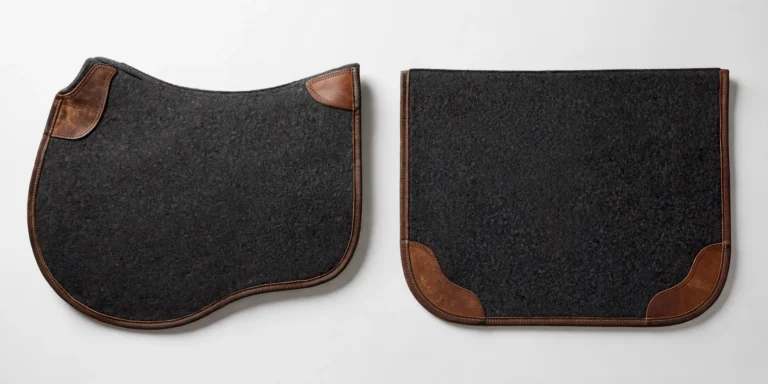
A contoured saddle pad is cut with a curved top line that rises over the withers and follows the dip of the back. A straight saddle pad is cut flat along the top edge, so it lies across the back like a rectangle. Only the top line changes — core, underside, and trim can be the same on both.
The difference lives along the top line only. Both are full-size western pads — common finished sizes include 30″x30″, 32″x32″, and 33″x38″ (see the saddle pad sizing guide before locking dimensions) — and both can use the same wool felt core, fleece underside, and wear leathers. What changes is how the pad meets the horse: a contoured top line cups the withers and follows the dip behind the shoulder, while a straight top line bridges across it.
That curve costs something. In our experience as a manufacturer, contoured pads take a more complex cut and leave more offcut waste, so they commonly quote a little higher per piece than a straight pad in the same material. At volume the difference is usually small, but it belongs in the quote comparison — one more reason to name the profile on the PO instead of assuming it.
How does pad profile affect fit on different horses?
On a horse with defined withers, a flat pad can tent over the bony ridge, touching at the front and back edges — a pad that creeps backward and rubs at the withers. On a round, low-withered back there is no ridge to tent over, so a straight pad sits flat and stable. Fit follows the horse’s build.
This is where buyers get tripped up by blanket claims. A contoured pad is not automatically better — on a round, low-withered horse it lies close and does no harm, but the customer paid for shaping they did not need. And a straight pad is not automatically inferior — under a well-fitted saddle on a flat-backed horse, it is exactly right. The honest exception to remember: no pad profile fixes a badly fitting saddle. If the saddle bridges or rocks on its own, changing the pad only moves the problem around.
One related distinction belongs here: wither relief is a separate feature from profile. A contoured pad usually clears the withers better than a straight one simply by following the back’s shape, but a contoured pad without a real cut-out or dip can still press on very prominent withers — and a straight pad with a proper cut-out is genuinely a wither-relief pad. Read wither relief and spine clearance explained and spec profile and wither treatment as two separate line items.
How should you split your order between the two profiles?
Most western retailers carry both profiles, weighted by who walks through the door. The deciding factor is the customer base, not the factory price. Use the table below as a starting point — then rebalance after the first season’s sell-through.
| Contoured | Straight | |
|---|---|---|
| Top-line shape | Curved to follow the spine | Flat, even front to back |
| Wither clearance | Curve built in; add a cut-out for prominent withers | Minimal, unless a cut-out is added |
| Commonly suits | Horses with defined withers or sway in the back | Round-barreled, low-withered horses |
| Stability note | Tends to stay put on curved backs | Stable on flat backs; can creep on withered backs |
| Typical cost position | Commonly a little higher per piece | Commonly lower per piece |
| Commonly stocked by | Performance- and show-oriented shops | Ranch suppliers, lesson programs, price-driven lines |
Per customer type, here are starting hypotheses to work from — adjust by your actual sales, not by the table:
- Tack shop near performance or show barns: contoured-heavy, around 60/40. These customers’ horses tend toward more defined withers, and their riders notice fit closely and return pads that rub.
- Distributor serving ranch and trail programs: straight-heavy, around 70/30 straight. The horses are often rounder, and at volume the per-piece cost math matters. Keep a contoured colorway for barns with mixed strings.
- Riding school or lesson program buying uniform sets: mostly straight for the cost, plus one contoured option. Twenty identical pads win on price; the contoured SKU covers the high-withered school horses that would rub in a flat pad.
If a line can carry only one profile per colorway, many buyers choose contoured for a genuinely mixed customer base — a curved pad still lies close on a flat back, while a flat pad tents over prominent withers. Treat that as a hypothesis to test against your own returns, not a rule: if your customers are mostly ranch riders on round horses, straight is the right single choice.
What should the purchase order specify?
Profile misunderstandings are one of the most common sources of factory disputes, because contoured means slightly different things to different makers. Spell it out:
- Profile: contoured or straight — with a reference to the approved sample or tech drawing, not just the word.
- Finished dimensions: e.g. 32″x32″; state whether measured flat or finished, since a curved top line measures differently each way.
- Thickness: 1/2″, 3/4″, or 1″ are typical western ranges — and how it is measured (compressed vs relaxed). Match thickness to the saddle as well as the job; see the thickness and fill guide.
- Core: wool felt, wool blend, or felt/foam laminate, with weight per piece.
- Top fabric and underside: canvas, suede, or blanket top; fleece or canvas bottom.
- Wither treatment: cut-out, split top line, contoured dip, or none — a separate line item from profile.
- Trim: wear leathers, binding, and any contour stitching along the spine.
- Colorway and private label: thread colors, woven label placement, hangtag specs. OEM and private label programs run on both profiles, so the same spec sheet can carry your brand’s details.
- Packing: quoted per inquiry — polybag, carton count, and labeling for your warehouse.
Send the full spec sheet once and keep it on file; the second reorder should be a one-line PO, not a new negotiation.
Requesting a quote: specs to confirm
Before requesting a quote, confirm these with your factory so the first sample matches the pad you plan to sell:
- Target profile and the horse build it is meant to serve (defined withers vs round, low-withered backs)
- Finished dimensions and the measurement method (flat vs finished)
- Thickness and how it is measured (compressed vs relaxed felt)
- Core material and weight per piece
- Wither treatment: cut-out, split, dip, or none — dimensioned on the drawing
- Top-line curve tolerance: how much the finished curve may vary from the approved sample
- MOQ: 50 pieces per color, per profile
Frequently asked questions
Can a straight pad work on a high-withered horse?
In a pinch, yes — if the saddle itself fits well, a straight pad will function. But the flat top line tents over prominent withers, concentrating contact on the ridge and encouraging the pad to creep. For resale, steer customers with withered horses toward contoured pads with a real wither cut-out; the return-rate difference commonly pays for the small price gap.
Do contoured pads cost more to manufacture?
Usually a little. The curved cut is more complex and leaves more offcut waste than a rectangle, and spine stitching adds a sewing step. At wholesale volume the difference is commonly modest per piece — a few percent, not a different price tier — but it belongs in the quote comparison, not discovered after production.
What thickness should I order for each use?
Typical western ranges run 1/2 in. for close-contact show and arena work, 3/4 in. as an all-round trail and training thickness, and 1 in. for ranch work and roping where impact absorption matters. Thicker is not automatically better: an overly thick pad under a well-fitted saddle can narrow the gullet and change fit, so match thickness to the saddle, not just the job.
Is a contoured pad the same as a wither-relief pad?
Related, not identical. Contoured describes the curved top line that follows the spine; wither relief is a specific feature — a cut-out, split, or raised section — that unloads the withers. Many contoured pads include wither relief, and a wither cut-out can be built into a straight pad too. Spec them as two separate line items.
Choosing between contoured vs straight saddle pads for your line? Send your target profile, thickness, dimensions, and quantity for a quotation. Standard MOQ is 50 pieces per color, OEM and private label are available, and packing is quoted per inquiry.
Sources & Further Reading
- Wither Relief and Spine Clearance Explained — wither treatment as a separate spec from pad profile
- Saddle Pad Sizing Guide — finished dimensions by discipline
- Saddle Pad Thickness & Fill Guide — matching thickness to saddle and job
- How Saddle Pads Are Made — how the curved cut and spine stitching are sewn
- Typical MOQs & Lead Times for Custom Saddle Pads — ordering economics per profile and colorway
