
Non-Slip Saddle Pad Technologies Compared
Published · Cornovo Saddlery
Consider a common scenario: a saddle that drifts sideways during a speed run, or creeps back over a long trail ride — with a smooth, slick pad underneath that never gripped the horse’s coat in the first place.
A non-slip saddle pad is a pad that stays in place under the saddle, using a high-friction underside — silicone grip print, neoprene, textured mesh, or dense felt — so friction against the horse resists sideways and backward drift. No grip technology replaces correct saddle fit: when a saddle slips, fit is the first thing to check, not the pad.
If you stock or import pads, this guide lays out the main grip technologies conditionally — what each one typically does well, where it struggles, and which riding it suits — so you can match the technology to the customer and spec it on your next order.
Key takeaways
- Non-slip pads raise friction between pad and horse — through grip dots, tacky layers, textured mesh, or dense felt. Each shines under different conditions.
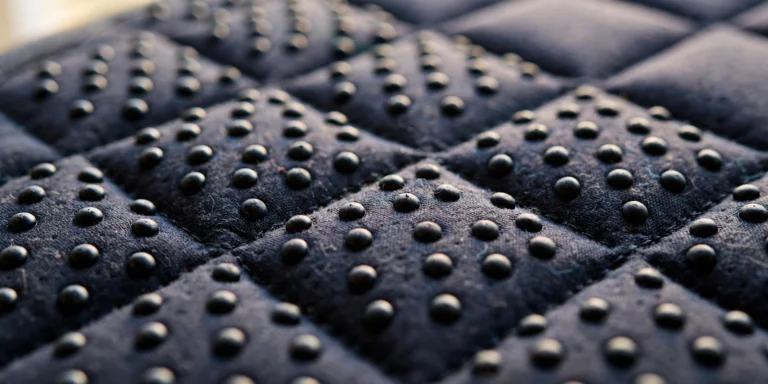
- Silicone grip print adds grip without changing the pad’s breathability or care; in our experience as a manufacturer, it is the most widely specified option on retail lines — but a sparse print grips poorly no matter how good the silicone is.
- Neoprene grips aggressively in short, intense work but traps heat and sweat, so it suits speed events better than long trail rides.
- No grip technology fixes a badly fitting saddle — spec non-slip as stability insurance, and train staff to check saddle fit first.
- Standard MOQ is 50 pieces per color; each grip technology and colorway combination is its own production run.
How does each non-slip technology work?
| Technology | How it grips (typical) | Typical strengths — and under what conditions | Watch-outs — and under what conditions |
|---|---|---|---|
| Silicone grip dots/print | Raised silicone pattern on the underside bites into the coat | Adds grip to an already good pad without changing breathability or care — a practical default for multi-discipline lines | Grip depends on print coverage and cure quality; sparse or poorly cured prints peel and grip little |
| Neoprene underside | Tacky rubber surface clings to the horse | Strong hold for short, high-force bursts — barrel turns, roping — where heat buildup is less of a concern | Traps heat and sweat; risky on long rides and for heat-sensitive horses; can irritate sensitive skin |
| Waffle-weave mesh | Textured grid creates mechanical grip with air channels | Grip plus breathability — a balanced choice for daily training pads that get used and laundered constantly | Less aggressive hold than neoprene for extreme lateral forces; the texture must face the horse, so label it clearly |
| High-friction felt | Dense wool or synthetic felt grips through fiber contact | Grip is inherent — no added layer — with good breathability; common and proven in western pads | Felt needs careful cleaning; grip varies with felt density and finish, which the factory should confirm |
| Tacky coated fabric | Polyurethane or PVC coating gives a sticky hand-feel | An inexpensive way to add grip to an existing base cloth | Breathability ranges from fair to poor; the coating can stiffen the hand and wear with repeated washing |
In our experience as a manufacturer, silicone print is the most widely specified grip on retail lines because it adds grip without re-engineering the pad — the base fabric breathes and washes as before, and the print step is modest at volume. You will see it as dot grids, hex patterns, or brand-motif prints; the pattern matters less than the coverage and the silicone quality. A grip pattern can even carry your brand’s motif — a small detail that makes a private-label pad recognizable at the rail.
Neoprene behaves differently: it holds a saddle rock-steady for a short speed run, which is why rodeo and gymkhana riders like it, but on a long trail ride it becomes a sweat trap, and some horses react to trapped heat with rubs. Stock it for the speed-event customer, not the trail customer.
Which technology suits which kind of riding?
Match grip to the job the horse actually does. Start with ride length and intensity. Speed events — barrel racing, pole bending, roping — generate violent sideways forces in short bursts, so a strong hold from neoprene or a heavy silicone print is justified and heat buildup is less of a concern over a run measured in seconds.
Dressage and flatwork need stability without bulk under the leg: silicone-printed cotton or a thin waffle mesh keeps the saddle quiet without changing the rider’s feel. Trail and ranch riding need breathability over hours: felt or breathable mesh with moderate grip wins, because a pad that grips perfectly but cooks the back still comes back as a complaint.
For young or green horses that spook and spin, any reliable grip helps — but remind customers that a non-slip pad is not a substitute for correct girthing and saddle fit. And on round, mutton-withered horses, grip helps but fights physics: with no withers to anchor against, any saddle wants to roll. For these horses, retailers should sell the system — pad, fit check, and girth advice together — rather than promising the pad alone will solve rolling.
Does non-slip change saddle fit?
It can, in two ways. First, thickness: a neoprene layer or heavy grip print adds material under the saddle, which slightly narrows the effective gullet. On a saddle fitted close already, that can matter — check the fit with that specific pad, not a different one. Second, position: a pad that grips holds the saddle exactly where it is placed, which is good when placement is correct and unforgiving when the rider tacks up crooked.
The practical advice for sales staff: non-slip pads reward correct tacking-up and punish sloppy tacking-up. Teach customers to place the pad and saddle deliberately, then let the grip do its job. And when a customer reports that the non-slip pad made my saddle tight, the answer is to recheck the saddle’s fit with that pad — not to blame the grip. For how wool vs synthetic materials behave under load, see the material trade-offs there.
What should you spec on a wholesale order?
- Technology and placement: silicone print, neoprene panel, or full mesh underside — and exactly where the grip sits (full underside vs panels under the saddle area only).
- Print spec: for silicone, the pattern, dot size, and coverage area — a sparse print grips poorly no matter how good the silicone is.
- Base fabric: the grip layer is only as good as what is behind it; name the cotton, felt, or mesh it bonds to.
- Breathability requirement: especially for trail and endurance lines — ask how the factory describes or corroborates airflow for the chosen build.
- Wash behavior: how the grip holds up in the wash — get the factory’s wash-life claim in writing for silicone prints; see how to wash and care for saddle pads for care-label wording.
- Skin sensitivity note: neoprene and coated fabrics can irritate sensitive horses — agree on care-label wording up front.
- Colorway: standard MOQ is 50 pieces per color, so each grip/color combination is its own run.
OEM and private label are available across these technologies. Packing is quoted per inquiry.
Requesting a quote: specs to confirm
Before requesting a quote, confirm these with your factory so the first sample matches the pad you plan to sell:
- Grip technology and placement: silicone print, neoprene panel, or full mesh underside — full underside vs panels under the saddle area only
- Silicone print detail: pattern, dot size, and coverage area — sparse prints grip poorly regardless of silicone quality
- Base fabric behind the grip layer: name the cotton, felt, or mesh it bonds to
- Breathability requirement for your market’s ride lengths — trail and endurance lines especially
- Wash-life claim in writing for silicone prints: how many wash cycles the factory stands behind
- Skin-sensitivity note for neoprene and coated fabrics, with agreed care-label wording
- MOQ: 50 pieces per color, per grip-technology and colorway combination
Frequently asked questions
Will the silicone grip dots wear off in the wash?
It depends on the silicone formulation and curing, not the pattern. Well-made prints survive normal machine washing for a long time; poorly cured ones crack and peel early. Ask your factory for a wash-life claim in writing and wash-test a sample repeatedly before approving bulk — peeling grip is one of the fastest ways to kill a private-label pad’s reputation.
Is neoprene safe for horses with sensitive skin?
Most horses tolerate neoprene fine for short work, but it traps heat and sweat against the skin, which can cause rubs or reactions on sensitive horses during long rides. If you stock neoprene pads, keep a breathable alternative — felt or mesh — on the same shelf and train staff to ask about ride length, not just discipline.
Can a non-slip pad damage the saddle?
Not normally. The grip faces the horse, not the saddle, and the saddle’s underside sees the pad’s top fabric as usual. The one exception is a coarse textured mesh used upside-down or a pad placed inside-out — user error, not a product flaw. Clear labeling of this side to horse on the pad prevents it.
Do non-slip pads work on round, mutton-withered horses?
They help, but they are fighting physics: with no withers to anchor against, any saddle wants to roll. A grippy pad plus a correctly fitted saddle plus proper girthing is the combination that works. Retailers should sell the system — pad, fit check, and girth advice together — rather than promising the pad alone will solve rolling. Our dealer staff training on fit issues covers exactly this conversation.
Looking to add non slip saddle pads to your line? Send your target grip technology, base materials, dimensions, and quantity for a quotation. Standard MOQ is 50 pieces per color, OEM and private label are available, and packing is quoted per inquiry.
Sources & Further Reading
- SG Saddles — What Can Cause Saddle Slip? (PDF) — a saddle fitter’s checklist of slip causes (conformation, asymmetry, girth, pad choice); supports checking fit before blaming the pad
- Wool vs Synthetic Saddle Pads: Fills Compared — material trade-offs behind neoprene and felt undersides
- Correcting Common Saddle-Fit Issues with Pads — dealer staff training on the fit-first conversation
- How to Wash & Care for Saddle Pads — care-label wording for grip pads
- Pre-Shipment QC Checklist for Saddle Pads — QC checks including printed-grip inspection before bulk ships
