Half Pads vs Full Saddle Pads: What's the Difference?
Published · Cornovo Saddlery
Consider a common scenario: a tack shop carries full quilted pads and sheepskin half pads side by side, and shoppers keep asking which one they need. The staff give three different answers, and the half pads sit unsold — not because the product is wrong, but because nobody in the store can explain the difference in one clear sentence.
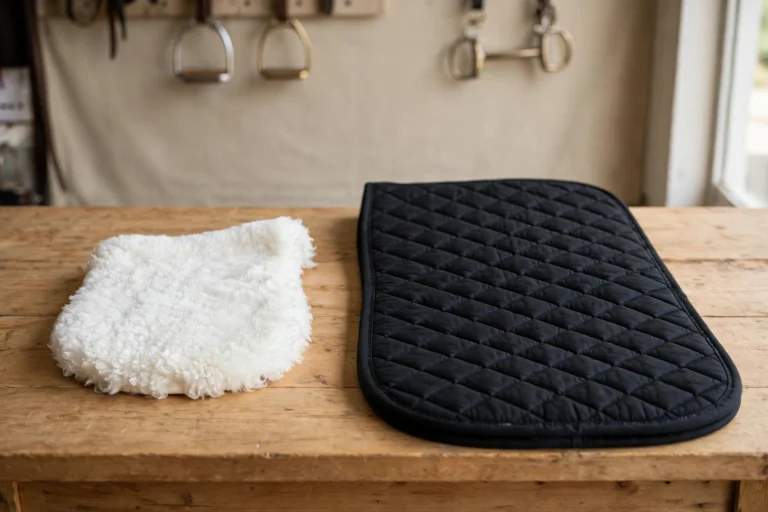
A half pad is a short pad covering only the saddle’s contact area; it fine-tunes fit and adds cushioning. A full saddle pad covers the whole saddle footprint plus margin, protecting the back and saddle from sweat and dirt. They are most often used together: a thin full pad underneath for hygiene, the half pad on top for fit.
For buyers, the two are different SKUs with different jobs, different margins, and different customers. This guide compares the half pad vs saddle pad difference so you can stock, explain, and order both with confidence.
Key takeaways
- A half pad covers only the saddle’s contact area on the horse’s back; a full saddle pad covers the whole saddle footprint plus extra area front and back.
- Full pads are the everyday essential: sweat absorption, saddle protection, hygiene — bought repeatedly, by every rider.
- Half pads are the adjustment layer: cushioning, fit fine-tuning, and correction with shims — the upgrade riders buy second.
- The most common setup is both together: a thin, washable full pad against the horse, the half pad on top doing the specialized work.
- Half pads sit at a premium price position — sheepskin, foam, and shim systems cost more to make — so they sell on explanation, not on price.
- Standard MOQ is 50 pieces per color for both half pads and full pads.
Half pad vs full pad: what’s the side-by-side difference?
| Half pad | Full saddle pad | |
|---|---|---|
| Coverage | Saddle contact area only | Full saddle footprint plus margin front and back |
| Primary job | Fit fine-tuning, cushioning, correction | Sweat absorption, saddle protection, hygiene |
| Typical materials | Sheepskin, memory foam, technical laminates | Quilted cotton, bamboo, technical wicking fabrics |
| Worn with | Often over a thin full pad | Directly on the horse |
| Price position | Premium — materials and construction cost more | Entry to mid-range; bought in multiples |
| Replacement cycle | Long — kept for seasons or years | Shorter — replaced as they wear or stain |
| Buyer | Committed riders with a specific need | Every rider, repeatedly |
The price gap reflects materials and purpose. Full pads are commonly cotton or technical quilted fabrics — durable, washable, replaceable. Half pads are often sheepskin, memory foam, or layered technical materials, built for cushioning performance rather than daily laundry. That material difference is why the two sit at different price points — and why the sales conversation matters so much for the half pad shelf.
Do riders use a half pad with, or instead of, a full pad?
Usually with. The most common configuration is layering: horse, then full pad, then half pad, then saddle. The full pad handles sweat and can be swapped and washed frequently; the half pad stays cleaner and lasts longer because it is one layer removed from the horse. Riders who use a half pad directly on the horse’s back exist, but they are the exception — usually showing, where bulk under the saddle must be minimal.
The use cases that sell half pads are specific. A young horse still developing topline gets a correction half pad with shims that can be adjusted as the back changes shape. A horse with a slightly asymmetric back gets a shimmed pad that evens out the saddle. A jumper gets extra shock absorption over fences. An older horse with a sensitive back gets the pressure-distributing comfort of sheepskin. Each of these is a problem the customer can feel — which is exactly why half pads sell on explanation, not on price.
One caution for your staff to pass on: stacking adds thickness, and thickness changes saddle fit. A saddle fitted without pads will sit tighter with two layers under it. Riders adding a half pad to an existing setup should check that the gullet still clears the withers with a rider up. And saddle fitters note an important limit: on an already well-fitting saddle, adding a correction pad can introduce pressure points at the shim edges — the half pad fine-tunes a fit that is basically right; it does not upgrade a good fit (see Sources).
Which half pad should your store stock?
For buyers settling the half pad vs saddle pad assortment, the guiding idea is simple: stock full pads for volume and half pads for margin. Full pads turn over: riders buy several, replace them as they wear, and choose on color and price. Carry the discipline your customers ride — dressage, all-purpose, or western — in a spread of colors at entry and mid price points.
Half pads are the consultative sale, so carry fewer SKUs but cover the three materials customers ask for: real sheepskin (the premium standard), synthetic fleece (the washable mid option), and correction pads with shim pockets (the problem-solver). A correction half pad with removable shims is the single most versatile SKU — it serves the young horse, the asymmetric horse, and the rider between saddle fittings.
How that breaks down depends on your customer. Treat these as starting hypotheses and adjust by your own sales:
- Tack shop near hunter/jumper or dressage barns: lead with a correction half pad with shims plus one sheepskin SKU. These riders check fit closely and pay for the adjustment layer.
- General mixed-discipline shop: full pads for volume across disciplines and colors; half pads limited to two materials — synthetic fleece and sheepskin — until sales say otherwise.
- Western-focused store: put the budget into quality full pads rather than half pad inventory. The half pad is mostly an English-discipline concept; western riders use built-up or shimmed full pads for the same job.
Sizing is simpler than it looks: half pads are commonly sold in S/M/L mapped to saddle seat size, and most lines cover the range with three sizes. Full pads size by discipline and saddle type. Keep a size chart at the half pad display — uncertainty about fit is the top reason shoppers walk away from a premium pad.
What should importers specify on a half pad order?
- Material and pile: for sheepskin, pile height and density; for synthetics, the exact fleece or foam spec — this is where quality differences hide.
- Shim system: pocket placement (front, rear, or both), shim material and thickness options included in the set.
- Size curve: S/M/L quantities matched to your market’s saddle sizes, not an even split.
- Straps and attachments: billet straps, girth loops, or hook-and-loop — and whether they fit the saddles your customers ride.
- Care labeling: sheepskin needs specific washing instructions; a good care label prevents the ruined-pad returns that eat margin. See how to wash and care for saddle pads.
- MOQ: standard MOQ is 50 pieces per color — plan size and color runs accordingly, since half pads come in fewer colorways than full pads.
OEM and private label are available on both half pads and full pads, and a branded correction pad with your shop’s label is a strong house-brand candidate — high perceived value, low price sensitivity. Packing is quoted per inquiry.
Requesting a quote: specs to confirm
Before requesting a quote, confirm these with your factory so the first sample matches the pad you plan to sell:
- Sheepskin pile height and density, or the exact synthetic fleece/foam spec — confirmed against the factory’s material report
- Shim system: pocket placement (front, rear, or both), shim material, and the thickness options included in the set
- Size curve: S/M/L quantities matched to your market’s saddle sizes, not an even split
- Straps and attachments compatible with the saddles your customers ride
- Care-label wording, especially for sheepskin — agreed before bulk production
- MOQ: 50 pieces per color, per half pad or full pad style
Frequently asked questions
Does a half pad replace professional saddle fitting?
No. A half pad fine-tunes a saddle that basically fits — it cannot fix a saddle that is the wrong width, rocks, or bridges. Correction pads with shims handle minor asymmetry and changing topline, as saddle fitters document (see Sources) — but anything beyond that needs a fitter. Retailers who say this clearly sell more half pads, not fewer, because customers trust the advice and come back for the right product.
Are half pads only for English riding?
Mostly, yes. The half pad concept grew up in English disciplines — dressage, jumping, eventing — where saddles sit close and fit is precise. Western riders typically use full pads, sometimes with built-up or shimmed designs that do the same job as a half pad. If your store is western-focused, put the budget into quality full pads rather than half pad inventory.
How do you wash a sheepskin half pad?
Carefully — and this is a selling point for the care label. Real sheepskin should be washed cool with a wool-safe detergent, never tumble-dried, and dried flat away from heat. Many retailers sell a matching wool wash alongside the pad, which is both good service and an add-on sale. Synthetic fleece pads are machine-washable and dry faster — a genuine advantage for daily riders.
Why do half pads cost more than full pads?
Materials and construction. Real sheepskin, multi-density foam, and shim systems cost more than quilted cotton, and half pads are built to last much longer than a season. The honest pitch: a premium half pad kept for years, doing a job no full pad can do, is what makes it the consultative sale rather than the volume sale. That is the sentence that closes the sale.
Still weighing half pad vs saddle pad quantities for your order? Send your target half pad or full pad specs, materials, and quantity for a quotation. Standard MOQ is 50 pieces per color, OEM and private label are available, and packing is quoted per inquiry.
Sources & Further Reading
- Trumbull Mountain Tack Shop — Should You Shim? — when and how to use correction pads with shims (asymmetry, young horses, changing topline); caution that shims can add pressure points on an already well-fitting saddle
- Sheepskin Half Pads: A Buyer’s Guide — wool density, backing, and stitching specs for the premium SKU
- Correcting Common Saddle-Fit Issues with Pads — dealer staff training on what pads can and cannot fix
- How to Wash & Care for Saddle Pads — care-label wording, especially for sheepskin
- Custom Saddle Pad MOQ and Lead Times — what’s typical when ordering both pad types
