Sheepskin Half Pads: A Buyer's Guide to Wool Density, Backing and Stitching
Published · Cornovo Saddlery
Consider a common scenario: a buyer orders a container of sheepskin half pads from a quote that said genuine sheepskin, good density. When the goods arrive, the wool on one batch lies flat like carpet while another stands tall and soft — and the catalog photos matched neither. There is no clean way to reject goods that were technically within spec, because the spec never defined what acceptable wool looked like.
For a wholesale buyer, a sheepskin half pad is worth stocking when you can judge three things before quoting: the wool (density and pile height, not the word genuine), the backing (what gives the pad its shape), and the stitching (where factories cut corners first). This guide walks through each, then shows how to put the findings on a one-page spec sheet so suppliers quote what you actually want. It assumes sheepskin is one option among several — when it suits the horse and the program, and when another pad earns the shelf space, is covered below.
This guide is written for importers, distributors, and tack-shop buyers placing wholesale programs — how to evaluate wool density, match the pad to the horse and discipline, specify backing and binding, and write a spec sheet factories can quote against without guessing.
Key takeaways
- Wool density and height matter more than real sheepskin claims: ask for pile height range, skin count per pad, and a sewn-in reference swatch.
- A sheepskin half pad suits some horses and programs and not others — thin-skinned horses, dressage and hunter riders, and minor fit gaps are the natural fit; hot climates, tight budgets, and poor saddle fit are not.
- Backing material decides shape retention and sweat handling — compare suede, synthetic suede, and cotton canvas by what each does under your customers’ riding conditions, not by a fixed ranking.
- Edge binding and stitch patterns are where cheap construction shows first: look for rolled binding, consistent stitch length, and reinforced stress points.
- A complete spec sheet needs wool standard, backing, binding, stitching, sizing, packaging — and photo references of approved samples.
- Pre-shipment inspection should compare every sampled pad against the sealed reference sample, not just against the PO description.
What is a sheepskin half pad?
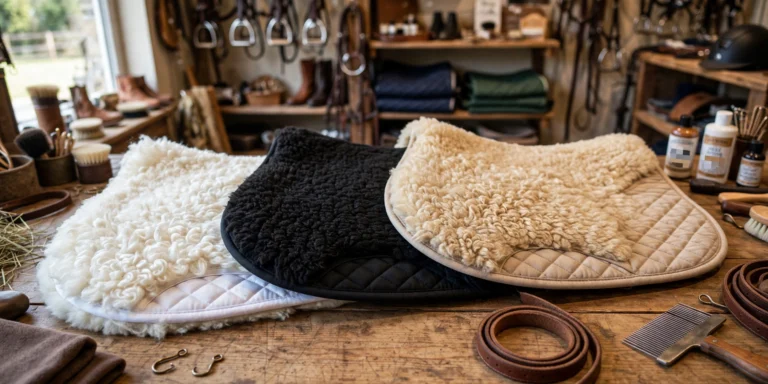
A sheepskin half pad is a pad worn under the saddle, made from genuine sheepskin — the tanned hide with the wool still attached — plus a backing layer. It adds cushioning and reduces friction, placed over or instead of a thin full pad. Do not confuse it with synthetic sheepskin-look fleece pads, which imitate the wool without the hide.
How do you evaluate wool density in a sheepskin half pad?
Start with the check, not the certificate. Part the wool down to the skin. In good wool, fibers stand upright in a dense bed and the skin is barely visible; in weak wool, the skin shows through in patches. That visual test catches more problems than any document — certificates describe the tannery’s output in general, not your order’s skins.
Then pin down the numbers with the supplier. The three values that separate a real spec from a vague promise are pile height, skin count, and skin grade:
- Pile height: Most commercial sheepskin half pads run 20–30 mm of wool — a typical range, not a rule; confirm per quote. Ask for a nominal height with a tolerance, such as 25 mm ± 5 mm, rather than accepting a single number. Taller piles need denser skins to resist matting under the saddle.
- Skin count per pad: One half pad is typically cut from two to four skins depending on skin size. Fewer, larger skins mean fewer seams and a more consistent wool bed across the pad. More seams mean more color and density variation risk — and more seam failure points under the saddle.
- Skin grade and selection: Ask what grade of skin the quote is based on. Baby lambskin or fine-wool skins command higher prices and deliver finer, denser wool; standard-grade skins work fine for mid-range retail. Either way, the factory must commit in writing to sorting out thin, damaged, or discolored skins before cutting.
Always request a sewn-in reference swatch with your first sample — a small cut of the approved wool stitched to a labeled card. Keep it sealed in your office. Every future inspection compares production wool against that swatch, not against memory.
When does a sheepskin half pad suit the horse — and when does another pad win?
No half pad material is best — only the right match for the horse, the discipline, and the saddle. A sheepskin half pad earns its place where its natural properties line up with the customer’s needs — and loses it where they don’t. Use these three conditions when deciding what to stock (see half pads vs full saddle pads):
| Condition | Sheepskin half pad commonly suits | Another pad may suit better |
|---|---|---|
| The horse | Thin-skinned or rub-prone horses, where wool’s friction reduction shows most; horses with minor asymmetry where a sheepskin shim pad balances the saddle | Heavy sweaters or horses worked hard in hot weather — sheepskin adds warmth and takes longer to dry than a thin synthetic pad |
| The discipline | Dressage, hunter, and show riders who pay for pressure distribution and a premium look under the saddle | Trail, ranch, and budget lesson programs, where wash-and-go durability and lower replacement cost matter more than wool performance |
| The saddle fit | Minor width or panel gaps a thin shim or wool bed fills without hard spots — an otherwise suitable tree with a small mismatch | Significant gaps, a wrong tree, or persistent soreness — no pad material fixes those, and padding them up creates new pressure points (see correcting common saddle-fit issues with pads) |
The practical takeaway for stocking: a shop serving dressage and hunter customers stocks sheepskin half pads as a premium tier; a general shop serving lessons and trail riders may do fine with one or two sheepskin SKUs alongside a deeper synthetic range. As a starting hypothesis — adjust by your own sales — few wholesale lines regret opening narrow (two or three colorways) and deepening only the colors that re-order.
What backing materials do factories use?
The backing is the shaped layer under the wool that gives the pad structure, holds its contour over the withers, and manages sweat at the skin side. Three options dominate factory quotes. Which one suits a program depends on the price tier, the washing expectations, and how the pad will be used — not on a fixed quality ranking:
| Backing material | Typical strengths — and under what conditions | Watch-outs — and under what conditions |
|---|---|---|
| Suede (split leather) | Holds shape and grips well over seasons of regular use; suits premium retail lines where the price carries the cost | Highest cost; quality varies between tanneries; heavier, and care instructions are stricter than for synthetics |
| Synthetic suede / microfiber | Consistent quality lot to lot, lighter, machine washes well; suits mid-range volume lines and lesson programs | Can stretch under load if the gauge is too thin — check grams per square meter; thin versions lose shape at the withers over time |
| Cotton canvas / twill | Lowest cost, breathable, easy to source; suits value lines and private-label basics | Least grip under the saddle; wrinkles over time; shrinks if washed hot — pair with cool-wash care labels |
Whatever the backing, confirm the grammage or leather split thickness on the spec sheet — synthetic suede alone tells you nothing. A buyer who writes microfiber backing, minimum grammage per confirmed quote gets repeatable results; one who writes suede-look backing gets whatever was cheapest that week.
How do binding and stitching reveal build quality?
Edge binding and stitching are the honest tell. Factories cut corners here first because buyers rarely check them at the sample stage, and retailers rarely photograph them for the catalog. Ask for a sample early and check these three points before approving bulk.
Binding. The edge should use rolled binding — a folded strip of fabric or leather that wraps the raw edge — not a flat tape stitched over it. Rolled binding resists curling and fraying through repeated use. Pull gently at a corner of the sample: the binding should lie flat and spring back, not twist. Check that binding width is consistent all the way around the pad; narrowing at curves signals rushed work.
Stitch pattern and length. Look for straight, even rows — a typical range is about 4–5 mm stitch length on quilted sections and slightly longer on binding attachment; confirm the factory’s standard per order. Wavy rows mean the operator fought the feed — common where thick wool meets backing. Flip the pad over: the underside stitching should look as clean as the top. Loose thread tails and skipped stitches at seam crossings are the most common defects flagged in pre-shipment reports, in our experience.
Stress points. Where the pad curves over the withers and where any straps or billets attach, stitching should be reinforced — either double-stitched or bar-tacked. A single row of stitching at a stress point pulls out within a season of regular use, and that is exactly the failure your end customer blames on the whole product.
How do you write a spec sheet for sheepskin half pads?
A usable spec sheet fits on one page but leaves nothing to interpretation. Include these eight blocks, each with a measured value or a photo reference:
- Wool standard: pile height with tolerance (e.g., 25 mm ± 5 mm), skin grade, color and dye standard (natural white, champagne, black — state which), plus the reference swatch number.
- Backing: material, grammage or thickness, and color. If suede, state the tannery source grade if the supplier can hold it.
- Binding: material, width, color, rolled vs. flat construction.
- Stitching: thread type and color, stitch length, stitch pattern (diamond quilt, straight channel, plain), and reinforcement points.
- Sizing: finished dimensions at each marked size (small, medium, large) measured flat, plus wither-contour depth. Never accept standard size without numbers.
- Extras: girth straps, shims or shim pockets, embroidery or woven labels, private-label packaging.
- Packing: individual polybag with or without header card, carton dimensions, pieces per carton.
- Photo reference: top, underside, close-up of wool, close-up of binding, and strap detail from the approved sample, dated and numbered.
Send this sheet with the RFQ, not after the quote. Suppliers price what is on the page — a tight spec usually returns a slightly higher quote and a dramatically lower defect rate. The cheapest quote against a vague spec is the most expensive pad you will ever buy.
What should your pre-shipment inspection check?
Run inspection against the sealed sample and spec sheet together. A practical sampling plan for a mid-size order: pull at least 10 pads from mixed cartons across the shipment, and run each one through the same five checks:
- Wool vs. swatch: compare pile height, density, and color side by side with the sealed reference swatch in natural light.
- Binding all around: check width consistency, corner finishing, and any loose ends or puckering at curves.
- Stitching audit: scan both faces for skipped stitches, loose tails, and reinforcement at stress points.
- Symmetry: fold the pad in half along the spine line — both halves should mirror. Asymmetry beyond a small visible gap at the edges (as a practical rule, around 1 cm) is a cut or sew defect.
- Odor and finish: sheepskin should smell clean, not chemical. Strong tannery or dye odor means inadequate washing and triggers customer complaints.
Record results per carton so problems can be traced to a production batch. If more than two pads in your pull show the same wool shortfall, stop and negotiate a sort or remake before the goods leave — after loading, your leverage drops to zero.
What specs should I confirm when requesting a quote?
When you send a sheepskin half pad inquiry to a factory, confirm the wool pile height range with tolerance and the skin grade the quote is based on, the skin count per pad, the backing material with grammage or thickness, the binding construction (rolled vs flat) and width, stitch length and reinforcement points, finished dimensions per size, colorways with a physical reference for each, the private-label and OEM options, and packing per carton. Standard MOQ is 50 pieces per color; pricing and delivery terms are confirmed per quote.
Frequently asked questions
What wool pile height should I specify for a sheepskin half pad?
Most commercial sheepskin half pads use 20–30 mm pile height, a typical range that balances cushioning, durability, and cost — confirm per quote. Specify a nominal height with a tolerance — for example, 25 mm ± 5 mm — because natural skins vary. Premium lines sometimes go taller, but taller piles need denser skins to resist matting under the saddle.
Is suede backing worth the cost over synthetic backing?
It depends on the line’s price tier and use case. Suede backing holds shape over more seasons and suits premium retail lines where the price carries the cost. For mid-range volume programs — lesson barns, busy training yards — synthetic suede or microfiber at a specified grammage performs reliably and washes more easily. The failure to avoid is unspecified backing: always put material and weight on the spec sheet (see how to wash saddle pads for what each backing tolerates).
How many skins should a half pad use?
A typical half pad is cut from two to four skins depending on skin size. Fewer, larger skins produce fewer seams and a more uniform wool bed, while more seams increase the risk of color and density mismatch between panels. Ask your supplier to state skin count per pad on the quote so you can compare like with like.
What is the typical MOQ for custom sheepskin half pads?
Our standard MOQ is 50 pieces per color for custom sheepskin half pads, which covers dyeing and cutting runs economically. Most factories treat wool color changes as separate production batches, so splitting across many colors multiplies setup cost. Fewer colors per order keeps unit cost down and color consistency up.
Can sheepskin half pads be machine washed?
It depends on the tanning and the backing, so confirm with the factory before printing care instructions. Real sheepskin should never go through a hot wash — it felts the wool and can shrink the skin. The safe baseline is cool washing with sheepskin-safe detergent, then air drying away from direct heat. If your line uses synthetic backing, confirm whether the full pad construction tolerates machine washing; do not assume a machine washable label transfers from one construction to another.
Sources & Further Reading
- Half pads vs full saddle pads (internal): where half pads sit in a program and how riders use them with or instead of full pads.
- Correcting common saddle-fit issues with pads (internal): which fit problems pads correct and when to refer to a fitter — applies to sheepskin as to any pad material.
- Pre-shipment saddle pad quality control checklist (internal): the full stitching, binding, and symmetry inspection routine this guide’s sheepskin checks sit within.
- How to wash saddle pads (internal): care instructions per pad construction, including what each backing material tolerates.
Ready to source sheepskin half pads with confidence? Send your target specs — wool height, backing, binding, colors, and quantity — and we will quote against a written spec sheet with a sealed reference sample. Standard MOQ is 50 pieces per color.
Related: half pads vs full saddle pads, saddle pad thickness and fill guide.
