
Dressage Pad vs All-Purpose Pad: What's the Difference?
Published · Cornovo Saddlery
Consider a common scenario: a tack shop buyer orders English saddle pads ahead of the spring season and receives a container of all-purpose pads — while the dressage customers walking in need the longer, straighter cut. The pads are good quality and correctly made, yet wrong for half the clientele. The whole loss came down to one misunderstood distinction: dressage vs all purpose saddle pad.
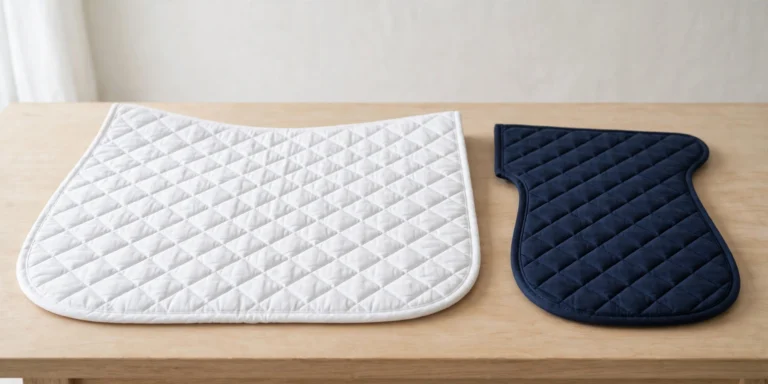
The difference is the pattern, not the materials: dressage pads are cut long and straight to cover a dressage saddle’s extended flaps, with longer billet straps for a short dressage girth; all-purpose pads are shorter and more forward-cut for jumping and flatwork. Both types share fabrics and construction, so wholesale cost and MOQs are usually comparable.
Both are English pads, both go under an English saddle, and to a new buyer they look nearly identical in a product photo. But the cut, length, strap layout, and flap coverage differ in ways that matter to riders — and to your sell-through. Here’s the full comparison, written for buyers who need to stock both correctly.
Key takeaways
- In the dressage vs all purpose saddle pad comparison, the first difference is cut: dressage pads are longer and straighter to match the long, straight flaps of a dressage saddle; all-purpose pads are shorter with a more forward-cut shape for jumping and flatwork.
- The two pads differ in girth strap placement: dressage pads carry longer billet straps positioned for a dressage girth, all-purpose pads use shorter straps for a standard girth.
- Buying the wrong type causes real problems: too-short pads leave dressage flaps rubbing the horse, too-long pads bunch under a jumping saddle.
- Competition color rules favor white or conservative colors for dressage pads (USEF DR121.1.b); schooling pads can run dark.
- The two types share materials and construction — the difference is the pattern, so confirm per-quote cost rather than assuming a gap.
What is a dressage saddle pad?
A dressage saddle pad is an English pad cut long and straight to match a dressage saddle’s extended, near-vertical flaps, with billet straps positioned for a short dressage girth and enough length to keep the entire flap off the horse’s side. Its squarer outline mirrors the dressage saddle’s geometry rather than following jumping-flap angles, and its topline usually carries a higher, straighter wither contour for the deeper seat.
How does dressage vs all purpose saddle pad shape differ?
Shape is the fundamental difference, and it’s driven by the saddles, not by fashion. A dressage saddle has long, straight flaps — the rider’s leg hangs long and the stirrup bar sits further back. The pad must extend below those flaps along their full length, or the leather edge rubs the horse’s side and the pad looks wrong in the arena.
An all-purpose saddle has shorter, more forward-cut flaps to accommodate a shorter stirrup for jumping and general flatwork. Its pad is correspondingly shorter front-to-back with a slightly more angled front edge. Put a dressage pad under an all-purpose saddle and the excess length bunches behind the flap; put an all-purpose pad under a dressage saddle and the flap overhangs the pad’s edge.
The topline differs too. Dressage pads usually have a higher, straighter wither contour to clear the deeper seat and higher pommel of a dressage saddle, while all-purpose pads use a more moderate wither cut that suits a range of saddle profiles (see saddle pad sizing guide for how profiles vary across types).
| Feature | Dressage pad | All-purpose pad |
|---|---|---|
| Length (front to back) | Longer — covers extended straight flaps | Shorter — matches forward-cut flaps |
| Outline | Straight, square | Slightly angled, rounded |
| Wither contour | Higher cut for deep-seat saddles | Moderate, fits varied profiles |
| Billet straps | Longer, positioned for dressage girth | Shorter, positioned for standard girth |
| Typical use | Dressage training and competition | Jumping, flatwork, schooling |
| Competition colors | White safest; conservative colors permitted under USEF rules | Colors and prints for daily use |
Why do the girth straps matter?
Every English pad has straps or loops that attach to the saddle’s billets to stop the pad sliding back. On a dressage pad, these straps are longer and positioned to meet the billets of a dressage saddle, which buckle lower because dressage girths are short. On an all-purpose pad, the straps sit higher and shorter for a standard long girth.
This is the detail that bites wholesale buyers: the straps look interchangeable in a catalog photo, but a dressage pad’s straps won’t reach the billets of an all-purpose saddle correctly, and vice versa. When vetting a supplier’s pattern, ask for the strap measurements against a standard saddle — or better, request a sample fitted to each saddle type before approving bulk (see saddle pad straps and girth billet keepers guide).
Does the difference affect performance or just looks?
Both. The visible part is presentation: in dressage competition, turnout expectations effectively require a white or conservative, correctly fitted pad, and a judge notices an overhanging flap. The functional part is friction and pressure: a pad edge sitting under a flap creates a ridge the rider’s leg presses into the horse, and a flap rubbing directly on the horse’s side causes the rub marks and sensitivity that customers blame on the pad’s quality.
For all-purpose riders, the risk runs the other way: an over-long dressage pad bunches behind the cantle or folds under the flap during jumping, shifting the saddle’s balance. The right pad disappears under the saddle; the wrong one announces itself within minutes of riding.
What do competition rules say about dressage pad colors?
USEF DR121.1.b states that saddle pads are optional and, when used, must be white or of conservative color; contrast trim and piping are permitted, while striped or multicolored pads are not (USEF Dressage Attire & Equipment Booklet). That makes white the safest choice for competition pads, with dark conservative colors as schooling options. Always check the current edition of your federation’s rulebook before approving bulk colorways, since wording and effective dates change.
How should a tack shop stock both types?
Think of them as two separate product lines that happen to share a factory, because the customers rarely cross over. As a starting hypothesis — adjust by your own sales — a dressage-focused shop might open with white-heavy assortments plus black and navy for schooling, while a general English shop splits depth across dressage white, and all-purpose black, navy, and one or two seasonal colors or prints for daily training. All-purpose riders — jumpers, eventers, lesson programs — buy colors and prints for daily use and replace on wear; dressage riders buy white for competition and replace on a schedule tied to show season.
Sizes are simpler than in western pads — most English pads come in full/standard with some lines offering pony or cob — so the SKU count stays manageable. Track sell-through by type for a season before deepening the split; the first reorder is where the ratio should come from your own numbers, not a generic rule (see saddle pad inventory planning for tack shops).
What should wholesale buyers check in the factory pattern?
Since dressage vs all purpose saddle pad differences live entirely in the pattern, your QC focus is dimensional. Request the factory’s measurement chart for each type: overall length, depth at front and rear, wither cut height, and strap length and position. Then compare those numbers against a known-good retail pad in each category — the fastest way to catch a factory that adjusted the pattern to save fabric.
Watch for the classic cost-cutting move: a factory producing both types from one compromise pattern. The giveaway is a pad marketed as dressage/all-purpose with in-between dimensions — it fits neither saddle properly. Insist on two distinct patterns with two measurement charts, even if the materials and quilting are identical. Shared materials keep your cost down; shared patterns cost you customers.
Binding and quilting quality matter equally for both types — check stitch density at the binding edge and whether the quilting lies flat after a wash test. But pattern accuracy is what separates a reorder from a return in this category.
What specs should I confirm when requesting a quote?
When you send a dressage/all-purpose inquiry to a factory, confirm the separate measurement charts for the dressage and all-purpose patterns, the strap length and position per type, the fill options and face fabrics per type, the colorways per type including a white confirmation for the competition line, and the private-label and OEM options. Standard MOQ is 50 pieces per color; pricing and packing are confirmed per quote.
Frequently asked questions
Can you use a dressage pad on an all-purpose saddle?
Physically yes, but it fits poorly: the extra length bunches behind the flap and the billet straps sit in the wrong position for a standard girth. For schooling it may be tolerable, but it looks wrong and can shift during jumping. Customers are better served with the correct type for their saddle.
Can you use an all-purpose pad on a dressage saddle?
Not well. In the dressage vs all purpose saddle pad matchup, the shorter pad leaves the long dressage flaps overhanging the pad’s edge, which lets leather rub directly on the horse and fails competition turnout expectations. This is the more common and more visible mismatch — if a customer rides dressage, sell them the dressage cut.
Are dressage pads more expensive than all-purpose pads?
Usually only marginally, when they are at all. The two types use the same materials and construction; the dressage pad simply uses slightly more fabric. Confirm the difference per quote — the pattern, not the cost, is what distinguishes them.
What colors sell best in each type?
White is the safest dressage pad color for competition, with black and navy covering schooling; competition rules shape this more than fashion does. All-purpose pads sell best in black and navy for everyday use, with seasonal colors and prints driving impulse buys. Stock white deep for dressage; stock variety for all-purpose — then adjust by your own sell-through.
How do I explain the difference to a new rider?
Keep it to one sentence: the pad has to match the saddle’s flap shape, and dressage saddles have longer, straighter flaps than all-purpose saddles. Show them both pads side by side against the two saddle types — the visual makes the point faster than any explanation, and it positions your staff as knowledgeable.
Sources & Further Reading
- USEF Dressage Attire & Equipment Booklet: DR121.1.b — saddle pads optional; when used, white or conservative color; contrast trim and piping permitted; striped or multicolored pads not permitted.
- Saddle pad sizing guide (internal): how profiles and sizes vary across pad types.
- Saddle pad straps and girth billet keepers guide (internal): strap attachment methods across English pads.
- Saddle pad thickness and fill guide (internal): what fill does and doesn’t change.
- Saddle pad inventory planning for tack shops (internal): building reorders from your own sell-through.
We wholesale both sides of the dressage vs all purpose saddle pad decision as distinct patterns — plus western pads, half pads, and cinches — with OEM and private-label options. Standard MOQ is 50 pieces per color, packing by inquiry. Send your target specs and quantities for a wholesale quotation.
Related: how saddle pads are made, saddle pad design trends 2026.
