Saddle Pad Trends 2026: What Retailers Should Stock
Published · Cornovo Saddlery
Consider a common scenario: a tack shop’s markdown bin fills with last season’s brights — neon-yellow and hot-pink pads marked down deep and still not moving. The buyer had ordered deep on the colors that sold two years earlier, and the market had already moved on.
Saddle pads are fashion goods wearing workwear. The core shapes barely change, but color and detailing decide what sells at full price and what dies in the discount bin. Getting saddle pad trends 2026 right isn’t about chasing every novelty — it’s about knowing which shifts are real, which are noise, and how much depth to buy behind each one.
Here’s what we’re seeing move at retail for the 2026 season, based on our own order patterns and buyer feedback: the colors, the details, the western/English split, and a practical way to build an assortment that sells through. Treat it as one supplier’s read of the market — validate against your own sell-through data before committing depth.
Key takeaways
- Earth tones and muted jewel tones lead 2026; neon and ultra-bright palettes continue to fade at retail.
- Contrast binding and piping remain the cheapest way to make a pad look new — detail outsells novelty prints.
- Matching sets (pad plus boots, bandages, or fly veil) keep driving multi-unit sales in English disciplines.
- Western pads hold steady on blanket-top patterns and tooled-leather-look detailing rather than chasing English color cycles.
- Stock core colors deep year-round and buy trend colors in smaller depth with faster reorder options.
What is a color story?
A color story is the coordinated seasonal palette a brand releases across its range — the pad body colors plus their matching binding, piping, and embroidery threads. Retailers buy into a color story rather than single colors because coordinated stock displays better, photographs better, and lets customers build matching sets. For 2026, most stories we’re seeing are built around two or three muted base colors with one accent.
Saddle pad trends 2026: which colors are leading?
The direction is consistent across the European and North American retail we track: quieter, deeper, more natural palettes. Here’s how the main color families are performing in the saddle pad trends 2026 cycle, as we see it:
| Color family | 2026 direction | Where it works |
|---|---|---|
| Earth tones (taupe, sand, olive, clay) | Strong — the leading trend family | Dressage and everyday schooling pads |
| Muted jewel tones (forest, deep teal, burgundy, plum) | Strong — replaces last year’s brights | Jumping pads, seasonal collections |
| Classic navy, black, white | Steady — never out, never the story | Show pads, core year-round stock |
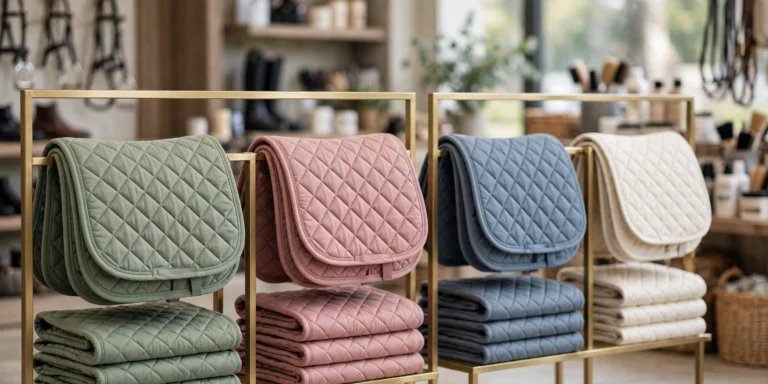
| Soft pastels (sage, dusty rose, powder blue) | Holding in spring assortments | Junior and amateur riders |
| Neon / hi-vis brights | Fading — markdown risk | Only for price-driven volume lines |
| Metallics and glitter | Niche — occasional, not core | Show-ring statement pieces in small depth |
The practical read: if a color needs a discount to move, it’s last season’s color. The 2026 palette sells at full price because it looks expensive — deep, muted, and coordinated.
What design details are selling?
Color gets the attention, but detailing closes the sale. These are the details defining saddle pad trends 2026 at the product level, in our experience supplying both disciplines:
- Contrast binding: a binding in a darker or lighter tone than the pad body remains the single most effective value-add. It costs little in production and reads as designed on the shelf.
- Double piping: two thin piping cords along the edge instead of one — a small upgrade that photographs well and justifies a higher ticket.
- Subtle tone-on-tone quilting: diamond or chevron quilting in thread that matches the shell, for a textured look without loud pattern.
- Discreet embroidery placement: small logos at the front corner or along the spine rather than large center motifs. Riders want the brand whisper, not the shout.
- Technical fabrics: moisture-wicking linings and breathable mesh panels marketed with plain-language benefit lines (keeps the back drier) rather than fiber jargon.
Do western and English trends differ?
Yes, and mixing them up is a classic assortment mistake. English disciplines (dressage, jumping) run on seasonal color stories — that’s where the earth-tone shift is happening fastest. Western pads move slower and more traditionally: blanket-top woven patterns, tooled-leather-look printed borders, and solid colors with contrast wear leathers hold year after year. A western buyer doesn’t need the 2026 color story; they need the patterns their customers have bought for a decade, executed well. Our western vs English comparison covers the construction differences behind the two markets.
Half pads sit in between — mostly conservative (black, brown, white, grey) with subtle piping as the only fashion element. Don’t push seasonal colors into half pads; the sell-through won’t support it.
What should retailers not overstock?
Three markdown traps for 2026: first, last season’s brights bought on closeout — cheap cost means nothing if the color won’t sell at any price. Second, novelty prints (novelty animal prints, slogan embroidery) in depth; they work as single-SKU conversation pieces, not as range builders. Third, white pads beyond show-season demand — white is a staple, but it’s also the color most returned for looking dirty, so keep depth tied to competition calendars.
How should a small shop build its 2026 assortment?
Use a core-plus-trend split. As a starting example — adjust to your own sell-through — put roughly two-thirds of your pad budget into core colors that sell every month (black, navy, white, brown, grey) in your best shapes, and the remaining third into two seasonal color stories, bought in smaller depth per color so you can reorder winners and let losers die quietly.
Display the trend colors together as a story, not scattered among the core stock — a coordinated wall of earth tones sells the palette, while single pads get lost. And keep one eye on reorder lead time: trend colors bought in small depth only work if you can restock the winner within the season, so confirm your supplier’s reorder timeline before the season starts. Our standard custom MOQ is 50 pieces per color, which sets the minimum depth for a trend-color test.
Where do saddle pad trends 2026 show up first?
If you want an early read on next season, watch three places. First, the big European trade shows, where brands preview color stories well before they hit retail — the earth-tone shift was visible there before it reached shops. Second, sponsored riders’ social feeds: when several top riders appear in the same muted palette, the retail wave follows within a season. Third, your own sell-through data — the colors that needed no discount last season are your safest trend bets for this one.
The common thread across all three: saddle pad trends 2026 reward restraint. The winners are the colors and details that look considered rather than loud, and the retailers winning with them are the ones who bought depth behind two or three stories instead of sprinkling budget across ten.
Frequently asked questions
How far ahead should I order trend colors for 2026?
Work backward from when you need them on the shelf. Custom pads typically need several weeks of production after sample approval plus freight, and sampling adds weeks before that — confirm the schedule with your factory. For spring 2026 delivery, most buyers finalize color stories in the preceding autumn. Ordering trend colors late means arriving after the demand peak.
Will white show pads ever go out of style?
No — white remains the required color in most dressage competition, so demand is structural, not fashionable. What changes is the detailing around it: contrast binding colors, piping styles, and embroidery trends move while the white body stays. Keep white in the core assortment permanently.
Are matching sets still popular?
Yes, particularly in jumping and among junior riders — a pad with matching boots or bandages lifts the average transaction noticeably. Stock the sets as sets: display them together and price the bundle slightly below the separate items. The 2026 muted palette actually helps here, since earth tones coordinate across products more easily than brights.
How do I test a new color without overstocking?
Buy the smallest viable depth in one shape first — for most shops that’s a single size run of a dressage or all-purpose pad — and watch the first month’s sell-through rate before committing the color across shapes. A supplier with reasonable reorder MOQs and short restock lead times makes this strategy work; one that doesn’t makes every new color a gamble.
Sources & Further Reading
- Western vs English Saddle Pads — the two markets behind the trend split
- Custom Saddle Pad MOQ and Lead Times — minimum depth for testing a trend color
- How OEM Saddle Pad Programs Work — building a seasonal color story with a factory
- Saddle Pad Thickness and Fill Guide — construction options behind the detailing trends
Planning your 2026 pad assortment? We produce dressage, jumping, western, and half pads in seasonal color stories with contrast binding, piping, and embroidery options — OEM and private label at a standard MOQ of 50 pieces per color. Send your target colors and quantities for a quotation and sample timeline.
