
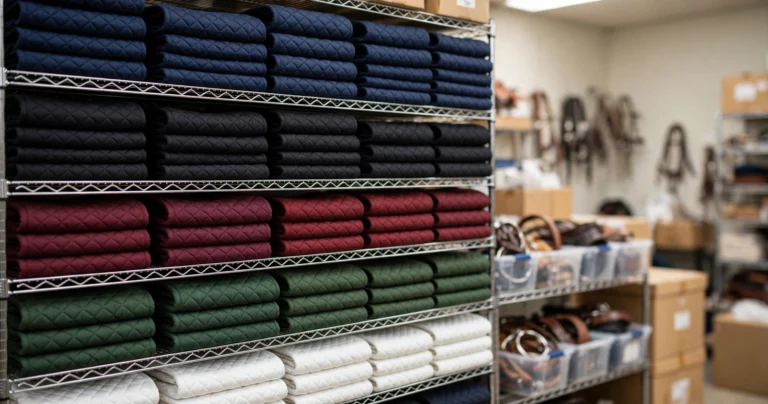
Saddle Pad Inventory Planning: Colorways, Sizes and Reorder Math for Tack Shops
Published · Cornovo Saddlery
Consider a common scenario: a tack shop places its first big custom pad order and splits it evenly across a wide color range — the same quantity of every color, neat and fair. Months later, the navy and black are gone, the burgundy is half gone, and the rest sit untouched, tying up cash and shelf space. The order wasn’t too big. It was too even. Real demand is never evenly distributed, and saddle pad inventory planning is the discipline of stocking to the curve instead of the average.
In short: treat each colorway as its own product with its own demand curve; weight the order toward proven core colors with smaller seasonal and test quantities; set reorder points from each colorway’s weekly sell-through against the full replenishment lead time (production plus freight plus customs) plus a safety buffer; and stop reordering any colorway that fails to move over a selling season. The worked examples below are starting hypotheses — adjust every split by your own sell-through data. This guide gives tack shops and distributors a practical method for all of it, built around 50-pieces-per-color custom economics.
Key takeaways
- Weight orders toward proven core colors, keep seasonal colors smaller, and reserve minimum-quantity test colorways for learning — then adjust every split by your own sell-through.
- Size curves follow your customer mix, not a generic ratio: English pads concentrate in horse/full, western pads spread wider, pony programs deserve their own line.
- Set reorder points from sell-through rate, not the calendar: reorder when remaining stock of that colorway covers the full lead time plus a safety buffer.
- Slow colors become pad-and-boot or pad-and-bridle sets — bundling moves dead stock faster than discounting and protects the line’s price perception.
- Review sell-through by colorway monthly — a color at low sell-through halfway through its season is already telling you to act, not to wait.
What is saddle pad inventory planning?
Saddle pad inventory planning is the method of deciding how many pads to stock in each color, size, and style — and when to reorder — so that bestsellers never stock out while slow movers never pile up. For tack shops and distributors, it is a cash-flow discipline: every pad on the shelf is money waiting to convert, and pads in the wrong colorway convert slowest. Good planning treats each colorway as its own product with its own demand curve, not as an interchangeable unit.
How should you split an order across colors?
There is no industry-standard stocking ratio — but there is a useful way to think about it: split the order into core colors (the proven year-round sellers), seasonal colors (tied to season or trend), and test colors (new or bold, ordered at minimum quantity for learning, not revenue). The right balance depends on your customer type, so treat these as starting hypotheses and adjust by your sell-through:
| Customer type | Core colors (starting hypothesis) | Seasonal colors (starting hypothesis) | Test colors (starting hypothesis) |
|---|---|---|---|
| General mixed tack shop | About half the order in 2–3 proven sellers | About a third in 3–4 season-driven colors | One or two new colorways at the 50-piece floor |
| Show and competition-focused shop | Heavier core weight — conservative show colors dominate | Smaller seasonal share; trends land slower here | One test colorway, kept minimal until proven |
| Riding school and bulk buyer | Most of the order in durable dark colors | Small seasonal share or none | Rarely — consistency beats novelty for fleets |
The point of the test bucket is learning, not revenue: a test color that sells out teaches you next season’s seasonal color; one that doesn’t gets replaced. Promote test colors to seasonal only after they prove sell-through at full price — never on the back of a discount.
For custom programs at 50 pieces per color, the arithmetic is concrete: a 300-pad order means six colorways. A mixed-shop starting hypothesis could be 3 core, 2 seasonal, and 1 test colorway at the MOQ floor. If a color can’t justify its 50-piece minimum from expected demand, it doesn’t belong in the order — fold its units into a proven core color instead.
How should you split across sizes?
Size curves follow the discipline mix of your customers, not a generic ratio. English pads typically concentrate in horse/full — a common starting hypothesis is weighting that size heaviest — with cob and oversize splitting the rest. Western pads spread wider because the customer base runs from youth riders to large ranch horses. Pony sizes deserve their own line in the plan wherever you serve riding schools or pony clubs.
The reliable method is your own sales history: pull the last 12 months of pad sales by size, convert to percentages, and apply those percentages to the new order. No history yet? Start with a conservative skew toward the mainstream sizes (horse/full first), keep the edge sizes at minimum quantities, and let one selling season of data correct the split. Guessing a wide size spread on a first order is how shops end up with oversize pads that sit for two years.
When should you reorder? The sell-through formula
Reorder on rate, not on date. The formula:
Reorder point = (weekly sell-through × lead time in weeks) + safety stock
Illustrative example (plug in your own numbers): a navy all-purpose pad sells 8 units per week. The full replenishment lead time is 6 weeks, and you want 2 weeks of safety stock. Reorder point = (8 × 6) + (8 × 2) = 64 units. When stock of that colorway hits 64, the reorder goes in — the new stock arrives just as the shelf empties, with buffer for a demand spike or a shipping delay.
Two refinements make this work in practice. First, calculate per colorway, not per style — the navy and the burgundy of the same pad have different sell-through rates and need different reorder points. Second, stretch the lead-time input to include the full cycle: production lead time plus ocean freight plus customs clearance, not just the factory’s quoted production days. A 30-day production quote with 35 days of freight is a 9-week lead time, not a 4-week one.
How do you prevent dead stock?
Dead stock is a colorway that stops selling, not a product that was wrong. Three moves keep it moving:
- Bundle it. Pair the slow pad color with matching boots, a bridle, or a halter as a set at a small bundle discount. Sets move slow colors faster than markdowns and protect the price perception of the line.
- Reposition it. A color that fails at full retail may succeed as a riding-school bulk color or a show-prize sponsorship — different channel, same inventory, better margin than a clearance bin.
- Stop reordering it. The hard rule: a colorway that stays at weak sell-through through a full selling season doesn’t get reordered — replace it with a new test color. Set your own cutoff from your margins and carrying costs; the point is having one, not what the number is. Sentimentality about a color is how shelves fill with last year’s palette.
Mark slow colors early. Review sell-through by colorway monthly — a color at low sell-through halfway through its season is already telling you it won’t recover. Acting in month three (bundle, reposition) costs far less than acting in month nine (clearance).
What specs should I confirm when requesting a quote?
- MOQ per colorway (our custom programs run at 50 pieces per color) and whether test colorways can run at the floor
- Lead-time band including production plus typical freight routing — confirm the full replenishment cycle per order
- Whether reorders can be split across colorways to match your sell-through curve
- Colorway-matching consistency between repeat runs (dye-lot control for restocking core colors)
- Packing per unit for shelf-ready delivery vs bulk — and whether bundling sets changes the pack
Frequently asked questions
How many saddle pads should a tack shop stock per color?
It depends on sell-through — start with most units in 2–3 proven core colors, a smaller share in seasonal colors, and one or two test colorways at minimum quantity, then adjust every split by your own sales data. For custom programs with a 50-pieces-per-color MOQ, a 300-pad mixed-shop order commonly starts as roughly 3 core, 2 seasonal, and 1 test colorway.
What is a good sell-through rate for saddle pads?
Track it per colorway, not per style. A healthy core colorway turns its stock within one selling season at full price; a colorway that stays weak through a full season is a signal to drop the color, not reorder it. Compare colorways against each other — the ranking matters more than any absolute number.
When should I reorder saddle pads?
When remaining stock of that colorway covers the full replenishment lead time (production + freight + customs) plus a safety buffer of 1–2 weeks of sales. Calculate it as: reorder point = weekly sell-through × lead-time weeks + safety stock.
How do I handle slow-moving pad colors?
Bundle them into pad-and-boot or pad-and-bridle sets, reposition them to bulk channels like riding schools, and stop reordering them. Monthly sell-through reviews catch slow colors early, when bundling still works — late clearance should be the last resort.
Should test colors get the full 50-piece MOQ?
Yes — 50 pieces per color is the floor for a custom colorway, which is exactly what makes it a good test size: small enough to limit risk, large enough to read real demand. If a color can’t plausibly sell 50 units, it shouldn’t be a custom colorway at all.
Sources & Further Reading
- Saddle pad buying calendar for tack shops (internal): when to place the orders this plan produces.
- Seasonal color drops for private-label saddle pads (internal): how the seasonal bucket is designed and launched.
- Saddle pad distributor pricing and margin tiers (internal): the margin math behind how deep to stock each color.
- Saddle pad SKU architecture for private-label brands (internal): structuring colorways and sizes into a clean SKU plan.
- Launching a private-label saddle pad line: timeline (internal): the production timeline your reorder points have to cover.
Planning your next saddle pad program? We manufacture custom pads at 50 pieces per color with reorder-friendly production scheduling — send your colorway plan and we’ll confirm lead times and split the production to match your sell-through. Send your specs for a quotation.
