
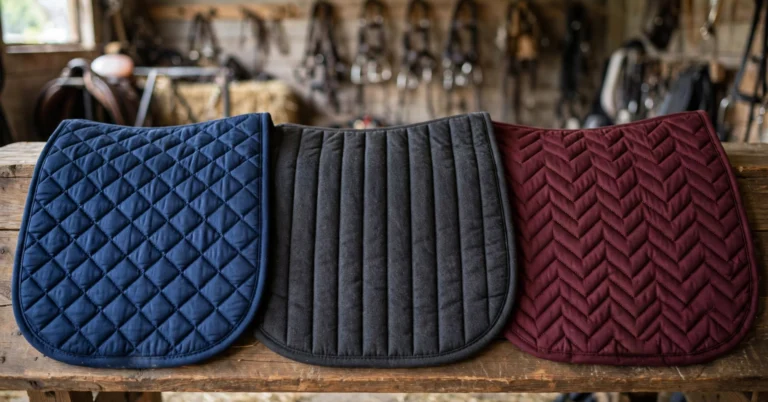
Saddle Pad Quilting Patterns Explained: Diamond, Channel and Chevron for Buyers
Published · Cornovo Saddlery
Consider a common scenario: a wholesale buyer develops two saddle pads — same face fabric, same fill, same price. One carries diamond quilting, the other channel quilting. The diamond version draws more interest from dressage-oriented shops, while the channel version sits naturally in schooling programs. Quilting pattern is the first thing a rider notices on a pad, and one of the last things buyers specify with enough precision — which makes it a quiet source of both retail preference and factory disputes.
Short answer for riders and buyers: quilting is the stitched grid that locks a pad’s layers together, keeps fill from migrating, and defines the pad’s look. Choose the pattern your discipline expects — diamond is the safe default for English show work — keep cells tighter for thick fills, and always write pattern, cell size, and stitch length into the tech pack rather than relying on a reference photo alone.
This guide covers the quilting patterns that matter in wholesale saddle pads, how quilting affects performance beyond looks, how to write the pattern into a tech pack, and what to check at inspection.
Key takeaways
- Diamond, channel (straight-line), chevron, and square quilting cover most wholesale saddle pad programs; each carries different discipline and market associations.
- Quilting controls fill migration: smaller quilt cells keep fill evenly distributed, while larger cells allow more shift under the saddle — a tradeoff, not a quality ranking.
- Specify quilting with numbers — pattern name, cell size in centimeters, and stitch length — never with a photo alone.
- Denser quilting adds stiffness; schooling pads for daily work commonly use larger cells and a softer drape, while show pads lean toward the crisp structure of tighter quilting.
- Quilting is one of the most productive pre-shipment checkpoints: check pattern symmetry, stitch consistency, and puckering on every inspection.
What is saddle pad quilting?
Saddle pad quilting is the stitched pattern that fixes the pad’s layers — top fabric, fill, and lining — into a set grid. It is structural: without it, fill migrates toward the edges and bunches under the saddle after a few rides. It is also visual: the pattern is the pad’s most recognizable design feature, and in wholesale buying it signals discipline, price tier, and target rider before anyone touches the pad.
The engineering job and the visual job are inseparable, which is why buyers should treat quilting as a specification, not a decoration. A pad’s quilting choice affects how the fill behaves over the pad’s life, how the pad conforms to the horse’s back, and how well it survives repeated washing — the sections below break each of these down for buying decisions.
What are the main quilting patterns?
Diamond, channel (straight-line), chevron, square, and custom programmed quilting cover nearly all wholesale saddle pad programs. Each carries different discipline and market associations — diamond reads English show ring, channel reads schooling workhorse. The table below gives commonly observed cell-size ranges; treat these as starting references for development, not fixed rules, and confirm exact dimensions with your factory on the tech pack.
| Pattern | Description | Commonly observed cell size | Market association | Where it typically fits |
|---|---|---|---|---|
| Diamond | Diagonal crosshatch forming diamonds | Often 5-8 cm | English disciplines, dressage | Show pads and premium all-purpose lines where the classic look sells |
| Channel / straight-line | Parallel lines, usually vertical | Often 4-7 cm spacing | Schooling, everyday work | Schooling pads and everyday work pads where soft drape matters |
| Chevron / herringbone | V-shaped zigzag rows | Often 5-8 cm | Fashion-led English lines | Trend-led retail lines; best treated as a seasonal SKU rather than a core one |
| Square / box | Grid of squares | Often 6-10 cm | Utility, stable | Stable rugs and budget pads where simplicity keeps cost down |
| Custom / logo quilt | Pattern incorporating brand shapes | Varies | Private label | Branded programs with enough volume to amortize the setup cost |
In our experience supplying wholesale programs, diamond quilting is the default visual language of English saddle pads — riders read it as proper almost unconsciously, which is why it remains the safe core choice for new dressage lines. Channel quilting is common on schooling pads partly for the softer drape it gives and partly for sewing economics: fewer direction changes generally mean faster, more consistent machine work. Chevron moves in and out of fashion; it sells strongly when current and dates a line when it is not, so plan it as a trend SKU rather than a multi-season core.
How does quilting affect pad performance?
Quilting affects three things buyers care about: whether the fill stays put, how the pad drapes on the horse’s back, and how the pad survives washing. The pattern choice is a tradeoff between these — tighter cells stabilize fill but stiffen the pad — so the right answer depends on the pad’s intended use. There is no universal best pattern; there is only the right pattern for the riding application and the buyer it serves.
- Fill migration. Smaller quilt cells pin the fill in place; larger cells allow more shift over time. For thick fills (wool felt, high-loft fiber), tighter quilting — commonly in the 5 cm range in our production experience — keeps pad thickness even across the pad’s life. This is the structural reason show-oriented pads commonly use tighter quilting, not only the look.
- Stiffness and drape. Every stitch line acts as a hinge point. Dense quilting makes a pad stiffer and more board-like; open quilting lets it conform to the horse’s back. Schooling pads commonly benefit from softer drape (fewer, wider-spaced lines); show pads commonly benefit from the crisp structure that denser quilting provides.
- Wash durability. Quilting takes the mechanical stress of washing. In our experience, broken quilting stitches are among the most common field failures on budget pads — the fill then migrates and the pad’s useful life effectively ends. Specify the stitch type and check stitch integrity at inspection; quilting is a durability feature, not decoration.
For a deeper look at how stitch construction interacts with pad engineering, see our guide on saddle pad stitch density and foam density.
How do you write quilting into a tech pack?
Diamond quilt written on a purchase order has caused more factory arguments than almost any other two words in this category. The fix is to write quilting as a numbered specification — pattern, cell size, stitch length, thread, and edge treatment — so the factory builds what you quoted instead of what it assumed. Our guide to briefing a factory on custom saddle pads covers the full tech-pack process; quilting deserves its own dedicated section within it.
- Pattern name plus a diagram. Name the pattern and attach a scaled drawing showing the geometry. The drawing resolves what the name leaves ambiguous — diamond alone says nothing about proportions.
- Cell size in centimeters. State the diamond diagonal, the channel spacing, or the chevron pitch as a number with a tolerance (commonly ±0.5 cm). Confirm the exact tolerance with the factory rather than assuming it.
- Stitch length. Specify stitches per centimeter or per inch. Shorter stitches hold better and look finer; longer stitches sew faster and cost less. This is a cost-quality lever the buyer should control deliberately, not leave to the sewing line.
- Thread specification. Thread type and color — contrast thread is a design feature, matching thread is the safe default. Confirm the thread is rated for the pad’s expected washing.
- Edge treatment. State how the quilting terminates at the binding — quilting lines should run under the binding, not stop short of it, or the edge cells lose their fill anchoring. See also our saddle pad binding and edge finishing guide.
For private-label programs, this is also where custom quilting enters: a brand’s logo or signature shape quilted into the pattern. It requires a template or programmed sewing setup, so it amortizes best at volume — discuss the setup cost as a separate line item from the per-piece price, at our standard MOQ of 50 pieces per color. Our custom branding and embroidery guide covers how logo quilting compares with embroidered branding.
What should inspectors check on quilting?
Quilting is one of the most productive checkpoints on a pre-shipment inspection — pattern defects are visible at a glance and almost always trace back to a specific sewing-stage problem. Add these five checks to the pre-shipment QC checklist for every saddle pad order:
- Symmetry. The pattern should mirror across the pad’s center line. Asymmetric quilting is immediately visible on the horse and reads as defective to riders.
- Cell consistency. Measure cell size at multiple points — drifting cell size across the pad indicates the layers shifted during sewing.
- Puckering. Rippled fabric between stitch lines means the top and lining fed unevenly. Light puckering may press out; heavy puckering will not.
- Skipped and broken stitches. Check stitch lines under good light, especially at pattern intersections where the needle changes direction.
- Quilt-to-binding junction. Confirm quilting runs fully under the edge binding with no unanchored edge cells.
What specs should I confirm when requesting a quote?
Before the factory prices your program, confirm these quilting-specific items in writing — they are the details that separate a clean production run from a round of remakes:
- Pattern geometry: name plus a scaled diagram, signed off by both sides.
- Cell size in centimeters with an agreed tolerance.
- Stitch length (stitches per cm or inch) and thread type rated for the pad’s washing.
- How quilting terminates under the edge binding.
- Whether the quoted price assumes standard or custom/programmed quilting, with any setup cost as a separate line item.
Frequently asked questions
Does quilting pattern affect saddle fit?
Indirectly. Denser quilting makes a pad stiffer, which changes how it conforms under the saddle — a very stiff pad can bridge over the horse’s back instead of following it. For fit-sensitive applications (narrow horses, high withers), more open quilting is commonly the safer choice. The pattern shape itself matters less than the density it creates.
Which quilting pattern is most popular for dressage pads?
Small diamond quilting, commonly in the 5-6 cm range, remains the standard visual language for dressage — you can see diamond stitching positioned as the classic choice on mainstream dressage pads across the market. White pads with subtle tonal stitching dominate the show ring; colored pads with contrast stitching sell in the schooling and fashion segments. When in doubt for a new dressage line, diamond is the safe core and chevron is the trend bet.
Can I get a custom quilting pattern at low MOQ?
Custom patterns need a template or machine program, which carries a setup cost. At our MOQ of 50 pieces per color, simple customizations — adjusted cell size, contrast thread, bound edges in a brand color — are straightforward; fully bespoke programmed patterns are more economical when the setup cost spreads across larger volumes. Ask for the setup cost as a separate line item.
Why does quilting sometimes pucker after washing?
Differential shrinkage between the top fabric, fill, and lining — the layers shrink at different rates and the stitch lines gather. It is prevented by pre-shrinking compatible materials and by matching layer shrinkage in development, not fixed after the fact. Wash-test the finished pad (not just the fabric) before approving bulk.
Is hand-quilting worth the premium over machine quilting?
For wholesale programs, machine quilting is the standard — it is consistent, fast, and strong. Hand-quilting appears in artisan and heritage-positioned lines where the story justifies the price. Do not pay a hand-quilting premium unless your retail channel can tell that story at the price tag.
Quilting is where a saddle pad’s engineering meets its shelf appeal — specify it with numbers, inspect it like a structural feature, and choose the pattern your riders already read as theirs. Send your target pattern, cell size, and quantities (from 50 pieces per color) for a quotation, and we will confirm stitch specifications and sampling on the tech pack.
Sources & Further Reading
- Cavalleria Toscana jumping saddle pad — diamond and line quilting described as improving weight distribution and comfort (supports the structural, not merely decorative, role of quilting)
- Equestro dressage saddle pad with diamond quilting (illustrates diamond stitching as the established visual standard for dressage pads)
- Saddle pad stitch density and foam density tech sheet (internal)
- How to brief a factory on custom saddle pads (internal)
- Pre-shipment QC checklist for saddle pads (internal)
