Saddle Pad Binding and Edge Finishing: What Wholesale Buyers Should Check
Published · Cornovo Saddlery
Consider a common scenario: a tack shop unpacks a new private-label saddle pad run. A thumb run along the edge finds the binding rippling away from the quilted shell — the pads go back into the box with a note instead of onto the shelf. Binding is the part of a saddle pad customers touch first, and it is where weak sewing shows first.
If you buy saddle pads wholesale, put binding on its own specification line: name the material, set the finished width with a tolerance, and require the stitch type and stitch count. Then check five edge defects on every pre-shipment sample — rippling, wandering width, frayed ends, skipped stitches, and off-grain binding — before the shipment leaves the factory.
For wholesale buyers, binding and edge finishing deserve a line in the tech pack, not a footnote. This guide covers the binding materials factories work with, how to specify widths and stitch types conditionally by program, and the inspection checks that catch edge failures before they ship.
Key takeaways
- Binding is the most-handled part of a saddle pad and a frequent source of tack-shop returns — specify material, finished width with tolerance, and stitch type explicitly.
- Polyester grosgrain suits daily-use and schooling programs; cotton twill suits natural-fiber lines; satin, leather-look, and suede suit show and premium lines where appearance outweighs wash-and-wear durability.
- Most wholesale tech packs specify double-needle stitching; single-needle binding is where failures typically start on pads that are used and washed hard.
- The six binding defects to inspect: rippling, uneven width, frayed ends, skipped stitches, off-grain binding, and color mismatch.
- Binding color and width are cheap private-label differentiators — supply Pantone references and approve a sewn swatch before bulk production.
What is binding on a saddle pad?
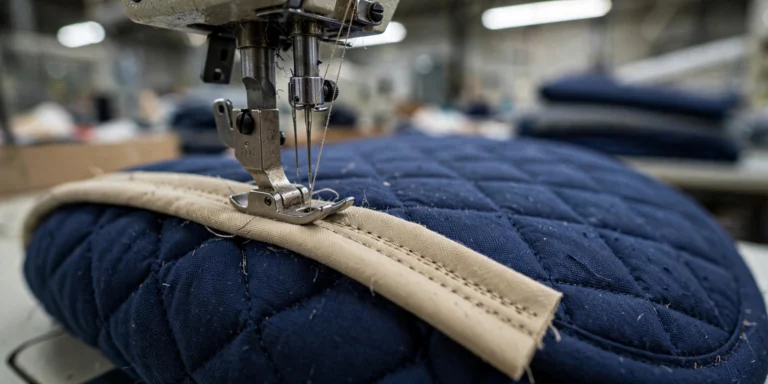
Binding is the strip of fabric folded over a saddle pad’s raw edges — the perimeter, the strap slots, and any shaped cutouts — and stitched down to enclose them. It does three jobs: it keeps the quilted layers from separating and fraying, it gives the pad its finished outline and color accent, and it absorbs the abrasion from girths, stirrup leathers, and daily handling.
What binding materials do factories use?
There is no single best binding material — each suits a different program type. Use this table to match the material to the pad’s use case, and name the material in the spec: standard binding means whatever the factory has on the shelf that week.
| Binding material | Where it typically fits | Watch out for |
|---|---|---|
| Polyester grosgrain | Mid-tier and daily schooling lines that see frequent washing — holds color and shape through repeated wash cycles | Ribbed texture reads utilitarian, so it suits workhorse programs better than premium show lines |
| Cotton twill tape | Natural-fiber and heritage-look programs where a soft hand matters | Fades faster in repeated washing and can shrink if not pre-shrunk — confirm colorfastness grade and shrinkage before approving |
| Polyester satin | Show and fashion colorways where a glossy finish helps sell the pad | Shows abrasion and snags sooner — avoid on daily schooling pads that face girths and leathers every day |
| Leather-look (PU) binding | Premium and show-ring lines where an upscale edge is part of the design | Higher cost and stiffer hand; ask for cracking-resistance data and check edge paint quality on samples |
| Suede / microsuede | High-end pads and half pads where a soft edge suits the design | Marks and stains show, especially on light colors — make sure care labeling matches the material |
| Self-fabric binding | Quilted cotton pads where the cleanest coordinated look matters | Consumes more shell fabric, which nudges the unit cost up — confirm pricing impact per quote |
For a standard wholesale program, polyester grosgrain typically covers the volume SKUs and a leather-look or suede option covers the premium tier. That split is a starting hypothesis from our supplier experience, not a rule — match the materials to your customers’ wash-and-wear reality.
What binding widths and stitch types should you specify?
Specify width, stitch type, and stitch count as three separate lines. Finished binding widths on saddle pads commonly run about 1 inch (2.5 cm) for a neat tailored look to about 2 inches (5 cm) for a bold contrast edge. Wider binding gives more visual weight and hides edge irregularities more forgivingly; narrower binding saves a little material but shows every wobble. Set the finished width with a tolerance (for example, 3.8 cm finished, plus or minus 3 mm) — binding that wanders between 3 and 5 cm around one pad looks handmade in the wrong way.
Stitch type. Most wholesale tech packs we see specify double-needle stitching — two parallel rows. The two rows share the load, so if one row’s thread breaks, the binding stays attached. Single-needle binding is acceptable on light-use pads, but on pads that are ridden and washed hard it is where failures typically start: at corners, the curve of the wither cutout, and strap slots.
Stitch count. In our supplier experience, 7 to 9 stitches per inch is typical for binding on quilted pads; bindings stitched below 6 per inch open first under wash-and-wear stress. Ask the factory to name the stitch count in the spec and confirm it is held in bulk production, not just on the sample.
Edge distance. The stitch lines should sit a consistent distance from the binding edge all the way around the pad. Wandering stitch lines are the fastest visual tell of rushed sewing — and they are visible to any customer who looks at the pad for five seconds. See our saddle pad tech sheet guide for how to write stitch and tolerance specs.
What is piping, and when should buyers specify it?
Piping (also called welting or corded edging) is a covered cord sewn into the seam between the binding and the pad body, creating a raised decorative ridge. It is a style choice, not a structural one — but it changes the QC picture. Piping adds a seam that must stay even all the way around the pad, and uneven piping is more visible than uneven binding.
Specify piping by cord diameter and covering material, and check it at the same stress points as binding — corners and curves. For schooling and daily-use pads, buyers who prioritize wash-and-wear durability commonly skip piping: it adds cost and a failure mode without adding durability. For show pads and fashion lines, it is a strong visual differentiator worth the extra inspection. When you write the brief, follow the same discipline as briefing a factory on custom pads: every trim choice named, measured, and approved on a sample.
Which binding defects should inspection catch?
Build these into the pre-shipment checklist, checking every sampled pad at the perimeter, the wither curve, and the strap slots:
- Rippling or puckering. Binding that waves instead of lying flat means the binding was stretched or the shell gathered during sewing. It does not press out — reject the piece.
- Uneven finished width. Measure the binding width at six points around the pad. Variation beyond the agreed tolerance signals sloppy folding, and it is visible on the shelf.
- Frayed or unfinished ends. Binding ends at the back slit or strap slots must be folded under or bar-tacked. Raw cut ends fray in the first wash.
- Skipped stitches and thread breaks. Run a finger along both stitch rows. Missed stitches on binding are a straight path to the binding peeling off in use.
- Off-grain or twisted binding. Binding sewn with the weave skewed twists along the edge and will never sit flat. Check by sighting down the edge.
- Color mismatch. Binding dyed in a different lot from the shell — or sourced from a different supplier — can read as a different shade. Check binding against shell under consistent light, across cartons.
How does binding factor into private-label programs?
Binding is one of the cheapest ways to differentiate a private-label pad. The pad body can be a proven standard construction while the binding carries the brand identity: a signature contrast color, an embroidered logo repeated on the binding, or a distinctive width. Because binding is applied late in assembly, colorway changes at the binding level are simpler than changing shell fabrics.
Practical notes for custom binding programs: each binding colorway typically counts as a separate production setup, so it falls under the same MOQ logic as colorways — our standard MOQ is 50 pieces per color. Supply Pantone references for binding colors rather than approving from screen photos, and approve a physical binding swatch sewn onto a sample corner before bulk production. If the binding carries an embroidered logo, the artwork needs the same vector-file and digitizing treatment as any other embroidery — see custom branding options for private-label buyers.
What specs should I confirm when requesting a quote?
When you request a quote on saddle pads, confirm the binding material by name (never standard binding), the finished width with a tolerance, the stitch type (double-needle or single-needle) and stitch count, the binding colorways with Pantone references, piping details if used (cord diameter and covering material), the stitch-line edge distance, the inspection points for edge finishing, and the MOQ per binding colorway — our standard is 50 pieces per color. Pricing and delivery terms are confirmed per quote.
Frequently asked questions
What binding material suits schooling saddle pads?
Polyester grosgrain is the workhorse choice for schooling programs: strong, colorfast, and resistant to the daily abrasion of girths and stirrup leathers. Cotton twill is softer but fades faster in repeated washing. Reserve satin, leather-look, and suede bindings for show and premium lines where appearance outweighs wash-and-wear durability.
Should I specify double-needle stitching on binding?
For wholesale pads that will be washed and used hard, it is the usual specification: the two rows share the load, so a single thread break does not open the binding. Single-needle binding is acceptable on light-use pads, but it is the first thing to fail on schooling pads — and binding failure is a full-pad return.
Why does binding ripple on some saddle pads?
Rippling happens when the binding is stretched during sewing or the quilted shell gathers under it — usually a sign of rushed feeding through the machine or mismatched tension. It is a construction defect, not something that presses out. Reject rippled pieces at inspection; they will not improve with use.
Can I get custom-colored binding on a standard pad?
Yes, and it is one of the simplest customizations available. Most factories can run standard pad bodies with custom binding colors, typically under normal colorway MOQ terms (50 pieces per color in our programs). Provide Pantone references and approve a sewn swatch before production.
How do I check binding quality without lab equipment?
Sight down the edge for rippling and twist, measure width at several points, pull gently at corners and strap slots, and run a finger along both stitch rows for skips. These five manual checks catch the large majority of binding defects — no equipment needed. Also check colorfastness expectations with proper wash and care guidance so your customers’ washing matches what the binding was built for.
Sources & Further Reading
- Pre-shipment saddle pad quality control checklist (internal): stitching, binding, and symmetry checks for the full pad, not just the edge.
- Saddle pad stitch density and foam density tech sheet (internal): how to write SPI, tolerance, and material specs factories can follow.
- How to brief a factory on custom saddle pads (internal): tech packs, artwork, and sample rounds for custom programs.
- How to wash saddle pads (internal): care guidance to give customers so binding survives the wash cycle it was specified for.
Sourcing saddle pads with binding that holds up? Send your binding material, width, and colorway specs — or ask for a recommendation from our standard program — and every shipment is inspected at the edge before it leaves the factory. MOQ 50 pieces per color.
