
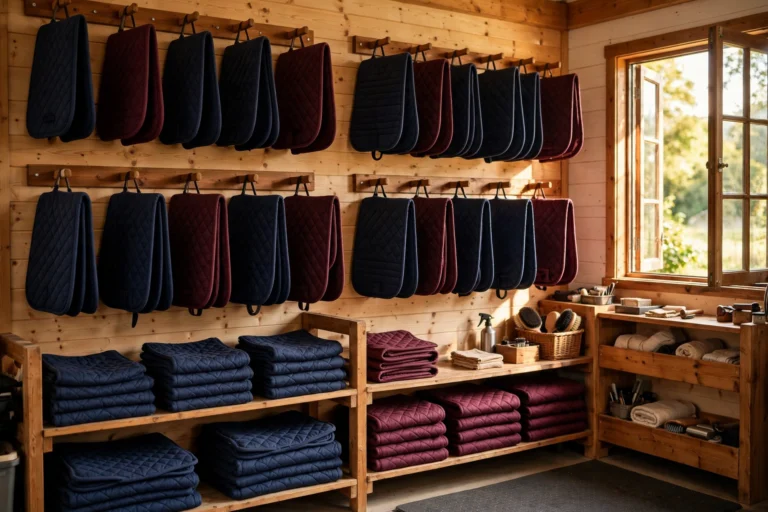
How Riding Schools and Equestrian Centers Buy Saddle Pads in Bulk
Published · Cornovo Saddlery
Consider a common scenario: a riding school with dozens of lesson horses replaces saddle pads the way a taxi company replaces tires — constantly, predictably, and at a cost that shows up in the operating budget every quarter. Yet many schools still buy pads the way individual riders do: one or two at a time, in whatever color is on sale, from whoever ships fastest.
Riding schools and equestrian centers should buy saddle pads as fleet programs: specify wash-durable construction once, color-code by string or lesson level, hold par levels in the tack room, and reorder on schedule against a locked spec — instead of emergency-buying one-off pads at retail prices.
Buying saddle pads as a fleet changes every decision: durability math beats fashion, washability beats color trends, and a standing reorder program beats emergency one-off orders. This guide is written for riding school managers, equestrian center buyers, and the distributors who serve them — covering how bulk programs are specified, costed, and kept running.
Key takeaways
- Riding schools should buy pads on cost-per-month math, not purchase price — a pad that survives many more wash cycles at a higher unit price often costs less in real terms.
- Specify for the wash cycle: colorfast fabrics, double-needle binding, and reinforced strap slots determine real fleet lifespan.
- Color-code pads by lesson group, horse string, or discipline to simplify tack-room management and track wear per group.
- Standardize on one or two pad models across the whole string to simplify reorders, repairs, and staff training.
- A standing reorder program with your supplier — locked specs, scheduled top-ups — eliminates emergency buying at retail prices.
How is fleet buying different from retail buying?
An individual rider buys one pad for one horse and cares about fit, fashion, and feel. A riding school buys dozens of pads for dozens of horses and cares about four things: how many wash cycles a pad survives, how fast it dries between lessons, whether staff can tell pads apart at a glance, and what each pad costs per month of service.
The numbers make the case. Take an illustrative case: a school with 30 lesson horses and two pads per horse in rotation holds 60 pads. If each pad averages 18 months of school service, the school replaces roughly 40 pads a year — every year, indefinitely. That is a standing wholesale account, not a series of retail purchases. Buyers who recognize this shift stop shopping for deals and start negotiating programs. (Plug in your own string size and service life — the structure is the point, not the numbers.)
What specs matter for school-string pads?
School pads live a hard life: multiple riders, daily sweat, industrial washing machines, and storage in tack rooms that are rarely climate-controlled. Specify for that reality:
Shell fabric: durability over delicacy. Tightly woven cotton-poly blends typically outlast pure cotton in school service — they hold shape through repeated hot washes and resist the abrasion of daily girthing. Avoid delicate finishes: satin bindings, contrast piping, and light colors that show every mark. Dark or mid-tone solid colors hide school wear longest.
Fill: quick-dry and wash-stable. Specify fills that survive repeated washing without clumping or migrating. Ask the factory about wash testing — how many cycles the fill has been tested to — rather than accepting a generic machine washable claim. A pad that takes a full day to dry is a pad the school needs two of; faster-drying fills reduce the rotation size.
Binding and straps: the failure points. School pads fail at the edges first. Double-needle binding, bar-tacked strap slots, and reinforced billet straps are the points to demand for fleet use. These are the exact points to check in pre-shipment inspection, because a school will find every weak edge within weeks. See our pre-shipment QC checklist for how to inspect them.
Sizing: standardize. Pick one size per discipline — typically a full-size all-purpose or a standard dressage cut — and buy the whole string in it. Mixed sizes across the string complicate reorders and mean staff grab the wrong pad. Pony strings get their own standard size, specified once.
How should schools color-code their pad fleet?
Color coding is the cheapest management system a school can install. Common schemes:
| Coding scheme | How it works | Best for |
|---|---|---|
| By lesson level | Beginner string in navy, intermediate in burgundy, advanced in hunter green | Schools where instructors grab pads for groups quickly |
| By discipline | Dressage pads white, jumping pads colored | Multi-discipline centers with separate arenas |
| By horse string | Each barn or string gets its own color | Large centers tracking wear and laundry per string |
| By size | Pony pads one color, horse pads another | Schools where wrong-size grabs are a daily problem |
For wholesale programs, color coding maps neatly onto MOQ structure: each color in the scheme is a colorway, and our standard MOQ of 50 pieces per color fits school-string quantities naturally — a mid-size string needs roughly that many pads per color in a two-per-horse rotation. Confirm colorfastness expectations per color with our color-fastness guide before locking dark colors into a wash-heavy program.
What does a pad really cost per lesson?
The number that matters is cost per month of service, not the invoice price. A simple way to compare:
Cost per month = pad price ÷ expected months of school service.
Take an illustrative pair: a $25 pad lasting 9 months of school use costs about $2.80 per month. A $45 pad built to school spec lasting 24 months costs about $1.90 per month — roughly a third less in real terms, before counting the staff time spent reordering and the lessons disrupted by failed pads. (Prices illustrative, not quotes — run the math with your own quotes and your wash-test data.) Ask suppliers for wash-cycle test data or documented school-program references to ground the lifespan estimate; durable without a number is marketing.
Factor in the hidden costs too: pads that dry slowly force a larger rotation (more pads purchased), pads with weak binding generate mid-season replacements at emergency prices, and non-standard sizes create a slow leak of mismatched inventory. The cheapest pad on the quote is rarely the cheapest pad in the tack room.
How should a school set up a reorder program?
The goal is to never place an emergency pad order again. A working reorder program has four parts:
- Locked specs. One document per pad model: shell, fill, binding, straps, colors, sizes, labels. Every reorder references the same spec — no re-deciding each time.
- Par levels. Set a minimum on-hand count per color (for example, reorder when any color drops below 15 pads). The school counts monthly; the count takes ten minutes. See inventory planning for tack shops for the reorder-point math.
- Scheduled top-ups. Agree a reorder rhythm with the supplier — quarterly is a common starting point — so top-up production can be slotted into the factory schedule instead of rushed. Confirm the rhythm per order.
- Annual review. Once a year, review wear data: which colors faded fastest, which binding failed first, whether the rotation size is right. Feed it back into the spec.
Distributors serving schools should offer this as a managed program, not just a product: locked specs on file, automated reorder reminders, and a named contact for top-ups. The distributor who runs the program keeps the account; the one who just ships boxes loses it to the next cheaper quote.
What specs should I confirm when requesting a quote?
When you request a quote on school-string pads, confirm the shell fabric and fill by name with wash-test cycle data (not a generic machine washable), the binding type and stitching, strap and billet-strap reinforcement, the standardized sizes per discipline, the colorway list with Pantone references, packing per colorway, the locked-spec document format, the reorder and top-up rhythm, and the MOQ per colorway — our standard is 50 pieces per color. Pricing and delivery terms are confirmed per quote.
Frequently asked questions
How many saddle pads does a riding school need per horse?
Two pads per horse in active rotation — one in use, one in the wash or drying — is a common starting point in our supplier experience. Schools with same-day back-to-back lessons on the same horse, or slow-drying pads, commonly run three. Start with two and adjust based on your laundry turnaround.
Which shell materials hold up best in school service?
Tightly woven cotton-poly blend shells with wash-stable fill and double-needle binding typically hold up well under daily school use and industrial washing. Avoid satin finishes, light colors, and delicate trims — they do not survive the school wash cycle regardless of price. The right answer depends on your wash frequency and machines, so confirm with wash-test data.
Should schools buy white pads or colored pads?
Colored pads for daily schooling, white for shows and photos. White school pads look tired within weeks, and the bleaching needed to revive them shortens fabric life. Dark and mid-tone solids — navy, burgundy, hunter, black — hide wear and wash marks longest.
How do I estimate pad lifespan for budgeting?
Ask the supplier for wash-cycle test data, then divide by your wash frequency. As an illustrative example: a pad tested to 200 wash cycles, washed twice a week, has a theoretical 100-week life — then derate for real-world conditions (industrial machines, imperfect drying) before budgeting. Treat the derate percentage as your own starting assumption, not an industry figure.
Can a small school get wholesale pricing?
Yes, if it buys like a fleet: standardized models, committed colorways, and scheduled reorders. A 20-horse school buying around 40 to 50 pads per colorway on a quarterly program is a solid wholesale account — our MOQ of 50 pieces per color aligns well with school-string quantities. See typical MOQs and lead times for how programs are structured.
Sources & Further Reading
- Saddle pad inventory planning for tack shops (internal): colorway splits and reorder-point math that apply directly to school-string programs.
- Saddle pad color fastness buyer’s guide (internal): fastness ratings and bleed-risk cases for dark school colors.
- Pre-shipment saddle pad quality control checklist (internal): inspecting binding, straps, and symmetry before the shipment leaves.
- How to wash saddle pads (internal): care guidance schools can hand to barn staff to protect fleet lifespan.
Running a riding school or supplying one? We build school-string pad programs to locked specs — fleet-durable construction, color-coded colorways, and scheduled top-up reorders so you never emergency-buy again. MOQ 50 pieces per color. Send your string size and we will spec the program.
