
Saddle Pad Display and Merchandising: How Distributors Help Tack Shops Sell Through
Published · Cornovo Saddlery
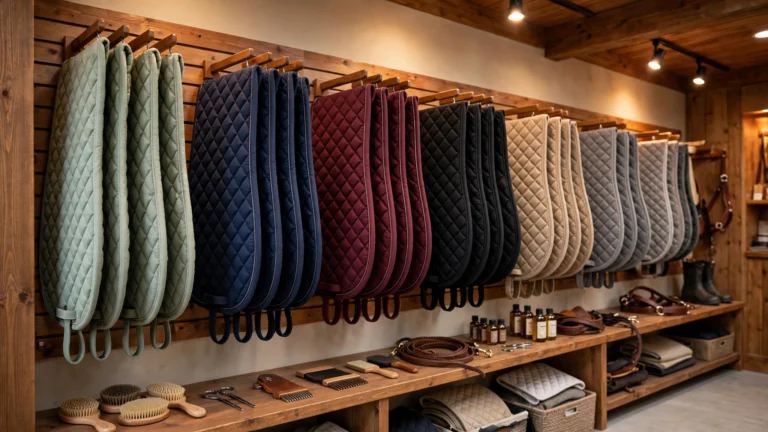
Saddle pad merchandising is how a tack shop presents, explains, and sells pads on the floor: display layout, signage, try-on programs, staff talk-tracks, and promotions. Shops that show pads where riders already look — hung in color columns at eye level, one on a saddled horse form — typically sell through faster than shops that fold everything flat on a table, because the display matches how riders actually shop: by color first, fit second.
Consider a common scenario: two tack shops carry the same private-label pad line at the same price. One folds the pads on a table near the register, sorted by size. The other hangs them in color columns on the wall, puts one on a saddled horse form, and clips a handwritten card to the rail: Try any pad on your saddle — just ask. The difference in sell-through is usually visible within a season. It isn’t the product that differs — it’s saddle pad merchandising, the last sales conversation before the rider buys, and the part of the business many distributors ignore once the carton leaves the warehouse.
This guide covers the display methods that move pads, try-on programs that protect margin, hang-tag and staff talk-tracks, and the merchandising support a distributor can supply.
Key takeaways
- Riders shop by color first and size second — displays grouped by colorway tend to outperform size-sorted stacks, because they match how the buying decision actually happens.
- One hero pad on a saddled horse form anchors the whole line and typically lifts full-price sell-through of the featured colorway.
- A managed try-on program — dedicated demo pads, a simple loan log, a clear return condition — removes the fit objection that kills many pad sales.
- Hang tags should answer three questions in five seconds: which shape, which fill, how to wash. Staff should be able to say it in one sentence.
- Bundles (pad plus boots plus halter in one colorway) and seasonal color rotations raise units per transaction without discounting the core line.
- Distributors who supply POS materials — swatch rings, endcap kits, QR fit guides, demo pads — win reorders, because shops reorder from suppliers who help them sell through.
What is saddle pad merchandising?
Saddle pad merchandising is how a tack shop presents, explains, and sells pads on the floor: display layout, signage, try-on programs, staff talk-tracks, and promotions. Good merchandising turns a wall of similar-looking rectangles into a set of distinct choices a rider can understand in under a minute.
Distributors can’t staff the shop floor, but they supply everything it needs: fixtures, color cards, demo pads, hang-tag copy, training. The distributor who treats merchandising as part of the product ships a sell-through kit with every line — and earns the reorder, not just the order.
Which display method works best — color walls or lifestyle displays?
In practice, saddle pad merchandising uses both: a color wall for browsing and one lifestyle display for aspiration. They do different jobs. The wall lets a rider find her color in seconds; the horse form shows her what the pad looks like where it matters — on a horse, under a saddle. What follows describes how each method typically behaves on a shop floor, from dealer experience rather than measured A/B results — test against your own till data.
| Display method | Best use | Floor space needed | Typical effect |
|---|---|---|---|
| Color wall (folded pads in color columns) | Core colorways, quick comparison shopping | One full wall or gondola end | Usually the strongest browsing conversion — riders spot their color instantly |
| Lifestyle display (pad on a saddled horse form) | Hero colorway of the season | A 1–2 sqm corner | Anchors aspiration; tends to lift full-price sales of the featured color |
| Flat stack table | Value lines and multi-buy offers | One table near the entrance | Suits promotions; can make premium pads look discounted |
| Hanging rack sorted by shape and size | Shops where staff actively fit riders | One wall run | Best with guided selling; can confuse self-service browsers |
| Trial station (saddle stand plus mirror) | High-ticket pads and custom lines | A small corner | Converts fit objections on the spot; needs staff attention |
Rules for every method, as starting assumptions to adjust against your own sales data: hold the wall to six to eight colorways — more tends to read as noise, not range. Fold every pad the same way. Keep prices visible; an unpriced pad is one the shy rider won’t ask about. Keep depth stock in the stockroom — a gap on the wall reads as sold out and ends the sale.
How should shops run pad try-on programs without losing margin?
With dedicated demo pads that never go back into sellable stock. The moment a loaner comes from the sale pile, it comes back shopworn — hairy, creased, unsellable — and the program costs more than it earns.
- Build a demo fleet. One pad per best-selling shape in the core colors, clearly tagged DEMO — not for sale. Ask your distributor about demo pricing; many will supply demo units at cost with a seasonal line because demo fleets drive reorders.
- Keep a simple loan log. Rider name, phone number, date out, date back, condition note. A typical loan runs a few days to a week, one pad at a time — a starting assumption, not a rule.
- Set the return condition in writing. Clean, hair-free, undamaged — or the rider buys it at a stated demo discount. Say it at handover, not at return.
- Schedule the hygiene. Shake out and lint-roll between every loan; wash on the care-label cycle on a fixed schedule. A grubby demo pad sells nothing.
- Track conversions loosely. Ask at purchase: Did you try the demo? A demo pad that keeps converting will show its value quickly in the loan log — and that number is also useful feedback for your distributor.
The try-on program answers the objection that kills most pad sales — but will it fit my saddle? — better than any signage. Riders who ride in the pad for a week come back to buy the color they wanted, which is rarely the cheapest one.
What should the hang tag and the staff say?
The tag answers three questions in five seconds — which shape, which fill, how to wash — and the staff adds one sentence about fit. Everything else is decoration.
On the hang tag, put the facts where the rider’s eyes land: the colorway name, the shape (dressage, all-purpose, jump), the size, the fill type, and the one key feature (wither relief, non-slip underside, sheepskin lining). Put care instructions and a QR code on the back linking to a short fit video. Keep marketing poetry off the tag — the romance copy about the color story belongs on the shelf card, not where the facts need to be. (The labeling details for US and EU resale are covered in our hang tag and care label compliance guide.)
Train staff on a one-liner per pad: This is our all-purpose in wool-blend fill — it suits a medium-wide saddle and it washes at 30 degrees. Then train them on the three questions that close pad sales: what saddle do you ride in, what discipline, and what problem are you trying to fix? A rider who came in for a blue pad and leaves with the right shape in blue is a rider who comes back.
How do bundles and seasonal rotation lift sell-through?
They raise units per transaction and give riders a reason to come back — both without discounting the core line.
Bundles. The classic is pad plus brushing boots plus halter in one colorway, priced just below the sum of the parts as the full look. Polo wraps pair into the same story — see our polo wrap and bandage guide for matching-piece options. Anchored to a strong pad colorway, bundles can pull slower-moving colors along. Cross-merchandise the pieces — boots beside the pad wall, halter on the horse form — so the rider assembles the set herself.
Seasonal rotation. Core colors (black, navy, white, grey) stay year-round; two to three fashion colors rotate per season, timed so stock lands before demand. How brands time those drops is covered in our seasonal color drops guide. Rotate the lifestyle display with the season, and mark down the outgoing fashion color only after the new one is up. The margin rule: discount the fashion color to clear it, never the core.
Placement. Give the color of the month an endcap or an entrance table. Newness near the door catches the regulars — the riders who already own three pads and need a reason to own a fourth.
What merchandising support can a distributor provide?
The fixtures, samples, and training materials a small shop can’t produce itself. If you distribute pads, this kit is your competitive edge — the supplier who shows up with it earns the wall:
- Swatch rings or color cards of the full colorway range, so the counter can sell colors that aren’t on the wall.
- Demo pad program — demo units at cost or free with the seasonal line, tagged and ready to loan.
- Endcap and display kits — a branded header card, shelf talkers, and a folding guide so the wall looks like one line in every shop.
- QR fit guides and care videos the shop can link straight from the hang tag.
- Staff training in one page — a fit cheat-sheet and a seasonal briefing, even by video call.
- Planograms for two shop sizes — a full-wall version and a compact version for shops with almost no floor space.
None of this costs much next to a lost reorder. A shop that sells through reorders; a shop sitting on stock doesn’t. For distributors, that kit is the sharp end of saddle pad merchandising: it decides which one your customer becomes.
Requesting a quote: specs to confirm
If you want a pad line built for merchandising — one that arrives with sell-through support, not just cartons — confirm these deliverables with your supplier before you order. They belong in the quotation, not in a handshake:
- POS kit contents: swatch rings, endcap header cards, shelf talkers, folding guide — what is included per line or per season
- Demo pad program terms: how many demo units, at what price (at cost or included), and whether they carry the demo marking
- QR fit guide and care video: whether the factory produces the content or you supply your own links
- Planogram options for full-wall and compact shop layouts
- Staff training material: one-page fit cheat sheet and seasonal briefing availability
- Seasonal colorway calendar: drop dates and stock arrival timing
- Hang-tag copy supplied per colorway (shape, size, fill, key feature) and compliance with your market’s care-label rules
- Western-pattern options for lifestyle displays, if the line includes them (see the western design guide for pattern and colorway planning)
Frequently asked questions
How many pads should be on the wall versus in the stockroom?
As a starting assumption: face one to two per colorway per shape, and keep the depth in the stockroom. Restock the face daily — a gap on the wall reads as sold out and ends the sale on the spot. The wall is a menu, not a warehouse; calibrate the face count against how fast each colorway turns.
Should we display the full line or just the bestsellers?
Bestsellers on the wall; the full range on a swatch ring with an order book at the counter. Displaying everything buries the winners under the slow movers. Let the wall do the selling and the ring do the range.
Do demo pads really pay for themselves?
They tend to, where the fit objection is the main reason sales die. Track it loosely — ask buyers at the till whether they tried the demo — and cut shapes whose demos never convert. The loan log, not a formula, tells you whether the program earns its keep.
How often should seasonal colors rotate?
Two rotations a year is the common rhythm — spring/summer and autumn/winter — timed so stock lands before the riding season starts. Rotate the lifestyle display and the entrance feature with each drop, and clear the outgoing fashion color with a markdown only after the new colorway is on the wall.
What works in a small shop with almost no floor space?
One compact color-wall section, a swatch ring at the counter, and a single hero pad on a saddle stand. Sell the range from the ring rather than the wall, and let the hero pad do the dreaming. Curation beats square footage — but only if the ring and the order book make the whole range buyable.
Sources & Further Reading
Sell-through guidance in this saddle pad merchandising guide comes from dealer and distributor practice rather than published retail studies — floor results vary by shop size, staff skill, and customer mix, which is why the article keeps pointing you back to testing against your own till data. The related wholesale guides:
- Seasonal Color Drops for Saddle Pads — how private-label brands plan collection timing
- Hang Tags and Care Labels for Saddle Pads — what US and EU retailers require on the tag
- Polo Wraps and Standing Bandages — matching-piece options for bundle stories
- Western Saddle Pad Design Guide — patterns and colorways for lifestyle displays
Distributors who help shops sell through get the reorder. If you want a pad line built for saddle pad merchandising — one that arrives with swatch rings, a demo program, QR fit guides, and seasonal color plans — send your target colorways and quantities for a quotation.
