Vegan & Faux-Fur Saddle Pads: A Wholesale Guide
Published · Cornovo Saddlery
Consider a common scenario: a tack shop buyer asks for a vegan saddle pad line, and the request lands on a factory desk as same as our sheepskin pad, but vegan. What comes back is a patchwork — PU vegan leather trims, a synthetic fur the factory calls artificial sheepskin, and marketing copy that calls the whole thing eco-friendly. None of that is a program; it is three separate materials decisions plus one label decision, and only the first one is easy.
The short answer: A vegan saddle pad contains no animal-derived materials — no wool, no leather, no real sheepskin, no silk. Wholesalers build the line from synthetic faux-fur fleeces, microfiber and suede-effect faces, and PU trims, and the program succeeds or fails on honest labeling: vegan describes inputs, not performance or sustainability.
This guide is the animal-free companion to the rest of the program: our sheepskin half pad guide covers what the real material offers, and our wool vs synthetic fills guide compares the insulation inside pads — this one is about building and positioning a line with no animal materials at all (boundary note: 007 compares fill families as materials; this guide is the brand program — assortment, labeling, and buyer targeting for the vegan shelf).
Key takeaways
- Vegan is an input claim, not a performance or eco grade: it means no animal-derived materials — verify it per construction, not per brand story.
- The wholesale material set is synthetic faux-fur fleece, microfiber and suede-effect faces, and PU trims — each with its own care and wash behavior, none a one-to-one swap for the material it replaces.
- Vegan does not mean sustainable: most vegan leather is PU or PVC, and plant-named alternatives are usually plastic-resin-bound — say cruelty-free, substantiate anything else.
- Never print sheepskin without faux: fiber-content naming on the hang tag is the cheapest compliance insurance the program has.
- MOQ 50 pieces per color.
What does vegan saddle pad actually mean — and what does it not mean?
Direct answer: A vegan saddle pad is made with no animal-derived materials: no wool fill or fleece, no leather trims, no real sheepskin or fur, no silk thread. That is the whole definition — an input claim. It says nothing about warmth, durability, breathability, or sustainability; each of those is a separate claim needing its own evidence.
The discipline that matters is listing the excluded materials, because vegan gets claimed loosely at the edges. Wool-blend trims are the classic trap: a pad lined with a wool-acrylic blend is not vegan even when the packaging says Merino in large letters and blend in small ones. LeMieux’s well-known Merino+ line is the instructive example — it is explicitly a 70% merino / 30% acrylic blend, marketed for washability and faster drying, and it is precisely not vegan. (LeMieux — Merino+ Half Lined Dressage Square) If your vegan brief does not name the exclusions in writing, the factory’s default soft trim will often be exactly this kind of blend.
What vegan does not mean is worth stating once, plainly, because buyers conflate it daily: it does not mean eco-friendly, it does not mean biodegradable, and it does not mean hypoallergenic. A vegan program that leans on any of those three words without substantiation is standing on a claim the label cannot carry — the honest word on the hang tag is cruelty-free or animal-free, and anything beyond that needs a test report or a certification behind it.
What animal-free materials do wholesalers actually build with?
Direct answer: Four material families cover the wholesale vegan range: synthetic faux-fur fleece for the sheepskin look, microfiber and suede-effect faces for the quilted body, PU trims and wear guards where leather would sit, and high-pile polyester linings for the contact side. Each behaves differently from the animal material it visually replaces — match the material to the use, not the look.
| Material family | Typical strengths — and when they hold | Watch-outs — and when they show up |
|---|---|---|
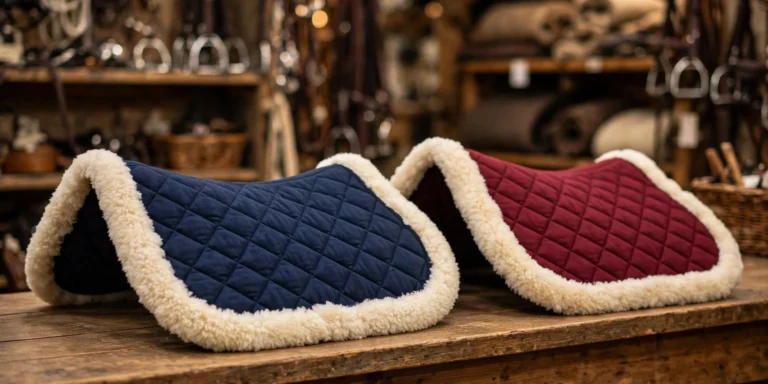
| Synthetic faux-fur fleece | The sheepskin-look answer: polyester or acrylic pile knitted to imitate wool fleece, used as pad lining or trim. A mainstream example is the Rhinegold numnah fully lined with faux fur and trimmed edges for a luxury look, offered across Pony, Cob, and Full sizes with a wide quilt-color range — the classic vegan-friendly retail construction. (Bonnie Bridles — Rhinegold Faux Sheepskin Numnah) Suits riders who want the plush look and easy care. | Faux fur is still plastic fiber: it sheds microfiber in the wash and the pile mats under pressure over time. Wash behavior and pile recovery should be specified and tested, not assumed from the look. |
| Microfiber / suede-effect face | The quilted body without cotton or wool: microfiber faces take quilting definition well and resist staining, and suede-effect gives the premium look programs use for fashion colorways. Suits everyday pads where wash-and-wear matters more than a natural-fiber story. | Microfiber shows every crease from compression packing — confirm the factory’s fold-and-ship method keeps the face presentable at unboxing, or budget for a steam-out step. |
| PU trim and wear guards | The leather-substitute for binding, wear leathers, and girth-protection areas: consistent color, no hide grading, and stable supply. Premium makers use it openly — Kentucky Horsewear’s faux-fur half pad lists its materials plainly as memory foam, 3D spacer, artificial leather, artificial fur. (Fundis Equestrian — Kentucky Horsewear Impact Equalizer with Faux Fur) Suits programs that need trim consistency across large runs. | PU is the material behind the vegan leather label — it is petroleum-based plastic that can crack and peel with age and heat. Call it what it is on the spec sheet; the word leather belongs nowhere near it without vegan or synthetic in front. |
| High-pile polyester lining | The contact-side option for riders with wool sensitivities or for pure wash-every-day programs: fully machine washable, dries faster than wool, and takes dye uniformly for fashion colorways. Suits school and lesson-barn fleets buying animal-free for policy reasons. | Polyester linings hold odor more readily than wool between washes and generate static in dry climates — brief the care routine on the hang tag (frequent washing is the design assumption, not an afterthought). |
One naming discipline belongs in every tech pack: specify materials by fiber and construction — 100% polyester high-pile fleece, PU trim — never by what they imitate. The factory that writes artificial sheepskin on the carton will write sheepskin on the next one.
Why can’t the line just say eco-friendly — where do brands get into trouble?
Direct answer: Because vegan answers the animal question and eco-friendly answers the planet question — they are different questions. Most vegan leather is polyurethane or PVC — plastic that sheds microfibers, cracks with age, and does not biodegrade — and even plant-named alternatives like pineapple leather are usually plastic-resin-bound. (Phys.org)
The honest positioning for a vegan pad line is narrower than brands want and safer than they fear: no animal materials is verifiable, defensible, and exactly what the vegan buyer is actually purchasing. The moment the copy upgrades that to kind to the planet, the claim needs a lifecycle or materials basis the program probably does not have — and the article above documents exactly how that upgrade fails, from resin-bound plant fibers to two-year product lifespans that make any eco claim hollow.
There is one more honest advantage worth naming, because it is real: washability. Faux-fur and microfiber constructions commonly machine-wash at 30°C on gentle cycles — the Kentucky Horsewear pad above carries exactly that instruction — where real wool asks for wool-cycle discipline. That is a care-convenience claim, not an eco claim, and it is the one the register team can say with a straight face.
How do real brands execute the vegan shelf — what can you copy?
Direct answer: The working pattern is the same everywhere: synthetic fur where wool would be, a quilted synthetic or cotton face, synthetic trim where leather would sit — and plainspoken materials lists. Kentucky Horsewear’s faux-fur half pad names artificial leather, artificial fur outright; Rhinegold’s faux-sheepskin numnah sells the luxury look in Pony, Cob, and Full. Copy the logic, not the ad copy.
Three execution notes travel well from these examples to a wholesale program. First, size the line like the market it serves: the Rhinegold example runs Pony through Full because faux-fur pads sell to the same rider pyramid as everything else — a vegan line that only offers Full is a line that skipped the pony-club buyer. Second, let the colorways do the work: animal-free pads compete partly on fashion, so the quilt-color range (the Rhinegold listing runs nine) is a feature, not decoration — plan the color program with the same discipline as the main line. Third, keep one construction honest per product: the Kentucky pad’s materials list works because it says what everything is. A hang tag that says faux fur on the trim and hides PU on the wear guards is one curious customer away from a trust problem.
And one boundary to keep straight when buyers ask: wool-blend performance trims are not a middle ground — a 70/30 merino-acrylic blend is 70% animal material. If the brief says vegan, blends are out; if the brief says mostly animal-free, that is a different claim and it should be written as exactly what it is.
What goes on the hang tag — the naming rules that keep you out of trouble?
Direct answer: Name every animal-free material with faux, synthetic, or artificial in front of the word it imitates, state fiber content by market labeling rules, and never let sheepskin appear unqualified. The hang tag is where a vegan program is won or lost: it is the only part of the product most buyers ever read.
- Imitation words stay qualified: faux fur, faux sheepskin, synthetic fleece, artificial leather — never the bare word. One unqualified sheepskin on a tag or product page turns a vegan program into a mislabeling complaint.
- Fiber content follows the destination market’s textile rules: generic fiber names and percentages, the same discipline our hang tags and care labels guide covers for the main line — the vegan line gets no exemption from fiber labeling.
- Care instructions are part of the honesty: machine-wash temperature, no-fabric-softener notes where they apply, and the pile-brushing routine for faux fur — riders who buy animal-free for convenience will judge the line on whether the wash routine is actually easy.
- Marketing claims stay inside cruelty-free: no animal materials is verifiable; eco, green, and sustainable need substantiation per the environmental-claims discipline our sustainable materials guide lays out.
- Vegan logos only if earned: third-party vegan marks exist and mean something to committed buyers — but a self-drawn leaf on the tag means nothing. Confirm any mark’s licensing before it goes to print.
Who buys the vegan line — and how do you stock it?
Direct answer: The vegan line sells to urban and online-first riders who buy animal-free as an identity, to riding programs with animal-material policies, and to gift buyers — not to the traditional wool-loyal core. Start it as a narrow capsule inside the existing color program and deepen only the colorways that reorder.
| Account type | Starting hypothesis — adjust by your own sell-through |
|---|---|
| Urban boutique / online-first tack shop | The primary home: a small capsule of faux-fur-lined pads in fashion colorways, merchandised as its own story. This buyer wants the look and the label — stock the colors, not the commodity basics. |
| General mixed tack shop | A test shelf, not a wall: one or two faux-fur styles in the shop’s proven core colors, so the vegan option is visible without competing with the wool line that pays the rent. |
| Schools and lesson programs | Conditional: only where the program has an actual animal-materials policy. Otherwise the wash economics of polyester linings matter more than the vegan story — pitch the care routine, not the label. |
The assortment rule that matters most: do not launch the vegan line as a parallel full collection. A capsule that shares the main line’s colorways and quilt patterns lets the factory run one dye program and one trim set — and lets the buyer see the vegan pad as a choice inside a brand they already trust, not a gamble on an unknown label.
What specs should you confirm when requesting a quote?
Direct answer: Confirm the animal-free material set in writing — fiber content of every component, the faux/synthetic naming on tags, care routine, colorways, and the factory’s definition of vegan for your order. Eight confirmations for a claim that lives or dies on the fine print.
- Material exclusions in writing — the PO names what is excluded (wool, leather, sheepskin, fur, silk) so a soft blend substitution cannot arrive unannounced
- Fiber content per component — face, fill, lining, trim, thread each stated by generic fiber name; no component described only by what it imitates
- Faux-fur specification — pile fiber, pile height range, backing construction, and the wash-and-brush recovery routine the factory recommends
- PU trim specification — thickness, finish, and the aging behavior the factory will stand behind (cracking and peeling are the known failure modes)
- Hang-tag and label wording — faux/synthetic/artificial qualifiers on every imitation term, fiber content per destination-market rules, care symbols
- Marketing-claim clearance — which words the factory will and will not print (cruelty-free yes; eco/sustainable only with substantiation)
- Colorway sharing — whether the vegan capsule can run the main line’s dye program and trim colors, and how color matching is controlled across different substrates
- MOQ — 50 pieces per color is our factory standard; confirm the vegan capsule’s colors count toward the same colorway minimums or carry their own
Key takeaways
- Vegan means no animal-derived materials — verify it per component, and write the exclusions into the PO so blend substitutions cannot arrive unannounced.
- The material set is faux-fur fleece, microfiber/suede-effect faces, PU trims, and high-pile polyester linings — specify each by fiber, never by what it imitates.
- Vegan is not sustainable: most vegan leather is PU/PVC and plant-named alternatives are usually resin-bound — keep the marketing inside cruelty-free unless a claim is substantiated.
- Name imitations honestly on the tag: faux fur, synthetic fleece, artificial leather — one unqualified sheepskin undoes the whole program.
- Launch as a capsule inside the existing color program, not a parallel collection — and deepen only the colorways that reorder. MOQ 50 pieces per color.
Frequently asked questions
Is faux fur warmer than real sheepskin?
There is no published head-to-head test to cite, so treat warmth as construction-dependent, not material-destined: pile height, density, and what sits under it decide insulation on both sides. Do not let marketing copy on either side claim a thermal winner — brief the factory for the pile spec and test the sample in the conditions it will be ridden in.
Can I call the line eco-friendly if it’s vegan?
No — not on the vegan fact alone. Most vegan leather is PU or PVC, and plant-named alternatives are typically plant fibers in plastic resins; neither is automatically low-impact. Cruelty-free and animal-free are the defensible words. Anything greener needs its own evidence, per the environmental-claims discipline in our sustainable materials guide.
Does a vegan pad cost less than the wool equivalent?
Not automatically. Synthetic materials can be cheaper per meter than graded sheepskin, but the finished price also reflects construction complexity, trim count, order volume, and how the factory prices small colorway runs. Compare per-quote on identical constructions — the material swap is only one line of the costing.
Is a wool-blend trim acceptable in a vegan line?
No. A wool-acrylic blend is still animal material — the wool percentage does not make it mostly vegan. If the brief says vegan, blends are out. Write the exclusion into the PO; otherwise the factory’s default soft trim will often be exactly such a blend.
How do I keep sheepskin off the product page by accident?
Search every asset — product page, hang tag, carton label, and the factory’s own spec sheet — for the bare word before launch. The rule is mechanical: every imitation term carries its qualifier (faux, synthetic, artificial) everywhere it appears, including image alt text and translations.
Building an animal-free line for your brand? Send us your colorways and target constructions — we quote vegan pad programs with the exclusions written into the tech pack, with free samples before bulk. MOQ 50 pieces per color.
Sources & Further Reading
- Fundis Equestrian — Kentucky Horsewear Impact Equalizer with Faux Fur: real brand’s materials list names artificial leather, artificial fur outright; machine wash 30°C.
- Bonnie Bridles — Rhinegold Faux Sheepskin Numnah: fully lined with faux fur and trimmed edges for a luxury look; Pony/Cob/Full sizes; wide quilt-color range.
- Phys.org — ‘Vegan leather’ isn’t as sustainable or eco-friendly as brands might claim: most vegan leather is PU/PVC; plant-named alternatives are usually plastic-resin-bound; durability and end-of-life caveats.
- LeMieux — Merino+ Half Lined Dressage Square: the boundary case — 70% merino / 30% acrylic is a wool blend, not vegan, however the marketing reads.
- Sheepskin Half Pads: A Buyer’s Guide — the real-material companion (wool density, backing, stitching).
- Wool vs Synthetic Saddle Pads — fill families compared (boundary: this guide is the brand program, not the fill materials).
- Bamboo, Recycled and Cork: Sustainable Saddle Pad Materials — environmental-claim discipline for the marketing copy.
- Hang Tags and Care Labels — fiber-content and care-label rules the vegan line still follows.
- Saddle Pad Face Fabrics Compared — specifying faux-fur and microfiber faces on the tech pack.
