Pony & Cob Saddle Pads: The Wholesale Size Program
Published · Cornovo Saddlery
Consider a common scenario: a distributor adds five colorways of a strong-selling all-purpose pad to a children’s riding program, and the program asks for the same collection in pony sizes. The factory scales the Full pattern down by a fixed percentage, and the pony pads arrive looking like shrunken Full pads — the drop barely covers the short flaps, the strap positions land nowhere near the billets, and the wither cut swims on a pony’s short back. The fix is not a smaller pad. It is a separate program.
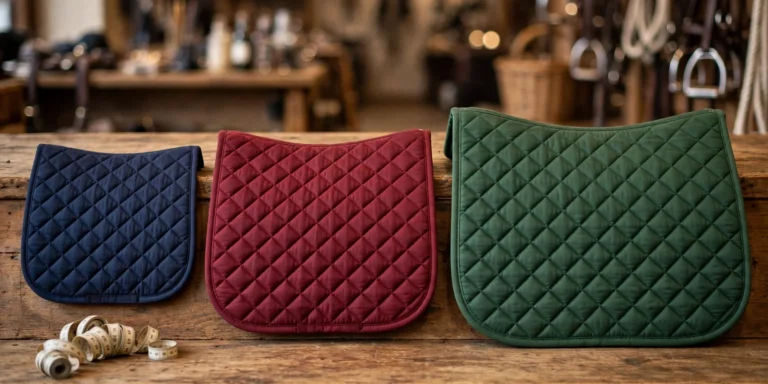
The short answer: Pony and Cob saddle pads are their own wholesale size program — not linearly shrunken Full pads — because drop, strap placement, and wither profile are re-engineered for short saddles and small backs. Buy the three-tier ladder (Pony / Cob / Full) in per-cut dimensions confirmed against the factory’s own chart, since no universal pony standard exists.
This guide is the pony-and-cob program layer on top of our general saddle pad sizing guide and our per-cut sizing charts (boundary note: those two cover how to measure and chart sizes across cuts; this one is the wholesale program question — why Pony and Cob run as their own size tier, and how to buy them). Riding-school and lesson-barn buyers should read it alongside our bulk programs for riding schools — schools are the largest single buyer of pony pads.
Key takeaways
- Pony and Cob are re-patterned sizes, not scaled-down Fulls: drop, strap placement, and wither profile change independently of spine length.
- No universal pony standard exists — one retailer’s Pony/Cob dressage pad publishes a 21″ spine while brand charts vary; always confirm against the factory’s own chart.
- Cob is the middle tier between Pony and Full — common in UK sizing, rare or absent in some US brand ranges.
- Kids’ and lesson accounts are the core pony-pad market; stock depth goes to AP/jumping cuts first.
- MOQ 50 pieces per color — confirm whether pony, cob, and full sizes can mix within one colorway’s MOQ.
Why is Pony/Cob a separate program — and not just a small Full?
Direct answer: A small Full is the wrong product for a pony saddle: the drop, strap positions, and wither profile a small saddle needs do not arrive by shrinking a Full pattern. Pony and Cob are re-patterned sizes with their own graded dimensions — buying them as a percentage of Full is how programs end up with returns.
The linear scale-down is the mistake to retire. A Full all-purpose pad is built around a long flap and long billets; a pony saddle has short flaps and short billets, so a proportionally shrunken pad keeps strap positions calibrated for a geometry that does not exist on the small saddle. The straps still reach, but they pull the pad at the wrong angle and the binding sits where the short panel cannot hold it. The same applies to the wither cut: a wither profile that clears a long, low-withered horse back is a loose pocket on a short, round pony back, and loose fabric at the wither is the first place a pad starts walking.
There is a second, commercial reason for treating pony as a program rather than a size: the buyers are different. Full-pad buyers are general tack shops and dressage/jumping accounts; pony-pad buyers are pony clubs, children’s riding schools, pony breeders, and the kids’ departments of larger retailers. Their assortment logic, colorway needs, and reorder rhythm differ — which is why this guide talks about a size program rather than a size option.
What actually changes across Pony, Cob, and Full?
Direct answer: Spine length, drop, strap and girth-keeper placement, and wither cut each change on their own grading — not by one ratio. Use published maker specs as shape-of-the-answer examples, then confirm the real numbers on the factory chart you are buying against.
The market’s own conventions give the rough shape. Horse & Hound’s sizing guidance for the UK market states that the most common divisions are pony or full, that some brands add cob as a third tier, and that with only two sizes to choose between, a saddle of 16½ inches or larger likely wants a Full pad while anything smaller likely wants a pony size — with the standing instruction to check the manufacturer’s size guide before purchase, since sizes depend on the maker. (Horse & Hound — Best saddle pads for everyday wear with your GP) That check the maker’s guide clause is the whole buying rule for pony programs: the H&H 16½-inch guidance is a starting reference, not a standard.
| Dimension | How it typically changes | Example from a published maker spec |
|---|---|---|
| Spine length | Shortens the most between tiers; the single most-quoted dimension | A US retailer’s Shires Pony/Cob dressage pad publishes a 21″ spine — one maker’s spec, not a rule (Just for Ponies — Shires Deluxe Dressage Saddle Pad, Pony/Cob) |
| Drop (hem depth) | Shortens proportionally less than the spine — a pony’s short flap still needs the pad edge to land below it | The same Shires spec publishes a 19.25″ drop against the 21″ spine — a drop-to-spine ratio the factory must hold on its own grading |
| Overall width | Tracks the spine shortening; keeps the pad balanced front-to-back under a short saddle | Shires publishes 23″ overall width; a European brand’s pony AP pad lists 53 cm width on its chart (QHP size chart) |
| Strap / keeper placement | Repositioned for short billets — the dimension that breaks most on scaled-down patterns | Not always published; confirm the billet-strap distance from the spine on the factory chart |
| Wither profile | Re-cut for short, round backs; a long-back wither pocket bunches on ponies | Confirm on the sample against a pony saddle, not just the chart |
Two things in the table deserve a buyer’s attention. First, the drop shrinks less than the spine — this is the ratio factories get wrong when they scale by percentage, and it is the reason pony pads made from shrunk Full patterns leave pony flaps uncovered. Second, strap placement is frequently unpublished, which makes it invisible in a quote comparison: two factories can quote identical spine/drop figures and ship pads whose straps land inches apart. Ask for the billet-strap-to-spine distance on the chart, or measure it on the approval sample.
How do you read a pony pad chart when there is no universal standard?
Direct answer: Read the chart as the factory’s own grading document: spine, drop, width, and strap positions, measured on the finished pad, ideally in both cm and inches and on a post-wash basis. Compare factories by their charts, never by the words Pony or Cob alone — the same label covers different dimensions at different makers.
The label inconsistency is the trap. In the UK market, pony / cob / full is a common three-tier ladder; in the US market, many brands offer pony or full only, and cob may not exist as a tier at all. A program that sources from two factories — one UK-patterned, one US-patterned — can order cob from both and receive different pads. The fix is mechanical: the PO references the factory’s chart revision, not the size word. Pony per chart rev. B is a specification; pony is a hope.
European brand charts give a useful template for what a complete chart looks like: one brand’s published chart lists, per cut, Pony AP at 53 cm wide by 44.5 cm high, Pony Dressage at 56 by 52.5, Full AP at 55 by 47.5, and Full Dressage at 62 by 55 — width and height side by side for every cut and tier. (QHP size chart) Notice what the chart tells you that a label cannot: the Pony Dressage pad is longer in height than the Full AP pad, because cut matters as much as tier. When you request the factory’s chart, ask for this same structure — every tier crossed with every cut you are ordering — and ask whether the measurements are pre-wash or post-wash, since cotton pads shrink and the finished size is what the rider sees.
What makes a pony pad actually fit a pony saddle?
Direct answer: Three fit conditions decide it: the pad edge stays below the short flap without hanging past it, the straps land on the billets at their working length, and the wither cut follows the short back without loose fabric. All three are checked on a real pony saddle — the chart confirms intent, the sample confirms fit.
The flap condition is the first to fail on bad patterns. Pony saddles run short flaps for short legs; a pad with a Full-derived drop leaves inches of fabric below the flap, and that loose edge is what catches on boots, shifts under the saddle, and reads as sloppy in a lesson program where parents judge the presentation. The test is simple: set the sample pad on the smallest saddle the program serves and confirm the hem clears the flap by a modest margin — enough to stay put, not enough to flap.
The strap condition is the one charts hide. Pony saddles carry short billets, so the billet straps on the pad must sit closer to the spine than a Full pad’s straps do. When straps are placed for a Full geometry and the pad is shrunk, the straps end up too far out on the panel and pull at an angle that rolls the pad edge — the classic pony pad that won’t stay straight complaint. On the approval sample, thread the straps to the actual billets of a pony saddle and check that they pull straight down, not inward.
The wither condition is a shape problem. Pony backs are short and often round-withered; the wither cut that suits a long, low-withered horse leaves a pocket of fabric that fills with sweat and shifts. Some makers add a fleece wither protector on pony sizes specifically — Horse & Hound notes one maker’s pony size carries a faux-fur wither protector where the full size does not (Horse & Hound — Best saddle pads for everyday wear with your GP) — which is the kind of tier-specific construction detail that marks a real pony program rather than a shrunk Full.
Which cuts should a pony program cover?
Direct answer: Start with all-purpose/jumping cuts — they serve the lesson and pony-club volume — and add dressage squares only for competition-turnout accounts that need white or conservative pads. Western pony pads exist as a separate pattern family with their own sizing conventions; an English cut does not convert.
The assortment logic follows the rider. Most pony mileage happens in riding schools, pony clubs, and children’s lessons, where the saddles are general-purpose and the pads take daily use — so the AP cut carries the program. Dressage pony pads serve a narrower lane: young riders competing dressage on ponies, where turnout rules expect the long, straight-edged square. That lane is real but thin; stocking dressage pony pads deep without a competition customer behind them is how programs end up with slow colorways.
Western pony pads deserve a boundary note: they are a different pattern family (contoured felt or blanket-top shapes sized to pony bars), not an English cut resized — western sizing runs on its own conventions, and an English-factory pony AP pattern cannot be relabeled western. If the account base includes western pony riders, brief that as a separate development, not a size extension.
How should different accounts stock pony and cob pads?
Direct answer: Depth goes where the young riders are: kids’ pony programs and lesson barns stock pony pads deep in workhorse colorways; general tack shops carry a shallow pony/cob row alongside Full depth; competition-oriented accounts add dressage pony squares in white. Treat every split below as a starting hypothesis to adjust by sell-through.
| Account type | Starting-hypothesis stocking | Why |
|---|---|---|
| Children’s riding school / pony club | Pony AP deep in dark workhorse colors; cob shallow | Daily lesson use, uniform presentation, frequent washing favors dark, durable colorways |
| Kids’ pony specialist retailer | Pony AP + jumping cuts in fashion colorways; cob row for the 14-hand overlap | Parents buy color for young riders; cob catches the large-pony/small-horse crossover saddles |
| General tack shop | Full depth first; pony shallow, one or two colorways | Pony is a service category here — it keeps the family customer from shopping elsewhere, not a volume driver |
| Competition / show-oriented account | White dressage pony squares; navy/black schooling pony AP | Turnout expectations drive the white pad; dark AP for schooling days |
The white-pony-pad question deserves a direct line: competition turnout for young riders is where white pony dressage squares move, and schools that show ask for them seasonally — stock them as a show-season item with a defined reorder point, not as year-round depth, because white pads in daily lesson service stain out of saleable condition fast.
What specs should you confirm when requesting a quote?
Direct answer: Confirm the full tier-by-cut chart, strap positions, wither construction per tier, whether pony/cob can mix inside one colorway’s MOQ, and the sample-to-bulk tolerance — in writing, against a physical sample on a real pony saddle. Seven confirmations for a size tier with no standard behind it.
- Chart — the complete Pony/Cob/Full by AP/Dressage/Jumping chart in cm and inches, pre- or post-wash stated; PO references the chart revision
- Strap positions — billet-strap distance from spine per tier and cut, since scaled patterns fail here first
- Wither construction — wither cut profile per tier and whether pony sizes carry a fleece or raised wither guard
- Drop-to-spine ratio — the factory’s own graded drop per tier, not a percentage of the Full drop
- Sample proof — approval sample checked on a real pony saddle: hem below the short flap, straps straight to the short billets, no loose wither fabric
- MOQ counting — whether Pony, Cob, and Full pieces can combine toward the 50 pieces per color MOQ within one colorway, or whether each tier carries its own minimum
- MOQ — 50 pieces per color is our factory standard; confirm colorway counting when the pony program runs fewer colorways than the Full line
Key takeaways
- Pony and Cob are re-patterned size tiers, not shrunken Fulls — drop, strap placement, and wither profile grade independently.
- No universal standard exists: Horse & Hound’s 16½-inch guidance is a starting reference; the maker’s chart is the specification.
- The drop shrinks less than the spine between tiers — the ratio that breaks on percentage-scaled patterns.
- Confirm strap positions on the chart and fit on a real pony saddle at sample approval; the chart confirms intent, the sample confirms fit.
- Stock depth follows the young-rider accounts; general shops carry pony shallow as a service category. MOQ 50 pieces per color — confirm tier-mixing rules.
Frequently asked questions
Is a Cob pad just a wide Pony pad?
No — cob is the middle tier of the three-rung ladder, sized for the large-pony/small-horse crossover (roughly the 14-hand range and saddles just under the Full cutoff). It differs from a Pony pad in spine, drop, and strap placement, not just width. Note that cob is a common UK tier and is absent from some US brand ranges — confirm the tier exists on the factory chart you are buying against.
Can a small horse wear a Pony pad, or a large pony wear a Full pad?
The saddle decides, not the horse’s height: a pony pad suits a saddle under roughly 16½ inches (per Horse & Hound’s commonly cited UK guidance — a starting reference, not a rule). A small horse in a 17-inch saddle typically needs a Full pad; a large pony in a 15½-inch saddle needs a Pony or Cob pad. When in doubt, measure the saddle’s spine and drop requirements against the maker’s chart for that specific pad.
Do pony pads come in western cuts?
Western pony pads exist but are a separate pattern family with their own sizing conventions — they are not English AP pads relabeled. If your accounts include western pony riders, brief that as a separate development with its own pattern, not a size extension of the English program.
Why do kids’ programs ask for so many white pony pads?
Young-rider competition turnout: dressage and showing classes expect white or conservative pads, and pony riders show in the same turnout rules as adults. Stock white pony dressage squares as a show-season item with a defined reorder point — in daily lesson service they stain out of saleable condition too fast for year-round depth.
How do you keep pony pad colors matching the Full pad program?
Run the same dye lots and trim sets across tiers wherever the factory’s material widths allow it, and approve pony samples against the Full gold seal under the same lighting. Small panels from narrow fabric cuts can shade-shift against full-width cuts, so the cross-tier color check belongs in the approval routine — see our reorder consistency guide for the discipline that keeps repeat runs identical.
Building a pony and cob program for a kids’ riding account or a tack shop’s family section? Send us your target cuts and colorways — we develop Pony, Cob, and Full as independently graded patterns with the chart in writing, and free samples go on a real pony saddle before bulk. MOQ 50 pieces per color.
Sources & Further Reading
- Horse & Hound — Best saddle pads for everyday wear with your GP: UK pony/full/cob tier conventions; the 16½-inch saddle guidance; check the manufacturer’s size guide; pony sizes with tier-specific wither protection; matching items available on retail pads.
- Just for Ponies — Shires Deluxe Dressage Saddle Pad, Pony/Cob: one retailer’s published Pony/Cob spec — 21″ spine, 23″ width, 19.25″ drop, for kids or small adult dressage saddles.
- QHP — Saddle pad size chart: one brand’s tier-by-cut chart (Pony AP 53×44.5 cm; Pony D 56×52.5 cm; Full AP 55×47.5 cm; Full D 62×55 cm) — the template for what a complete chart looks like.
- Saddle Pad Sizing Guide with Measurement Chart — the general sizing companion: how to measure, per-discipline fit basics.
- Saddle Pad Sizing Charts for Dressage, Jumping, Western and Half Pads — per-cut chart structure this program’s pony tier plugs into.
- Saddle Pad Bulk Programs for Riding Schools — the largest pony-pad buyer profile: program structure, replacement rhythm.
- Keeping Reorders Consistent — dye-lot and gold-seal discipline for cross-tier color matching.
