Matching Saddle Pad Sets: Building a Wholesale Collection
Published · Cornovo Saddlery
Consider a common scenario: a brand’s quilted pad sells well, and riders start asking for the bonnet and boots in the same colorway. The factory sources the pad, the bonnet, and the boots from three different sub-suppliers, and the set arrives in three slightly different navies — each correct against its own swatch, none matching each other. The set fails not in sewing but in color management: nobody owned the collection as one project.
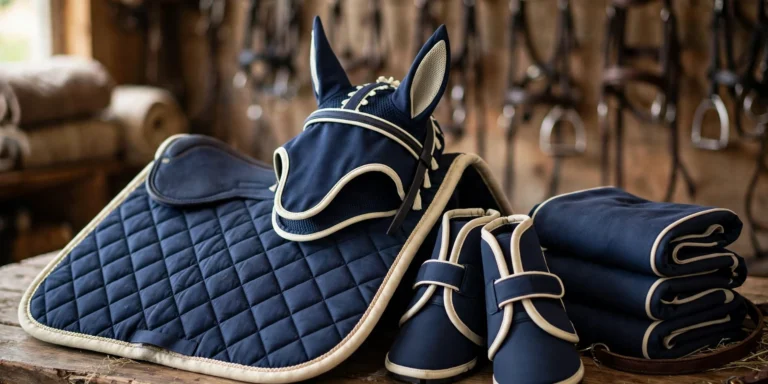
The short answer: A matching equestrian set is a pad, bonnet, and boots (plus optional wraps, halter, and rug) developed from one colorway so riders buy the whole outfit at once. The pad anchors the sale; the accessories lift basket size. The hard part is color discipline across materials — one lab dip per material, approved as a set.
This guide is the collection-building layer on top of our SKU architecture guide (boundary note: that guide covers how many SKUs a pad line should carry; this one covers how the pad line extends into coordinated accessories) and our seasonal color drops guide (the colorway planning rhythm these sets ride on). For the register-side version of bundled selling, see our gift bundles guide — that one is value-pack bundling at retail; this one is the OEM collection program upstream of it.
Key takeaways
- A matching set is developed as one project: pad + bonnet + boots/wraps as the core, halter and rug as optional extensions.
- Color does not transfer identically across materials — yarn, woven fabric, thread, webbing, and rope absorb and reflect color differently, so every material gets its own lab dip and set-level physical approval.
- The pad anchors the collection; accessories are the margin and basket-size layer — brief them together, sample them together, approve them together.
- Set programs multiply MOQ math: each component carries its own minimum within the colorway.
- MOQ 50 pieces per color — confirm how the minimum counts per set component and whether partial sets can run.
Why do matching sets sell — what is the commercial logic?
Direct answer: Matching sets convert a single-product buyer into a multi-item buyer by removing the color-risk decision: the rider trusts that the bonnet and boots will coordinate with the pad, so the set sells what separate items would not. The pad is the anchor the rider came for; the accessories are the basket the set adds.
The retail evidence for the demand is not subtle. Major equestrian buying guides list matching items available as a product feature on saddle pads — Horse & Hound’s pad roundup carries the line on multiple products, and links out to matchy-matchy sets coverage for young riders. (Horse & Hound — Best saddle pads for everyday wear with your GP) When a buying guide treats coordination as a product attribute, the retail floor has already decided it matters. The wholesale translation: accounts that buy pads without the matching accessories leave the coordination sale to whoever stocks them.
There is a second logic that matters more at wholesale level — season refresh. A private-label brand does not need to redesign a pad to launch a new season; it needs a new colorway executed across the whole set. The pad pattern stays, the colorway changes, and the set relaunches as a collection. That is why matching sets pair so tightly with seasonal color drops: the set is the delivery vehicle for the new color story, and the color story is the reason the account reorders.
What belongs in a matching set — and what stays out?
Direct answer: Pad, bonnet (fly veil), and boots or wraps are the core trio riders buy together; halters, lead ropes, and rugs extend the set for brands with the volume to support them. Keep the set inside one factory’s textile scope — products it cannot make well are licensed out, not forced in.
The composition table below reflects how OEM factories actually structure these programs — one equestrian textile manufacturer describes its matching sets as combining saddle pads, ear bonnets, horse boots, bandages, halters, lead ropes, and horse rugs into coordinated product lines with consistent colors, materials, and branding. (Petmomo — OEM Matching Equestrian Sets) Treat that as one manufacturer’s scope list, not a mandate — your set is the subset your accounts actually buy together.
| Component | Role in the set | Typical buyer expectation |
|---|---|---|
| Saddle pad | The anchor — the item the rider came for | Must carry the full colorway story (body, binding, piping, trim); everything else keys to it |
| Ear bonnet / fly veil | The visual match — worn on the horse’s head, the most visible coordination | Closest visual match to the pad’s trim and binding colors; crochet or technical fabric per line |
| Brushing boots / polo wraps | The basket lift — leg items the rider adds once the outfit exists | Match binding/piping color; boots and wraps are alternatives within one set, not both |
| Halter + lead rope | The yard extension — same colors, different use | Webbing and rope take dye differently from pad fabric; approve as its own material family |
| Horse rug / sheet | The seasonal extension — high ticket, high fabric volume | Only where the factory’s rug scope and your volume justify it; rugs are their own program |
Two composition disciplines keep sets profitable. First, boots and wraps are alternatives within one set — offering both in the same colorway splits the leg-accessory volume and doubles the accessory MOQ load for no additional basket. Second, the rug extension is a separate program decision: rugs consume far more fabric per piece than pads, carry their own sizing and hardware complexity, and only belong in the set when the factory genuinely makes rugs and the order volume supports the fabric buy.
How does color actually match across different materials?
Direct answer: It does not match by itself — yarn, woven fabric, embroidery thread, rope, and webbing absorb and reflect color differently, so each material gets its own lab dip developed against one physical master, and the finished set is approved as a set under controlled light. One Pantone number assumed across materials is how three-navies happen.
This is the load-bearing spec of the whole program, and the honest statement of it comes from the factory side: buyers should not expect different materials to look identical. Yarn, woven fabric, embroidery thread, rope and webbing reflect and absorb colour differently. Physical colour approval remains necessary. (Petmomo — How European Brands Should Evaluate an Equestrian Textile Manufacturer) That single paragraph is the specification discipline for matching sets: develop per material, approve as a set.
The working method has four steps. First, nominate one physical master — usually the pad’s binding or body fabric — as the set’s color reference, not a screen image. Second, develop a lab dip per material family (pad fabric, bonnet crochet yarn, boot neoprene or shell, webbing, rope) against that master. Third, approve the set as a set: all components together, under controlled lighting, against the master — because two materials that match under daylight can diverge under stable fluorescent light. Fourth, carry that approval forward as the set’s gold seal for the colorway, and re-approve per production run — materials come from different dye lots and different suppliers, so last run’s match is a reference, not a guarantee.
One more mechanism buyers should understand: changing one component’s color forces a coordination cascade. The same factory guide notes that if a brand changes a saddle pad’s color, the development team must coordinate the outer fabric, binding, embroidery thread, logo patch, webbing strap, fly veil, halter, lead rope, and packaging artwork — one change, nine surfaces. (Petmomo — How European Brands Should Evaluate an Equestrian Textile Manufacturer) Price your colorway changes accordingly: a simple color change on a five-component set is a multi-surface development job, and the sampling calendar should reflect it.
How many colorways can a set program carry?
Direct answer: Fewer than the pad line alone — every colorway multiplies across every set component, so the program carries the colorways whose set-level demand justifies the multiplied MOQ. Start with the anchor colorways and expand only when reorders prove the set moves as a set.
The arithmetic is the discipline. A pad line running six colorways is six colorways; a five-component set in six colorways is thirty component-colorways, each carrying its own minimum and its own dye development. That is why the standard advice is to launch the set on the two or three strongest pad colorways — the ones with reorder history behind them — and treat additional colorways as earned by the set’s own sell-through, not by the pad’s. A colorway that sells as a pad does not automatically sell as a set; the bonnet-and-boots buyer is a subset of the pad buyer, and the set program should be sized to that subset until the data says otherwise.
Per-account-type starting hypotheses, labeled as such and adjustable by sell-through:
| Account type | Starting-hypothesis set program |
|---|---|
| New private-label brand | One hero colorway as a full set; two more as pads only |
| Established brand, seasonal drops | Two to three set colorways per drop, anchored to the season’s pad story |
| Distributor house brand | Core black/navy/white sets year-round; one fashion set per season |
| Kids’/pony program | Bright fashion sets — the matchy buyer skews young (per the H&H matchy-matchy coverage) |
How do you structure the OEM set program?
Direct answer: One brief, one colorway master, one sampling round across all components — the set is developed as a single project with the pad anchoring the timeline. The factory that can coordinate sewing, embroidery, webbing, dyeing, and packaging in-house (or under one project manager) is the factory that keeps the set’s color story intact.
The brief for a set is a pad brief plus a coordination brief: the pad’s tech pack as usual, then the bonnet, boots, and wraps specified against the same color master with their material-specific notes (bonnet yarn, boot shell and binding, wrap fleece). The sampling round must be synchronized — approving the pad in March and the bonnet in May means the two were developed against different dye lots, and the set-level approval never happened. Insist on the set arriving as a set for approval.
The factory-scope question decides the program’s shape. One OEM guide puts it plainly: these sets are ideal for seasonal collections, promotional programs, retail launches, and stable management solutions, and the manufacturer’s coordinated resources — sewing, embroidery, webbing, dyeing, sampling, private-label packing — are what keep a multi-product collection consistent. (Petmomo — OEM Matching Equestrian Sets) When vetting a factory for sets, the question is not can you make boots — it is who owns the color story across the pad, the bonnet, and the boots. If the answer is three different sub-suppliers with no coordination point, the set will show it.
MOQ math is the other program structure. Each component carries its own minimum within the colorway — the set does not run as one MOQ. At our standard of 50 pieces per color per component, a three-colorway core set (pad + bonnet + boots) is nine component-colorway minimums before the first carton ships. Plan the launch colorways against that arithmetic, not against the pad minimum alone.
What specs should you confirm when requesting a quote?
Direct answer: Confirm the set composition, the per-component MOQ counting, the color-approval method per material, the synchronized sampling plan, and the private-label scope — in writing, against a physical set sample. Seven confirmations for a program whose failure mode is always coordination.
- Set composition — which components are in the set (pad, bonnet, boots or wraps, halter, rug) and which are excluded; alternatives chosen, not stacked
- Color master — the single physical master the whole set develops against; which component carries it (usually the pad)
- Per-material approval — lab dips developed per material family against the master; set-level approval under controlled lighting before bulk
- Synchronized sampling — all components sampled and approved in the same round, against the same dye lots
- MOQ counting — whether each set component carries the 50 pieces per color minimum independently, and whether partial sets (pad + bonnet only) can run
- Branding scope — logo embroidery or patches per component, label and hang-tag program, retail packaging for the set
- MOQ — 50 pieces per color is our factory standard per component; confirm how the minimum multiplies across a multi-component, multi-colorway launch
Key takeaways
- The pad anchors the set; bonnet, boots, and wraps are the basket-size layer — brief, sample, and approve them as one project.
- Color matching across materials is a per-material lab-dip discipline approved as a physical set, never a shared Pantone number.
- Launch sets on the strongest pad colorways only; additional set colorways are earned by the set’s own sell-through.
- Each component carries its own MOQ within the colorway — size the launch against the multiplied minimums. MOQ 50 pieces per color per component.
- The factory’s coordination point (who owns the color story across components) matters more than its product list.
Frequently asked questions
Can a pad and a bonnet ever match exactly?
Functionally, not molecularly — quilted cotton and crochet yarn will never reflect light identically. What the buyer approves is a set-level match: all components developed against one physical master and approved together under controlled light, close enough that the rider reads them as one colorway. That approval, documented as the set’s gold seal, is the standard — not a claim of identical color.
Should every colorway include every accessory?
No — run the full set only on the colorways whose set-level demand justifies the multiplied MOQ. The standard launch pattern is the hero colorways as full sets and the rest as pads only, with accessories added when reorders show the set moving as a set. Every accessory on every colorway is how programs drown in slow component stock.
How do you keep last season’s navy matching this season’s?
You usually don’t try — treat each season’s set colorway as its own development against its own master, and do not promise cross-season matching across dye lots. Where continuity matters (core black/navy/white sets), hold the master and re-approve per run rather than assuming the dye house repeats itself.
Is a matching set the same as a gift bundle?
No — and the distinction matters for how you buy them. A matching set is a coordinated collection developed at the factory (this guide); a gift bundle is a retail value pack assembled at the shop, often mixing existing stock with a box and a bow. See our gift bundles guide for the register-side program — the set is what goes into the bundle.
Do western programs do matching sets?
They do, in their own idiom — blanket-top pad with matching headstall and breast collar accents — but the color-matching discipline differs (tooled leather, wool patterns, and concho hardware rather than dyed textiles). Brief western sets as their own program with their own material families, not as an extension of the English textile set.
Building a matching collection for your brand — pad, bonnet, boots, and wraps in one colorway? Send us your target set composition and color story — we develop the whole set as one project with per-material lab dips and set-level approval, with free samples before bulk. MOQ 50 pieces per color per component.
Sources & Further Reading
- Petmomo — OEM Matching Equestrian Sets Manufacturer: matching sets as an OEM category — pads, ear bonnets, boots, bandages, halters, lead ropes, rugs in coordinated lines; full customization (logo, embroidery, labels, hardware, colors, retail packaging).
- Petmomo — How European Brands Should Evaluate an Equestrian Textile Manufacturer: color coordination across materials (different materials reflect and absorb color differently; physical approval necessary); lab dips and per-material development; the nine-surface coordination cascade on a color change.
- Horse & Hound — Best saddle pads for everyday wear with your GP: retail evidence for matching demand (matching items available on multiple pads; matchy-matchy sets coverage).
- Saddle Pad SKU Architecture for Private-Label Brands — the SKU-count discipline this set program plugs into (boundary: SKU structure vs collection building).
- Seasonal Color Drops for Saddle Pads — the colorway planning rhythm matching sets ride on.
- Saddle Pad Gift Bundles & Value Packs — the retail bundle program downstream of the set (boundary: factory collection vs register bundle).
- Custom Branding: Embroidery, Piping and Logo Options — per-component branding methods for set pieces.
