Saddle Pad Gift Bundles and Value Packs: How Tack Shops Lift Average Order Value
Published · Cornovo Saddlery
Consider a common scenario: a tack shop carries a slow line of schooling pads in a colorway that photographed well and sold poorly. The shop marks the pads down and clears them at a thin margin — while the matching boots in the same colorway sit untouched on the next shelf. Boxed together at a price just under the separate total, the pair could have moved at close to full margin. The markdown was not the mistake; applying it to the pad alone was.
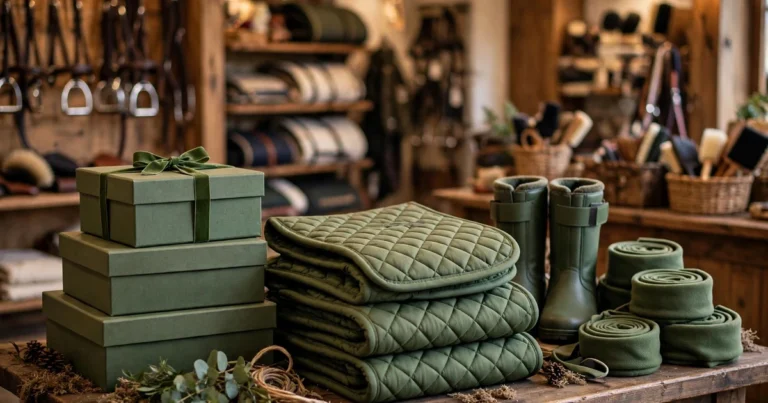
Saddle pad gift bundles lift average order value by converting one-item trips into multi-item purchases. A color-matched pad-plus-boots set, priced just under the separate-item total, gives riders convenience and gift-readiness in one box. Shops that run two seasonal programs — holiday and show-season — and brief the factory so components actually match, capture the biggest lift.
This guide covers the bundling logic that works for saddle pads, an illustrative pricing ladder, holiday and show-season stocking, how bundles digest slow colorways, and how to brief a factory so the components actually match. Prices in this article are illustrative starting assumptions, not market quotes — adjust every number to your own cost and margin structure.
Key takeaways
- A working bundle answers a shopping trip the rider already makes — one color, one discipline, one occasion — so the box reads as a solution, not a clearance pile.
- Pair the pad with items bought on the same trip: brushing boots, polo wraps, half pads, fly masks, or a second pad in a matching colorway.
- Build a pricing ladder where each tier sits just under the separate-item total; the ladder below is illustrative, with a starting discount depth to confirm against your own margins.
- Bundle stock has two peaks: holiday gift boxes (plan orders by late summer) and show-season prep sets (plan by late winter) — both need matched dye lots from one production run.
- Slow colorways move fastest inside themed sets, never with a clearance sticker on the box — one slow item per bundle is the working rule.
What makes a saddle pad bundle work?
A bundle works when the combination answers a shopping trip the rider already makes — one color, one discipline, one occasion — so the box feels like a solution rather than leftovers the shop wants gone. Bundling guides across retail keep returning to the same principle: products grouped around a shared use case outperform products grouped by category or price point (ThinkNectar’s 2026 bundling guide).
Riders buy in three kinds of trips. The color trip: I want everything in hunter green. The discipline trip: I need show-ring kit for next weekend. The occasion trip: I need a gift for my trainer. A bundle built around any one of these sells itself; one built around these were in the back room sells to nobody.
That is why the single strongest rule is matching. The pad, boots and wraps in the box should come from the same dye lot, or at least the same approved color standard. This is the equestrian version of what bundling literature calls compatibility-based bundling: everything in the bundle must work together seamlessly, because mismatched components erode trust in the whole purchase (Zoovu’s product-bundling strategies). Riders spot a mismatched matching set instantly — and a set that doesn’t match reads as cheap, which kills the reason the bundle can hold its price.
The second rule: the anchor item must be one the rider would buy anyway. The saddle pad is almost always the anchor. The boots and wraps ride along on its momentum. Bundles built around two slow items just create a slower bundle.
Which combinations should a tack shop bundle?
Start from trips riders already make, and keep every bundle to two or three components — more than that and the box gets expensive and hard to price.
| Bundle | What’s inside | Buyer logic | Best season |
|---|---|---|---|
| Color-match starter kit | Schooling pad + brushing boots + polo wraps, one colorway | The matchy rider buys all three on one trip anyway; the box saves her the hunt | Year-round; peaks at holidays |
| Show-ring set | Dressage or all-purpose pad + half pad, white or cream | Competition prep trip — everything needed for show turnout in one box | Spring show season |
| New-horse kit | All-purpose pad + cooler rug | New owners buy the basics together; a textile-only kit keeps packing simple | Autumn |
| Summer turnout pair | Breathable mesh schooling pad + fly mask | Heat-season problems solved together; natural add-on at the register | Late spring / summer |
| School-string value pack | Three same-style pads, assorted colorways | Riding schools rotate pads daily; a three-pack is one purchase decision instead of three | Year-round for school accounts |
Notice what the table leaves out: random pairs made from whatever was overstocked. If the combination does not match one of the three trip types — color, discipline, occasion — it is not a bundle, it is a clearance shelf wearing a ribbon.
How many bundle SKUs to start with depends on the shop. As starting hypotheses to adjust on sell-through: a small independent tack shop begins with one bundle SKU in its bestselling colorway at the register; a regional chain runs a seasonal set per peak (holiday gift box + show-season set) across its core colorways; an online-first retailer builds one page per combination with a flat-lay photo. All three rebalance after the first selling season — expand what attached, retire what didn’t.
How should you price a bundle ladder?
Price the bundle against the separate-item total, not against your cost. The rider’s mental math is what would I pay separately — the bundle wins by coming in just under that number, with convenience and the gift box as the reason the deal feels generous.
The ladder below is an illustrative starting assumption. Adjust every number to your own cost and margin structure:
| Tier | Contents | Illustrative retail | Positioning |
|---|---|---|---|
| Single | 1 schooling pad | $79 | The anchor price everything else is compared against |
| Duo | Pad + brushing boots | $99 | The gateway bundle; an easy yes at the register |
| Kit | Pad + boots + polo wraps, color-matched | $129 | The hero SKU — highest perceived value, gift-ready |
| Deluxe gift | Kit + rigid gift box + care card | $159 | Holiday tier; the box itself is part of the product |
Two guardrails keep the ladder profitable. First, start with a modest discount depth and confirm against your margins — bundling guides cite roughly 10–20% off the combined individual prices as a common sweet spot, going deeper only to accelerate clearance of a specific SKU (ThinkNectar). A deep bundle discount trains customers to wait for bundles instead of buying singles. Second, never price a tier below your component cost floor plus packing — the bundle should carry your margin, not donate it.
One pricing move works better than a discount: keep the bundle price fixed and upgrade the box. A sturdier gift box, a printed care card and tissue paper cost little at volume but let the deluxe tier sit above the kit without touching the textile margin.
When should you stock bundles — holiday or show season?
Both, but they are different programs with different order deadlines. Holiday bundles are a gifting program: deluxe boxes, gift-ready packaging, stocked late October through December. Show-season bundles are a preparation program: show-ring sets and color-match kits, stocked March through June. The mistake is ordering one generic bundle assortment and hoping it serves both peaks.
Work backward from the selling window. Holiday gift boxes selling in November need factory shipment in September, so lock colorways and packaging by July. Show-season sets selling in April need shipment in February, colors locked by December. Custom lead times run several weeks plus freight — confirm the timeline with your factory and add a buffer for packaging components, which often arrive late.
The shared requirement across both peaks: matched dye lots. A bundle whose pad and boots come from different production runs will not match, and nothing deflates a gift box faster than two shades of navy. Order bundle components as one production lot, or require the factory to cut all components against the same approved shade standard. This is the detail to put in writing on the purchase order, not to assume.
How do bundles digest slow-moving stock?
The slow colorway is the classic tack shop headache: pads in a shade that photographed well and sold poorly. The instinct is a markdown. The bundle alternative keeps the margin: build a themed set around the slow shade, price it at the kit tier, and let the set’s story do the selling. Bundling guides describe exactly this as leader bundling — pairing a high-demand product with a slower-moving item so the bestseller draws attention and the weaker product rides along, without a sitewide or markdown-sign sale (ThinkNectar).
The working rule is one slow item per bundle. Pair the slow pad with a strong-selling boot and a neutral wrap — the set reads as the olive collection, not the olive clearance. Rotate the theme quarterly so regular customers see a fresh story.
Track sell-through per bundle SKU, not per component. If the olive set sells out in six weeks while the single olive pad had been sitting, the bundle has done its job — even though the pad itself never got cheaper.
How do you brief a factory on bundle orders?
A bundle is a manufacturing instruction, not just a merchandising idea. The purchase order should spell out the exact components in each bundle SKU, the requirement that all textile components come from one dye lot, the packing format (polybag per component, consolidated in one retail box), and a barcode per bundle SKU rather than per component.
Ask for a pre-production bundle mockup: one fully packed box, photographed and shipped for approval before bulk. The mockup catches the classic failures — boots that don’t fit the box, a box that crushes in the carton, colors that looked matched on screen and aren’t in hand.
On quantities: the standard custom MOQ of 50 pieces per color applies per component colorway, so start the first bundle run in one colorway and expand once it proves itself.
What specs should you confirm when requesting a quote?
A bundle quote has more moving parts than a single-pad quote. Confirm these in writing before the factory starts:
- Bundle SKU definitions: the exact components in each bundle tier, with quantities
- Component MOQ per colorway — our standard is 50 pieces per color
- Color matching: single dye lot per bundle SKU, or cut against an approved shade standard
- Packing format: polybag per component plus retail box, belly band, or printed sleeve
- Barcode per bundle SKU rather than per component
- Pre-production mockup: one fully packed box for approval before bulk
- Shipment schedule tied to your selling window, with a buffer for packaging components
Frequently asked questions
Do bundles need custom packaging?
The deluxe holiday tier does — a rigid box is part of what the customer pays for. The duo and kit tiers usually don’t: a clear polybag set, a belly band with the bundle name, or a printed sleeve over the standard packaging is enough.
What if my pad supplier and my boot supplier are different factories?
Then the matching risk moves to your warehouse. Order both components against the same Pantone-based shade standard, receive them separately, and assemble the bundles yourself or through a third-party packer. Consolidating at your own dock also lets you build bundles from stock on hand without a new production run.
How deep should the bundle discount be?
Deep enough to beat the separate-item total, shallow enough to protect the margin — a common starting point is around 10–20% off the separate total, confirmed against your own cost structure (ThinkNectar’s bundling guide). The convenience, the matching and the gift presentation carry most of the perceived value; the discount just needs to make the mental math work at the shelf.
Can a small tack shop run bundles with limited floor space?
Yes — small shops often do it best, because one endcap of bundled boxes replaces three scattered displays. Start with one bundle SKU in your bestselling colorway, displayed at the register or on a single endcap, and expand only after it sells through. The register is the highest-conversion spot in the shop for an add-on box.
Do bundles work online as well as in the store?
They work differently. Online, the bundle needs a dedicated product page with a flat-lay photo of all components and a clear buy the set, save line — shoppers can’t pick up the box, so the page has to do the selling. In-store, the box does the work.
Send us your target bundle — components, colorways, and the retail ladder you want to hit — and we will quote matched pad, boot and wrap components from single dye lots at 50 pieces per color, with consolidated bundle packing and per-SKU barcoding built into the order.
Sources & Further Reading
- What Is Product Bundling Strategy? A 2026 Guide — ThinkNectar: leader bundling for slow-moving SKUs, the 10–20% discount sweet spot, and the design principle of grouping products around a customer problem rather than a category.
- 5 Winning Product Bundling Strategies for 2026 — Zoovu: compatibility-based bundling, visual bundling, and why accurate product relationships prevent mismatch and reduce returns.
- Saddle Pad Display and Merchandising: A Tack Shop Guide — cornovosaddlery.com/
- Saddle Pad Inventory Planning for Tack Shops — cornovosaddlery.com/
- Saddle Pad Buying Calendar for Tack Shops — cornovosaddlery.com/
- Launching a Private-Label Saddle Pad Line: Timeline — cornovosaddlery.com/
