Published · Cornovo Saddlery
Consider a common scenario: a distributor orders Navajo western pads from two factories. One ships thin woven saddle blankets. The other ships 32-by-32 padded pads with a patterned woven top, a felt core, and leather wear guards. Both cartons are labeled Navajo pad — and in each factory’s trade usage, the label is honest. The buyer’s retail accounts, though, expected the padded version, and the thin blankets land in the wrong price position. Nothing was mislabeled. The name itself covers two different products.
The short answer: Navajo pad is trade shorthand for two different products: a thin woven saddle blanket and a padded blanket-top western pad (woven patterned top over a felt core). Wholesale buyers should name the construction in writing — blanket-top for riding programs, thin blankets for show layering and add-ons — and treat thickness, weave quality, and wear leathers as spec lines.
This guide is the buying-category companion to our western saddle pad design guide (boundary note: that guide covers the private-label design process — patterns, tooling, colorways; this one covers buying Navajo and blanket-top products as finished wholesale categories) and our western show pad standards guide (the ring-standard and retail-buying angle for show pads, which this category sits just below). For fit and measuring, see our saddle pad sizing guide.
Key takeaways
- Navajo pad names a look — a southwestern geometric pattern — not a single construction. Thin woven blankets and padded blanket-top pads are different products with different prices and uses.
- Three constructions cover the wholesale line: thin woven blankets, blanket-top pads (woven top + felt core + fleece underside), and felt pads with a printed blanket-look face.
- Thickness follows the riding job and comes from maker guidance, not from a universal standard — the 1/2-inch show liner, the 3/4-to-7/8-inch all-rounder, and the 1-inch ranch pad each have their place.
- Wear leathers and edge finishing are the durability spec lines that separate a daily-work pad from a fashion pad.
- MOQ 50 pieces per color — confirm whether thin blankets and padded pads carry separate minimums within one pattern colorway.
What is a Navajo pad — and how does it differ from a blanket-top pad?
Direct answer: A Navajo pad usually means a thin woven saddle blanket with a southwestern pattern — worn over a felt pad in the show ring. A blanket-top pad is a padded western pad whose top face carries the same woven pattern, built over a felt core. Ask which one the supplier means before quoting: price and use case differ completely.
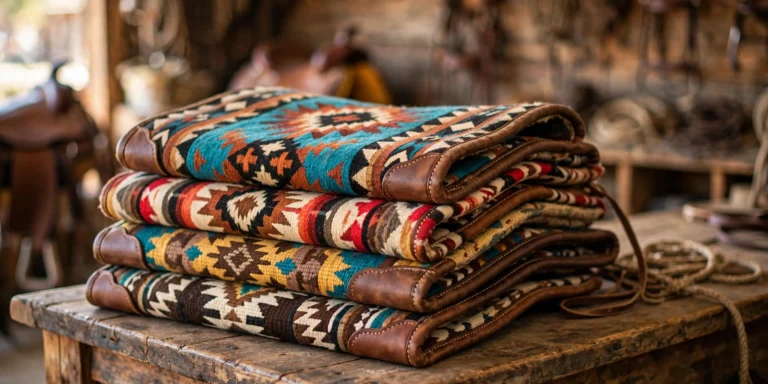
The confusion is understandable: retailers sell both under Navajo, and the visual family is the same. But the products diverge at construction. A retailer describes blanket-top pads as combining a woven Navajo or Southwestern-pattern top with a pressed felt bottom — the pattern face of one product over the working structure of a felt pad. (Saddle Up Colorado — Western Saddle Pads & Blankets) A thin woven blanket has no core and no shock absorption of its own. Treating them as one SKU family is how the two-carton mix-up happens.
| Product | Construction | Typical job |
|---|---|---|
| Thin woven Navajo blanket | Single-layer woven blanket, southwestern pattern; no felt core | Show-ring layer over a felt pad; fashion add-on; affordable gift item |
| Blanket-top western pad | Woven pattern top + felt or foam core + fleece or felt underside; wear leathers and bound edges | Everyday riding pad with the traditional look built in — the riding-program core SKU |
| Felt pad with printed blanket-look face | Felt pad with the pattern printed (not woven) on the face | Price-positioned alternative where the woven top’s cost does not fit the program |
Two naming notes for tech packs and listings. First, Navajo here is a pattern family — diamonds, zigzags, stepped motifs in earthy and high-contrast colorways — not a claim about who wove it. Second, write the construction into the product name your buyers see (e.g., blanket-top pad vs woven saddle blanket), so the distinction survives to the retail floor instead of living only in your purchasing notes.
What are the three constructions buyers should know?
Direct answer: The wholesale line runs on three constructions, and each suits a different buyer: thin woven blankets for show layering and fashion, blanket-top pads as the padded riding core, and printed blanket-look felt pads for price-sensitive programs. None is the best pad — they are three answers to three different price and use positions.
| Construction | Typical strengths — and when they hold | Watch-outs — and when they show up |
|---|---|---|
| Thin woven blanket | Light, folds small, and cheap to ship — the show-ring color pop; ranch riders traditionally layer one over a felt pad for easy washing and a second color story | No shock absorption on its own; ridden alone under a western saddle it is a style choice, not a working pad — confirm the intended use with the account |
| Blanket-top pad | The traditional look riders ask for with real structure underneath — one maker builds theirs on a one-inch felt center with a double-woven Navajo blanket top and a moisture-wicking fleece bottom (Teskeys — Mustang Navajo Pad) | Heavier and costlier than a plain felt pad; pattern alignment across the top and consistent binding need factory discipline — inspect the sample, not the photo |
| Printed blanket-look felt | The pattern at felt-pad economics — the cheapest route to the southwestern look, with the print as durable as the printing method | The pattern is ink, not weave; experienced western buyers can tell at a glance — position it on price, not as the woven article |
The layering tradition is worth knowing because it still drives sales. Working-cowboy practice runs a thin blanket over (or under) the felt pad — one reason thin blankets keep selling alongside the padded line rather than being replaced by it. Stock the two as companions, not competitors: the blanket is the fashion refresh; the padded pad is the working core.
What does Navajo promise about the weaving — and what doesn’t it?
Direct answer: The name promises a look, not a provenance or a weave standard. On wholesale lines, Navajo describes the pattern family — not hand-weaving, a set fiber, or any weaving tradition. Buy what you can specify: weave density, color retention, yarn fiber, and edge finishing — written into the tech pack, not assumed from the name.
The quality signals are the ones you can check on a sample. A tight, dense weave holds its pattern and resists pulling; a loose weave bags and snags. Color retention matters because these pads are bought for their color — ask how the pattern yarns are dyed and whether the factory can show a colorfastness report for the dark colorways (see our color fastness guide). The edges tell you about the factory: bound and even, or fraying out of the carton.
Fiber content is the spec that most changes the pad’s behavior. A wool or wool-blend woven top wicks and breathes like the heritage article; an all-synthetic top holds color vividly and costs less but handles moisture differently. Neither is wrong — but the hang tag should say which one the buyer is getting, because the fiber rules behind the tag do not accept pattern names as fiber content.
How thick should a blanket-top western pad be?
Direct answer: Thickness follows the riding job, and guidance comes from pad makers — no universal standard exists. Per makers: 1/2-inch pads for show liners, 3/4 to 7/8 inch as the daily pad, 1 inch for ranch days, roping, and heavy use. Thicker is not automatically better — on a well-fitting saddle, thickness can change the fit it meant to protect.
The maker-attributed version is specific enough to quote. Cowgirl Magazine’s thickness guide, citing 5 Star Equine guidance, frames it this way: 3/4 to 7/8 inch for lightweight riders, shorter daily rides, and barrel work; 1 inch for four-plus-hour days, heavier riders, and cutting, sorting, or roping; and a 1/2-inch liner pad that is not meant to be ridden alone. (Cowgirl Magazine — How Thick Should Your Western Saddle Pad Be?) 5 Star’s own how-to guide runs the same ladder in its own words: 1/2 inch for showing under a blanket, 3/4 inch as the daily all-rounder, 7/8 inch as the best all-around use pad, and 1 to 1-1/8 inch for ranch work and roping. (5 Star Equine — How To Guide)
| Job (maker-attributed guidance) | Typical thickness cited | Buyer note |
|---|---|---|
| Show liner under a blanket | 1/2 inch | Not a standalone riding pad — the blanket carries the look, the liner carries thin protection |
| Daily riding, barrel, pleasure | 3/4 to 7/8 inch | The volume band for most retail accounts |
| Ranch work, roping, long days | 1 inch and up | Where shock absorption earns its price; the working-shop core |
Two cautions from the same sources. Saddle Up Colorado’s fitting note warns that a thicker pad is not always better: on a well-fitting saddle, a thinner pad keeps the rider’s leg closer and reduces rolling, and bridging or dry spots are fit issues a pad alone will not solve. And 5 Star’s contoured-fit note adds that double padding creates movement and slippage — one well-chosen pad, not a stack of them. (Saddle Up Colorado — Western Saddle Pads & Blankets) Your staff should be able to say both sentences, because the customer asking for the thickest one is often solving the wrong problem.
How do wear leathers and binding change the value story?
Direct answer: Wear leathers are the sacrificial strips at the cinch, fender, and wear points that absorb the abrasion a moving saddle creates. Their material, width, and stitching separate a daily-work pad from a fashion pad — and working buyers check them first, because a pad whose top fails at the cinch is done regardless of the felt beneath.
One retailer’s own copy makes the mechanism plain: its Navajo pad is finished with durable black wear leathers, reinforced to handle the constant movement of the cinch and fenders. (Teskeys — Mustang Navajo Pad) That sentence is also your inspection checklist: wear-leather material (leather, synthetic, or none), width and coverage of the strips, stitch density holding them, and whether the binding at the pad’s edges is even and tight. A thin blanket typically carries lighter finishing; a padded work pad should carry the full wear-leather set.
Price the feature honestly in your line. Real leather wear guards cost more than synthetic and read as premium to the buyer who knows the difference; synthetic wears well and keeps the price down. What fails programs is the middle case — a pad priced like a work pad with fashion-pad finishing — so make the wear-leather call per price tier and write it into the tech pack as a named line.
How do you size a blanket-top western pad?
Direct answer: Western pads size by square inches, and 32-by-32 is the commonest stock size. Retailers teach a simple working rule: the pad should show beyond the saddle skirt all the way around. Every maker cuts its own numbers, though — so quote against the factory’s finished-dimension chart, not the trade nickname.
The size ladder in retail practice runs from 30-by-30 for short-backed horses and compact barrel saddles up through 32-by-32 as the all-rounder — one retailer’s blanket-top Navajo pad is built exactly 32 by 32 (Teskeys — Mustang Navajo Pad) — to larger squares for long-skirt trail and roping saddles. For the wholesale program, the discipline is the same as any pad family: lock the finished dimensions (length, width, and the contoured profile if the pad is shaped rather than square) on the tech pack with written tolerances, measure the approval sample, and do not assume one maker’s 32-by-32 matches another’s. See our saddle pad sizing guide for the measuring method.
How should you stock Navajo and blanket-top pads?
Direct answer: Stock the line the way the products actually sell: thin blankets as the show and fashion layer, blanket-top pads as the riding-program core. Pattern colorways turn faster than solid felt lines, so the color program — not the pad count — is where this category wins or loses. Starting hypotheses per account type, labeled as such and adjustable by sell-through:
| Account type | Starting-hypothesis assortment |
|---|---|
| General western tack shop | Blanket-top pads as the core (neutral + two fashion patterns); thin blankets in seasonal patterns as the refresh layer |
| Ranch / working shop | Heavier on 1-inch blanket-top pads with full wear leathers; thin blankets as the inexpensive add-on beside the register |
| Show-oriented account | Thin woven blankets in current pattern colorways; padded show pads per our show standards guide rather than blanket-tops |
Two stocking mechanics specific to this category. First, patterns have a fashion cycle — tie the pattern colorways to your seasonal color-drop rhythm rather than treating them as permanent cores, and use the reorder math from our inventory planning guidance. Second, thin blankets make natural companions to the felt pad line — the same register that sells a 3/4-inch felt pad sells the woven blanket that goes over it, which is why the two-carton story at the top of this guide is a merchandising opportunity once the naming is sorted.
What specs should you confirm when requesting a quote?
Direct answer: Confirm the construction (which of the three products you are quoting), the finished dimensions and thickness, the woven top’s fiber and weave spec, the wear-leather and binding spec, and the MOQ counting rule — in writing, against a physical sample. Eight confirmations for a category whose failure mode is always the name covering the wrong product.
- Construction named — thin woven blanket, blanket-top pad, or printed blanket-look felt; which product the quotation covers
- Finished dimensions and thickness — length, width, thickness, and profile per size, measured on the approval sample
- Woven top spec — fiber content, weave density, yarn dye method; colorfastness reporting for dark pattern colorways
- Wear leathers — material (leather vs synthetic), width, coverage points, stitch density
- Binding and edge finishing — binding material and width, edge evenness as an inspection point
- Underside — fleece, felt, or other bottom material and its wash behavior
- Pattern colorways — which patterns run in the order; whether pattern colorways carry separate minimums
- MOQ — 50 pieces per color is our factory standard; confirm whether thin blankets and padded pads count as separate minimums within one pattern colorway
Key takeaways
- Navajo pad covers two products — name the construction (thin woven blanket vs blanket-top pad) on the quote, the tech pack, and the product listing.
- The blanket-top pad is the riding-program core: woven pattern top, felt core, protective underside, wear leathers, bound edges.
- Thickness follows the riding job per maker guidance — 1/2-inch show liners, 3/4-to-7/8-inch all-rounders, 1-inch ranch pads — not a universal rule.
- Weave quality is a spec (density, dye, fiber, edges), not something the pattern name guarantees.
- Stock patterns on a fashion rhythm and blanket-tops as the core; treat the thin blanket as the felt pad’s companion, not its competitor. MOQ 50 pieces per color.
Frequently asked questions
Can a thin Navajo blanket be used alone for riding?
It can be ridden in, but it is not a working pad — it has no shock-absorbing core, so it belongs over a felt pad for real riding or alone in the show ring where the look is the job. Working-cowboy practice treats the thin blanket as the layer and the felt pad as the structure; stock and sell them that way.
Is a blanket-top pad the same as a western show pad?
No — and the distinction matters for how you buy them. A blanket-top pad is an everyday riding pad with a patterned woven face. A show pad carries overlays, wear guards, and ring presentation as its reason for existing. See our western show pad standards guide for the show-ring category; this guide covers the working and fashion line below it.
Do the woven patterns fade?
Conditionally — pattern yarns are dyed goods like any other, and dark colorways on any textile carry bleed and fade risk. Ask for the colorfastness reporting on the dark patterns before the order, and see our color fastness guide for how to read the grades.
Should the woven pattern be on both sides of the pad?
Typically no — the pattern faces up on a blanket-top pad, with the working underside (fleece or felt) against the horse. Some thin woven blankets are genuinely double-sided and reversible; confirm per product rather than assuming, and price the reversible ones as the feature they are.
Are hand-woven tops worth the cost premium over printed blanket-look pads?
Conditionally, per quote and per customer. The woven top is the authentic article that connoisseur western buyers pay for; the printed face is the price-positioned route to the same look. Carry both only if your accounts split across the two price positions — otherwise pick the lane your buyers already shop in.
Building a Navajo and blanket-top western pad program — padded riding cores, show-layer blankets, or both in your pattern colorways? Send us your target constructions, sizes, and color stories — we develop woven tops and felt cores to one tech pack with free samples before bulk. MOQ 50 pieces per color.
Sources & Further Reading
- Teskeys — Mustang Navajo Pad: three-tier blanket-top construction (one-inch felt center, double-woven Navajo blanket top, fleece bottom, black wear leathers, 32″ x 32″).
- Saddle Up Colorado — Western Saddle Pads & Blankets: blanket-top pads as woven Navajo/Southwestern top over pressed felt; the thicker-is-not-always-better fitting note.
- Cowgirl Magazine — How Thick Should Your Western Saddle Pad Be?: maker-attributed thickness ladder (3/4–7/8 inch daily/barrel, 1 inch ranch/roping, 1/2 inch liner not for solo use).
- 5 Star Equine — How To Guide: per-discipline thickness recommendations (1/2 inch show, 3/4 inch daily, 7/8 inch all-round, 1–1 1/8 inch ranch/roping); contoured fit vs double padding.
- Western Saddle Pad Design Guide for Private-Label Buyers — the design-process companion (boundary: design process vs buying category).
- Western Show Pads, Overlays & Show Standards — the show-ring category above this one.
- Saddle Pad Sizing Guide — measuring method for finished dimensions.
- Saddle Pad Color Fastness: A Buyer’s Guide — reading colorfastness reports for dark pattern colorways.
