
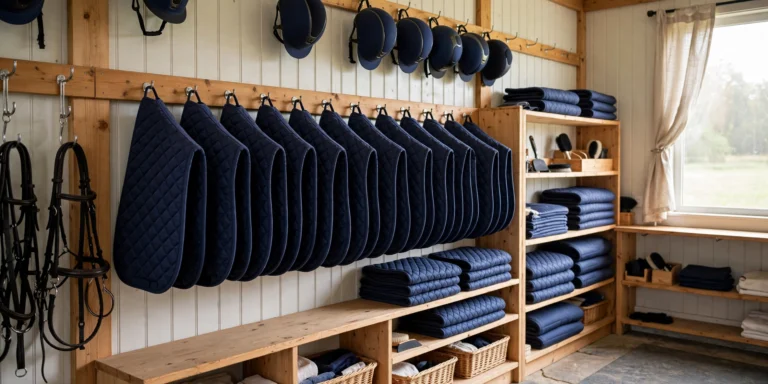
Saddle Pad Bulk Programs for Riding Schools and Lesson Barns: A Distributor's Guide
Published · Cornovo Saddlery
Consider a common scenario: a distributor quotes a riding school its first batch of pads in the school’s colors. The order ships, the program runs well — until mid-season, when the barn needs a few replacements and the new pads arrive a shade off from the originals. The distributor reorders, and the second batch matches neither the first nor the second. Nobody chose the wrong color. The program simply had no shade-continuity plan, and bulk programs live or die on reorders, not on the first shipment.
The short answer: riding schools buy saddle pads as a program, not a purchase — uniform colors, construction that survives daily rotation and constant washing, budget-cycle pricing, and reorders that match the original shade. Distributors who engineer the reorder cycle upfront keep the account; those who only quote the first shipment lose it at the top-up.
This guide is written for distributors and tack shops selling into riding schools, lesson barns, and camps: what makes a school color program hold together, which durability features matter under lesson-barn use, how to structure bulk pricing, and how reorder and replacement cycles work. It companions our distributor pricing guide, our reorder consistency guide, our color fastness guide, and our returns and warranty guide.
Key takeaways
- Schools buy programs, not purchases: uniform color, heavy-rotation durability, budget-cycle pricing, and shade-matched reorders are the four pillars.
- A school color program needs a physical color standard on file — screen colors drift; reorders match the swatch, not the memory of the first batch.
- For lesson-barn use, colorfastness to repeated laundering and binding/strap construction matter more than face-fabric hand feel.
- Structure pricing in tiers tied to program size, labeled as starting assumptions, and quote the replacement top-up price alongside the opening order.
- Write the reorder rules into the first quote: shade continuity, reorder minimums, who holds the color standard.
Why do riding schools buy saddle pads differently than individual riders?
Direct answer: A school buys for a string of horses and a rotation of riders, so uniformity, durability under daily use, and budget-cycle pricing outweigh individual fit preferences and fashion colors. The buyer is usually a barn manager spending an annual equipment budget — which changes every term of the sale, from the SKU count to the reorder conversation.
Lesson horses work multiple rides a day, so the fleet needs one or two colors that look uniform on every horse — the school’s identity is the point. Pads rotate through the wash constantly, making laundering behavior a primary spec. And where a school plans on an annual budget cycle, the purchase lands once a year; a distributor who quotes early — with replacement pricing attached — becomes the standing supplier. The SKU discipline: one or two colors, two to three sizes. Every extra colorway is a shade-matching liability at reorder time.
What makes a school color program work?
Direct answer: A working color program rests on a physical color standard held by both sides, a construction and dye process chosen for repeatability, and a written rule for how reorders get matched. Screen images and the same navy as last time are not standards — a cut swatch from the approved bulk, filed by both distributor and factory, is.
Shade continuity is the failure point the scenario describes, and it is preventable. Dye lots vary — that is normal textile production — so the factory keeps the approved swatch and dye recipe on file, each reorder is checked against the swatch before shipment, and the distributor knows whether a reorder comes from the same lot or a new one. Our reorder consistency guide covers the mechanics; the school-program addition is one rule — tell the barn manager honestly when a top-up comes from a new dye lot, before it ships. A disclosed slight variation keeps trust; a discovered one ends the program.
Logos are the second half of the color program: factory embroidery versus local embroidery after delivery. Factory embroidery keeps the logo identical across every pad and reorder and ships finished — the tradeoff is that the logo file, size, and placement must be locked before production. Local embroidery lets the school change logos later, but placement consistency is lost. Our print methods guide compares the routes; factory embroidery suits settled logos, local decoration suits schools still building their brand.
Which durability features matter most for lesson-barn use?
Direct answer: For lesson-barn use, prioritize colorfastness to repeated laundering, binding and girth-strap construction, and stitch density at stress points — in that order. A school pad gets washed after nearly every use, pulled on and off multiple horses daily, and girthed by riders of varying skill; those three conditions decide which features earn their cost.
Washing is the dominant stress. School pads go through the laundry far more often than a private rider’s pad, so the colorfastness-to-laundering grade matters more here than in any other program — AATCC TM61, the accelerated laundering colorfastness method, predicts whether the school’s colors survive the season’s wash count. Ask for the result on the actual face fabric in the actual school colorway, not a generic mill certificate: dark colors show fading faster than light ones, so a grade that passes on white may not pass on the ordered color. Our color fastness guide explains how buyers specify these grades.
Construction is the second stress. Binding that rolls or separates under daily handling, and girth straps that stretch or tear at the attachment, are the two physical failures lesson barns report. Dense, even stitching at strap attachments and a stitched (not merely folded) binding edge hold up under the pull-on, pull-off, re-girth cycle; our tech sheet guide covers specifying stitch density. The conditional rule: pads washed after nearly every ride need the laundering grade specified first and construction second; pads used hard but washed weekly reverse the priority. Write both into the tech pack.
How should distributors structure pricing for bulk school programs?
Direct answer: Structure school pricing in tiers tied to program size — opening order, annual fleet size, and top-up reorders — and quote the top-up price in the first proposal. Schools compare total program cost across the season; a distributor whose replacement pads cost a surprise premium loses the reorder.
Tiers should be published, not negotiated case by case — published tiers let the barn manager sell the program internally without a new quote every time the fleet grows. One workable starting assumption: a small lesson barn fleet, a mid-size riding school fleet, and a large multi-barn or camp fleet, each with its own per-pad tier. Adjust the breaks by your own cost structure and sales history. Quantities below are starting assumptions to calibrate against real accounts, not norms.
| Program type | Typical fleet shape | Opening-order starting assumption | What the pricing must cover |
|---|---|---|---|
| Small lesson barn | One arena, single colorway | One to two dozen pads plus spares | Single color standard; simple reorder path |
| Mid-size riding school | Multiple arenas, two colorways | Several dozen pads plus spares | Shade continuity; logo consistency |
| Large school / camp / multi-barn | High horse count, heavy rotation | Triple-digit fleet plus spare pool | Budget-cycle quoting; scheduled top-ups |
Two pricing rules specific to schools. First, always quote the spare pool: a starting assumption of roughly one spare per four to six pads in service covers the wash rotation — adjust by actual laundering frequency. Second, put the reorder per-pad price in the opening quote with its validity period — never let the top-up price be a surprise. Our distributor pricing guide covers margin-tier mechanics; the school-program addition is that the reorder price is part of the opening deal.
How do reorder and replacement cycles work in practice?
Direct answer: School reorders come in two kinds — planned top-ups against the annual budget and emergency replacements when pads fail mid-season — and the program needs a written path for both. The planned path runs on the color standard and the published reorder price; the emergency path runs on matching buffer stock the distributor holds.
The planned cycle is the easy one: remind the barn ahead of its budget window, quote against the standing color standard and tier, and the top-up ships matched. The emergency cycle tests shade discipline — a mid-season failure needs a pad now, so buffer stock in the school’s colorway is what makes the replacement match; a fresh cut from a new dye lot triggers the disclosed-variation rule. Say at the opening quote which path each reorder will take. And note the MOQ interaction: at 50 pieces per color, a small barn’s emergency top-up of six pads cannot be a fresh production run — it comes from planned buffer stock, or it waits for a consolidated reorder. Flag this upfront; it catches small-school programs off guard more than any other detail.
What should a warranty and replacement policy cover for institutional buyers?
Direct answer: Cover construction defects — seam failures, binding separation, strap-attachment tearing — for a defined period from delivery, and explicitly exclude normal wear from heavy rotation and washing against the care label. The line between defect and worn out is the whole policy; write it before the first shipment.
Lesson-barn use is genuinely hard on pads: daily girthing, constant washing, multiple horses per pad per day. A warranty promising private-rider longevity drowns in claims; one calling everything wear and tear loses the account. The workable middle, from our returns and warranty guide: cover what construction controls for a stated period, exclude what use controls (fading within the tested grade, thinning from rotation, care-label violations), and require the care history with each claim — it surfaces barns washing outside the care label, which is a training conversation rather than a warranty event.
What specs should you confirm when requesting a quote?
Direct answer: Send the school’s color standard, logo file and placement, size mix, and the laundering reality (wash frequency, method) at RFQ stage, and ask how the factory holds shade continuity across reorders. School-program questions asked before production get built into the process; asked after delivery, they become claims.
- Physical color standard — an approved swatch, not a screen image — filed with distributor and factory, with a written shade-tolerance rule for reorders
- Logo: file format, embroidery size and placement, and whether the logo is locked for the program or may change
- Size mix per colorway, and whether all sizes carry the logo
- Colorfastness-to-laundering grade on the actual face fabric in the actual school colorway (AATCC TM61 or equivalent)
- Wash reality — frequency and method — so the construction spec matches the laundering load
- Reorder mechanics: who holds the color standard, how new dye lots are disclosed, and the buffer-stock plan for top-ups
- Packing per barn or per arena, labeled for direct distribution
- MOQ 50 pieces per color for the opening order and any new colorway added mid-program
Frequently asked questions
Should the school logo be embroidered at the factory or added locally?
Factory embroidery suits settled logos: every pad and reorder matches, and pads ship finished. Local embroidery suits schools still finalizing branding — but placement consistency is lost. Lock the decision before the opening order; changing it mid-program restarts setup on both routes.
What happens if the school changes its colors mid-program?
Treat it as a new program: new color standard, new swatch filing, and the MOQ applies to the new colorway. Old-colorway buffer stock covers emergency replacements during the transition. Put the color-change rule in the opening quote.
How many spare pads should a school keep?
As a starting assumption, roughly one spare per four to six pads in service covers a daily-rotation barn through the wash pipeline — adjust by laundering frequency. The spare count belongs in the opening quote, not discovered mid-season.
Can one pad design serve both the English and western lesson strings?
Only with compromise: the two disciplines need different cuts, so one design leaves one string in a suboptimal fit. Schools running both typically standardize the colorway and logo across two different constructions — uniform branding, correct fit per discipline.
Do school programs need multiple sizes, or is one size enough?
Most need at least two: a main size for the school horses and a smaller size where the barn runs a pony string. One-size programs work only when the string is genuinely uniform in size. Check the actual string before quoting — the size mix is a five-minute conversation that prevents a season of poor fit.
Quoting a riding school or lesson barn program? Send us the school colors, logo file, fleet size, and wash routine — we file a physical color standard and produce at 50 pieces per color MOQ.
Sources & Further Reading
- AATCC TM61 — Test Method for Colorfastness to Laundering: Accelerated (the accelerated method approximating multiple home launderings; the relevant test for school pads washed constantly)
- AATCC TM135 — Test Method for Dimensional Changes of Fabrics after Home Laundering (why repeated laundering can change a pad’s dimensions across a season)
- Saddle Pad Print Methods Compared
- Saddle Pad Color Fastness Explained
- Saddle Pad Reorder Consistency for Brands
- Saddle Pad Distributor Pricing and Margin Tiers
- How Tack Shops Handle Saddle Pad Returns and Warranty Claims
