
Textile Lab Testing for Saddle Pads: Martindale, Pilling, Tensile — What Wholesale Buyers Should Request
Published · Cornovo Saddlery
Consider a common scenario: the bulk order arrived on time and the pre-shipment inspection passed — stitching clean, binding straight. Weeks later the returns started: the face fabric was pilling after repeated washes, and girth strap seams were opening under load. Nothing the inspector checked was wrong. The problems were in the fabric and the seam construction, and they only reveal themselves under laboratory conditions. A lab test report would have flagged both before the pads shipped. The warranty claims that followed cost far more than the test ever would.
The short answer: inspection checks what eyes can see; lab testing checks what only cycles, washes, and pull tests reveal — pilling, abrasion, seam strength, shrinkage. Request four core tests on bulk-fabric PP samples — Martindale abrasion, pilling, seam strength, and dimensional stability — and write the standard numbers and lab-set minimums into the tech pack.
This guide covers the textile lab tests that matter for saddle pads: what each test measures, how pass levels get set, who pays for testing, and how often to retest. It companions our pre-shipment QC, tech sheet, color fastness, and warranty claims guides — inspection catches visible defects, the tech sheet records the spec, and lab testing verifies the fabric and seams perform the way the spec promises. One deliberate choice below: no pass-level numbers are printed. Thresholds are qualitative throughout, because the lab sets the numbers for your fabric weight and end use — not an article.
Key takeaways
- Pre-shipment inspection checks what eyes can see; lab testing checks what only cycles, washes, and pull tests reveal — pilling, abrasion, seam strength.
- The four tests that catch most saddle pad failures: Martindale abrasion, pilling resistance, seam strength, and dimensional stability to washing.
- Test bulk-fabric PP samples — testing a salesman sample sewn from a different cloth proves nothing about your production.
- Write the test standard numbers into the tech pack, and let the lab recommend the minimum grades for your fabric and end use.
- Retest when the fabric, the factory, the construction, or the dyeing changes — a passing report from last season does not cover this season’s new twill.
What does lab testing catch that inspection misses?
Direct answer: Lab testing catches performance failures that develop over time and use — fabric pilling after repeated washing, abrasion wear at the girth area, seam slippage under load, and shrinkage that changes the pad’s dimensions. A pre-shipment inspector sees the pad once, on day one; the lab simulates weeks of use in days.
The failure pattern is consistent across the industry. The pad looks perfect out of the carton: quilting even, binding clean, colors matching the approved sample. Then the rider washes it, the horse sweats in it, the girth rubs the same two spots every ride. Months in, the face fabric has pilled into a fuzzy mat, the binding edge has thinned where the girth passes, or the pad has shrunk enough that the fit changed. That is what the returns in our warranty claims guide usually trace back to.
Lab testing also settles the arguments that inspection cannot. When a retailer claims the fabric is too thin and the factory replies it meets the spec, the Martindale result and the GSM report end the discussion with numbers. Buyers who test hold an objective record; buyers who don’t hold an opinion. In a dispute over a defective run, the side with the test report wins the credit negotiation.
Which lab tests should saddle pad buyers request?
Direct answer: Request four core tests on every new fabric and construction — Martindale abrasion, pilling resistance, seam strength, and dimensional stability to washing — plus tensile strength for webbing straps and binding. Name the standard number for each in the tech pack, and ask the lab to recommend the pass level for your fabric weight and end use.
| Test | What it measures | Failure it prevents | How the pass level is set |
|---|---|---|---|
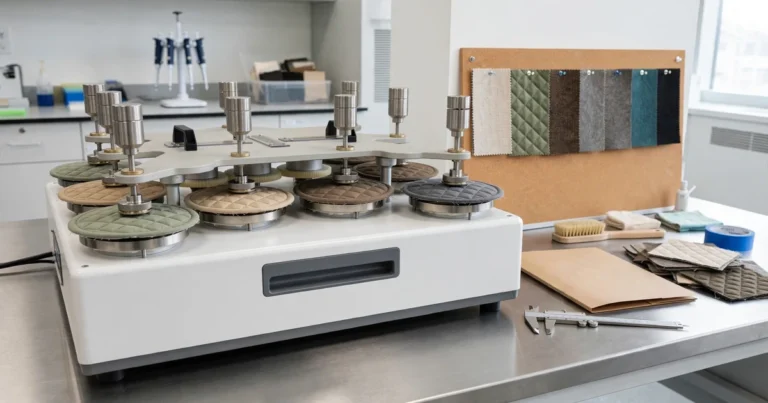
| Martindale abrasion (ISO 12947) | Cycles of rubbing until the fabric breaks down | Girth-area wear-through; thin spots on the face | Lab recommends a minimum cycle count for your fabric weight and end use |
| Pilling resistance (ISO 12945) | Surface fuzz after controlled tumbling, graded on the standard’s 1–5 scale | Fuzzy, worn-looking pads after repeated washes | Lab recommends a minimum grade for your fiber and end use |
| Seam strength (ISO 13935) | Force to rupture a sewn seam, in Newtons | Girth strap and binding seams opening under load | Set per seam type — strap seams carry the highest loads; lab advises per construction |
| Dimensional stability to washing (ISO 6330) | Shrinkage or stretch percentage after standard wash cycles | Pads shrinking out of fit; quilting distortion | Lab sets an acceptance band for your fabric and wash method |
| Tensile strength (ISO 13934) | Force to break the fabric itself | Webbing and binding tearing at stress points | Required for straps and girths — lab sets the minimum per construction |
| Color fastness suite (ISO 105) | Wash, rub, and light fastness grades | Dye bleed and fading complaints | See our color fastness guide for how buyers specify these |
A note on reading the table: the standards name the method, not the pass level. A lab’s recommended minimum for your fabric weight and end use is what makes the number in the tech pack defensible. Writing a cycle count into the tech pack without the lab’s input is better than writing nothing — but the lab’s recommendation is what you can defend when a claim lands.
Test the right material at the right stage. The sample sent to the lab must be cut from the actual bulk fabric, in the actual construction — quilting, binding, and straps included for seam tests. Testing a salesman sample sewn from a different fabric run proves nothing about your production. The correct timing is the PP-sample stage: approve the lab results before bulk cutting starts, so a failure costs a fabric change, not a full-production rework.
Who pays for lab testing, and how much does it cost?
Direct answer: Expect a modest panel fee per fabric-and-construction combination — a small cost next to a single warranty claim wave. The buyer typically pays for independent testing, while factories often cover their own in-house or mill-certificate testing. Either way, write who pays into the PO.
There are three testing routes, and buyers use different ones at different stages. Mill certificates come with the fabric from the textile mill — useful background, but they describe the greige fabric, not your quilted, bound, washed pad. Factory-arranged testing uses the factory’s lab relationship and costs less; acceptable for routine reorders of unchanged constructions, but the buyer should still receive the full report, not a summary. Independent third-party testing — the buyer sending bulk-fabric cuttings directly to an accredited lab — is the route for new fabrics, new factories, and any program where the buyer needs an arm’s-length record.
Put the testing clause in the PO: which tests, which standards, whose lab, who pays, and what happens on a failure. Bulk production starts after PP sample passes the agreed test panel is one sentence that prevents the most expensive conversation in this guide — the one where finished pads exist and the pilling result comes back with a failing grade. Factories that work with specification-driven buyers expect this clause; factories that resist it are telling you something.
When should you retest, and when can you skip it?
Direct answer: Retest whenever the fabric, the factory, the construction, or the dyeing changes. Skip retesting only on exact reorders — same fabric from the same mill, same construction, same factory, within the same season — and even then, run the panel annually to catch quiet drift.
The retest triggers are specific because each one changes what the last report measured. A new fabric — even the same cotton twill, just a different mill — is a different fabric to the lab. A new factory sews different seams with different thread tension, so the seam-strength result does not transfer. A construction change, like switching from diamond to channel quilting (see our quilting patterns guide), changes how stress distributes across the face. A dye change can affect hand feel and, at the margins, abrasion behavior. Any one of these restarts the clock.
For steady reorders, an annual panel on the core fabrics keeps the record current and catches quiet drift — the mill that thinned the yarn slightly, the factory that changed thread suppliers. File every report by fabric code and season alongside the shipment file. When a retailer questions a fabric two seasons later, the report history shows whether anything actually changed — or whether the complaint is about expectations, not the goods.
How often to test also scales with the program. The table below is a set of starting assumptions — set your own cadence with your lab and factory, and adjust by how much history you have to lean on.
| Program type | Suggested testing cadence | Why it fits |
|---|---|---|
| New label, first program | Full core panel on each new fabric at PP stage | Highest — no history to lean on |
| Growing distributor, repeat seasons | Panel on new fabrics; annual panel on core fabrics | Medium — drift is the risk |
| Established private-label chain | Per-spec panel at tech-pack sign-off; incoming-lot spot checks | Lower per lot — the spec record carries the weight |
What specs should you confirm when requesting a quote?
Direct answer: Send the fabric and construction plans at RFQ stage and ask how the factory handles lab testing on bulk-fabric PP samples. Testing questions asked before the order get answered; asked after the deposit, they get delayed.
- Fabric and construction plans — face fabric, fill, binding, straps — so the test panel can be planned
- Whether bulk-fabric PP samples are available for lab testing before bulk cutting starts
- Lab options: factory lab vs independent lab, typical turnaround, and which tests run in-house
- How test reports reference fabric codes and dye lots, and how lot changes are communicated
- Wash method used for dimensional stability testing — matched to the care-label instructions (see our wash guide)
- Which reports ship with the bulk: test reports, fiber-content reports, and report dates
- MOQ 50 pieces per color for programs that pass the agreed test panel
Frequently asked questions
Which single test matters most for saddle pads?
If you can only run one, run pilling resistance on the face fabric — it is the most common customer-visible failure and the one that generates the most looks worn out returns. If you can run two, add seam strength on the girth strap attachment. The full panel is still the right answer for any program you intend to reorder.
How do I write test requirements into a tech pack?
Name the test, the standard number, and add lab to recommend the minimum grade for this fabric weight and end use. Our tech sheet guide covers tech-pack writing in full. Specific, numbered requirements are enforceable; good quality fabric is not.
The factory sent a test report — can I trust it?
Check three things: that the report identifies your fabric (not a generic mill certificate), that the test date is recent and the lab is accredited, and that the tested construction matches your pad. For new fabrics or new factories, send your own cuttings to an independent lab once — the cost buys certainty, and the factory’s future reports then have a verified baseline to match.
Should the binding and straps be tested separately?
Seam strength should cover the strap attachments and binding seams as part of the finished pad, not as loose webbing. Tensile strength applies to the webbing and binding materials themselves at the stress points. Ask the lab to test the finished edge construction, because a seam that passes on flat webbing can still fail where binding turns a corner.
My pads passed lab tests but customers still complain — what now?
Separate the complaint types. Lab tests cover fabric performance; they do not cover fit, washing behavior against the care label, or expectations set by marketing. Check the care-label instructions (our wash guide), the fit guidance given at sale, and whether the complaints cluster on one colorway or wash method. If the lab panel was the right one and the bulk matched the tested fabric, the fix is usually in instructions or expectations — not the spec.
Starting a new saddle pad program and want the testing built into sampling? Send us your fabric and construction plans — we run the core lab panel on bulk-fabric PP samples before production, write the pass levels into the tech pack, and produce at 50 pieces per color MOQ.
Sources & Further Reading
- ISO 12947-2:2016 — Textiles: determination of abrasion resistance by the Martindale method, specimen breakdown (the published Martindale breakdown procedure: fixed-interval inspection, cycles-to-failure end point)
- Testex: Martindale Abrasion Test: Pilling & Abrasion Solutions (maps ISO 12947 parts 1–4 and ISO 12945-2 pilling to what each measures, plus the ASTM D4966 / D4970 US equivalents)
- Pre-Shipment QC Checklist for Saddle Pads
- Saddle Pad Tech Sheet: Stitch Density & Foam Density
- Saddle Pad Color Fastness Explained
- How Tack Shops Handle Saddle Pad Returns and Warranty Claims
- How to Wash Saddle Pads
