
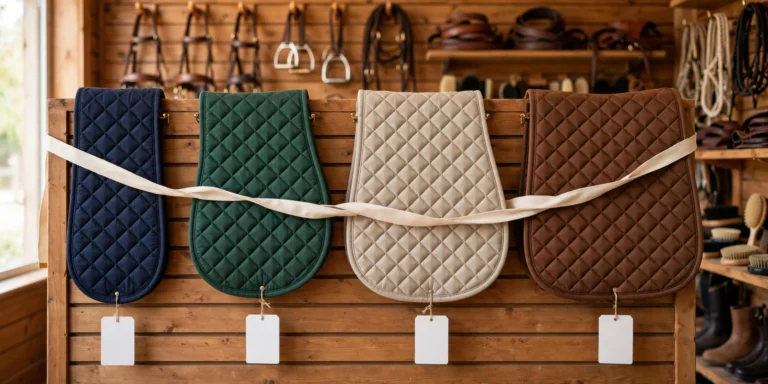
Saddle Pad Sizing Charts: Dressage, Jumping, All-Purpose and Western Dimensions Tack Shops Stock
Published · Cornovo Saddlery
Consider a common scenario: a tack shop carries three brands of Full dressage pads. A customer tries one over her saddle — perfect. She orders a second brand in the same Full size. It arrives with a noticeably shorter drop that barely covers the flap, so she returns it and the shop absorbs the shipping both ways. Nothing was mislabeled: the two brands simply cut Full differently. Multiply that mismatch across a wall of pads and you have the sizing returns problem this guide solves.
The short answer: saddle pad sizes are brand-cut, not standardized — a Full in one label can measure like a Cob in another. Stock by measured dimensions (spine length and drop length), keep your own in-store comparison chart, and train staff to match pads to saddles rather than category names. That single habit cuts sizing returns more than any SKU decision.
It companions our tack shop merchandising guide, our returns and warranty guide, and our pre-shipment QC checklist. One deliberate choice below: every size range is labeled typical, because brand pattern blocks differ and no industry-wide pad standard exists.
Key takeaways
- Pad size names are not standardized — each brand cuts to its own pattern block, so Full in one label can measure like Cob in another.
- Two measurements do most of the work: spine length (center seam, front edge to back edge) and drop length (spine to bottom edge at the longest point).
- Dressage, jumping/all-purpose, and western pads are cut to different saddles — English pads are sized by flap coverage, western pads by rectangular footprint.
- Keep a store-level comparison chart with measured dimensions per brand and size name — it is the fastest way to cut sizing returns.
- State whether listed dimensions are pre-wash or post-wash — laundering can change a pad’s dimensions, so the basis belongs on every chart.
Why do saddle pad sizes vary so much between brands?
Direct answer: No published standard defines what Full, Cob, or Pony means for a saddle pad — each manufacturer cuts to its own pattern block, and the apparel terminology standard ASTM D5219 does not cover saddle pads. Nominal size names are labels, not measurements, and two pads with the same name can differ in spine and drop by several centimeters.
The variation comes from how pads are developed: each brand designs its pattern around its target saddle fit, so a European dressage label cuts longer drops for deep-flap saddles while a value label cuts a shorter, generic rectangle. The problem appears only when a shop treats the size name as a specification — it is shorthand that loses meaning across brands, while measured spine and drop are the specification. Our SKU architecture guide shows how to encode dimensions into SKUs, and the discipline to adopt is simple: define spine, drop, and measurement method once, then use the same words on hangtags, listings, and purchase orders.
How do you read dressage saddle pad dimensions?
Direct answer: Read a dressage pad by spine length (center seam, front to back) and drop length (spine to bottom edge at the longest point). Dressage pads run long both ways to cover near-vertical flaps — typical Full-size ranges run roughly 60–68 cm in spine and 53–60 cm in drop. Confirm every brand against its own chart.
The long cut is functional: the dressage flap extends well below the rider’s knee, and the pad must clear it on both sides. Too short in the drop and the flap edge rubs the binding; too long and fabric bunches behind the leg. Both are fit problems solved by dimension matching. One more constraint for show-client shops: the USEF Dressage Equipment Booklet (DR121) requires competition pads to be white or of conservative color and bars striped or multicolored pads — white is the anchor line, fashion colors the secondary line.
How are jumping and all-purpose pads sized differently?
Direct answer: Jumping and all-purpose (AP) pads are cut for forward flaps: the spine runs slightly shorter than a dressage pad of the same size name, and the front edge angles forward. Typical Full-size ranges run roughly 58–65 cm in spine with a drop of roughly 50–57 cm — the cut shape defines the category, so compare pattern outlines, not just numbers.
The forward cut is where most cross-category mistakes happen: a dressage pad under a jumping saddle folds under the forward flap; an AP pad under a dressage saddle leaves flap exposure at the bottom edge. Neither is a defect — it is a category mismatch, so the staff script is what saddle is this going under? One pad for both saddles works only when the drop still clears the dressage flap at the girth line — measure the saddle, not the category name. Half pads and correction pads sit outside this system: typically S/M/L or one-size, sized by spine only (roughly 50–60 cm for full-size) — an accessory, not a fix for a mis-sized square pad.
How are western show pads sized, and why does the system differ?
Direct answer: Western pads are sized as rectangles — length by width, not spine-and-drop. The retail convention clusters around two typical footprints: roughly 32 by 32 in and roughly 34 by 38 in, with contoured-spine options within each. Verify the brand’s footprint — one inch matters more in a rectangle system than under an English flap.
The rectangle system exists because the western saddle is a different object: it spreads weight over a broad tree with skirts, and the pad reads as a blanket footprint — so what matters is how much pad extends beyond the skirt. Contoured versus straight spine is the second decision: contoured suits pronounced withers, straight suits broader, flatter backs — conditional on the individual horse, not a ranking. Western pads compress into fewer size names than English pads, but each name carries more shape variation, so record the shape with the footprint numbers.
| Pad category | What it is sized to cover | How it is measured | Typical ranges (Full-size equivalent) | Watch for |
|---|---|---|---|---|
| Dressage square | Long, near-vertical flaps | Spine × drop | Spine roughly 60–68 cm; drop roughly 53–60 cm | Short drop leaves flap-edge rub; competition color rules apply |
| All-purpose | Medium-forward flaps | Spine × drop | Spine roughly 58–65 cm; drop roughly 50–57 cm | Front edge must angle forward; compare pattern outlines |
| Jumping | Forward flaps | Spine × drop | Similar to AP, more aggressive forward cut | Deep forward flaps can outrun a generic AP cut |
| Western show pad | Skirt footprint | Length × width | Roughly 32×32 in or 34×38 in | Record contoured vs straight with the footprint |
| Half / correction pad | Withers-to-cantle zone | Spine only, S/M/L | Full-size spine roughly 50–60 cm | An accessory, not a fix for a mis-sized square pad |
A note on reading the table: every range is compiled from retail sizing charts and presented as typical — brands deviate in both directions. Inches dominate US charts, centimeters dominate EU charts; hangtags should carry both. Where a brand publishes its own chart, its numbers override the table.
How should staff measure a saddle pad consistently?
Direct answer: Lay the pad flat and unsquashed, measure the spine along the center seam from front edge to back edge, then measure the drop from the spine to the bottom edge at the longest point — the same way every time. Consistency beats precision: a store chart built from one method is comparable; a chart mixing methods is not.
The routine takes under a minute per pad. Lay it flat with no tension and let the quilting settle. Run the tape along the center seam, front edge to back edge, for the spine — the one English-pad measurement nearly every brand publishes. Find the longest point of the bottom edge and measure perpendicular from the spine for the drop. For western pads, measure the full rectangle — length along the spine, width edge to edge — and note contoured or straight.
Record the measurement basis next to the numbers. AATCC TM135 — the test method for dimensional changes of fabrics after home laundering — exists because textiles change size in the wash, pads included. State whether your numbers are as-received or post-wash — a customer comparing your chart against a brand’s differently-based numbers is otherwise comparing two different things.
How do size charts actually cut returns and warranty claims?
Direct answer: Most sizing returns trace to two errors — the pad category matched the wrong saddle type, or the size name was assumed to mean the same thing across brands. A store chart with measured dimensions, plus the staff habit of asking what saddle is this going under, addresses both before the pad leaves the shop.
The chart belongs where the pads hang. One workable starting assumption: brands and size names in rows, measured spine and drop (or footprint) in columns, plus a plain-words fits saddle type column. Adjust by what actually sells after the first season. Staff need one script: ask for the saddle, find its flap length or skirt footprint, match to the measured columns. The other return driver charts expose is wash shrinkage mistaken for a sizing defect — a documented measurement basis plus care instructions discussed at sale turns most of these from disputes into five-minute explanations, as covered in our returns and warranty guide.
What specs should you confirm when requesting a quote?
Direct answer: Send the dimension table you intend to print — finished spine, drop, and footprint per size name — and ask the factory to confirm finished measurements, the tolerance band, and whether dimensions are pre-wash or post-wash. Size questions asked at RFQ stage get engineered into the pattern; asked after the deposit, they get argued about.
- Finished dimensions per size name — spine, drop, western footprint — and how the factory measures each (flat, which edge, longest point or averaged)
- The dimension tolerance band held in bulk production, and how it is checked — our pre-shipment QC checklist shows where dimension checks sit
- Whether quoted dimensions are pre-wash or post-wash, and the fabric’s dimensional-change behavior after home laundering
- Whether the brand’s size names match your market’s naming (Full vs Large, Cob vs Medium) or need a conversion line
- Binding and edge construction — thick binding changes how the finished edge measures versus the cut panel
- Color program per size: competition-white availability for dressage sizes, since show clients anchor on white
- MOQ 50 pieces per color for each size in the program
Frequently asked questions
Should my size chart list inches, centimeters, or both?
Both, on any customer-facing chart. US brands publish in inches, EU brands in centimeters, and customers compare across brands — a chart that forces mental conversion creates the errors it exists to prevent. Keep one column per unit and let the tape measure settle arguments.
Can a customer use a dressage pad under a jumping saddle?
Conditionally — only when the drop still clears the forward flap at the girth line and the straight front edge does not fold under the flap. Deep forward flaps usually outrun a dressage cut, so measure the flap rather than guessing from the category name.
Why do two Full pads from different brands fit so differently?
Full is a label, not a specification — each brand cuts to its own pattern block, and the difference usually sits in the drop, where a few centimeters decide whether the flap clears. The store chart records measured dimensions so the name never carries that weight.
How do I stock western pads when contoured and straight spines both sell?
Record the spine shape with the footprint numbers, and train staff to ask about the horse’s wither profile — pronounced withers generally suit contoured, broad flat backs straight. The two cuts fit different backs; neither is better.
Do saddle pads shrink enough after washing to change the fit?
They can change dimensions after laundering — that is why AATCC TM135 exists. Whether a given pad changes enough to matter depends on its fabric and construction, so ask for the dimensional-change behavior at quote stage and declare the basis on your chart.
Building a size chart for your pad wall or private-label line? Send us your saddle categories and size names — we confirm finished spine, drop, and footprint dimensions per size before production and produce at 50 pieces per color MOQ.
Sources & Further Reading
- USEF Dressage Equipment Booklet (DR121) — saddle pads optional; when used, white or conservative color; striped/multicolored not permitted
- ASTM D5219 — Standard Terminology Relating to Body Dimensions for Apparel Sizing
- AATCC TM135 — Dimensional Changes of Fabrics after Home Laundering
- Saddle Pad Display and Merchandising Guide for Tack Shops
- How Tack Shops Handle Saddle Pad Returns and Warranty Claims
- Saddle Pad Distributor Pricing and Margin Tiers
- Pre-Shipment QC Checklist for Saddle Pads
