
Horse Girths Wholesale: Long vs Short, Leather, Fleece and Synthetic Types, Sizing and Tack Shop Assortment — A Buyer's Guide
Published · Cornovo Saddlery
Consider a common scenario: a rider buys a smart leather girth for a dressage saddle, brings it home, and finds the buckles sitting halfway up the saddle flap — it is a long girth, made for short-billet jump saddles, and on a dressage saddle it is unusable. The mistake was buying before understanding the two girth families: long girths for short billets, short girths for long billets.
The short answer: English girths come in two length families — long girths for short-billet saddles, short (dressage) girths for long-billet saddles — and three materials: leather, fleece-lined, and synthetic. Sizes run buckle end to buckle end in even inches. No material is universally best; match to billet length first, then to horse sensitivity and care routine. MOQ 50 pieces per color.
This guide covers girth types, conditional material comparisons, elastic-end configurations, inch sizing, quality checkpoints, stocking by account type, and quote specs. It companions our cinch materials and sizing guide (the western equivalent), our bridles, reins and halters guide (the English leather-tack family), our saddle pad straps and billet keepers guide, and our stirrup leathers guide (the other safety-critical leather line).
Key takeaways
- Billet length decides girth length: short billets take long girths; long billets take short girths. Get this wrong and nothing else about the girth matters.
- Leather, fleece-lined, and synthetic are three answers to different questions — prestige and shape retention, softness for sensitive horses, wipe-clean value — not a ranking.
- Elastic configuration matters more than most buyers think: none, one end, or both ends, each with its own fitting behavior.
- Sizes run buckle end to buckle end in even-inch increments; fit targets the middle billet holes with room above and below the buckles.
- Girths are safety-critical tack: elastic resilience, buckle stitching, and hardware quality are the checkpoints that matter. MOQ 50 pieces per color.
What are the main English girth types?
Direct answer: Long (straight or shaped) girths for short-billet saddles, and short dressage girths for long-billet saddles — the primary split, and not interchangeable. Within each family: straight, shaped/anatomical, stud-guard variants for jumping, and fleece-lined or padded versions. The shape suits the horse’s build; the length suits the saddle.
| Type | Typical strengths — and under what conditions | Watch-outs — and when they show up |
|---|---|---|
| Long girth (straight) | The standard for short-billet jump and all-purpose saddles; simple construction, easy to measure and replace | Buckles sit under the rider’s thigh on some leg positions — shaped profiles exist for riders bothered by this |
| Long girth (shaped / anatomical) | Cut away behind the elbow and shaped to the barrel; commonly chosen for forward girth grooves or when the saddle must stay put | The shaping must suit the horse — a shaped girth on a horse whose groove doesn’t match can sit less stably than a straight one |
| Short / dressage girth | For long-billet saddles: reduces bulk under the leg for a closer contact feel; buckles stay clear of the rider’s calf | Buckles sit lower on the ribcage — fit demands care so the buckle ends clear the elbow, and the longer billets must be in good condition |
| Stud-guard girth | Belly protection built into the girth for jumping horses wearing studs; combines girth and guard in one line item | Only relevant to horses that jump in studs — dead stock in a purely dressage or schooling account |
| Fleece-lined / padded girth | Soft inner surface for sensitive or thin-skinned horses; often chosen as the horse’s first girth or for horses with girth-area rubs | Fleece needs washing to stay soft and hygienic; matted or gritty fleece can rub worse than a smooth surface |
Leather, fleece-lined, or synthetic — which material should you spec?
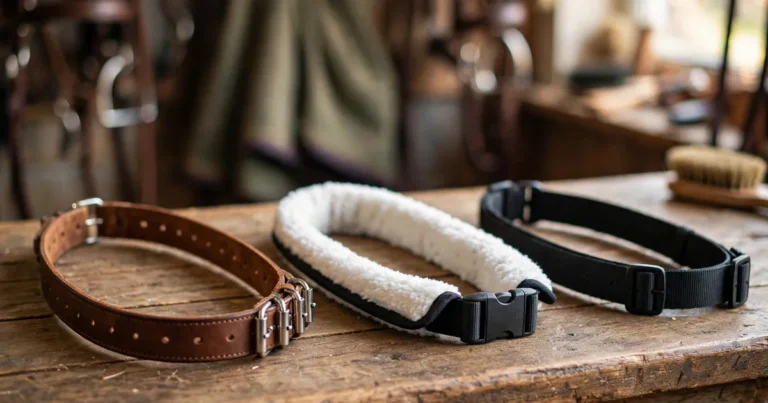
Direct answer: Spec by the account’s customer, not by prestige: leather for the classic look and shape retention on a quality saddle; fleece-lined for sensitive horses and as the safe recommendation when a horse rubs; synthetic for easy-care, wipe-clean, budget lines where maintenance decides. Each has conditions where it wins and conditions where it disappoints.
| Material | Typical strengths — and under what conditions | Watch-outs — and under what conditions |
|---|---|---|
| Leather | The classic match for leather saddles; holds its shape over time; develops a worn-in look riders on quality tack expect | Needs regular cleaning and conditioning or it dries and cracks; the highest-maintenance option; shade matching matters on brown tack |
| Fleece-lined | Soft against the skin for thin-skinned or clipped horses; a forgiving choice for the horse prone to girth rubs | Fleece compresses and mats with use and needs regular washing; inspect it like a consumable layer, not a permanent one |
| Synthetic | Wipe-clean and water-resistant; the lowest-maintenance line; suits schools and everyday riders who want function without a care routine | Lacks the prestige look on a premium leather saddle; some riders find the feel less supple — position it on value and care, not status |
One careful claim: fleece is not automatically kinder — a gritty, matted fleece can rub worse than a smooth, clean surface. What makes a girth kind is clean, correct fit, so the fleece line should ship with washing instructions. Our leather tack care guide covers the leather line’s maintenance.
What do the elastic-end configurations mean?
Direct answer: Girths come with no elastic, elastic at one end, or elastic at both ends. The elastic lets the girth flex with the horse’s ribcage as it breathes and moves — but it is meant to work with a correctly fitted girth, not compensate for a wrongly sized one. Riding Warehouse’s dressage girth guide puts it plainly: a small amount of elastic helps the girth conform to the horse, and it is meant to work with a properly fitted girth rather than instead of one.
The configurations each have a trade-off: elastic on both ends gives the most even flex; elastic on one end is the common middle ground; no elastic is the traditional choice for a fixed, predictable feel. But elastic is a wearing part — Horse & Hound notes that girths with elastic can stretch over time, and tired elastic lets the saddle move (Horse & Hound — How to Measure Horse Girth). That belongs on the product card: a rider whose saddle won’t stay may simply need a new girth.
For the wholesale spec, the elastic configuration should be a named line item, not an assumption: no elastic / elastic one end / elastic both ends. It changes the price, it changes the feel, and it changes the fitting advice — so it must be explicit on the tech pack, the hang tag, and the reorder record.
How are girth sizes sold and measured?
Direct answer: English girths are measured buckle end to buckle end — the full length of the girth — and normally come in two-inch increments. The fitting target: the girth should land on the middle holes of the billet straps, leaving room to tighten a few holes evenly on each side, with at least two billet holes above and one below the buckles (Horse & Hound). Between sizes, round up to the next even size.
The measuring method Horse & Hound teaches is the one to print for customers: saddle and pad on the horse in the usual position, then a fabric tape or string from the middle billet hole on one side, under the barrel about four inches back from the elbow, to the corresponding billet hole on the other side — that measurement is the girth size needed. Riding Warehouse adds the dressage-specific notes: most short girths range from around 18 to 36 inches, European girths may be marked in centimetres, and a tightened girth should leave two to three fingers of space between its top and the bottom of the saddle pad (Riding Warehouse — How to Measure, Size, and Fit a Dressage Girth).
Three wholesale traps to build into the size chart. First, buckle placement changes the measured length: buckles set back measure longer overall than buckles right at the ends, so the chart must state where the buckles sit. Second, an old elastic girth measures long because the elastic has stretched — never copy a size from a worn girth. Third, the long and short families are separate size runs and separate products, not small and large versions of one product.
What quality checkpoints decide a good wholesale girth?
Direct answer: Buckle-end stitching, elastic resilience, edge finishing, and hardware quality — in that order. The girth is safety-critical tack, so the checkpoints are about failure points and pressure behavior, not surface looks.
| Checkpoint | What to look for | Why it matters |
|---|---|---|
| Buckle-end stitching | Even, tight stitching with no skipped stitches where the buckle folds back into the girth | The buckle fold carries the full load — worn or skipped stitching here is the first retirement signal |
| Elastic resilience | Elastic returns to length when stretched and released; consistent tension end to end on double-ended girths | Tired elastic lets the saddle shift and reads as a fit problem — check the sample, then confirm the bulk matches it |
| Edge finishing | Smooth, sealed edges with no sharp trim lines; binding or edge coating intact along the full length | Rough edges rub the skin behind the elbow — the most common girth-complaint area |
| Buckles and hardware | Roller buckles that turn freely; metal free of rust, sharp flashing, or weak welds; billet-width match to the saddles it will serve | Stuck rollers make gradual tightening impossible; mismatched buckle width is a top return reason |
How should a tack shop stock girths?
Direct answer: Stock by saddle type first, material second: long girths in core sizes for the jump and all-purpose customer, short girths for the dressage customer, fleece-lined as the sensitive-horse recommendation across both. Open each family in the middle sizes with the standard elastic configuration; deepen by reorder data. These are starting hypotheses — adjust by your own sell-through.
| Account type | Starting hypothesis | Watch for |
|---|---|---|
| General mixed tack shop | Long girths in leather and synthetic, core adult sizes; short girths in the common dressage sizes; one fleece-lined line across both | Staff must ask which saddle the girth is for before recommending a size |
| Dressage-focused shop | Short girths deep, leather and fleece-lined; shaped profiles as the upgrade line; longer lengths for the warmblood customer | Worn, stretched billets change the effective girth size — train staff to check billets when fitting |
| Jumping / eventing shop | Long girths with shaped options; stud-guard girths as the seasonal jumping line; elastic both ends as the common request | Stud-guard demand follows the jumping season — carry it as a seasonal SKU, not a year-round core |
| Riding school / lesson barn | Synthetic and fleece-lined in the standard sizes; wipe-clean care and simple sizing over prestige | Schools replace on wear — the safety-check messaging belongs on the school order, not just the retail shelf |
What specs should you confirm when requesting a quote?
Direct answer: Make the five things buyers assume explicit: length family, material, elastic configuration, buckle placement and width, and size-run conventions. Because a 26-inch leather girth can be several different products depending on the answers.
- Length family: long girth for short billets, or short/dressage girth for long billets — stated explicitly, not inferred
- Material: leather grade and thickness; fleece pile spec and attachment method; synthetic compound or webbing construction
- Elastic configuration: no elastic, elastic one end, or elastic both ends — named as a line item
- Profile: straight, shaped/anatomical, or stud-guard — with the shaping template confirmed for shaped lines
- Buckles: roller or plain, width matched to the billet standard the account’s saddles use, placement (at ends vs set back)
- Size run: inches and centimetres per size, measured buckle end to buckle end, with length tolerance stated
- Edge finishing and stitching spec: edge treatment, stitch density at buckle folds, hardware finish
- Colorways and MOQ: 50 pieces per color; black and each brown shade counted as separate colorways
Frequently asked questions
Can a long girth and a short girth be used interchangeably?
No. Long girths pair with short-billet saddles (jump, all-purpose); short girths pair with long-billet saddles (dressage, monoflap). A long girth on a dressage saddle puts buckles up the flap where they interfere with the leg; a short girth cannot reach a jump saddle’s short billets. Match the girth family to the saddle’s billet length first.
How is a girth different from a western cinch?
An English girth is a single strap with buckles at both ends that fastens directly to the saddle’s billets, sized in inches buckle end to buckle end. A western cinch fastens through rigging with latigo straps and comes in materials like mohair, wool felt, and neoprene. Same job, different saddles — see our western cinch guide for that category.
How do I know if a girth is the right size?
It should land on the middle billet holes, with at least two billet holes above and one below the buckles (Horse & Hound). On a short girth, allow two to three fingers between the top of the girth and the bottom of the saddle pad when tightened. Fastening only on the last holes means too short; buckles riding up under the thigh means too long.
When should a girth be replaced?
When it shows failure signals: stretched or dead elastic, worn stitching at the buckle folds, cracks in the leather, sharp or worn edges, or fleece matted beyond washing. The girth is safety-critical — the check is a regular habit tied to use, not a calendar date. Any doubt means retirement.
Adding girths to your program? Send us your length families, materials, elastic configurations, and colorways — we quote at 50 pieces per color MOQ.
Sources & Further Reading
- Horse & Hound — How to Measure Horse Girth and Buy the Correct Size (buckle-end-to-buckle-end measuring; two-inch increments; middle-hole fitting target; two holes above / one below the buckles; string measuring method; elastic stretches over time)
- Riding Warehouse — How to Measure, Size, and Fit a Dressage Girth (short girth for long billets; 18–36 inch typical range; even-inch increments; two-to-three-finger clearance; buckle-placement effect on measured length; elastic works with proper fit, not instead of it)
- Cinch Materials and Sizing Guide for Retailers
- Bridles, Reins and Halters: A Buyer’s Guide for Equestrian Distributors
- Saddle Pad Straps, Girth Billet Keepers Guide
- Stirrup Leathers Wholesale Buyer’s Guide
