
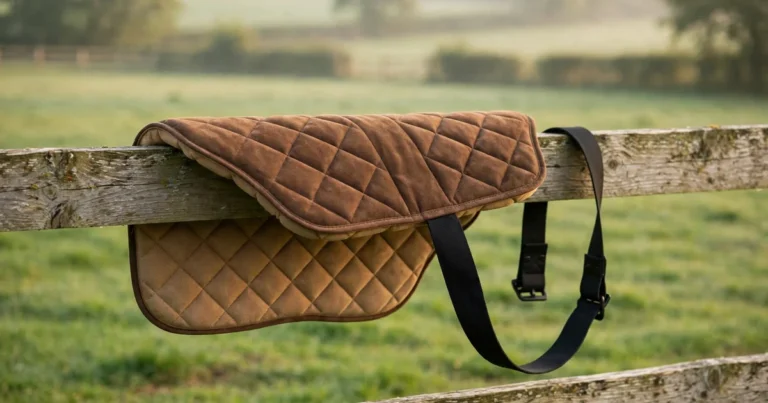
Bareback Pads Wholesale: Types, Spine Clearance, Girth Systems, Sizing, and Stocking — A Buyer's Guide
Published · Cornovo Saddlery
Consider a common scenario: a rider who loves close-contact work buys a thin, unpadded bareback pad for longer rides — and the horse goes hollow-backed and sour, because the rider’s seat bones press straight through the pad onto the spine.
The short answer: Bareback pads wholesale sell on four construction families — minimalist cloth, foam-core cushioned, wither-relief channel, and western-style rigged — each secured by a girth, not by a tree. No pad distributes weight like a saddle, no stirrups should ever be attached, and sizing follows the horse’s back length plus the rider’s seat. MOQ 50 pieces per color.
This guide covers bareback pad constructions, spine and wither clearance, girth systems, the no-stirrup rule, sizing, materials, quality checkpoints, and stocking by account type. It companions our half pads vs full saddle pads guide, our horse girths guide, our saddle pad sizing charts, and our wash and care guide.
Key takeaways
- A bareback pad is a saddle substitute for short, low-intensity rides — not a saddle, and not a half pad. It has no tree, so the rider’s balance distributes the weight.
- Never attach stirrups to a bareback pad: without a tree there is no structure to stop the pad rotating under foot pressure.
- Spine clearance depends on the pad’s channel or foam layout plus the horse’s build — high-withered horses need a channel or cutback design.
- Stock by construction family first, then by horse size — and staff the category with fit guidance. MOQ 50 pieces per color.
What is a bareback pad, and how is it different from a half pad?
Direct answer: A bareback pad is a cushioned, girth-secured pad the rider sits on instead of a saddle — contoured shape, non-slip underside, girth, and no tree, pommel, cantle, or stirrups. A half pad is a correction or comfort layer worn with a saddle. Different products, different jobs, different customers.
Bareback pads serve balance training, warm-ups, cool-downs, and short casual rides — the close-contact use cases. (Mad Barn — Bareback Pads for Horses) Half pads serve riders who already own a saddle and want shimming, wither relief, or a wool interface.
One more boundary: treeless saddles are neither — a treeless saddle has a shaped seat and stirrup attachments, so it belongs in the saddle category, not the pad category.
What are the main bareback pad constructions wholesale buyers should know?
Direct answer: Four construction families cover the wholesale market: minimalist cloth pads, foam-core cushioned pads, wither-relief channel pads, and western-style rigged pads. Each trades cushioning, stability, and close contact against the others — which is why the assortment carries all four instead of ranking them.
| Construction family | Typical strengths — and under what conditions | Watch-outs — and when they show up |
|---|---|---|
| Minimalist cloth pad | Thin quilted or fleece pad closest to true bareback feel; suits experienced riders doing short balance work on well-muscled backs | Almost no weight distribution — with a less balanced rider, seat-bone pressure concentrates on the spine |
| Foam-core cushioned pad | Thick foam or felt core adds rider comfort and evens pressure for moderate sessions; the volume line of the category | Foam compresses with use and washing — density and recovery are the specs that separate a one-season pad from a multi-season one |
| Wither-relief channel pad | Raised or cut-back channel over the spine keeps the rider’s weight on the muscles beside the backbone; suits high-withered horses and longer sessions | The channel only works if it stays centered — on very round or short backs, pad rotation can put the channel anywhere |
| Western-style rigged pad | Bareback pads built with western cinch rigging serve the western trail and ranch-hacking customer | English billets and western cinch straps are not interchangeable — rigging choice is a SKU decision, not a footnote |
How does spine and wither clearance work on a pad with no tree?
Direct answer: A tree keeps a saddle’s seat off the spine; a bareback pad has no tree, so clearance comes from the pad’s own structure — a channel, a cutback front, or foam that holds its shape under the rider’s weight. Where the pad has none of those, the rider’s balanced seat is the only thing keeping weight off the backbone.
Mad Barn’s guide makes the mechanism explicit: unlike a saddle with a gullet, most bareback pads sit directly on the horse’s spine, and pressure can build along the backbone if padding or rider balance is not adequate. (Mad Barn — Bareback Pads for Horses) The rider’s weight creates a much smaller pressure surface than a saddle does, concentrated along the muscle groups most vulnerable to back pain — the pad helps, but it does not make the physics go away.
Three design answers to the clearance question. A spine channel runs a recessed or raised track down the pad’s center so the rider’s seat loads the muscles either side of the backbone. A cutback or raised front follows the wither profile so the pad’s front edge does not dig into the withers on high-withered horses. Thick dual-density foam holds its shape under load where thin single-density foam bottoms out.
Can riders use stirrups with a bareback pad?
Direct answer: No — stirrups should never be attached to a bareback pad, and the pads you import should not have stirrup attachment points. The structure that keeps a saddle from rotating under foot pressure is the tree; a bareback pad has no tree, so downward pressure on a stirrup rolls the pad sideways under the rider.
The safety logic is mechanical. A stirrup gives the rider’s foot leverage, and that leverage becomes torque on the girth. A treed saddle resists it with its rigid structure; a bareback pad cannot — the pad slides and the rider slides with it. Cowgirl Magazine’s bareback riding guidance lists stirrup-equipped bareback pads as a danger point. (Cowgirl Magazine — 9 Useful Tips for Bareback Riding) Do not spec stirrup attachments on bareback pads, do not stock lines that carry them, and make sure shelf cards say plainly that the pad is for stirrupless riding.
How are bareback pads sized?
Direct answer: Bareback pads size by horse first, rider second: the pad must span enough of the back to keep the rider’s weight off the loins without overhanging the shoulder or the last rib. There is no universal size standard — confirm the maker’s chart per line.
Two dimensions decide the size. Back length coverage: the pad should sit behind the wither and end ahead of the hip, covering the ribcage the way a saddle would. Rider seat area: the cushioned zone needs to fit the rider’s seat bones, so very tall riders on very small pads defeat the cushioning. Most wholesale lines run pony, cob/small horse, and full/large — but break points differ by maker.
The girth is part of the sizing. English-rigged pads take a standard English girth sized to the horse — see our horse girths guide — while western-rigged pads take a cinch matched to the rigging style.
What materials appear in the top layer, padding, and underside?
Direct answer: Bareback pads build in three layers: a rider-side top layer for grip and wear, a padding core for cushioning, and a horse-side underside for comfort and stability. Common materials across the three are suede, fleece, neoprene, foam, and wool — each layer with its own job and its own trade-offs.
| Layer | Common materials — and their conditional roles | Watch-outs |
|---|---|---|
| Top layer (rider side) | Suede or synthetic suede for grip and a classic look; fleece for warmth and softness; neoprene where wipe-clean durability matters | Suede wears smooth with heavy use; synthetic suede varies widely in grip — confirm the grade, not just the name |
| Padding core | Foam (open or closed cell) for cushioning and shape; wool felt for breathability and a traditional feel; fiberfill on value lines | Foam density and recovery decide the pad’s working life; wool felt breathes but compresses and needs washing discipline |
| Underside (horse side) | Fleece or wool lining for comfort; non-slip rubberized mesh to resist rotation; breathable mesh where heat matters | Synthetic undersides trap heat — Mad Barn flags heat buildup under synthetic pads as a real drawback in warm weather |
What quality checkpoints matter at pre-shipment inspection?
Direct answer: Girth strap attachment strength, binding and edge stitching, symmetry, foam consistency, and non-slip base integrity — in that order. A bareback pad’s failure modes are structural: a strap that tears or a base that loses grip is a safety issue, not a cosmetic one.
| Checkpoint | What to look for | Why it matters |
|---|---|---|
| Girth strap attachment | Straps box-stitched or bar-tacked to reinforced panels, not just edge-stitched; buckles or D-rings free of sharp edges | The girth strap is the pad’s only anchor — its failure in motion is the incident you are insuring against |
| Binding and edge stitching | Continuous binding around the pad edge with even stitching; no skipped stitches at curves and corners | Binding carries the pad’s shape under load; a failed edge unravels the whole construction |
| Foam core consistency | Even thickness across the pad; no lumps, thin spots, or delamination; compression recovers after pressing | Thin spots become pressure points — the pad’s cushioning promise fails exactly where the foam is thinnest |
| Non-slip underside | Coating or mesh uniform and firmly bonded; no flaking, bubbling, or patchiness | Rotation control is the underside’s job; patchy grip is a rotation accident waiting for a round back |
| Symmetry and finishing | Left and right mirror each other; spine channel centered; no loose threads or glue residue | Asymmetry shifts the rider’s weight to one side of the spine — the pressure problem the pad exists to soften |
Write the strap pull-test into the QC agreement with the factory: the acceptance criterion is the strap holding a stated pull load without stitch failure, tested on the approved sample and spot-checked in bulk.
How should tack shops stock bareback pads?
Direct answer: Stock by construction family first and horse size second: a foam-core cushioned pad in the middle sizes as the depth line, a wither-relief channel pad as the fit upgrade, and a minimalist cloth pad for the experienced-rider segment. These are starting hypotheses — adjust by your own sell-through.
| Account type | Starting hypothesis | Watch for |
|---|---|---|
| General mixed tack shop | Foam-core cushioned pads in the middle sizes as the depth line; one wither-relief channel line for high-withered horses; matching girths stocked alongside | Ask about the horse’s withers and the rider’s experience before recommending — a minimalist pad sold to a beginner is a return and a sore horse |
| Western / trail-focused shop | Western-rigged pads matched to the cinch inventory; cushioned English-rigged pads as the crossover line | Rigging and cinch must be matched at the counter — a rigging mismatch is a dead sale |
| Riding school / lesson barn | Durable foam-core pads in school colors, wipe-clean tops, one channel design for the high-withered school horses | School pads get washed hard — confirm the non-slip coating’s wash rating before committing a fleet order |
| Online-first retailer | Narrow the range: one cushioned line, one channel line, clear size charts with back-length diagrams; no-stirrup safety copy on every product page | Online buyers can’t try the pad — the size chart and wither-fit guidance must be accurate |
What specs should you confirm when requesting a quote?
Direct answer: Make the four things buyers assume explicit: construction family, clearance design, rigging system, and size-run conventions. A full size bareback pad can be four different products depending on the answers, and the quote that leaves them ambiguous is the order that arrives wrong.
- Construction family: minimalist cloth, foam-core cushioned, wither-relief channel, or western-rigged — named explicitly, with foam or fill type and density
- Clearance design: spine channel dimensions (width and depth), cutback front profile, or stated no-channel design — confirmed per model, not per catalog
- Rigging: English billets or western cinch straps; strap material, width, and buckle/D-ring spec; whether a girth is included
- Sizing: horse-size break points with back-length coverage per size; rider seat-area dimensions; no stirrup attachment points anywhere in the construction
- Materials: top-layer material and grade; padding core spec with density and recovery; underside material and non-slip treatment with wash rating
- Handles and extras: grab handles included or not, pull-strength rating if included; D-rings for lead attachment if spec’d
- Packing: pieces per carton, carton dimensions and weight, individual polybag with care insert including the no-stirrup notice
- Colorways and MOQ: 50 pieces per color; each construction family and each colorway counted as a separate line for MOQ purposes
Frequently asked questions
Is a bareback pad a replacement for a saddle?
No. A saddle’s tree distributes the rider’s weight across the ribcage; a bareback pad has no tree, so the rider’s balance does the distributing. Bareback pads suit short, low-intensity rides — balance training, warm-ups, cool-downs, casual hacks. Longer or harder work belongs in a saddle.
Why can’t stirrups be used with a bareback pad?
The tree is what stops a saddle rotating under foot pressure, and a bareback pad has no tree. Downward pressure on a stirrup torques the girth and rolls the pad sideways. Cowgirl Magazine’s bareback riding guidance flags stirrup-equipped bareback pads as dangerous — stock and sell the category as stirrupless.
Which bareback pad suits a high-withered horse?
A wither-relief channel or cutback-front design — the clearance is built into the pad, not the rider’s balance. Minimalist cloth pads are the worst choice for prominent withers. Confirm the channel dimensions on the maker’s size chart rather than trusting product names.
What girth goes with a bareback pad?
The one the rigging was built for: a standard English girth for English-billet pads, a western cinch for western-rigged pads. They are not interchangeable. See our horse girths guide and cinch sizing guide.
Adding bareback pads to your program? Send us your construction families, rigging systems, and size runs — we quote at 50 pieces per color MOQ.
Sources & Further Reading
- Mad Barn — Bareback Pads for Horses (three-layer construction; contoured shape with non-slip underside and girth; spine-clearance limitation; pressure-surface physics; heat buildup under synthetics)
- Cowgirl Magazine — 9 Useful Tips for Bareback Riding (stirrup-equipped bareback pads as a danger point; helmet recommendation; rider experience and horse temperament guidance)
- Half Pads vs Full Saddle Pads: What’s the Difference?
- Horse Girths: A Wholesale Buyer’s Guide
- Saddle Pad Sizing Charts: Dressage, Jumping, Western and Half Pads
- Pre-Shipment Saddle Pad Quality Control Checklist
