
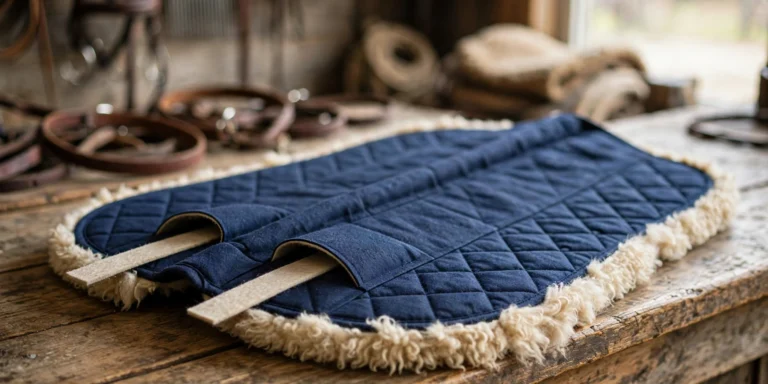
Correction Half Pads Wholesale: Shim Pocket Layouts, Fit Cases, and Stocking — A Buyer's Guide
Published · Cornovo Saddlery
Consider a common scenario: a rider brings a horse back into work after a layoff, and the saddle that fit fine last season now sits low in front. The horse is still changing shape, so a new saddle is premature. The tack shop sells a shimable correction half pad, pulls shims out as the topline fills in, and the saddle stays usable through the transition.
The short answer: A shimable correction half pad is a slim half pad with pockets along the spine that hold removable shims — thin inserts of felt or foam. Adding or removing shims changes lift at the front or back, bridging small fit gaps while a horse changes shape. It is a transitional fit tool, not a replacement for a correctly fitted saddle.
This guide covers what a correction half pad is, which fit situations it serves, shim-pocket layouts and shim materials, sizing and sampling checks, tack-shop stocking, and what to confirm when quoting. It companions our half pads vs full pads comparison, our dealer training on saddle-fit issues, and our sheepskin half pad buyer’s guide. Boundary note: that comparison covers the categories; this guide covers shimable correction pads at the specification level.
Key takeaways
- Shim pockets let riders add or remove lift at the front or back as the horse changes shape — the value is in the adjustment, not the padding.
- Full correction systems typically use four pockets along the spine (two front, two rear); front-only or rear-only layouts suit buyers targeting one fit problem.
- Correction pads serve transitional fit situations — fitness changes, young horses developing, mild asymmetry — not saddles that are fundamentally the wrong tree size or shape.
- Sizing is by spine length and cut, and shim sets should be specified by material, thickness, and count — not assumed from the pad spec.
- A correction half pad is a depth SKU, not a breadth line: stock the common cuts first and let fitting demand set the reorder rhythm. MOQ 50 pieces per color.
What is a shimable correction half pad?
Direct answer: A shimable correction half pad is a half pad — worn over a full quilted pad — with pockets sewn along its spine that hold removable shims. The shims are thin inserts of felt or foam, added, removed, or repositioned to raise the saddle’s front or back independently: a fit aid tuned as the horse’s shape changes.
The best-documented retail example is E.A. Mattes’s Correction System: four pockets along the spine — two front and two rear — with shims included, so the rider can shim one pocket or all four and remove shims one by one as the horse gains muscle. (SmartPak — Mattes Correction Half Pad with Pockets for Shims, Dressage) The same listing positions the system for horses out of shape or returning from injury, one-sided horses, and front-or-rear risers.
HorseLoverZ’s listing of the same system describes three 5-mm-thick felt shims per pocket — a useful reference for how correction systems are sold: shims counted per pocket, measured in millimeters, named by material. (HorseLoverZ — E.A. Mattes Gold Dressage Correction Half Pad with Shim Pockets) Those three fields — count, thickness, material — belong in the tech pack and the purchase order, not in the assumptions.
Which fit situations do correction pads actually serve?
Direct answer: Correction pads serve situations where the gap is small and the horse’s shape is likely to change: a horse returning to fitness, a young horse developing, seasonal condition changes, and mild one-sided asymmetry. They do not fix a wrong tree size or shape — a correction pad stacked to its limit on a fundamentally wrong saddle is a fitting error.
Each situation has a different buying logic: a horse returning to work needs removable shims; a young horse needs a layout re-checked at each saddle check; mild asymmetry needs independent per-side tuning. Naming the three jobs trains staff to match the pocket configuration to the fitting job.
The hard boundary comes from the maker’s own copy: Mattes’s correction-system description states that long-term conformation irregularities should never be corrected by adjusting the saddle itself — and by extension, not by stacking shims indefinitely either. (HorseLoverZ — E.A. Mattes Correction System) In buying terms: small, changing gaps are the product’s job; large or permanent gaps are a fitter referral.
How do the common shim-pocket layouts compare?
Direct answer: The four-pocket full system (two front, two rear) is the most flexible and the standard on the established retail systems; two-pocket layouts target one specific problem; split or asymmetric sets serve fitters who tune each side independently. The decision is about which fitting jobs your customers present, not about one layout being better.
| Pocket layout | Typical strengths — and when they hold | Watch-outs — and when they appear |
|---|---|---|
| Four-pocket full system (two front, two rear) | Most flexible; independent front and back tuning; the standard on the leading retail systems — suits general tack shops | More pockets to specify, sample, and stock; riders needing one end’s lift pay for flexibility they won’t use |
| Two-pocket front-only | Simpler spec and lower cost; suits programs targeting downhill or low-withered horses | No rear adjustment — turns away the bridging and low-back customers |
| Two-pocket rear-only | Targets the rear-lift case (horses that lost topline behind the withers) with an easy-to-explain product | Narrowest use case; typically a fitter-channel product rather than a general-shop SKU |
| Split/asymmetric pocket sets | Per-side tuning for one-sided horses — the layout fitting specialists reach for | Smallest audience; needs trained staff to sell, so it adds SKUs a general shop can’t move |
One detail to specify on the tech pack regardless of layout: the pocket opening direction and closure method. Spine-side openings are easy to reach but let shims migrate; enclosed pockets with closures stay put. Confirm the method in writing — it decides whether shims survive a season or end up on the arena floor.
What shim materials are used, and when does each fit?
Direct answer: Felt, open-cell foam, and closed-cell foam are the three shim materials buyers will meet. Felt is the traditional choice — dense, stable, trimmable, documented in millimeter thicknesses on the retail systems. Open-cell foams breathe and compress more; closed-cell foams hold height longer but trap more heat. No universal winner — the choice follows the fitting job and wash expectations.
| Shim material | Typical strengths — and the conditions they depend on | Watch-outs — and when they show up |
|---|---|---|
| Felt (needled felt) | Dense and stable under load; trims cleanly so fitters can taper a shim; millimeter-measured sets make specifying unambiguous | Adds weight at the pocket; trimmed edges can fray over wash cycles — confirm edge behavior on the sample |
| Open-cell foam | Lighter than felt at the same thickness; compresses progressively for a softer initial feel; graded densities widely available | Compression set over time — ask for the compression-recovery figure and the test behind it |
| Closed-cell foam | Holds lift height longest; moisture-resistant, suiting heavy-sweating programs | Lowest breathability; stiff edges can create pressure lines unless tapered — specify beveled edges |
One brand’s engineering choice is worth knowing when comparing quotes: E.A. Mattes builds its correction system on felt shims and a felt core, avoiding foam, neoprene, and gel in the core for breathability. (StateLineTack — E.A. Mattes Correction Half Pad) Two factories quoting correction half pad can be quoting different fill families — which is why shim material belongs as an explicit line on every quote.
What should buyers check on sizing and sampling?
Direct answer: Size by spine length and by cut — dressage and all-purpose/jump cuts are different products. Retail sizing illustrates the method: one retail correction pad lists a 20.5-inch spine, medium, and 22.5 inches, large, per cut. When sampling, check pocket fit with shims installed, wash the sample with shims in place, and confirm whether shims are meant to be trimmed.
The spine figures above come from SmartPak’s published specifications for the Mattes correction pad. (SmartPak — Mattes Correction Half Pad specifications)
Sampling a correction pad differs from a standard half pad in three places: check pocket dimensions against the shim set that ships with it (pockets cut for one thickness and shims supplied in another is a defect you only catch with both in hand); wash the sample with the shims inside the pockets, since linings, closures, and shim edges behave differently wet than dry; and confirm in writing whether riders are expected to trim shims and which edge treatment survives trimming. A shim that frays when the rider follows the fitting advice is a warranty claim waiting to happen.
Also lock down at sampling whether the shim set ships bundled with the pad as one SKU or as a separate line item. Bundled shims simplify the shop’s story; separate shim SKUs enable replacement and upsell sales. Either is defensible — discovering the assumption after the container sails is the expensive version.
How should tack shops stock correction half pads?
Direct answer: Correction pads are a depth category, not a breadth line: stock one or two well-chosen SKUs per cut and go deep enough to survive the fitting season, rather than spreading the budget across many layout and material variants. Reorder follows fitting demand and staff recommendations — the assortment should match the shop’s fitting capability.
| Account type | Starting-hypothesis assortment |
|---|---|
| General tack shop (mixed disciplines) | One four-pocket correction pad in the main cut sold, plus one in the secondary cut; felt shims; sizes per the shop’s saddle mix. Adjust on sell-through. |
| Dressage- or hunter-focused shop | Four-pocket system in the primary cut, both spine sizes; add the split/asymmetric layout only if the shop employs or hosts a fitter. Adjust on sell-through. |
| Riding school / lesson barn buyer | One cut only — the cut the fleet rides; full four-pocket system, since lesson horses change condition across a season. Adjust on replacement rate. |
| Online or catalog distributor | The two most documented retail configurations (four-pocket, felt shims) in both cuts; spare shim sets as a separate SKU. Adjust on sell-through. |
The table is a starting hypothesis — calibrate every cell against the shop’s own fitting volume and reorder data. One staffing note applies across all rows: correction pads sell through trained recommendations, so pair the assortment with our dealer staff training guide — an untrained counter cannot sell a tunable product.
What specs should you confirm when requesting a quote?
Direct answer: Confirm pocket layout and count, pocket dimensions against the shim set, shim material/thickness/count per pocket, trimmability, spine-length sizing per cut, wash behavior of pockets and shims together, shim-set bundling, and the MOQ basis. Eight written confirmations before the sample round.
- Pocket layout and count — the configuration, not just the words shim pockets
- Pocket dimensions vs the shim set — measured on the sample with shims installed
- Shim material (felt / open-cell foam / closed-cell foam), thickness in mm, and count per pocket
- Whether shims are trimmable, and the edge-finish behavior after trimming
- Spine-length sizing per cut in the factory’s own size chart
- Wash test: pad washed with shims inside the pockets, per the care-label method — confirm pocket lining, closures, and shim edges hold up
- Shim-set bundling: included in the pad SKU or a separate SKU
- MOQ basis — 50 pieces per color is our standard; confirm whether the count applies per colorway, per cut, or per configuration
Key takeaways
- The correction half pad’s buying story is adjustability: pockets plus removable shims let the fit change as the horse changes — that is what the customer pays for.
- Specify the system, not the slogan: pocket layout and count, shim material, thickness, and count per pocket all belong on the tech pack and the purchase order.
- Retail reference points exist and are checkable: four pockets (two front, two rear) with millimeter-measured felt shims is the documented standard on the leading correction systems.
- The hard boundary is a fitter referral: small, changing gaps are the product’s job; large or permanent gaps are not — stock the sentence along with the pad.
- Stock correction pads for depth, not breadth, and pair the assortment with fitting training. MOQ 50 pieces per color.
Frequently asked questions
Can a correction half pad replace a saddle fitter?
No. A correction pad tunes the interface between a basically correct saddle and a changing horse back. A wrong tree size or shape, or permanent structural asymmetry, is a fitter referral — the pad sale follows the fitting, not the other way around.
How often do the shims get adjusted?
As often as the horse’s shape changes — that is the product’s design logic. Retail guidance describes removing shims one by one as the horse gains muscle. For a horse returning to work, check at each saddle-fitting interval; for a stable horse, the set typically stays as set.
Can riders trim the shims?
On felt shim systems, commonly yes — retailer reviews document fitters trimming shims in a staggered fashion to taper the profile. Whether trimming is supported, and how trimmed edges behave in the wash, should be confirmed with the factory in writing before it becomes counter advice.
Do correction pads come in dressage and all-purpose cuts?
Yes, and the cut is separate from the shim system — a dressage cut and an all-purpose cut with the same four-pocket layout are two SKUs with two size charts. Size each by the factory’s chart for that cut.
How are shimmed pads washed?
Per the care label, with the shims inside the pockets — that is also how the sampling wash test should run. Confirm on the sample that pocket linings, closures, and shim edges hold up to repeated washing. Full wash-care guidance is in our saddle pad wash and care guide.
Requesting bulk correction half pads? Tell us the pocket layout, cuts and spine sizes, and shim material and thickness per pocket — we quote pad and shim set to one tech pack, with free samples before bulk. MOQ 50 pieces per color.
Sources & Further Reading
- SmartPak — Mattes Correction Half Pad with Pockets for Shims (Dressage): four pockets along the spine (two front, two rear), 12 shims included, shim-one-or-all-four guidance, and the remove-as-the-horse-muscles-up logic.
- HorseLoverZ — E.A. Mattes Gold Dressage Correction Half Pad: three 5-mm felt shims per pocket; the maker’s statement that long-term conformation irregularities should not be corrected by adjusting the saddle.
- Half Pads vs Full Saddle Pads: What’s the Difference? — the category-level comparison this guide builds on.
- Correcting Common Saddle-Fit Issues with Pads (Dealer Staff Training) — the fit problems a correction pad is one answer to, and the fitter-referral boundary.
- Saddle Pad Sizing Charts: Dressage, Jumping, Western & Half Pads — spine-length sizing method per cut.
- Sheepskin Half Pads: A Buyer’s Guide — wool density, backing, and stitching specs for the sheepskin correction variants.
- How to Wash Saddle Pads: A Care Handout — wash method for shimmed pads.
