Jumping Saddle Pads: A Wholesale Buyer's Guide
Published · Cornovo Saddlery
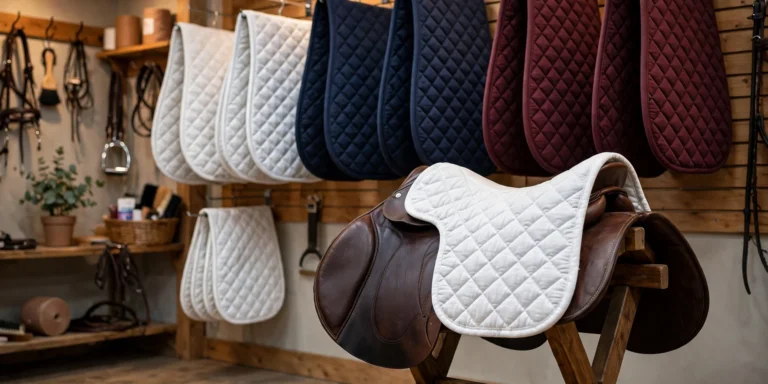
Consider a common scenario: a tack shop’s general-purpose pads keep coming back from jump-saddle riders — the long straight cut bunches under the knee roll, and the pad edge sits proud of the forward flap. The fix is not a better all-purpose pad; it is stocking the jump cut as its own category, cut forward and shorter to sit under jump saddles.
The short answer: Jumping saddle pads are cut forward and shorter to sit under jump saddles: the front edge follows the flap, the drop runs deeper, and the wither stays clear of the pommel. Wholesale buying means matching the cut to the saddle flaps in your market, confirming sizes per maker, and choosing linings for the sweat and wash load.
This guide covers the jump cut’s anatomy, how jumping pads compare with dressage and all-purpose cuts, sizing conventions, lining and fill options, private-label angles, and tack-shop stocking. It companions our dressage vs all-purpose comparison (boundary note: that post compares the two other English cuts; this guide covers the jump cut as a wholesale category), our per-cut sizing charts, and our measurement guide.
Key takeaways
- The jump cut is defined by the forward flap: a forward front edge, deeper front drop, shorter spine than a dressage pad, and a wither profile that sits clear under the pommel.
- Cut choice is a matching exercise — the pad’s front edge should follow the flap it sits under; too long bunches under the knee, too short leaves the saddle on bare pad edges.
- Sizes run Full/Pony/Cob per maker’s own chart — there is no universal jump-pad size standard, so sample-fit against the saddle styles your customers ride.
- Linings decide the wash story in this discipline: moisture-wicking quick-dry linings, bamboo blends, and mesh spines each manage sweat differently.
- Jump pads are the brand canvas of the English line: colorways, contrast piping, and matching sets with bonnets and wraps carry the private-label margin. MOQ 50 pieces per color.
What makes a jumping saddle pad different?
Direct answer: The cut. A jumping pad is forward at the front to clear the rider’s knee under the flap, shorter along the spine than a dressage pad, and shaped at the withers to sit clear of the pommel. The buyer’s rule: check the forward profile, the wither clearance, and the fastening type on the sample.
Equestrian Stockholm’s jump pad product copy names the same three job descriptions buyers should verify on any quote: forward-cut freedom for shoulder movement over fences, neat wither clearance for a tidy position under the pommel, and a lining that wicks moisture and dries fast between rounds. (Equestrian Stockholm — Jump Saddle Pad Modern Bordeaux) Those three — forward freedom, wither clearance, moisture management — are the spec fields to check on a sample, in that order.
One naming note for exporters: the UK trade calls these numnahs — a buyer searching jump numnahs wholesale is the same buyer as jumping saddle pads wholesale, and listings should carry both terms where the market uses them.
How do jumping, dressage, and all-purpose pads compare?
Direct answer: Jumping pads are the shortest and most forward of the three English cuts; dressage pads are long and straight to clear a flap; all-purpose pads split the difference. The buying rule: the pad’s front edge should follow the flap it sits under, too long and it bunches under the knee, too short and the saddle sits past the pad’s edge.
| Feature | Jumping pad | All-purpose pad | Dressage pad |
|---|---|---|---|
| Front edge cut | Forward — follows the forward jump flap | Gently forward — the middle ground | Long and straight — clears a long flap |
| Spine length | Shorter, ends ahead of the cantle zone | Medium | Longest of the three |
| Drop depth | Deep at the front for knee clearance | Even, moderate | Deep overall for the longer flap |
| Wither profile | High-wither clearance under a low pommel | Standard contoured | Standard contoured, longer rise |
| Typical buyer | Show-jumping and hunter shops, eventers | General mixed shops, schools | Dressage-focused shops |
The table describes directions, not measurements — every cell is cut to the maker’s pattern. That is why the buying rule is stated as matching, not as numbers: ask which saddles dominate the fitting room before choosing the cut.
The cross-cut mistake to brief staff on: a dressage pad under a jump saddle does two bad things at once — the long straight front edge folds under the knee roll, and the extra spine length bunches behind the cantle. Our dressage vs all-purpose comparison covers those two cuts’ own sizing logic in detail.
What sizing conventions do jump pads use?
Direct answer: Jump pads are sold in Full, Pony, and Cob sizes, each defined by the maker’s own size chart — there is no universal standard. One retailer’s published guide measures spine length, pad depth, and pad length, and notes the measurements are approximate. Buy to the factory’s chart and sample-fit against the saddle styles your customers ride.
The measurement-method note matters more than the numbers: Premier Equestrian’s jump-pad size guide publishes the three-measurement method (spine length, pad depth, pad length) with measurements are approximate stated outright. (Premier Equestrian — GP/Jump Saddle Pad Size Guide (PDF)) When a factory quotes sizes, confirm which of those three points each figure refers to — Full means nothing until it is tied to a chart.
Two sizing traps to brief staff on. First, saddle seat size does not map cleanly to pad size: flap length and rise vary independently of seat size, so two saddles of the same seat size can take different pad sizes from the same maker. Second, ponies and cobs are not scaled-down fulls — their backs are shaped differently, and the pony jump pad’s wither profile is its own pattern.
What lining and fill options matter for jump pads?
Direct answer: Jump pads sweat hard, so the lining decides the wash story. Moisture-wicking quick-dry linings, bamboo blends, and mesh spines each manage heat and sweat differently — choose by your market’s climate and wash cadence, not by a ranking. Fill stays standard quilted polyfill; thickness is a schooling-vs-show choice.
The moisture story is the one to write into the assortment plan. Equestrian Stockholm builds its jump pads on a quick-dry, moisture-wicking lining explicitly positioned for managing sweat between rounds — repeated rounds with short turnarounds are the use case, and the lining is chosen for it. (Equestrian Stockholm — Jump Saddle Pad Modern Bordeaux) A school that washes pads twice a week needs that fast-turnaround lining; a show-only account that spot-cleans between rounds cares more about the outer face staying crisp.
The mesh-spine option deserves its own buying note: it adds airflow for warm-climate and heavy-work riders but is a second fabric with its own colorfastness and shrinkage to confirm. For accounts that wash hot or need the simplest spec, a solid spine is the safer buy.
Quilting pattern on jump pads is mostly aesthetic — but check the sample under an actual jump saddle, not flat on the table, since a large quilting cell on a short forward pad can land its seam lines oddly relative to the flap.
What private-label angles sell jumping pads?
Direct answer: Jump pads are the brand canvas of the English line: fashion colorways, contrast piping and binding, and matching sets with ear bonnets and polo wraps. Seasonal color drops land hardest here; core white, navy, and black carry the reorder volume. Specify piping, binding, and branding placement on the tech pack — the details are the product.
The private-label logic for jump pads differs from dressage in one useful way: dressage sells on white-purity and rule compliance; jumping sells on coordinated color. That makes the jump pad the anchor SKU for matching sets — bonnet, wraps, and pad in one colorway. The matching-set program needs one discipline on the factory side (same dye lot across the set) and one discipline on the buying side (order the set together, reorder the set together). Our seasonal color drop guide covers the drop-planning mechanics.
Two tech-pack details that decide private-label quality on jump pads. First, piping is a wear item on a forward pad — it runs along the edge the knee presses, so specify the piping cord and its wash behavior, not just the color. Second, badge and embroidery placement must clear the flap line: a crest embroidered where the flap sits will be hidden, and one placed too far forward gets covered by the knee roll. Check placement against the actual saddle, not the flat sketch.
White jump pads deserve a compliance note: show white must stay white. Confirm the face fabric’s wash-fastness and the binding’s dye behavior in writing — white pads with dark binding that bleeds in the first wash are the category’s classic private-label failure.
How should tack shops stock jumping pads?
Direct answer: Stock the jump cut as its own line with its own color ladder: white for show, a dark core (navy or black), and one or two fashion colorways per season. Depth goes to white and the dark core; fashion colors are breadth plays that test and rotate. Start from the shop’s saddle mix — forward-flap shops need forward pads.
| Account type | Starting-hypothesis assortment |
|---|---|
| Jumping- or hunter-focused shop | White, navy, black in Full; one fashion colorway per season; matching bonnet/wrap sets on the fashion colors. Adjust on sell-through. |
| General mixed tack shop | White and navy in Full plus Pony in the lead color; jump pads as a sub-line beside the all-purpose core. Adjust on sell-through. |
| Riding school / lesson barn buyer | One dark colorway in the sizes the fleet rides — schools buy jump pads for wash-turnaround, not color. Adjust on replacement rate. |
| Online or catalog distributor | Full, Pony, and Cob in white and navy with published per-cut measurements; fashion colorways as limited drops. Adjust on sell-through. |
The table is a starting hypothesis — calibrate every cell against the account’s own sell-through. One stocking note applies across all rows: the jump pad and the all-purpose pad must be visibly different SKUs on the wall and in the system, or staff will hand the wrong cut to the customer.
What specs should you confirm when requesting a quote?
Direct answer: Confirm the cut profile (forward edge angle and front drop), per-size measurements on the maker’s chart, the wither profile, girth attachment type, lining and mesh specs, quilting cell size, piping and branding placement, and the MOQ basis. Eight written confirmations before the sample round.
- Cut profile — the forward edge shape and front drop depth for the cut, checked against the saddle flaps in your market
- Per-size measurements (Full / Pony / Cob) on the maker’s own chart — spine length, pad depth, and pad length defined the same way as the sample
- Wither profile — clearance shape under the pommel, confirmed on a sample under a real jump saddle
- Girth attachment — Velcro straps vs girth loops vs both; adjustable and elasticated fastenings preferred where the pad must stay put
- Lining spec — wicking, bamboo blend, or mesh spine; wash temperature and shrinkage confirmed per lining fabric
- Quilting — cell pattern and size, stitch length, and fill weight; pattern placement checked under a saddle, not just flat
- Branding placement — piping color, binding color, badge or embroidery position cleared against the flap line
- MOQ basis — 50 pieces per color is our standard; confirm whether the count applies per colorway, per cut, or per size
Key takeaways
- The jump cut is a matching exercise: forward edge, deeper front drop, shorter spine, high-wither profile — specified against the saddle flaps in your market, not against a universal chart.
- Sizes run Full/Pony/Cob per maker; there is no industry-standard jump-pad size. Tie every size name to a measurement chart and sample-fit under a real jump saddle.
- Linings decide the wash story in this discipline — wicking quick-dry, bamboo blend, or mesh spine chosen by climate and wash cadence, not by ranking.
- Jump pads are the private-label canvas: fashion colorways, contrast piping, and matching sets carry the margin; white pads need written colorfastness.
- Keep the jump line visibly separate from all-purpose on the wall and in the system. MOQ 50 pieces per color.
Frequently asked questions
Can a dressage pad be used under a jump saddle?
It fits poorly enough to matter: the long straight front edge folds under the knee roll and the extra spine length bunches behind the cantle. Riders do it in a pinch, but a shop selling dressage pads to jump riders is selling returns.
What is the difference between a jump pad and an all-purpose pad?
An all-purpose pad is the middle cut — gently forward, medium length — meant to sit acceptably under both moderate jump saddles and general riding. A jump pad is cut further forward and shorter for dedicated jump saddles: the compromise SKU vs the fitted one.
How do I match pad size to saddle seat size?
You don’t, directly — flap length and rise vary independently of seat size, and makers cut Full/Pony/Cob to their own charts. Use the maker’s per-cut measurements and check the sample against the saddle styles your customers ride.
Do jump pads need special girth attachments?
They need attachments that hold under jumping work: Velcro billet straps, girth loops, or both. Confirm the attachment type on the quote, since it varies by maker — it is the easy-to-overlook feature that decides whether the pad stays put.
Are mesh spines better than solid spines?
Conditional, not better: mesh adds airflow for warm-climate and heavy-work riders but is a second fabric with its own colorfastness and shrinkage to confirm. For hot washes or the simplest spec, a solid spine is the safer buy.
Requesting bulk jumping saddle pads? Tell us the cut profile, sizes, lining, and colorway program — we quote forward-cut jump pads to one tech pack, with free samples before bulk. MOQ 50 pieces per color.
Sources & Further Reading
- Horse & Hound — Best jump saddle pads: pads designed to fit more forward cut jumping saddles, high-wither designs, breathable mesh spine, and the adjustable/elasticated/Velcro fastening note; also the UK numnah naming reference.
- Equestrian Stockholm — Jump Saddle Pad Modern Bordeaux: forward-cut freedom for shoulder movement, bamboo-blend quick-dry lining, Full/Pony/Cob sizing, 30°C wash care.
- Premier Equestrian — GP/Jump Saddle Pad Size Guide (PDF): published three-measurement method (spine length, pad depth, pad length) with measurements stated as approximate.
- Dressage Pad vs All-Purpose Pad: What’s the Difference? — the two other English cuts this guide’s table compares against.
- Saddle Pad Sizing Charts: Dressage, Jumping, Western & Half Pads — the measurement points to lock per cut.
- Saddle Pad Sizing Guide with Measurement Chart — general measurement method this guide builds on.
- Saddle Pad Color Fastness: A Buyer’s Guide — wash grades to specify on white and fashion colorways.
- Saddle Pad Quilting Patterns Explained — cell size and stitch specs for the tech pack.
