
Gel & Anti-Slip Saddle Pads: A Wholesale Buying Guide
Published · Cornovo Saddlery
Consider a common scenario: a tack shop buyer adds gel pads because saddle slip keeps coming up at the counter, and the first shipment reveals the category is three different products wearing one name — clear sticky sheets, perforated pads, and shaped anatomical gel. The reorder goes to the construction that solved the complaint.
The short answer: Gel saddle pads are polymer-sheet pads placed on the horse’s back, between quilted pad and saddle, or as shaped risers lifting the front or rear. They grip through tacky surfaces and spread point pressure. Wholesale buying means choosing among three construction families, confirming thickness and dimensions, and locking the care method: some machine-wash at 30°C, others are wipe-clean only.
This guide covers the three gel construction families, where gel pads fit and where they don’t, thickness and sizing logic, care and wash behavior, QC sampling checks, and tack-shop stocking. It companions our non-slip technology comparison (boundary note: that guide compares grip technologies across categories; this one covers the gel family as a wholesale product line), our insert-material comparison, and our wash and care guide.
Key takeaways
- Gel pads are one construction family with three distinct builds — smooth solid sheet, perforated/textured sheet, and anatomically shaped gel — each with its own care method.
- Buy the construction for the job: sheets for general anti-slip, perforated for warmer work, shaped or riser gel for targeted lift.
- Thickness is conditional, not standard: thin sheets keep close contact; shaped pads add lift. Published specs from one maker are a reference, not a category rule.
- Care method follows the maker, not the category — confirm machine-wash vs wipe-clean per SKU, since heat damages most gel polymers.
- Sample like the material demands: check thickness evenness, edge trimming, perforation consistency, and re-check flatness after washing by the maker’s method. MOQ 50 pieces per color.
What is a gel saddle pad, and what are the three constructions?
Direct answer: A gel saddle pad is a solid-sheet polymer pad, not a quilted pad with gel inside. Wholesale buyers will meet three builds: smooth solid sheets for maximum tacky grip, perforated or textured sheets for airflow and bite, and anatomically shaped gel, sometimes with built-in front or rear risers. The construction decides the care method and the stocking story.
The three builds exist because gel describes a material, not a shape — name the construction on the RFQ.
| Construction | Typical strengths — and when they hold | Watch-outs — and when they appear |
|---|---|---|
| Smooth solid sheet (clear or colored) | Maximum surface grip for the thinnest profile; sits invisible under the pad; lowest bulk for close-contact riders | Traps the most heat against the skin in warm work; shows sweat lines and dust; thin edges can curl if stored rolled |
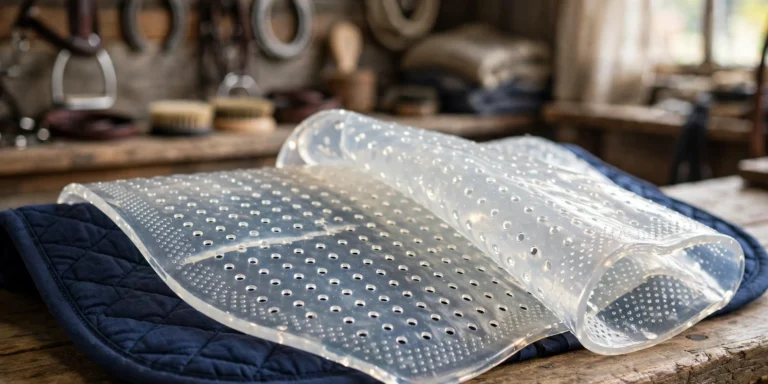
| Perforated or textured sheet | Holes or raised points improve airflow and add mechanical bite; balances grip with temperature management for everyday riding | Perforation edges are the first place to tear if the sheet is thin; dust packs into holes and needs rinsing, not brushing |
| Anatomically shaped gel / front-rear riser | Built-in lift where the saddle needs it, with a withers-free profile; the fitting-story SKU that counter staff can sell with a diagnosis | Most expensive of the three; wrong riser placement adds pressure rather than relieving it — staff must match the profile to the horse |
The perforated build is the documented mainstream: Eskadron’s anti-slip gel pad carries small holes across its entire surface for temperature balance, with a thin profile for close contact and shock absorption distributed across the back. (Fundis Equestrian — Eskadron Gel Pad Anti-Slip Gel) Two quality claims to verify in writing on any quote: the gel cannot leak and it is skin-friendly for direct contact.
The shaped build is the specialist’s build: Acavallo’s shaped gel pad is moulded thicker than the lightweight sheet for dual anti-slip and shock-absorbing duty, runs a thinner depth of gel down the center so the pad sits up in the gullet instead of pressing on the wither and spine, and can be cut to the saddle’s profile. (TDS Saddlers — Acavallo Shaped Gel Pad) The gel is non-toxic and hypoallergenic for direct-skin use.
When does a gel pad fit the job — and when does it not?
Direct answer: Gel pads fit riders whose saddles shift despite a basic fit: round-barreled horses, ponies, and horses returning to condition are the classic cases. They do not fix a saddle that is the wrong tree: if the saddle rocks or bridges, a tacky layer can hold the mistake in place. That is a fitting check before the gel recommendation, not after.
Grip depends on what sits under the gel: a sheet on a hairy, unclipped back behaves differently from one on a clipped back, and gel-on-gel contact can bind instead of settle. When a rider reports the gel doesn’t work, the surface pairing is usually the cause — one counter question before the pad gets blamed.
The fitter-referral boundary is the same one that governs shims and correction pads: small, changing fit gaps are the product’s job; large or permanent gaps are a fitter referral. A riser gel pad stacked under a saddle that is far too narrow is a fitting error, not a solution.
How thick should a gel pad be?
Direct answer: Thickness is conditional on the job, and there is no wholesale thickness standard for gel pads. Thin sheets keep the rider close to the horse; shaped pads and risers add targeted lift at the pommel or cantle. Published specs from individual makers are references — one product’s published 3-mm sheet does not make 3 mm the category rule.
Gel-Eze publishes 3 mm for its perforated sheet pad — a concrete reference point to calibrate quotes, not a prescription. (PADD — Gel-Eze Saddle Pad) When a factory quotes thin or standard, ask for the millimeter figure and the measurement points: center vs edge thickness differs on shaped pads.
Two thickness-related specs belong on every RFQ beyond the number itself: whether the sheet can be trimmed to the saddle profile (cut lines are a retail feature), and whether the product is sold one-size or in sized variants. One-size sheets are the volume SKU; sized shaped pads are the fitting-channel SKU.
How do you care for gel pads — and what goes wrong?
Direct answer: The care method follows the maker, not the category. Eskadron and Acavallo both approve machine washing at 30°C, but not all gel pads are machine-washable, and Cheshire Horse’s care guide advises checking the maker’s instructions first, since many gel pads are designed to be wiped clean rather than submerged. Heat is the common enemy: no tumble drying or direct heat.
The wipe-clean instruction is the one staff forget to pass on, and it decides whether the product survives its first season. A machine-washed wipe-clean pad softens, thins, or loses tack over a few cycles — which reads as a quality defect at the counter. Print the care method on the hang tag.
One product-specific note: Gel-Eze ships with an oily surface feel that disappears with washing and does not affect performance. (PADD — Gel-Eze Saddle Pad) Brief counter staff once — an oily feel reads as a defect to an unbriefed customer.
Storage deserves one line on the care label: gel sheets should ship and store flat. Rolled or folded storage takes a set that never fully comes out, and curled edges are the most common visible defect — usually a storage issue, not a material one.
What should you check when sampling gel pads?
Direct answer: Gel sampling is physical and quick: even thickness across the sheet, clean trimmed edges, consistent perforation or texture, accurate cut lines, and no bubbles or discoloration in the polymer. Then wash the sample by the maker’s own method and re-check flatness and tack afterward — the wash test is the decisive sampling test for this category.
- Thickness evenness — measure center, mid-panel, and edge; shaped pads should match the maker’s stated profile, not just the thickest point
- Edge trimming — clean, even edges with no ragged cuts; on trim-to-fit sheets, the factory cut should not pre-tear along the trace lines
- Perforation/texture consistency — holes evenly spaced and fully punched (no half-cut webs), grip points uniform in height
- Polymer clarity — no bubbles, clouding, or yellowing in clear gel; color sheets even with no dye pooling
- Flatness — the sheet lies flat from the carton; check both sides, since one-sided curl reads as warping to the customer
- Odor and feel — mild polymer smell is normal; strong chemical odor beyond the maker’s stated norm is a reject-and-ask signal
- Wash test — wash by the maker’s own method, air-dry flat, and re-check thickness, tack, and flatness
- Packaging — shipped flat in a rigid or semi-rigid pack; no folding creases, since a creased gel sheet is a damaged sheet
One gel-specific inspection point: tack. The surface should feel tacky but release cleanly — too sticky and it collects dust on day one; too smooth and it’s a sheet of plastic, not an anti-slip product. There is no universal tack meter in wholesale practice, so the maker’s reference sample is the standard the bulk is judged against.
How should tack shops stock gel pads?
Direct answer: Gel pads are a depth category, not a breadth line: stock one sheet construction and one shaped or riser option, rather than five variations. Start with the constructions your fitters and counter staff can actually recommend with a diagnosis attached, then let sell-through set the depth.
| Account type | Starting-hypothesis assortment |
|---|---|
| General mixed tack shop | One perforated sheet (the everyday anti-slip answer) plus one anatomical shaped pad. Adjust on sell-through. |
| Jumping- or hunter-focused shop | Shaped pad and a front riser, plus one perforated sheet for the schooling riders. Adjust on sell-through. |
| Riding school / lesson barn buyer | One wipe-clean-friendly construction in the sizes the fleet rides. Adjust on replacement rate. |
| Online or catalog distributor | The most documented retail configurations (perforated sheet + shaped pad) with published care methods. Adjust on sell-through. |
The table is a starting hypothesis — calibrate every cell against the account’s own sell-through. One merchandising note applies across all rows: gel sheets all look like clear plastic on the wall, so the hang tag must name the construction, with one staff sentence per build. Our inventory planning guide covers the reorder math.
What specs should you confirm when requesting a quote?
Direct answer: Confirm the construction family, thickness in mm with the measurement points stated, dimensions per size, trimmability to the saddle profile, the exact care method in writing, the riser profile and lift points if applicable, flat packaging, and the MOQ basis. Eight written checks before the sample round.
- Construction family — smooth sheet, perforated/textured sheet, or anatomically shaped; no gel pad without the qualifier
- Thickness in millimeters with the measurement points stated (center, mid-panel, edge) — especially on shaped pads
- Dimensions — length x width per size, plus whether the line is one-size or sized
- Trimmability — can the rider cut it to the saddle profile, and what does the edge look like after trimming
- Care method exactly as the maker intends it (machine-washable at 30°C, wipe-clean only, or other) — printed on the hang tag, not assumed
- Riser profile, if applicable — front, rear, or full; lift height at the pommel/cantle points; wither clearance on shaped pads
- Packaging — flat shipment, rigid or semi-rigid; no folded or rolled gel sheets in the carton
- MOQ basis — 50 pieces per color is our standard; confirm whether the count applies per construction, per size, or per colorway
Key takeaways
- Gel pads are a material family with three distinct constructions — buy the construction for the job, not the word gel.
- Performance is conditional: grip depends on the surface pairing, heat management depends on the construction, and fit problems are a fitter’s job, not a gel pad’s.
- Care method is a spec, not a guess: machine-washable vs wipe-clean varies by maker and decides whether the pad survives its first season.
- Sample physically: thickness evenness, edge trim, perforation consistency, flatness after the maker’s own wash method.
- Stock for depth, not breadth: one sheet plus one shaped option, with the construction named on the hang tag. MOQ 50 pieces per color.
Frequently asked questions
Can a gel pad be used directly on the horse’s back?
Maker-dependent. Non-toxic, hypoallergenic gels like Acavallo’s are documented for direct-skin use, and Eskadron’s publishes skin-friendly direct-contact claims — but not every gel sheet is made for it. Confirm per SKU and print the answer on the hang tag.
Can riders trim gel pads to fit their saddle?
Some, not all. Shaped gel pads from the established makers are commonly trimmed to the saddle profile, and some sheets ship with trace lines for shaping. Whether trimming is supported — and what trimmed edges look like — belongs in the factory confirmation before it becomes counter advice.
Do gel pads replace non-slip saddle pads?
Gel pads are one branch of the anti-slip family, not its replacement. Our non-slip technology comparison covers the other branches with the conditions each suits — buying gel for every slip complaint narrows the solution set.
How long do gel pads last?
No fixed lifespan can be quoted without test data. Replace when surface tack changes materially, edges crack or curl beyond flattening, or perforation edges start tearing. Treat any maker-published cycle life as a starting reference and confirm it against your own returns.
Are gel pads allowed in competition?
Generally yes as under-pad layers — but color rules still apply where the sheet peeks past the flap, and discipline rulebooks should be checked per market.
Requesting bulk gel saddle pads? Tell us the construction family, thickness, dimensions, and whether you need riser profiles — we quote smooth sheet, perforated, and shaped gel to one tech pack, with free samples before bulk. MOQ 50 pieces per color.
Sources & Further Reading
- Fundis Equestrian — Eskadron Gel Pad Anti-Slip Gel: perforated surface for temperature balance, thin close-contact profile, leak-free gel, skin-friendly direct contact, machine washable at 30°C.
- TDS Saddlers — Acavallo Shaped Gel Pad: dual-purpose anti-slip and shock absorption, thinner gel down the gullet for wither clearance, cut-to-fit, non-toxic hypoallergenic gel, machine washable at 30°C.
- Cheshire Horse — Proper Saddle Pad Care: material-specific care guidance — check the manufacturer’s instructions first; many gel and memory-foam pads are designed to be wiped clean rather than submerged; no heat drying.
- Non-Slip Saddle Pad Technologies Compared — the technology-level comparison this buying guide sits inside.
- Wool Felt vs Foam vs Gel Saddle Pad Inserts: A Buyer’s Comparison — gel as a fill material vs gel as a standalone sheet.
- How to Wash Saddle Pads: A Care Handout — the care methods this guide’s gel section builds on.
- Pre-Shipment Saddle Pad Quality Control Checklist — the general pad inspection flow for gel sampling.
- Saddle Pad Inventory Planning for Tack Shops — reorder math for gel assortments.
