
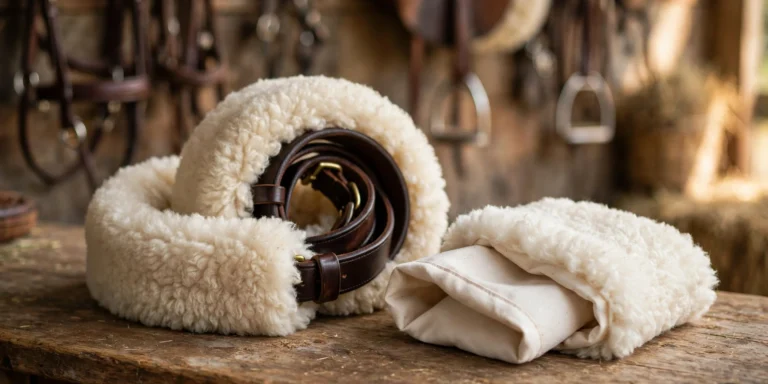
Sheepskin Girth Covers: A Distributor's Buying Guide
Published · Cornovo Saddlery
Consider a common scenario: a tack shop sells a popular leather dressage girth all season, and the riders with sensitive-skinned horses keep asking the same question — how do they soften the girth area without replacing a girth that already fits? The answer that turns that question into a sale is a sheepskin girth cover: a wool sleeve that upgrades the girth the customer already owns.
The short answer: Sheepskin girth covers are wool sleeves or strap-on covers that add a soft pile layer between girth and horse, distributing pressure and reducing rubbing and sweat build-up. Wholesale buying means choosing the attachment type, confirming wool and construction specs, matching cover sizes to the girth families your customers ride, and selling the wash care that keeps covers working.
This guide covers cover types, the wool specs that matter on a quote, size matching by girth family, wash and care rules, and distributor stocking. It companions our English girth wholesale guide (boundary note: that post covers girths as products; this one covers the sheepskin sleeve that fits over them), our sheepskin half pad buyer’s guide (same wool expertise, different product), and our wash and care guide.
Key takeaways
- A girth cover is an upgrade accessory, not a girth: it fits over the customer’s existing girth, so it attaches to every girth sale rather than competing with one.
- The three construction families — slip-on sleeve, Velcro strap cover, and integrated lined girth — suit different girths and buyers; stock the one that matches your girth wall.
- Wool specs to lock on the quote: pile density and length, skin or backing material, edge finishing, wash method, and colorfastness on dark colors.
- Wash care decides repeat sales: covers that flatten or felt in hot washes come back as complaints; documented care instructions sell the second cover.
- Stock covers as girth accessories with per-family sizing, not as standalone products. MOQ 50 pieces per color.
What is a sheepskin girth cover, and what does it do?
Direct answer: A sheepskin girth cover is a wool-pile sleeve that slides or straps over a girth, placing a soft moving layer between the girth webbing and the horse’s skin. It distributes pressure across a wider area, reduces rubbing and chafing (girth galls), and wicks sweat — which is why it sells to the same riders whose horses object to girthing.
The mechanism is mechanical, not magic. A maker of sheepskin girth linings describes the construction plainly: sheepskin attached by Velcro to the girth webbing, with the wool lining slightly wider than the girth itself — that extra width is what distributes pressure and chafing beyond the girth’s own footprint. The fur absorbs movement between girth and skin, which is the part that prevents bruising, chafing, and pressure sores on sensitive horses. (Barefoot — Sheepskin Dressage Girth) The same maker notes the wool stays breathable, wicks sweat, and helps regulate humidity — the girth area sweats hard, and a cover that traps moisture defeats its own purpose.
One buyer caution belongs in every assortment plan. An independent girth-buying guide states it outright: Sheepskin covers are helpful on leather girths but they tend to bunch and are difficult to keep clean. (HorsesDaily — Choosing the Best Girth) That sentence is not a reason to skip the category — it is the spec brief. Bunching is a fit and construction problem (sleeve too loose, poor elastication, elastic straps that don’t hold position); cleanliness is a care-instructions problem. Buy the construction that resists both, and print the care rules on the hang tag.
Which cover types should a distributor stock?
Direct answer: Stock the cover type that matches the girths on your wall: slip-on sleeves for standard straight girths, Velcro strap covers for shaped or contoured girths, and integrated lined girths for buyers who want the softness built in. No type is universally better — the wrong attachment for the girth shape is the bunching problem the HorsesDaily caution warns about.
| Cover type | How it attaches | Typical strengths — and the conditions they depend on | Watch-outs — and when they show up |
|---|---|---|---|
| Slip-on sleeve | Tube pulled over the girth from one end | Clean look, no hardware; suits straight girths of even width along their length. LeMieux publishes this style in merino lambskin for dressage (60 x 15 cm, one size, can be cut to size) and jumping (80 x 12 cm) girths. | Needs the right girth width to stay put — a sleeve much wider than the girth bunches; shaped girths resist pull-on fitting. |
| Velcro strap cover | Elasticated loops plus adjustable Velcro straps around the girth | Fits shaped and contoured girths; position can be adjusted; removable for washing without removing the girth. Shaped-cover makers add strap pinch points to lock position and prevent rotation. | More parts to specify: strap elastic grade, Velcro peel strength, and the rolled edge finishing that stops the cover edge curling. |
| Integrated lined girth | Sheepskin built into the girth itself | Maximum stability, no separate cover to lose or mis-fit; the lining wider than the webbing distributes pressure. Removable-lining versions wash separately via Velcro. | This is a girth purchase, not an accessory — higher price, sized by girth length (one maker lists 45/55/65/75 cm), and it competes with your girth wall instead of attaching to it. |
The LeMieux sleeve dimensions above are one brand’s published spec, not a wholesale standard — use them as a reference for what the market already understands, then confirm the factory’s own sleeve chart per girth family. (Houghton Country — LeMieux Lambskin Dressage Girth Sleeve) The same applies to the 45/55/65/75 cm lined-girth lengths from the Barefoot copy — that maker’s range, quoted here only to show how integrated linings are sold by girth length. (Barefoot — Sheepskin Dressage Girth)
The distributor’s stocking logic follows from the table: slip-on sleeves pair with your straight-girth SKUs, Velcro strap covers pair with shaped and anatomical girths, and integrated linings are a separate girth SKU for the sensitive-horse customer. One cover type does not cover the wall — but two (one sleeve, one strap cover) handle most English girth shapes.
What wool specs should the quote lock in?
Direct answer: Lock the wool pile (density and length), the skin or backing material, the edge finishing, the wash method the wool survives, and colorfastness on dark colors. Real sheepskin on a quote is a starting word, not a spec — two covers with the same word can behave completely differently after ten washes.
Start with the wool itself. Retail makers describe their covers as dense and soft merino lambskin — that phrasing is marketing copy, but the two adjectives point at the right spec fields: pile density (how tightly the fibers pack) and pile length. Denser, even pile distributes pressure better and mats less; sparse pile goes flat quickly and the cover’s selling life ends with it. Ask for the pile spec in writing and compare the sample after several washes, not just out of the box.
Then the backing the wool is attached to. Covers are typically wool on one face with a cotton fabric or suede-skin reverse; some makers add a rolled edge. The reverse matters because it is the surface that slides against the girth — cotton is the common breathable choice, and the reverse fabric’s own shrinkage rate has to match the wool side’s, or the cover twists after washing.
Three spec traps to brief buyers on. First, natural variance is real and should be disclosed, not hidden: one sheepskin girth maker states plainly that small variances in color and length of the fur are normal in a natural product. (Barefoot — Sheepskin Dressage Girth) That is a selling point for natural wool, but it means color matching across covers in one order needs a stated tolerance. Second, dark wool can leach dye — a retailer care sheet for a merino girth cover warns that black wool dye can give a slight blue tint and stain grey coats. (Houghton Country — LeMieux sleeve details via the same retail family) Confirm dark-color fastness in writing. Third, do not let a quote claim certification labels the factory does not hold — if the wool is not certified to a named scheme, the cover sells on genuine sheepskin/lambskin material claims only, with substantiation kept in the file.
How do cover sizes map to girth families?
Direct answer: Cover sizes map to the girth’s width and the length of its pressure zone, not to girth length alone. Dressage girths are short and wide; long girths are longer and narrower; western cinches are a different tradition. Match the sleeve’s internal width to the girth webbing and its length to the zone the horse actually wears.
| Girth family | What the cover must fit | Buying note |
|---|---|---|
| Dressage / short girth | Wider webbing, shorter pressure zone under the flap | Sleeve-style covers sized for this family are commonly wide and short — one brand’s published spec is 60 x 15 cm in a single cut-to-size option. Confirm your factory’s equivalent. |
| Long / AP / jumping girth | Narrower webbing, longer wrap around the barrel | Narrower, longer sleeves — the same brand publishes 80 x 12 cm and 82 x 16 cm for jumping/GP covers. Elasticated strap covers also suit this family well. |
| Shaped / anatomical girth | Curved profile, sometimes contoured edges | Slip-on sleeves fight the shape; Velcro strap covers with adjustable positioning are the safer stock choice here. |
| Western cinch | Different hardware and tradition | Treat separately — see our cinch materials and sizing guide. Do not promise girth-cover fit on cinches without a maker-confirmed spec. |
Two fitting details that decide whether covers stay on. First, buckle clearance: the cover must end clear of the buckles, or it interferes with girthing up. Second, rotation control: strap covers need the elasticated loops and Velcro pinch points positioned so the cover cannot twist around the girth — rotation is the field version of the bunching problem. Write both into the tech pack as position checks, not assumptions.
What wash and care rules decide repeat sales?
Direct answer: Wash care decides whether a cover becomes a repeat purchase or a return: wool survives wool-cycle washes with non-biological detergent and air drying, and dies fast in hot washes, tumble dryers, and radiators. Print the care method on the hang tag — the rider who washes it right buys the next colorway; the one who felts it blames the cover.
The care method is consistent across the category’s retail copy, which makes it safe to standardize. One retailer’s sleeve care sheet: hand wash or wool cycle no hotter than 30 degrees, non-biological washing powder or liquid, a small amount of human hair conditioner rubbed into the wool before washing to keep it soft, never dry directly on a radiator, and no tumble drying. (Houghton Country — LeMieux Lambskin Dressage Girth Sleeve) A sheepskin girth maker gives the same shape: wash with special detergents, lay flat after washing, do not dry in direct sunshine. (Barefoot — Sheepskin Dressage Girth) When every serious maker converges on the same method, the wholesale move is to make that method the product’s documented spec — and to sell a second cover per girth as the wash-rotation spare.
The wash-rotation angle is the category’s margin mechanic. A cover that takes a full day to air-dry properly cannot be the rider’s only cover if the horse works daily — the spare-cover sale is not an upsell trick, it is the honest consequence of the care rules. Tack shops that merchandise covers in pairs (one on the girth, one drying) report the category’s best attach rates in our experience.
How should distributors and tack shops stock girth covers?
Direct answer: Stock covers as girth accessories, not standalone products: sleeve and strap-cover types matched to the girth families on your wall, in matching colors, with wash-care printed on the tag. Depth goes to the cover type matching your best-selling girth family; breadth covers the second.
| Account type | Starting-hypothesis assortment |
|---|---|
| Dressage-focused tack shop | Slip-on sleeves in the dressage size as the core, one strap-cover SKU for shaped-girth customers; natural and black to match the girth wall. Adjust on sell-through. |
| General mixed tack shop | One sleeve SKU (long-girth family) plus one strap-cover SKU; natural as the core color with black as the second. Adjust on sell-through. |
| Jumping / eventing dealer | Narrower jumping-family sleeves; consider the GP-length sleeve as the breadth SKU. Adjust on sell-through. |
| Riding school buyer | Strap covers only — fastest to fit across a fleet of different girths, removable for the school laundry. One dark colorway. Adjust on replacement rate. |
The table is a starting hypothesis — calibrate every cell against the account’s own sell-through. Two cross-sell mechanics apply across all rows. First, the attach pitch: every leather girth sale is a cover conversation, because the sensitive-horse buyer and the prevention-minded buyer are both in the same fitting room. Second, the pair rule: sell covers in wash-rotation pairs where the rider works the horse daily, per the care rules above.
What specs should you confirm when requesting a quote?
Direct answer: Confirm the wool pile spec, backing and edge construction, per-family sleeve dimensions, strap and elastic hardware where applicable, the wash method in writing, dark-color fastness, and the MOQ basis. Seven written confirmations before the sample round — each one prevents a class of field complaints.
- Wool pile spec — density and length per colorway, natural variance tolerance stated
- Backing and edge — cotton reverse or suede skin, rolled or bound edge, shrinkage matched between faces
- Sleeve dimensions per girth family — internal width, length, buckle clearance, on the factory’s own chart
- Strap hardware (strap covers) — elastic grade, Velcro peel strength, loop/strap positions that prevent rotation
- Wash method — confirmed in writing: temperature ceiling, detergent type, drying method
- Dark-color fastness — dye-leach behavior on black/brown wool documented, especially against grey coats
- MOQ basis — 50 pieces per color is our standard; confirm whether the count applies per colorway, per cover type, or per size
Key takeaways
- A sheepskin girth cover is an accessory that upgrades the girth the customer already owns — it attaches to girth sales instead of competing with them.
- Three constructions serve different girths: slip-on sleeves for straight girths, Velcro strap covers for shaped girths, integrated linings as a separate girth SKU.
- Wool specs to write into the quote: pile density and length, backing material, edge finishing, wash method, and dark-color fastness.
- Wash care is the repeat-sale lever: 30-degree wool cycle, non-biological detergent, air dry — print it on the tag and sell the wash-rotation pair.
- Size covers to girth families (dressage/short, long/AP, shaped), not to girth length alone; keep buckle clearance and rotation control in the tech pack. MOQ 50 pieces per color.
Frequently asked questions
Is a girth cover the same as a sheepskin-lined girth?
No. A cover is a separate sleeve or strap-on accessory that fits over an existing girth; a lined girth has the sheepskin built in and is bought and sized as a girth. Covers attach to your girth wall; lined girths compete with it.
Will one cover fit any girth?
No — fit follows the girth family. Slip-on sleeves suit straight girths of matching width; shaped or anatomical girths need adjustable Velcro strap covers. Confirm the sleeve’s internal width against the girth webbing, not just the cover’s length.
How often should a sheepskin girth cover be washed?
Wash it when sweat and hair load the pile — for daily-work horses that is often weekly. Keep a second cover in rotation since proper air drying takes a full day. Hot washes, tumble dryers, and radiators felt the wool and end the cover’s working life early.
Real sheepskin or synthetic fleece for covers?
Conditional, not better: genuine wool’s pile absorbs movement and wicks sweat, and it carries the premium price; synthetic fleece is cheaper and easier to wash but mats differently. Do not blend the two stories — label the material honestly and spec each to its own care method.
What MOQ applies to custom-color girth covers?
Our standard is 50 pieces per color — confirm at quote whether the count applies per colorway, per cover type, or per size family, since covers split across sleeve and strap-cover constructions.
Requesting bulk sheepskin girth covers? Tell us the cover type, girth families, wool spec, and colorways — we quote covers to one tech pack with free samples before bulk. MOQ 50 pieces per color.
Sources & Further Reading
- Houghton Country — LeMieux Lambskin Dressage Girth Sleeve: pull-on sleeve style, 100% Australian merino lambskin, one-size 60 x 15 cm cut-to-size, anti-gall positioning; wash method (30°C wool cycle, non-biological detergent, conditioner, no radiator, no tumble dry).
- Barefoot — Sheepskin Dressage Girth: Velcro-removable sheepskin lining slightly wider than the girth for pressure distribution; fur absorbing movement to prevent chafing; breathability and sweat wicking; special-detergent wash, lay flat, no direct sun; natural variance disclosure; 45/55/65/75 cm lengths as that maker’s range.
- HorsesDaily — Choosing the Best Girth: the buyer caution that sheepskin covers on leather girths tend to bunch and are difficult to keep clean — the spec brief this guide answers; plus the soft/pressure-distributing/breathable material criteria.
- Horse Girths: A Wholesale Buyer’s Guide — the girth families (dressage, long, shaped) these covers fit over.
- Sheepskin Half Pads: A Buyer’s Guide — wool density, backing, and stitching specs from the same material family.
- How to Wash Saddle Pads: A Care Handout — wool wash principles retailers can hand to customers.
- Saddle Pad Inventory Planning — assortment and reorder math this guide’s stocking table builds on.
- Saddle Pad Color Fastness: A Buyer’s Guide — dye-leach testing relevant to dark wool covers.
