
Sheepskin Seat Savers: A Wholesale Buying Guide
Published · Cornovo Saddlery
Consider a common scenario: a tack distributor’s pad line is established and the catalog still has a blind spot between the saddle and the rider. A customer asks for sheepskin seat savers, and the distributor realizes nobody on the team knows how they attach or what a fair specification looks like.
The short answer: A sheepskin seat saver is a wool-pile cover fitted over the saddle seat to cushion the rider and reduce friction. Distributors order three builds — full sheepskin, sheepskin over a gel or foam core, and fleece-look alternatives — with strap anchors as the critical spec. This guide covers types, attachment, sizing, care, and the quote checklist.
This guide completes the sheepskin corner of your catalog: our sheepskin half pad guide covers the horse-side product and our sheepskin girth cover guide covers the girth-side accessory — this one is the rider-side product. It also pairs with our bareback pad guide (seat savers are covers for existing saddles, not saddle substitutes) and our wash and care guide.
Key takeaways
- A seat saver cushions the rider’s seat without touching saddle fit, half-pad territory, or bareback-pad territory.
- Three builds serve three buyers: full sheepskin for the comfort buyer, sheepskin over gel or foam for sensitive riders, synthetic fleece for the price and school line.
- Attachment is the highest-failure component: specify straps, anchors, and hardware on the tech pack — and fit-test the sample on a real saddle.
- No universal size standard exists: pattern per seat cut (English vs western), confirm the factory’s size list, keep two cuts as two SKUs.
- Care labels must carry the wool-safe routine for real sheepskin — cold wash, dedicated detergent, no heat. MOQ 50 pieces per color.
What is a sheepskin seat saver — and what is it not?
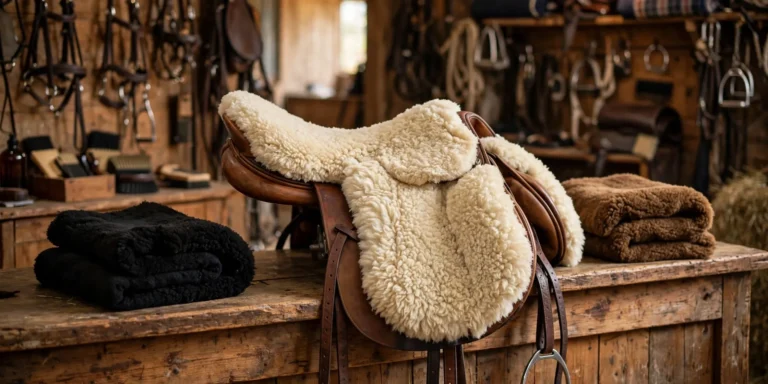
Direct answer: A sheepskin seat saver is a wool-pile cover shaped to fit over a saddle’s seat, adding cushioning and reducing friction for the rider. It changes the rider’s contact with the saddle only — it does not change saddle fit on the horse, it is not a half pad, and it is not a bareback pad.
The construction is straightforward: real sheepskin (wool pile on a leather hide backing) cut and sewn to follow the seat’s contours, with straps or elastic underneath. A well-known western maker describes the standard build as a thick wool top with a natural leather underside, held by a cantle elastic and a T-strap design. (Cowgirl Magazine — A Rider’s Guide to Sheepskin) That leather underside is a real buying signal: it grips the seat leather and resists the slipping that smooth-backed covers suffer.
Three things a seat saver is commonly confused with — get the boundaries right before briefing your team:
- Not a half pad. A half pad sits between the saddle and the horse’s back and touches fit and clearance questions. A seat saver sits above the saddle seat and only touches the rider. Different customers, different shelving.
- Not a bareback pad. A bareback pad substitutes for a saddle; a seat saver requires one.
- Not a gel saddle pad. Gel pads cushion horse-side load. A seat saver’s gel, where present, sits under the rider — a different layer of the system.
Why sheepskin at all, given synthetic fleece exists? The same sheepskin guide notes the material’s moisture-wicking behavior — the wool absorbs and releases moisture into the air faster than many alternatives — and the plush surface matters exactly where the rider spends hours: at the seat. (Cowgirl Magazine — A Rider’s Guide to Sheepskin) That gives your team an honest talking point: sheepskin is about the riding experience, not about saddle mechanics.
What types of seat savers do distributors order?
Direct answer: Three builds cover the wholesale range — full sheepskin covers for premium lines, sheepskin over a gel or foam core for riders wanting both cushion types, and synthetic fleece for the price-conscious. None is simply the best.
| Build | Typical strengths — and when they hold | Watch-outs — and when they show up |
|---|---|---|
| Full sheepskin cover | The premium line: real wool pile with a leather underside for grip on the seat. Suits long-hour riders in trail, endurance, and school programs. | The highest material cost in the family; pile compresses under sustained pressure and needs the wool-safe routine (below). Natural color variation between hides is part of the material — state it on the copy. |
| Sheepskin over gel or foam core | Combines the wool surface riders recognize with a cushioning core under the sit bones. Suits riders wanting more than pile height can give — where the core is thin and shaped so the saver follows the seat. | Two materials mean two wash behaviors and two failure points (core edge exposure, delamination). Confirm how the core is enclosed and what the wash instructions require. |
| Synthetic fleece look-alike | The price line: the sheepskin look at a fraction of the hide cost, machine-washable without wool detergents. Suits school programs and entry riders where the saver is a consumable. | Does not carry sheepskin’s moisture handling or hand feel — position it as the budget alternative openly, never as sheepskin-like. Heat buildup is the typical complaint. |
Retail listings commonly offer black and natural colorways — the natural palette is the material’s own, not a dye trend. (Kramer Equestrian — Sheepskin Seat Saver) Sizes follow saddle cuts — one major retailer lists Pony and Full as its two English-saver sizes — but there is no universal standard: every maker’s pattern is its own. (Kramer Equestrian — Sheepskin Seat Saver) English and western seats need different patterns entirely, so treat them as two SKUs with two tech packs.
How do seat savers attach — and why does the strap spec matter most?
Direct answer: Most seat savers attach with straps under the saddle, elastic at the cantle, and a front fastening near the pommel. Attachment is the spec that fails first — anchors pull out, elastic slackens, and a shifting saver is worse than none — so strap construction belongs at the top of the tech pack.
The working designs are variations on one idea — hold the cover on the seat against mounting forces and riding movement:
- Under-saddle straps: webbing straps that run beneath the saddle flaps and fasten under the belly side — the workhorse attachment on English patterns.
- Cantle elastic with T-strap: elastic at the rear holds the saver against the cantle while a front strap anchors near the pommel — the design a known western maker’s seat saver uses, and a useful reference point for briefing your own factory. (Cowgirl Magazine — A Rider’s Guide to Sheepskin)
- Ladder-lock buckles: adjustable buckle hardware (cushion-style English savers strap to the saddle in three places with webbing and cinching buckles) lets riders re-tension as materials settle — worth specifying where a foam core will compress over time.
- Friction underside: the natural leather underside of real sheepskin grips the seat leather passively; synthetic covers commonly add a silicone or non-slip panel for the same job.
What to specify, since attachment failures generate the returns: strap webbing width and material, anchor stitch pattern (bar-tack or box-stitch — state which), buckle type if adjustable, elastic width and attachment method, and the anchor count. A saver that fits visually in the showroom but migrates under a school rider’s mounting leg is a pattern problem — confirm anchor placement on the fitting sample before bulk, not after.
Which riders buy seat savers — and what does that mean for your program?
Direct answer: Seat savers sell to long-hour riders (trail, endurance, school), sensitive or returning riders, and school programs buying rider comfort — different buyers with different color and build preferences. Start narrow by buyer type and deepen winners on reorder.
| Account type | Starting hypothesis — adjust by your own sell-through |
|---|---|
| Trail and endurance shops | Full sheepskin in black and natural; English and western patterns where the shop serves both disciplines. These riders buy comfort as the product. |
| School and lesson barns | Synthetic fleece and entry sheepskin; dark colors that hide wear. The saver is rider-comfort equipment in quantity, not a gift item. |
| General mixed tack shops | One premium sheepskin pattern plus one budget fleece — two SKUs that bracket the price wall and let staff trade customers up or down. |
Our inventory planning guide covers the reorder discipline that applies equally to accessories.
What should bulk inspection check on a seat saver?
Direct answer: Inspect pile consistency, edge finishing, strap-anchor stitching, shape symmetry, and the underside — the five points where a weak saver shows itself before the first ride. Inspect against the approved sample, not against an ideal.
- Pile consistency: compare pile density and direction against the gold-seal sample — natural variation is expected, bald patches and sewn-in repairs are not.
- Edge finishing: check the bound or turned edge around the seat opening for even stitching and no loose thread chains; the edge sits under the rider’s leg.
- Strap anchors: pull-test the anchor points on the inspection sample — the highest-failure component and the cheapest to get right in bulk.
- Shape and symmetry: lay the saver on its seat pattern and check left-right symmetry and the pommel/cantle cutouts; an off-center cut rides crooked from day one.
- Underside: on real sheepskin, check the hide backing for thin or torn areas at the anchors; on synthetic covers, check the non-slip panel adhesion.
How do riders wash a sheepskin seat saver — and what should the care label say?
Direct answer: Real sheepskin washes differently: cold water, a wool-safe or dedicated sheepskin detergent, no heat, and no tumble drying. Put this on the care label in writing — a sheepskin saver ruined by a hot wash becomes your warranty claim.
The care routine your label should carry:
- Detergent: a wool-safe or dedicated sheepskin detergent. Major retailers sell sheepskin-specific detergent alongside their seat savers — the category treats this as a requirement, not a nicety. (Kramer Equestrian — Sheepskin Seat Saver)
- Temperature: cold wash. Heat felts the wool and shrinks the hide backing — the two most common ways a saver is ruined.
- Drying: air dry away from direct heat and strong sun; never tumble dry. Shape the saver while damp so it keeps its seat contour.
- Brushing: a soft brush restores pile loft after washing — often the difference between a matted saver and a plush one.
On the gel-core build, the care label must name the core’s rule too: whichever layer is most restrictive wins. Synthetic fleece savers, by contrast, carry the straightforward machine-wash routine — one of their genuine selling points for school programs.
What specs should you confirm when requesting a quote?
Direct answer: Confirm the hide and pile spec, the build, the attachment system, the pattern’s seat-cut match, sizes, colorways, wash behavior, and packaging — in writing, against a sample. Eight confirmations that turn a seat saver from a catalog picture into a reorder.
- Material build — real sheepskin, sheepskin over core (core material named), or synthetic fleece; pile height range and backing spec per build
- Attachment system — strap count and placement, webbing width and material, anchor stitch pattern, buckle type if adjustable, elastic spec
- Pattern and seat match — English vs western pattern named, pommel and cantle cutout drawings, seat sizes covered
- Sizes offered — the factory’s size list with the measurement basis stated
- Colorways — natural hide tones vs dyed; natural-variance disclosure for the copy
- Wash and care — wool-safe or machine-wash routine per build, care-label wording confirmed before bulk
- Packaging — single-piece polybag vs retail box, barcode and hang-tag options, carton piece count
- MOQ — 50 pieces per color is our factory standard; confirm whether it applies separately to natural and dyed hides
Key takeaways
- Seat savers are rider-side comfort products — they cushion the rider’s seat without touching saddle fit, half-pad territory, or bareback-pad territory.
- Three builds serve three buyers: full sheepskin for comfort buyers, sheepskin over gel or foam for sensitive riders, synthetic fleece for the price and school line.
- Attachment is the highest-failure component: specify straps, anchors, and hardware on the tech pack — and fit-test the sample on a real saddle.
- No universal size standard: pattern per seat cut (English vs western), confirm the factory’s size list, keep two cuts as two SKUs.
- Care labels must carry the wool-safe routine — cold wash, dedicated detergent, no heat. MOQ 50 pieces per color.
Frequently asked questions
Does a seat saver change saddle fit?
No. It sits on top of the seat and cushions the rider only — it does not alter how the saddle sits on the horse. Fit questions belong to the saddle, the half pad, and a qualified fitter, not to a seat cover.
Real sheepskin or synthetic fleece — which should I stock?
Both, at different price points. Full sheepskin suits comfort-focused riders in trail, endurance, and private-horse shops; synthetic fleece suits school programs and entry budgets where the saver is a consumable. The comparison table above walks through the trade-offs per build.
Can one seat saver fit both English and western saddles?
No — cut the patterns separately. English and western seats differ in seat shape, cantle height, and where straps can run; a cover patterned for one sits crooked on the other. Order them as two SKUs with two tech packs.
Why do some seat savers slip off the saddle?
Slipping is an attachment failure: weak anchors, slackened elastic, a smooth backing, or a pattern cut for a different seat. It is the most common return reason in this category — confirm anchor stitching and fit on a real saddle before bulk.
How should a sheepskin seat saver be washed?
Cold water with a wool-safe or dedicated sheepskin detergent, air dried away from heat — never a hot wash or tumble dry, which felts the wool and shrinks the hide backing. Gel-core builds follow whichever layer is most restrictive; synthetic fleece savers follow their own simpler routine.
Building out the sheepskin corner of your catalog? Send us your target colors, seat cuts, and volumes — we quote private-label seat savers with free samples before bulk. MOQ 50 pieces per color.
Sources & Further Reading
- Cowgirl Magazine — A Rider’s Guide to Sheepskin: sheepskin’s moisture-wicking behavior; seat saver construction reference (thick wool top, natural leather underside, cantle elastic and T-strap design).
- Kramer Equestrian — Sheepskin Seat Saver: real sheepskin product reference; Pony and Full sizes (one retailer’s published sizing, not a standard); black and natural colorways; dedicated sheepskin detergent as the matching care product.
- Sheepskin Half Pads: A Buyer’s Guide — the horse-side sheepskin product (boundary: this guide is the rider-side cover).
- Sheepskin Girth Covers: A Distributor’s Buying Guide — the girth-side sheepskin accessory.
- Bareback Pads: A Wholesale Buyer’s Guide — saddle substitutes (boundary: seat savers require a saddle underneath).
- How to Wash Saddle Pads — the wash discipline the care label builds on.
- Saddle Pad Inventory Planning for Tack Shops — reorder discipline for accessories.
