Numnah vs Saddle Pad: Regional Naming Guide for Equestrian Exporters
Published · Cornovo Saddlery
Consider a common scenario: a manufacturer ships a well-made line of English saddle pads to a UK distributor, and the distributor’s listings call them dressage saddle pads and GP saddle pads. The pads are good, the price is fair, but the UK search traffic goes to competitors — because a large share of British buyers types dressage numnah and GP numnah into the search box, and the listing never used the word. The product did not fail. The vocabulary failed.
The short answer: A numnah is a saddle pad — the standard UK term for the pad worn under the saddle, often cut to follow the saddle’s outline rather than as a rectangle. Exporters selling into Britain should treat numnah as a first-class product name in titles, listings, and labels, while keeping one master spec name per SKU internally.
This guide is the terminology companion to our jumping saddle pads guide (boundary: that guide mentions the UK numnah naming in passing as a buying note; this guide owns the full naming system — pad, cloth, and numnah definitions plus every regional term an exporter meets) and our horse blankets and turnout rugs guide (boundary: that guide covers rugs as products; this one covers the naming layer across all tack — rug vs blanket, headcollar vs halter, girth vs cinch).
Key takeaways
- Numnah is the standard UK word for a saddle pad; in British usage the two terms are commonly interchangeable, though numnah often implies the shaped, saddle-following cut.
- Regional names are a search-behavior problem, not a product problem: UK buyers search numnah, US buyers search saddle pad — titles must carry the term the destination market types.
- Keep one master internal name per SKU (e.g. DR-PAD-01) and maintain a per-market name list for titles, listings, and hang tags — never let market names leak into the spec.
- Apply the same discipline to the rest of the tack vocabulary: rug vs blanket, headcollar vs halter, girth vs cinch, jodhpurs vs breeches.
- MOQ 50 pieces per color applies across all naming variants — naming does not change the program economics.
What does numnah actually mean?
Direct answer: A numnah is a saddle pad — typically one that follows the outline of the saddle rather than being cut as a rectangle. In UK retail vocabulary, numnah and saddle pad are used interchangeably, while US retail defaults to saddle pad. Mad Barn’s guide notes the same UK interchangeability. (Mad Barn — Complete Guide to English Saddle Pads)
That dual usage — technically a shaped cut, practically a synonym — is the whole of the export problem in one word. A British retailer lists a category called Numnahs; a US retailer lists the identical product under Saddle Pads. Horse & Hound’s own term glossary defines the numnah simply as a saddle pad used beneath the saddle to protect the horse’s back — the same job, the British word. (Horse & Hound — equestrian terms glossary) Neither market is wrong; they are describing the same article with different shelves.
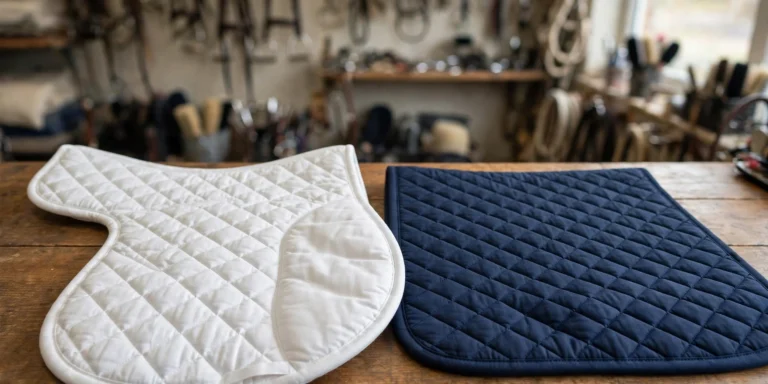
Where the distinction does carry weight is in the cut. UK retail descriptions commonly present numnahs as slightly smaller and more fitted than standard square saddle pads — shaped to the saddle, less fabric outside the flap line — which makes them the default choice for close-contact work where a clean outline matters. This is a retailer’s usage convention, not a regulated definition: one brand’s numnah and another’s shaped pad can be the same cut. The exporter’s job is not to arbitrate the definition but to carry both terms on the listing.
Is a saddlecloth the same thing as a numnah?
Direct answer: Not quite — in UK usage a saddlecloth is usually the rectangular pad, while a numnah is the saddle-shaped one; numnah cloth is a colloquial term for the rectangular style. The practical rule: numnah = shaped to the saddle, saddlecloth = the big rectangle. Retailers keep them as separate categories, and exporters should mirror that separation per market.
The three-term set causes more buyer confusion than any other naming point in English tack, so the export brief should pin it down once and never revisit it. The definitions below are usage conventions observed in UK retail and rider vocabulary — they describe how the terms are used in the market, not a standard anyone enforces:
| Term | Usual meaning in UK trade vocabulary | What to watch for — and the conditions |
|---|---|---|
| Numnah | The saddle-shaped pad: cut to follow the saddle’s outline, minimal fabric outside the flap line | Watch for: buyers using it as a generic synonym for any saddle pad. Under Mad Barn’s UK note, numnah and saddle pad are used interchangeably by many riders — so a category called only Numnahs can hide from US-trained searchers too |
| Saddlecloth / saddle cloth | The rectangular or square pad — the big rectangle in rider shorthand | Watch for: US listings sometimes use saddle cloth for any pad regardless of cut. Where the cut matters (dressage vs AP programs), specify the cut in the title, not just the term |
| Numnah cloth | Colloquial UK term, usually the rectangular style sold under the numnah naming family | Watch for: the least standardized of the three — some brands use it for shaped pads. Treat it as a search synonym in titles, not as a spec term in tech packs |
| Half pad | The shorter correction or cushion layer worn under or over the main pad — distinct from all three above | Watch for: never merge into the numnah/pad naming. Half pads are a separate wholesale category with their own specs (see our half pads vs full saddle pads guide) |
The operational rule: three search terms can coexist on one product page, but only one name goes on the spec sheet. The factory’s tech pack should carry the master internal name and the cut (shaped vs rectangular, dressage vs AP), and the per-market title list should carry the numnah/saddlecloth/saddle-pad wording — each serving a different system.
Which other tack names change between markets?
Direct answer: Several core terms shift between the UK and the US: rug vs blanket (the turnout/stable covering), headcollar vs halter (the headpiece for leading), girth vs cinch (the strap securing the saddle), jodhpurs vs breeches (riding trousers). Each pair names the same product family — the exporter’s job is to know which word each market searches, lists, and prints.
The naming table below is a working reference for export programs. Terms are given as market conventions observed in retail and rulebook vocabulary, not as legal definitions; where a term carries a product-spec meaning (girth vs cinch traditions), the product differs too and the naming cannot be swapped freely.
| UK term | US term | Same product — and the conditions | Export handling |
|---|---|---|---|
| Rug | Blanket | Same family — Horse & Hound defines the rug as a blanket intended for keeping a horse warm or otherwise protected from wind and the elements. Usage condition: UK catalogs run turnout rug / stable rug / fly rug; US catalogs run turnout blanket / stable blanket. The product is identical; only the word changes | Swap the word per market on listings, tags, and category pages. Keep one internal SKU name |
| Headcollar | Halter | Same product — the headpiece used for leading and tying. Both markets understand both words, but each defaults to its own in search | Carry both terms in titles and search metadata for the destination market’s default first |
| Girth (English) | Cinch (western) | Different products, different traditions — a girth secures an English saddle, a cinch secures a western saddle. The naming difference here reflects a real product difference, detailed in our horse girth and cinch buying guides) | Do not swap freely: confirm the discipline before translating. A girth listing sent to a western account is a category error, not a vocabulary one |
| Jodhpurs | Breeches | Same family of riding trousers with regional cut differences by discipline more than by market | Both terms in titles; market default first |
| Fly veil | Ear bonnet | Same accessory — the crocheted or technical ear covering | Both terms in titles; market default first |
One caution from the labeling side: market naming discipline stops at the claim level. A hang tag can carry both market names (Numnah / Saddle Pad), but fiber content, care symbols, and country of origin follow the destination market’s labeling rules regardless of which name sits on top — see our hang tags and care labels compliance guide for the FTC and EU mechanics.
Why does naming matter so much for an exporter’s listings?
Direct answer: Because buyers search in their own vocabulary: a UK buyer types numnah, a US buyer types saddle pad. A listing using only one term is invisible to the other market’s searchers, and search relevance rewards the exact term in the title. Per-market naming is the cheapest visibility lever an exporter has — a title rewrite, not a product change.
The mechanism is the v2 SEO alignment rule from our own program: title audience and body audience must match, and the page should open by answering the general selection question. Applied to export naming, that means the title carries the destination market’s word first. A UK-facing title leads with Numnah; the US-facing version of the same product leads with Saddle Pad. The body copy can then carry both terms naturally — which is also how the page captures the long tail of riders who use the terms interchangeably.
Three places where the naming discipline pays, in order of effort:
- Product titles: the highest-leverage slot. Lead with the market’s default term; the alternate term belongs in the subtitle, description, or search-keyword field, not crammed into the title.
- Category pages: a UK-facing category should be called Numnahs with saddle pads in the intro copy and filters — matching how British retailers (and their shoppers) navigate. US-facing categories do the reverse.
- Paid search and marketplace keywords: bid and tag both terms, but write the ad and the landing title in the market’s default — relevance scores and click behavior follow the familiar word.
The failure mode to avoid is the split listing: two separate listings for the numnah version and the saddle pad version of the same SKU. That duplicates inventory, splits reviews and sales history, and doubles the maintenance — one product page with both terms, localized per storefront, is the exporter-correct structure.
How should naming appear on labels, tags, and tech packs?
Direct answer: Market names go on consumer-facing surfaces — titles, listings, hang tags — while the tech pack and the factory carry one master internal name plus the cut. A tag may print both names (Dressage Numnah / Dressage Saddle Pad), but the spec sheet should say shaped dressage pad, spine in cm — names describe the market; dimensions describe the product.
The discipline breaks into three layers:
- Tech pack layer — one master name: the SKU code plus a plain descriptive name in the factory’s working language (e.g. DR-PAD-01, shaped dressage pad). The tech pack’s naming block should list the per-market commercial names as reference data only, so a pattern change on the master name propagates everywhere while the market names stay untouched. See our tech sheet guide for how spec names belong in the specification block.
- Hang tag layer — market names, both where space allows: Numnah / Saddle Pad dual naming on the front, with fiber content, care, and origin per the destination market’s rules on the reverse. Dual naming protects the product when a UK-bought pad is resold or gifted into a US context and vice versa.
- Listing layer — market default first: the destination market’s term leads the title; the alternate term appears in the description and search terms. Never let the listing layer’s wording flow backward into the tech pack.
What naming discipline should the RFQ brief carry?
Direct answer: The brief should name the destination markets, list the commercial name each market gets per SKU, and specify which name goes on the hang tag — confirmed in writing before sampling. Five checklist items cover it: market list, per-SKU market names, tag artwork per market, listing-title wording per market, and the internal master-name register.
- Destination markets for the program (UK, US, EU — and whether Australia follows UK or US naming for your line).
- Per-SKU commercial names per market: which cuts sell as numnah, which as saddle pad, which as saddlecloth — confirmed against the retail categories you will list in.
- Hang-tag artwork per market: dual-name front vs single-name front, and the regulatory reverse block per destination (fiber, care, origin).
- Listing-title wording per market: market default first, alternate term in description/search fields — brief the copy, not just the product.
- The internal master-name register: one name per SKU that never changes with market, mapped to every commercial name — so a reorder six months later does not resurrect the wrong word.
- MOQ confirmation: 50 pieces per color on the pad program — naming variants do not split or change the MOQ.
Frequently asked questions
Should I list the same pad as both a numnah and a saddle pad?
On one listing, yes — with both terms present. As two separate listings, no. One product page carrying the market’s default term in the title and the alternate in the description captures both search vocabularies without splitting inventory, reviews, or sales history.
Is numnah used outside the UK?
The term is standard in UK retail and rider vocabulary and is also used in other English-speaking markets with British equestrian influence. In the US market, saddle pad is the default retail term. When in doubt, brief the commercial name per destination market rather than per language.
Does calling it a numnah change what I should specify to the factory?
No. The factory needs the cut (shaped vs rectangular), the discipline pattern (dressage, AP, jump), the dimensions, and the materials — not the market word. Numnah tells the shopper which shelf; the spec tells the factory which pattern. Keep the two systems separate.
What about rug vs blanket on labels?
Same discipline: the destination market’s word on the consumer-facing surface, one internal name behind it. A UK hang tag says rug; the US version of the same tag says blanket. The fiber-content and care information follows each market’s labeling rules regardless of the name on top.
Can the wrong name actually cost sales?
It costs discoverability, which costs sales. Search relevance — on marketplaces and search engines — rewards the exact term the buyer types. A UK buyer searching dressage numnah will not reliably find a listing titled only dressage saddle pad, however good the product. The fix is a title rewrite, not a product change.
Exporting pads into the UK, the US, or both and want the naming right from the first sample? Send us your target markets and pad cuts, and we will propose the per-market commercial names, the hang-tag wording per destination, and the internal master-name register — with free samples and a per-market title list for your listings. MOQ 50 pieces per color.
Sources & Further Reading
- Mad Barn — Complete Guide to English Saddle Pads: the numnah as a specific saddle-pad type following the saddle’s outline; UK riders using numnah and saddle pad interchangeably (verified live 2026-10-04).
- Horse & Hound — equestrian terms glossary: Numnah — a saddle pad used beneath the saddle; Rug — a blanket intended for keeping a horse warm (verified live 2026-10-04).
- Discount Equestrian — Horse Numnahs category: UK retailer listing numnahs, also known as saddle pads, described as slightly smaller and more fitted than standard square pads (retail category page, verified via search 2026-10-04).
- Jumping Saddle Pads: A Wholesale Buyer’s Guide — the UK numnah naming note in a buying context.
- Horse Blankets and Turnout Rugs: A Distributor’s Guide — the rug product family behind the rug-vs-blanket naming.
- Hang Tags and Care Labels: What US and EU Retailers Require — the labeling rules that sit under the market name.
- Saddle Pad Tech Sheet: Stitch Density, Foam Density and Tolerances — where spec names (not market names) belong.
