Stable Kit Bundles: Pad + Girth Cover + Boots Programs
Published · Cornovo Saddlery
Consider a common scenario: a distributor launches a stable kit — a quilted pad, a girth cover, and brushing boots packed as one wholesale program unit in a single colorway story. The pads sell. The boots lag, because the size mix was guessed and never corrected. The girth covers arrive in a navy that doesn’t match the pad’s navy — cover fleece and pad twill were dyed at different houses, and nobody wrote the color relationship down. The kit becomes three separate problems in one box. The lesson: bundling is not the strategy. Bundle design is the strategy.
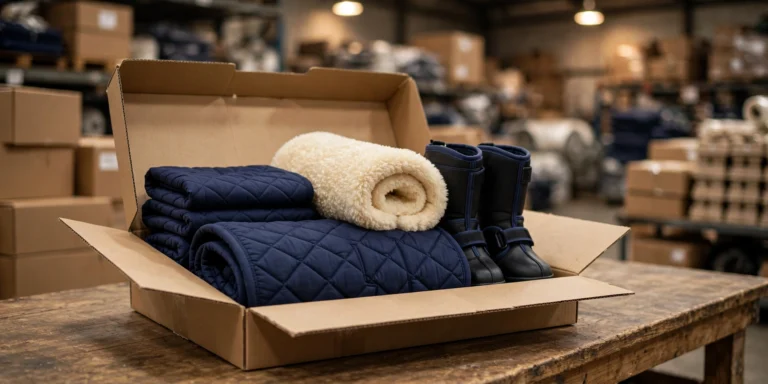
The short answer: A stable kit bundle is a wholesale program unit combining the three pieces of tacking up — saddle pad, girth cover, leg protection — in one colorway, one size story, one SKU. It works when components share a per-material color master, size ratios reflect the account’s rider mix, and the kit sells as one tacking-up solution, not three discounted singles.
This guide is the distributor-program companion to our saddle pad gift bundles guide (boundary: that guide covers retail value packs a tack shop sells to riders — consumer-facing and seasonal; this one covers the B2B kit program a distributor or brand builds — synchronized sampling, kit packing, program SKUs) and our matching saddle pad sets guide (boundary: that guide covers building the OEM colorway collection; this one covers assembling the bundled buying unit — composition, sizing, packing, and the kit’s commercial mechanics).
Key takeaways
- A stable kit = pad + girth cover + leg protection (boots or wraps), sold as one coordinated wholesale program unit — the three pieces of one tacking-up job.
- Build the kit around one customer problem (tacking up in matching kit), not around category or discount — problem-based bundles outperform component-list bundles.
- Color coordination across pad fabric, cover fleece, and boot shells is the hard part: different materials take dye differently, so each component needs its own lab dip against one master, approved at set level.
- Compatibility is a return-rate lever: pad size, girth length, and boot size must fit the same horse-and-rider profile, or the kit generates exchanges, not loyalty.
- MOQ 50 pieces per color on the pad program; confirm the MOQ-counting rule for the kit’s other components (per colorway across all sizes, or per colorway per size) before quoting.
What goes into a stable kit — and what should stay out?
Direct answer: The core kit: a quilted saddle pad (anchor and color story), a girth cover or sleeve (comfort add-on), and leg protection — brushing boots or polo wraps. Conditional: a fly veil for set programs, a saddle cover for storage. Keep out rugs and blankets (separate size program and carton logic) and anything fitted per horse, like bits.
| Component slot | What typically fills it | Why it fits — and the conditions | Watch-outs — and when they show up |
|---|---|---|---|
| Anchor (the color story) | Quilted saddle pad — dressage, AP, or western cut per program | The pad carries the colorway and the branding; the kit’s identity follows it. Works when the pad cut matches the account’s discipline mix | A fashion colorway still needs the pad to sell on its own — the kit multiplies exposure of a colorway buyers already reach for; it doesn’t rescue one they don’t |
| Comfort add-on | Sheepskin or fleece girth cover / sleeve | Shares the pad’s material language and the same pressure-point story; the natural second piece in the tacking-up sequence | Cover sizing must follow the girth-length range the account actually sells — a cover range sized for dressage girths fails in a western-leaning account |
| Leg protection | Brushing boots, tendon boots, or polo wraps | The most frequently replaced piece — the kit’s repeat-attachment engine — and it carries the colorway onto the legs | The highest size-risk component: boots and wraps multiply SKUs by size, and a guessed size mix is the classic kit failure |
| Conditional add-on | Fly veil / ear bonnet in the kit colorway | Extends the color story onto the horse’s head; tiny freight weight, strong perceived value in set-driven programs | The set program’s highest color-risk item per dollar — crochet yarn is a different material family from pad fabric (see our fly veils guide); include only with the color discipline below in place |
| Keep out | Rugs/blankets, bits, fitted tack | Rugs run their own length-based size program and carton geometry — adding one turns a one-box kit into a two-box logistics problem. Bits and fitted leather are per-horse decisions that don’t belong in a pre-packed unit. | |
The anchor-first rule is the one to brief the factory on: the pad’s colorway, cut, and branding lead; every other component is developed against the pad, not in parallel. Programs that develop the three pieces as separate briefs and kit them at packing are the ones that produce the mismatched navy from the opening scenario.
Why do stable kits work commercially?
Direct answer: Kits work for the same reasons bundling works anywhere: they raise average order value by attaching slower accessories to a proven anchor, move inventory without training buyers to wait for markdowns, and simplify a multi-piece decision into one purchase. The equestrian twist: the kit mirrors tacking up, so it sells a job done, not a discount given.
Bundling theory gives the kit three working models. ThinkNectar’s 2026 guide names them plainly: leader bundling pairs a high-demand product with a slower-selling item so the bestseller draws attention and the weaker product rides along — the pad leads, the girth cover and boots ride; mixed bundling lets customers buy components individually or as the kit, preserving single-SKU listings while nudging toward the set; and the design principle that matters most — build the bundle around a specific customer problem, not around category or price, because products grouped by a shared use case outperform products grouped by price. (ThinkNectar — What Is Product Bundling Strategy? A 2026 Guide) The kit’s problem is tack up the horse in coordinated kit — one box, one color story.
The same guide’s discount guidance maps directly onto kit pricing: a low-double-digit discount on the combined individual prices is typically the sweet spot, with deeper cuts reserved for accelerating clearance of a specific SKU. The kit discount should feel like a meaningful saving without training the account to expect component prices at kit prices forever — handle a slow component by adjusting the mix, not by deepening the whole kit’s discount.
Zoovu’s compatibility-based bundling adds the wholesale-critical layer: bundles of functionally compatible products reduce friction and returns, because the worst bundle outcome isn’t a lost sale but a return that erodes trust. (Zoovu — 5 Winning Product Bundling Strategies for 2026) In a stable kit, compatibility is literal: the pad cut must suit the same saddle the girth length fits, and the boot size must suit the same horse the pad is cut for. A dressage-cut pad kitted with a short-girth cover range and cob boots is three incompatible products in one box.
The kit earns its discount only when it drives incremental attachment — riders buying the cover and boots who wouldn’t have bought them separately. A kit that merely re-prices three things the account was buying anyway is a margin gift, not a program; the tacking-up framing is what changes the buying behavior.
How do you color-match three different materials?
Direct answer: You develop each component against a color master and approve the set together. Pad twill, cover fleece, and boot shell take dye differently — none will be the same navy unless deliberately brought to the same target. The discipline: one master swatch, one lab dip per material against it, set-level approval with all components present, and the written dip record.
The physical reason is stated well in a competitor’s manufacturing guide: different materials — yarn, woven fabric, embroidery thread, rope, webbing — reflect and absorb color differently, so physical color approval remains necessary even when every component references the same Pantone. (Petmomo — How to Evaluate an Equestrian Textile Manufacturer) The factory brief must therefore name the color relationship per component — cover fleece dipped to match pad master, boot shell trim matched to pad binding — not just the colorway name.
Approve the pad master first, develop each component’s dip against it, then approve the set — all components together under controlled lighting — never a component alone. A girth cover approved alone against a Pantone chip can pass its own inspection and still clash with the pad it ships beside. Record which dye house dyed what, which dip number was approved, and the light-source standard — the reorder six months later is where undocumented color relationships go to die. Keep the full drift-prevention discipline in the program file from day one.
One practical simplification: where the program allows it, carry the colorway on the trims rather than the base materials. Matching binding tapes, piping cords, and boot trim is a narrower, more controllable color problem than matching three different base fabrics — the bases can stay in commercial neutrals while the colorway lives where the eye reads it.
How do you size and pack the kit?
Direct answer: Size from the account’s rider mix: pad cut follows the discipline split, girth-cover range follows the girth lengths sold, boot sizes follow the horse sizes. Set ratios as a starting hypothesis; correct at the first reorder. Pack as one program SKU — one barcode, one carton, one insert card — so the warehouse handles a kit, not three loose products.
No universal size ratio exists — a general tack shop, a dressage-focused dealer, and a riding school buy different horses’ worth of sizes. Brief the factory with the account profile and a starting-hypothesis ratio per component, explicitly labeled as a starting assumption to adjust against sell-through. And confirm the MOQ-counting rule up front: per colorway across all kit sizes, or per colorway per size — a multi-size kit multiplies minimums fast, and that rule decides whether a three-colorway kit is feasible.
Packing should be specified like a product, not left to the packer’s judgment: one program SKU and barcode (component SKUs retained underneath for the account’s receiving system — confirm each retailer’s barcode requirement); one carton configuration (kits per carton, dimensions, weight — a pad-plus-boots carton cubes very differently from a pads-only carton); one insert card (care basics, the size story, the reorder contact — and the colorway name, so the rider can reorder the matching pieces); and a packing method that protects pad loft, since boots and covers compress differently from quilted pads.
What does the program look like for different accounts?
Direct answer: The kit’s shape follows the account: the general tack shop takes the three-piece kit in its discipline split; the riding school takes a simplified, durability-first kit (pad + wraps, neutrals only); the online retailer takes the kit as one listing with the component singles beside it. One architecture, three assortments — each assortment’s ratios a starting hypothesis, not a rule.
| Account type | Kit shape that typically fits | Starting-hypothesis notes — adjust by sell-through |
|---|---|---|
| General tack shop / distributor | Full three-piece kit in the shop’s discipline split, two to three colorways | The classic kit buyer: breadth across disciplines, seasonal colorway turnover. Start narrow on colorways (proven sellers), deepen on reorder. Mixed-bundling logic — keep component singles live so the kit is a nudge, not a forced set |
| Riding school / lesson barn | Simplified kit: pad + polo wraps, covers optional; neutral colorways only | Durability and washability outrank color story; wraps over boots (simpler sizing, easier replacement). The kit’s value here is the one-box reorder — price it as a fleet unit |
| Online retailer / brand | Kit as a single listing with set photography, component singles listed beside it | The listing does the selling: one hero image of the full kit, then component detail. Leader-bundling mechanics work hardest here — the pad listing carries the traffic, the kit captures the basket |
The first kit order is a hypothesis; the program becomes profitable when the second order corrects the size ratios, colorway depth, and component mix. Build that correction in — a post-season review of which components reordered fastest — rather than treating the launch assortment as permanent.
What should you confirm when requesting a quote for a stable kit program?
Direct answer: Confirm the kit as a program, not three product quotes stapled together: the MOQ-counting rule across components and sizes, one synchronized sampling calendar with set-level approval, per-component color development against one master, the kit packing specification, and reorder mechanics. A factory that quotes three products well but cannot coordinate them is not a kit factory.
- MOQ counting rule: does 50 pieces per color apply per colorway across all kit sizes, or per colorway per size — and what are the minimums for the girth covers and boots/wraps, whose counting rules may differ from the pad program’s?
- Synchronized sampling: one calendar with a set-level approval milestone — pad master first, component dips against it, full-kit approval together. Confirm the sample fee structure for the kit vs per component.
- Color development: lab dips per component material against one physical master; which dye houses handle which components; the set-level approval light source and the dip-record format for reorders.
- Size program: the factory’s measured charts per component; the recommended starting size ratios for your account profile — the factory’s starting hypothesis, confirmed against your sell-through at reorder.
- Kit packing: single-SKU carton configuration (kits per carton, dimensions, weight), barcode scheme (program SKU plus component SKUs), insert-card production, and the compression method that protects pad loft.
- Compatibility check: the factory’s confirmation that pad cut, girth-cover length range, and boot sizes suit the same horse-and-rider profile — the Zoovu compatibility rule, applied before sampling.
- Reorder mechanics: component-level top-ups vs full-kit reorders, and the lead-time difference between the two.
- Certification: if any component carries a certified material, confirm the certificate scope covers the kit article — see our wool certifications guide.
Frequently asked questions
Is a stable kit the same as a gift bundle?
No — different jobs. A gift bundle is a retail sell-through unit: a tack shop gift-boxes slow or seasonal pieces for riders. A stable kit is a B2B program unit built with synchronized sampling, kit-level packing, and program SKUs. The gift bundle in our gift bundles guide clears inventory at retail; the stable kit builds a repeatable wholesale program.
Should the kit include a horse rug or blanket?
Usually not. Rugs run a separate, length-based size program with different carton geometry — adding one turns a one-box kit into a two-box logistics problem. Keep the kit to the tacking-up trio and run rugs as their own program.
How many kits should I start with?
Start with the account’s proven colorways, not its aspirational ones — two to three colorways is a common starting shape for a distributor, fewer for a school fleet program. The launch assortment is a hypothesis; the second order, corrected against sell-through by component and size, is where the program’s real shape emerges.
Can I build a kit from components made at different factories?
Conditionally — but the color coordination and the synchronized calendar become your job instead of the factory’s. A manufacturer that coordinates sewing, dyeing, and finishing under one project process reduces the communication transfers when a colorway changes across components (the Petmomo coordination argument, linked above). If you split factories, budget the extra sampling rounds and color-approval overhead explicitly.
Does the kit need one barcode or three?
Both: one program SKU and barcode for the kit as the selling and shipping unit, with the component SKUs retained underneath for inventory and receiving. Confirm each retail account’s requirement — some chains need the component barcodes scannable on the kit packaging too — and specify the scheme in the packing spec, not as an afterthought.
Building a stable kit program — pad, girth cover, and boots in one coordinated, packable unit? Send us your target disciplines, colorways, and account profile, and we will propose the kit composition, the per-component color development plan, and the packing specification — with a synchronized sampling calendar and free set-level approval samples. MOQ 50 pieces per color on the pad program.
Sources & Further Reading
- ThinkNectar — What Is Product Bundling Strategy? A 2026 Guide: the three bundling models (pure, mixed, leader), the low-double-digit discount sweet spot, and building bundles around a customer problem rather than a category.
- Zoovu — 5 Winning Product Bundling Strategies for 2026: compatibility-based bundling (functionally compatible components reduce returns) and the product-relations discipline behind scalable bundles.
- Petmomo — How to Evaluate an Equestrian Textile Manufacturer: why different materials reflect and absorb color differently (the physical basis of the kit’s color discipline) and the value of coordinated dyeing, sewing, and finishing resources.
- Saddle Pad Gift Bundles & Value Packs for Tack Shops — the retail-bundle boundary (consumer value packs vs B2B kit programs).
- Matching Saddle Pad Sets: Building a Wholesale Collection — the OEM collection program the kit is assembled from.
- Horse Boots & Leg Protection: A Buyer’s Guide — the leg-protection component spec companion.
