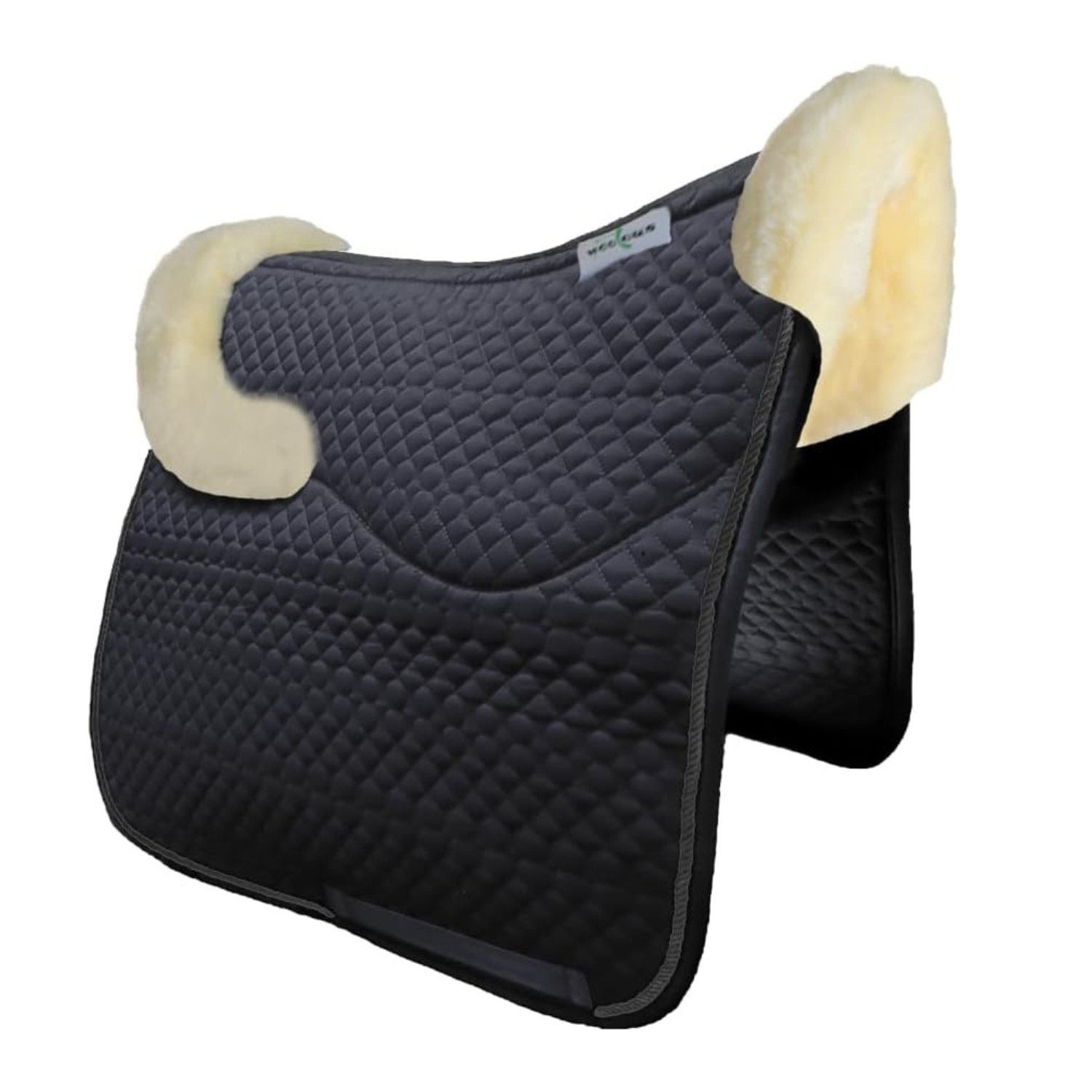
Consider a common scenario: a distributor\’s saddle pad line sells steadily, and customer emails start arriving — \do you have matching boots?\ \can we bundle leg protection with the pads?\ Every request goes unanswered, and a competitor launches exactly that: a pad-and-boot colorway program that wins shelf space the distributor never contested. The pads had not lost. The assortment had simply stopped where the customer\’s shopping list continued.
Horse boots and leg protection are the natural adjacent line for any distributor already selling saddle pads: same riders, same disciplines, same colorway logic, and a purchase cycle driven by wear-and-tear replacement. The core wholesale range covers four types — brushing, tendon, fetlock, and bell boots — and the buying discipline centers on closures, sizing conventions, and the pairs-versus-sets packing unit.
Key takeaways
- Open the range with the four core types — brushing, tendon, fetlock, and bell (overreach) boots — then add jumping-specific and premium styles once the core moves.
- Closure quality (hook-and-loop strength, strap layout, anchor stitching) drives more field failures and returns than shell or lining choices.
- Horse boots are sold in pairs (front or hind) or sets of four — confirm the packing unit in every quote, because per-pair and per-set prices cannot be compared directly.
- Sizing runs by discipline convention (small/medium/large), not by measurement — map the factory\’s sizes against real leg circumferences in centimeters before committing.
- Coordinated pad-and-boot colorways are one of the strongest upsell mechanics in this category — plan colors across both lines at the design stage.
What are the main types of horse boots, and which should distributors stock first?
Horse boots are impact protection for the horse\’s lower legs — guarding against brushing injuries (one leg striking the other), tendon knocks, and overreach, where a hind hoof catches the front heel. Unlike saddle pads, which center on comfort and fit under the saddle, boots are judged on coverage area, strike resistance, and staying in place at work. These are the four types that form a wholesale core range:
| Boot type | Protects | Typical use | Stocking guidance |
|---|---|---|---|
| Brushing boots | Cannon bone and fetlock, all four legs | Everyday schooling, hacking, turnout | The volume driver for most accounts — most riders need them, so they lead most opening assortments |
| Tendon boots (front) / fetlock boots (hind) | Tendons (front), fetlocks (hind) | Jumping and fast work | Essential for jumping-oriented accounts; open-fronted designs are the jumping convention and buyers expect strike guards |
| Bell / overreach boots | Coronet band and heel bulbs | Horses that overreach; turnout; competition | Strong repeat business — pull-on rubber versions wear through at the heel and replace on a wear cycle |
| Sports medicine boots | Full lower leg with support wrap | Rehabilitation, high-performance training | Premium tier for specialist accounts; buyers scrutinize support claims, so keep claims on the packaging verifiable |
For most wholesale assortments, brushing boots and bell boots form the opening pair — they serve every discipline and replace on a wear cycle. Add tendon and fetlock boots for jumping-oriented accounts, and treat sports medicine boots as a premium extension once the core range is established. Plan the opening mix the same way you plan a pad assortment — see saddle pad inventory planning for the colorway and reorder discipline that applies to boots as well.
How should distributors plan a boot assortment?
There is no fixed stocking ratio for boots — it follows the account type. These are starting hypotheses from our supplier experience; adjust them by your customers\’ sell-through:
- General tack shops: brushing boots lead the range in black and brown across sizes, bell boots second, one tendon/fetlock style for the jumping customers. Open narrow, deepen the sizes that reorder first.
- Jumping-oriented accounts: tendon and fetlock boots take a larger share, with strike-guard construction as the specification to win on — these buyers know boots and compare shell specs.
- Schools and riding centers: volume brushing boots in easy-care construction and easy-to-fit sizes; these buyers replace on wear and price, not fashion.
Do not spread thinly across every style at launch. Four types, the account\’s discipline mix, and the sizes confirmed against the factory\’s centimeter chart will outsell a twelve-style catalog that confuses the buyer. And hold the colorway discipline: one or two boot colors that match your pad colorways are easier to sell through than a rainbow of mismatched boots.
What materials separate a good boot from a weak one?
Boot construction is a sandwich: an outer shell for strike protection, a lining for comfort and shock absorption, and a closure system. Each layer has a mainstream choice and a budget alternative, so ask for the material specification of each layer — two quotes for \brushing boots\ can describe products with entirely different shells, linings, and strap systems:
- Outer shell. TPU (thermoplastic polyurethane) or hard strike-guard inserts are commonly specified for mid-market jumping boots — they deflect knocks without adding much weight. Budget boots use plain neoprene or thin synthetic shells with no hard protection; they look similar in photos and behave differently on the leg.
- Lining. Perforated neoprene is the common choice: it cushions, conforms to the leg, and resists slipping. Check neoprene thickness consistency — thin spots compress flat quickly and the boot starts rotating.
- Strike guards. Extra-thick or hard-plastic panels over the tendon area on jumping boots. Confirm the attachment method: guards that are glued rather than stitched or riveted are the first thing to delaminate, in our experience.
- Closures. Hook-and-loop straps are the standard. Strap count and layout matter more than buyers expect — three well-placed straps hold better than five poorly placed ones, and hook-and-loop quality (hook density and adhesive backing) is the single biggest durability variable in the boot. In our supplier experience, closure failures drive more returns than any other feature.
Do not accept \neoprene boots\ as a specification. Name the shell material and thickness, the lining type and thickness, the strike-guard construction and attachment, and the strap count, layout, and closure type — on the purchase order, not just in the sample description. The spec sheet is where the difference between two factory quotes becomes visible before the container does.
How does horse boot sizing work?
Horse boot sizing follows discipline convention — small, medium, large, sometimes with cob and full variants — rather than direct leg measurements. The trap for new buyers is assuming one factory\’s \medium\ equals another\’s. Always map the factory\’s sizes against actual leg circumferences in centimeters:
| Size label | Typical fit | Buyer notes |
|---|---|---|
| Small | Ponies, small Arabs, fine-boned horses | Lowest volume for most accounts — confirm demand per market before depth |
| Medium | Average 15–16 hh riding horses | The mainstream size for most accounts; verify against the factory\’s centimeter chart |
| Large / Full | 16.2 hh and up, warmbloods, draft crosses | Essential for jumping and dressage markets where horses run larger |
Request the factory\’s size chart with centimeter measurements — boot height and the leg-circumference range each size fits — and check it against a physical sample on a real leg or a measured form. Boots that run small generate the classic complaint (\medium doesn\’t fit my medium horse\), and the fix is a size chart verified before bulk, not a returns policy after. Write the agreed size chart into the purchase order so repeat orders hold to it.
Pairs, sets, or singles: what is the packing unit?
This is the most expensive misunderstanding in boot importing. Horse boots are sold as pairs (two boots, front or hind), sets of four, or occasionally singles — and factory quotes do not always state which. A quote that looks substantially cheaper than a competitor\’s may simply be priced per pair against a per-set quote. Never compare quotes without normalizing the packing unit.
Common conventions: brushing boots and tendon/fetlock boots are typically quoted per pair; bell boots per pair; full \four-leg\ sets are usually a retail packaging choice. Whatever the convention, put the packing unit in writing on the purchase order — \price per pair, front brushing boots, packed 20 pairs per carton\ — and verify the first production run matches it. Distributors repackage for their own retail customers, so the factory\’s inner packing (pairs bagged together, left and right marked) directly affects the distributor\’s handling cost.
What should buyers inspect before shipment?
Boot defects concentrate in closures and attachment points. Build these checks into the inspection plan — the same pre-shipment discipline as the saddle pad QC checklist, applied to boots:
- Hook-and-loop strength and alignment. Fasten and pull every strap on sampled boots. Weak hooks, misaligned straps, or straps that barely reach are the number-one field failure.
- Strike-guard attachment. Flex and pull-test glued or stitched guards. Delamination in the first month is a full-line returns event.
- Stitching at stress points. Check strap anchor points and edge binding — the two places stitching carries load. Skipped stitches here fail in work, not in the warehouse.
- Neoprene consistency. Compress the lining across the boot; thin or uneven spots indicate poor lamination and predict pressure points.
- Left/right marking and symmetry. Anatomically shaped boots are sided — verify pairs contain a true left and right, correctly marked.
- Odor and finish. Strong chemical odor from adhesives or low-grade neoprene fades slowly and shows up in unboxing reviews; check a sealed-bag sample after a couple of days.
How do boots pair with a saddle pad line?
The commercial logic is straightforward: the same rider buys both, often in the same shopping trip, and color coordination across pad and boots is one of the strongest upsell mechanics in equestrian retail in our supplier experience. Distributors that plan colorways across both lines — the same navy, the same burgundy, the same piping — sell sets where single-line distributors sell items.
Practical bundling moves: offer pad-and-boot sets in matching colorways at a small bundle discount; align the boot launch calendar with the pad colorway refresh so retailers can merchandise them together; and run the same custom piping and embroidery program across both lines so the branding investment does double duty. The factory economics help too — one colorway program across two product lines reaches trim dye-lot minimums faster and reduces per-unit trim costs. Adjacent leg-protection lines follow the same logic — see polo wraps and standing bandages for the wrap side of the assortment.
What specs should I confirm when requesting a quote?
When requesting a quote on horse boots, confirm: the boot type and intended discipline, the shell material and thickness, lining type and thickness, strike-guard construction and attachment method, strap count, layout, and closure type, the packing unit (pair, set of four, or single) and inner packing format, the factory size chart in centimeters with the leg-circumference range per size, the colorway program and trim dye-lot controls, the inspection plan for closures and attachments, and the MOQ per boot type and colorway — our standard saddle pad program runs at 50 pieces per color; confirm boot MOQ per quote. Pricing and delivery terms are confirmed per quote.
Frequently asked questions
Which horse boots sell in the highest volume?
In our supplier experience, brushing boots for everyday schooling and bell boots for overreach protection move fastest across most accounts — they serve every discipline and replace on a wear cycle. Tendon and fetlock boots follow for jumping-oriented markets; sports medicine boots are a premium niche. Stock to your account mix, not to a fixed ratio.
Are horse boots sold in pairs or sets of four?
Both, and the quote must say which. Brushing, tendon, and bell boots are commonly quoted per pair (front or hind); sets of four are usually a retail packaging decision. Always confirm the packing unit in writing — per-pair versus per-set pricing is the classic quote-comparison trap.
What is the most important quality check on horse boots?
Closure function. Hook-and-loop strap strength, strap placement, and strap anchor stitching drive more field failures and returns than shell or lining issues in our experience. Pull-test every strap on inspection samples and check anchor stitching at load-bearing points.
How should boot sizing be verified before a bulk order?
Get the factory\’s size chart in centimeters — boot height and the leg-circumference range per size — and verify it against a physical sample on a real leg or a measured form. Do not assume one factory\’s \medium\ matches another\’s; map sizes to measurements in the purchase order.
Can boots be made in the same colors as our saddle pads?
Yes — and they should be. Coordinated pad-and-boot colorways are among the strongest upsell mechanics in this category. Plan colors across both lines at the design stage so trim dye lots and embroidery programs serve both products.
Sources & Further Reading
- Saddle pad custom branding: embroidery, piping and logo options (internal): run the same embroidery and piping program across pads and boots.
- Saddle pad inventory planning (internal): colorway and reorder discipline that applies to boot assortments too.
- Pre-shipment saddle pad QC checklist (internal): the inspection discipline to apply to boot shipments.
- Polo wraps and standing bandages (internal): the wrap side of the leg-protection assortment.
Expanding your horse boots wholesale line? We manufacture brushing, tendon, fetlock, and bell boots in coordinated colorways with our saddle pad lines — confirm MOQ per boot type and colorway, with strike-guard and closure specs verified on pre-production samples. Send your target styles and quantities for a quotation.