
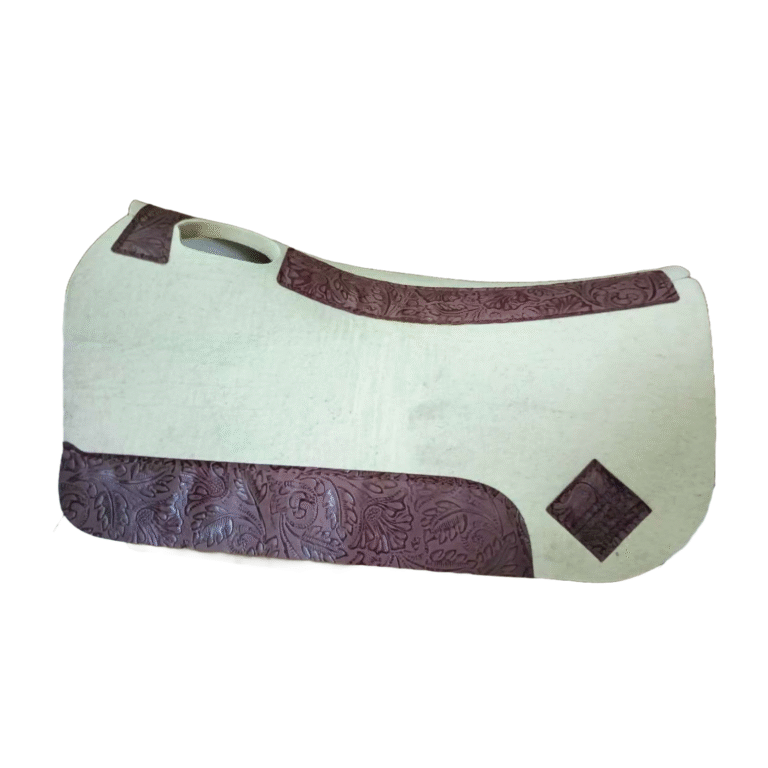
Leather-trim saddle pads pair a wool felt pad body with genuine leather wear patches, spine strips, binding, or corner reinforcement. For a tack shop or distributor, the trim is not decoration: it is the part of the pad that takes the most friction, so it is the first place to judge quality. Buy on four things — the leather itself, where the trim sits, how it is stitched on, and whether the pad body underneath is built for the work your customers do.
Key takeaways
- Leather trim should protect high-friction areas: wear patches under the stirrup bars, the spine strip, and the binding.
- Ask the supplier to confirm the trim is genuine leather, and check the edges and stitching on a sample before ordering.
- Trim placement differs between western pads and English-style pads, so stock the layout your customers actually ride in.
- Neat, even stitching and finished edges matter as much as the leather, because loose trim is the most common visible failure.
- Order colourways against the 50 pieces per color minimum, and start with paid samples to check the leather in hand.
What leather trim actually covers
The phrase leather trim covers several different features, and buyers should know which one they are looking at. On a western wool felt pad, the most common trim is a pair of wear patches where the stirrup leathers and fenders rub, plus a spine strip that protects the centre line and a bound edge that keeps the felt from fraying. On English-style pads, trim is more often a leather binding around the edge, leather corner patches, or a reinforced girth area. Each version serves the same purpose — putting a tougher material where friction and pressure concentrate — but they are not interchangeable, and a customer who rides western will not be satisfied with a pad trimmed for the wrong discipline. When you brief a supplier, name the trim pieces you want and ask where each piece sits.

How to judge the leather
Genuine leather behaves differently from lookalike materials, and a sample in hand will tell you more than a photograph. Flex the trim: genuine leather bends without creasing white along the fold and returns to shape, while coated substitutes tend to crack or hold a sharp crease. Look at the cut edge — real leather shows a fibrous edge that can be burnished smooth, rather than a layered or foamy cross-section. The British Horse Society advises buyers of second-hand tack to check for areas of wear and for cracked and worn leather, especially on girth straps, and the same habit serves a wholesale buyer well: inspect the trim the way a saddler would, looking for thin spots, dry patches, and stitch holes that sit too close to the edge. If the supplier cannot confirm in writing that the trim is genuine leather, treat that as information, not as a detail to skip over. The FEI tack and equipment requirements state that bridles must be made entirely of leather or leather-like material, a reminder that competition riders take leather seriously as a material standard.
Stitching and attachment: where trim fails first
Most leather-trim failures are stitching failures, not leather failures. A wear patch is only as good as the stitching that holds it to the felt, so examine the stitch line closely on every sample. Stitches should be even in length, set back from the edge of the leather far enough that they cannot tear through, and locked at the start and finish so a single broken thread does not unzip a whole edge. The binding deserves the same attention, since a binding that is stitched through only one layer of felt will roll and lift, while one that catches the full edge stays flat through washing and daily use. Our guide to saddle pad binding and edge finishing explains what to check along the edge of any pad, and the same checks apply here with extra weight, because the binding is the trim your customer sees first. Ask the supplier how the trim is attached and whether the thread is a heavyweight bonded type suited to tack.
Matching trim to discipline and use
Trim that suits a western ranch pad can look wrong on a dressage pad, and the buying decision should start from the rider, not the catalogue photo. Western pads take the hardest wear under the stirrup leathers and need broad wear patches and a strong spine strip; the leather there is working protection, and riders expect it to look substantial. English pads, including dressage pads, use trim more sparingly — a bound edge, neat corner patches, and a reinforced girth zone — because the pad sits under a closer-fitting saddle and bulky trim can create pressure points. Schooling pads can carry simpler trim, while show pads earn their keep on finish: even dye, clean edges, and stitching that is straight enough to pass a close look in the collecting ring. Keep the colourways disciplined: a brown trim on a black pad and a black trim on a white pad are the combinations most shops sell through first. The leather-trim saddle pads range groups these pads together, and the wool felt saddle pads range shows the pad bodies the trim is built on, so you can compare the felt and the trim side by side when you plan an order.

Ordering, sampling, and caring for the trim
Leather-trim pads are a premium line, so order them the way you would any premium line: samples first, colourways second, volume third. Samples are paid, and that is money well spent, because leather varies from batch to batch in colour, temper, and finish — what you approve on a sample is the standard the bulk order should meet. Our minimum is 50 pieces per color, so choose colourways you can sell through rather than spreading the order across many shades that each sit half-finished. For your retail customers, the care advice is simple and worth printing on a handout: keep leather trim clean and dry, wipe off sweat and dust after riding, condition the leather only with a product the maker recommends, and never soak a leather-trimmed pad the way you might soak a plain cotton pad. Damp storage is the enemy of both felt and leather, so pads should be stored flat or hung where air circulates, away from direct heat. For related reading, see our guide to stitch density and foam density specs and our sheepskin saddle pads wholesale hub for pads where the trim material is sheepskin rather than leather.
FAQ
Is leather trim only decorative?
No. On a well-made pad the trim protects the areas that wear first — under the stirrup leathers, along the spine, and around the edge.
How can I tell genuine leather trim from imitation?
Flex it, look at the cut edge, and check the grain. Genuine leather flexes without whitening along the crease and shows a fibrous edge; substitutes often look layered or foamy at the edge and feel plasticky. Ask the supplier to confirm the material in writing on the order.
Does leather trim change how a pad should be washed?
Yes, in practice. Leather trim should not be soaked or machine washed on a harsh cycle unless the maker says so. Advise customers to clean the felt as directed, wipe the trim clean, and dry the pad naturally away from direct heat.
What should I ask a supplier before ordering leather-trim pads?
Confirm the trim material, the trim pieces and their placement, the stitching and thread, the colourways available at the 50 pieces per color minimum, and the sample terms. Then check all of it against a physical sample before approving the bulk order.
RFQ checklist: trim pieces and placement (wear patches, spine strip, binding, corners); written confirmation the trim is genuine leather; stitching and thread specification; felt body and thickness; colourways at 50 pieces per color; paid sample approval before bulk production; care instructions for retail customers.
Sources
- FEI Tack and Equipment Requirements, effective 1 January 2026 — competition tack material rules, including that bridles must be made entirely of leather or leather-like material.
- British Horse Society — Tack affordability — advice on checking tack for wear and cracked leather, and on having a saddle correctly fitted.
