
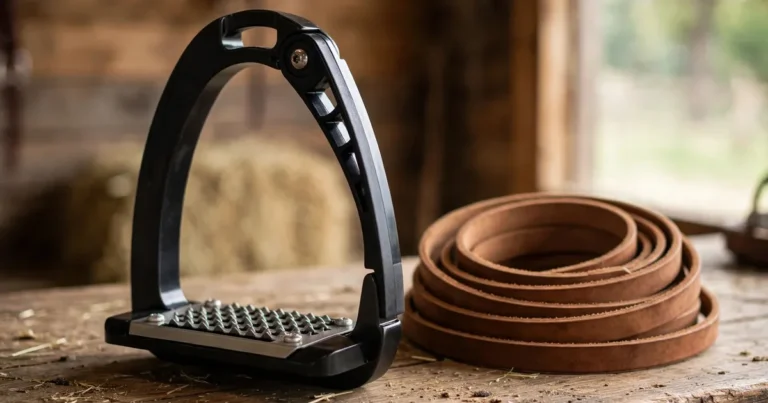
Consider a common scenario: a rider comes off and the foot stays in the iron — the horse moves, the rider doesn\’t, and a fall becomes a dragging accident. That is the failure a safety stirrup exists to prevent. Any stirrup that frees the rider\’s foot in an emergency qualifies, but the mechanisms differ: rubber bands that pop, outer arms that flex open, shaped irons that resist trapping the foot in the first place.
The short answer: a safety stirrup is any stirrup that frees the foot in an emergency — via a rubber-band outer side, a flexible or mechanical breakaway arm, a bent-leg shape, or a design that releases from the leather. No mechanism is universally best; they suit different riders, budgets, and disciplines. Size the iron about an inch wider than the ball of the foot. MOQ 50 pieces per color.
This guide covers the release mechanisms wholesale buyers will spec, tread and grip options, how stirrups are sized and fitted, the quality checkpoints that decide a good safety stirrup, how to stock the category by account type, and what to confirm when requesting a quote. It companions our stirrup leathers guide (the strap the stirrup hangs on), our horse boots guide (the leg-protection family), and our riding gloves guide (the rider-safety category).
Key takeaways
- \Safety stirrup\ describes an outcome — the foot gets free in a fall — not one mechanism. Stock the mechanism families, not a single design.
- Peacock rubber-band stirrups are the entry point but the bands are a wearing part; breakaway-arm and shaped-iron designs are the mainstream retail lines.
- Size the iron about an inch wider than the ball of the foot — too snug risks accidental release or entrapment; too wide lets the foot slide through.
- Show-ring acceptance varies by design and discipline — check the rulebook before promising a customer a mechanism is \show legal.\
- Safety stirrups are safety-critical tack: the release function, hinge points, and tread grip are the checkpoints that matter. MOQ 50 pieces per color.
What are the main safety stirrup mechanisms?
Direct answer: Four families: peacock (rubber-band outer side), breakaway/flexible outer arm, bent-leg or shaped irons, and stirrups that release from the leather itself. Horse & Hound\’s buyer\’s guide frames the market the same way: the most common designs are shaped irons and breakaway stirrups with mechanical or flexible arms. Peacock stirrups were the first option on the market and remain the entry point; the breakaway and shaped designs are where the category\’s growth sits.
| Mechanism | Typical strengths — and under what conditions | Watch-outs — and under what conditions |
|---|---|---|
| Peacock (rubber band) | The classic entry-level safety stirrup; the rider\’s weight pops the band off the outer side in a fall, freeing the foot | The bands are a wearing part — old or stretched bands can pop off while riding, not just in a fall, so they need periodic replacement |
| Breakaway / flexible arm | Outer arm opens under uneven pressure in a fall and typically resets for continued riding; the mainstream modern line across price tiers | Reset mechanisms need to work after triggering — and some designs release under normal riding loads if sized wrong, so fit matters |
| Bent leg / shaped iron | The curved outer branch makes foot entrapment less likely without any moving parts; usually the cheapest safety option and simple to maintain | Fixed design — less positive release than a true breakaway; a middle ground between a plain iron and a mechanical release |
| Releases from the leather | The whole stirrup disengages from the leather under abnormal twisting forces while holding firm under normal riding pressure | The newest family — fewer years of field history than the other designs; some riders take time to trust it |
Two mechanism notes from published guidance belong in the buying conversation. Horse Rookie notes that most breakaway designs release only at a certain degree of uneven bend — not during normal riding — and that bent-leg and peacock designs can make correct leg position harder to maintain (Horse Rookie — How Safety Stirrups Work). Horse & Hound adds the price logic: shaped irons usually cost much less than breakaway styles, making them the natural upsell path rather than the competitor (Horse & Hound — Safety Stirrups: What Are Your Options?).
What tread and grip options should you spec?
Direct answer: Tread choice is about wet-weather confidence and foot placement, not just looks: metal-stud or cheesegrater grips for maximum traction, inclined footbeds for heel depth and leg position, and shock-absorbing elastomer or polymer pads for joint comfort on long rides. Frame materials — stainless steel, aluminum, polymer composites — trade weight against stiffness and cost, and each suits a different price tier.
Read the options conditionally: metal-stud treads grip hardest in mud and wet arenas — exactly when riders want confidence — but they are the most aggressive on boot soles. Inclined footbeds help riders keep heels down, a real selling point for lesson programs. Shock-absorbing pads suit long hacks or joint concerns. A menu to match against the account\’s customer, not a ranking.
One spec point worth locking: tread width and boot compatibility. A tread sized for an adult boot swallows a child\’s boot, and a narrow tread under a wide winter boot leaves the foot unsupported. Size the tread to the boot it will serve, and keep junior sizes as a separate line item — junior riders are a distinct market with their own sizing, as Horse & Hound\’s review listings show (adult and junior sizes listed separately across the tested models).
How are safety stirrups sized and fitted?
Direct answer: The iron should be about an inch wider than the ball of the foot — snug enough that the foot cannot slide through, roomy enough that it cannot get trapped or accidentally trigger a release. As a starting reference, Horse Rookie suggests trying a stirrup between 4.25 and 4.75 inches if you are unsure, then sizing against the actual boot. Juniors and children need dedicated smaller sizes, not adult irons.
Three fitting details matter at wholesale. First, orientation: bent-leg stirrups must be hung with the curve forward toward the toe, not the heel — get this wrong and the safety geometry reverses. Print the orientation on the hang tag. Second, the leather slot: offset or angled eyes position the stirrup correctly on the leather and make a lost stirrup easier to recover — worth specifying rather than assuming. Third, the release check: the mechanism should be demonstrated at the counter, because a customer who has seen the arm open and reset trusts the stirrup, and a mechanism that is never demonstrated is a return waiting to happen.
One honest boundary: show-ring acceptance. Horse Rookie notes that some safety-stirrup types may not be approved — or simply not appreciated — in the show ring, and acceptance varies by discipline and level. Never promise a customer that a mechanism is \show legal\ as a blanket statement; check the discipline\’s current rulebook and state the position per market. A stirrup sold as show-legal that isn\’t will come back.
What quality checkpoints decide a good safety stirrup?
Direct answer: The release function, the hinge and latch points, tread grip, and finish quality — in that order. A safety stirrup that looks premium but releases unreliably is worse than a plain iron, because the rider trusts it. Test the mechanism the way it will be used: trigger it, reset it, and confirm it still holds under normal load.
| Checkpoint | What to look for | Why it matters |
|---|---|---|
| Release function | Arm opens under uneven side pressure and resets cleanly; no binding, no half-open states | The entire product promise — a mechanism that binds or half-releases can trap the foot worse than a plain iron |
| Hinge and latch points | No play, no sharp flashing, consistent action across the pair; springs and latches return fully | These are the wearing parts — play at the hinge today is a failed mechanism later |
| Tread grip | Studs or grip elements even and secure; pads bonded without lifting edges; no sharp points that cut boot soles | Grip is the daily-use promise; a lifting pad or uneven studs undermine confidence fast |
| Frame and finish | No weak welds, no sharp edges, finish even with no corrosion on the sample | Finish quality signals manufacturing discipline — and sharp edges on safety tack are a non-starter |
| Pair consistency | Both stirrups release at the same behavior, same weight, same dimensions | A pair that behaves differently left and right reads as defective from the first ride |
One more checkpoint for peacock lines specifically: band condition and spares. The bands are consumables — check the sample\’s band tension, confirm replacement bands are available as a spare part, and put the replacement interval on the product card. A peacock stirrup without available spare bands is a product with a built-in expiry date and no service plan.
How should a tack shop stock safety stirrups?
Direct answer: Stock by rider segment: shaped irons as the entry price point, breakaway-arm stirrups as the mainstream line in the core adult sizes, and junior sizes as a dedicated line — not an afterthought. Peacock stirrups serve the budget end and the classic look. Open each mechanism family in the middle sizes; deepen by reorder data. These are starting hypotheses — adjust by your own sell-through.
| Account type | Starting hypothesis | Watch for |
|---|---|---|
| General mixed tack shop | Shaped irons at entry, breakaway-arm models in core adult sizes, one junior line | Demonstrate the release at the counter — customers who have seen the mechanism trust it and convert |
| Jumping / eventing shop | Breakaway-arm models as the featured line; technical treads with strong grip | These riders know the mechanisms — stock depth in the models they ask for by name, and check show-ring acceptance per design |
| Dressage-focused shop | Shaped irons and discreet breakaway designs; comfort features over aggressive treads | Dressage riders prioritize a quiet leg — loud, studded treads are a harder sell here |
| Riding school / lesson barn | Junior sizes deep; peacock or shaped irons for the fleet; durable finishes over fashion colors | Schools buy on safety messaging and durability — the release demonstration belongs in the school sales pitch |
The natural companion sale is the stirrup leather: every stirrup needs a leather, and the pair is sold together more often than apart. Keep the core leather lengths near the stirrup display and train staff to offer both — our stirrup leathers guide covers that category\’s sizing and QC. A shop that fits the leather and the iron together sells the right system the first time.
What specs should you confirm when requesting a quote?
Direct answer: Safety-stirrup quotes go wrong on the three things buyers assume: which mechanism the stirrup actually uses, how it resets after triggering, and what the size numbers mean. The checklist below makes each explicit before pricing — because \safety stirrup\ alone can describe four different products.
- Mechanism: peacock band, breakaway/flexible arm, bent-leg/shaped iron, or leather-release — named explicitly, not inferred
- Release behavior: what triggers it, how it resets or re-engages, and whether any tool or spare part is needed
- Peacock lines: band spec, replacement interval guidance, and spare-band availability as a separate line item
- Frame material and tread: stainless, aluminum, or polymer composite; tread type, width, and grip elements
- Sizing: inches and centimetres per size, adult vs junior ranges, and the measurement convention used
- Weight per stirrup: affects rider feel and freight allocation — confirmed per size
- Finish and colors: frame finishes and any colorway options for fashion lines
- Packaging: pair-packed with orientation and release-demonstration instructions for the counter
- Colorways and MOQ: 50 pieces per color; each frame finish counted as a separate colorway
Frequently asked questions
What makes a stirrup a \safety stirrup\?
Any stirrup that frees the rider\’s foot in an emergency qualifies — through a rubber-band outer side that pops off, an outer arm that flexes or breaks away, a bent-leg shape that resists entrapment, or a design that releases from the leather. There is no single certification behind the term, so compare the actual mechanism, not the label.
Do breakaway stirrups open while riding normally?
They are engineered not to — most designs release only at a certain degree of uneven bend, distinct from normal riding loads (Horse Rookie). That said, a stirrup sized too snugly for the boot can trigger more easily — another reason the inch-wider rule matters. If a customer reports nuisance releases, check the size before blaming the mechanism.
Are safety stirrups allowed in the show ring?
It depends on the design, the discipline, and the level — some types are widely accepted, others may not be approved in certain rings. Check the discipline\’s current rulebook for the market you sell into, and never promise blanket show-legality. When in doubt, shaped irons are generally the least controversial choice.
How long do peacock stirrup bands last?
Bands are consumables: they lose tension with age, sun exposure, and use, and a stretched band can pop off during normal riding — which is why Horse Rookie flags band maintenance as the peacock design\’s weak point. Replace bands on a schedule rather than waiting for a failure, keep spare bands in stock as a separate SKU, and put the replacement guidance on the product card.
Can children use adult safety stirrups?
Poorly. An adult iron on a child\’s boot is too wide — the foot can slide through or sit wrong on the tread, and the release geometry assumes adult proportions. Junior sizes exist across the mechanism families (Horse & Hound\’s reviews list adult and junior sizes separately), so spec dedicated junior lines and size them to the child\’s boot, not the adult chart.
Adding safety stirrups to your program? Send us your target mechanisms, sizes, and colorways — we quote at 50 pieces per color MOQ.
Sources & Further Reading
- Horse & Hound — Safety Stirrups: What Are Your Options? (shaped irons vs breakaway arms as the most common designs; shaped irons usually much cheaper; release-at-specified-pressure mechanisms; adult and junior sizes; mechanism-by-model details)
- Horse Rookie — How Safety Stirrups Work (any stirrup that frees the foot in an emergency; peacock band maintenance; release at a certain degree of bend; inch-wider sizing rule; 4.25–4.75 inch starting reference; show-ring acceptance varies)
- Stirrup Leathers Wholesale Buyer\’s Guide
- Horse Boots and Leg Protection: A Buyer\’s Guide for Equestrian Distributors
- Riding Gloves Wholesale Buyer\’s Guide
